
Adhan
Hadith Collection
11 Hadiths
Hadith 1
1 of 11
1. This hadith is narrated by Abu Musa, where he describes an incident when the sun eclipsed during the time of the Prophet Muhammad (peace be upon him).
2. The Prophet, concerned that the eclipse might signal the arrival of the Day of Judgment, immediately went to the mosque to pray.
3. The prayer he performed was unusually long, with extended standing (Qiyam), bowing, and prostration, reflecting the seriousness of the moment.
4. After completing the prayer, the Prophet clarified that natural signs like eclipses do not occur due to the life or death of any individual but are a way for Allah to remind and warn His servants.
5. The Prophet advised that when such signs occur, Muslims should remember Allah, make supplications, and seek His forgiveness as acts of devotion and reflection.
6. This hadith emphasizes the importance of turning to Allah in moments of awe or fear, understanding natural phenomena as reminders of Allah’s power and mercy.
Hadith 2
2 of 11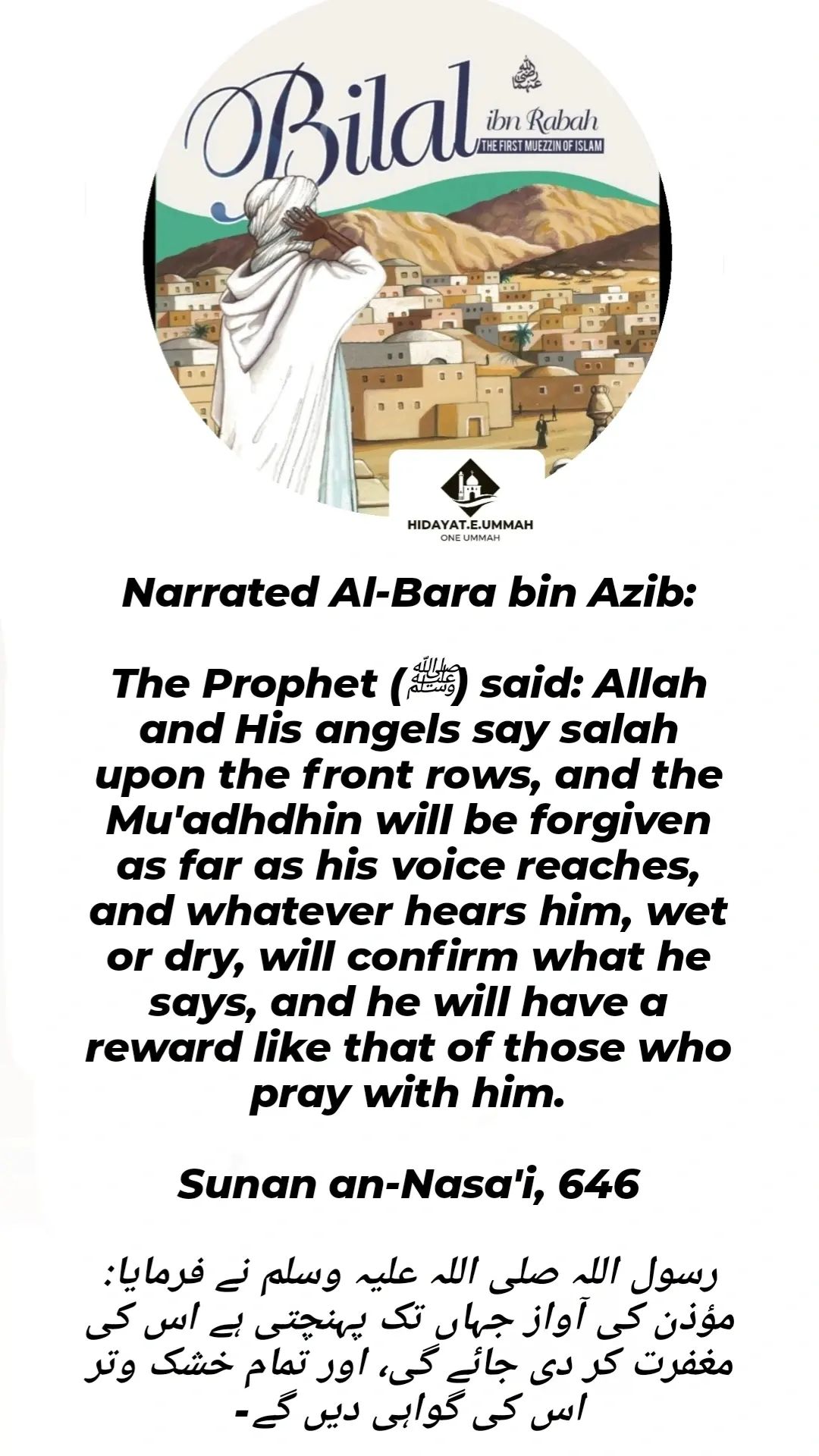
1. This hadith is narrated by Al-Bara bin Azib, where the Prophet Muhammad (peace be upon him) emphasizes the great rewards for certain acts related to prayer.
2. The Prophet states that Allah and His angels send blessings (salah) upon those who stand in the front rows during congregational prayer, highlighting their virtue and eagerness to worship.
3. He mentions that the Mu'adhdhin (the one who calls to prayer) is forgiven by Allah for sins, to the extent that his voice reaches, demonstrating the immense blessings of this role.
4. Everything that hears the Adhan, whether living beings or inanimate objects (wet or dry), will bear witness to the truth of his call on the Day of Judgment.
5. The Mu'adhdhin receives a reward equivalent to those who pray in congregation with him, making his reward vast and multifaceted.
6. This hadith encourages Muslims to value and strive for roles that help facilitate prayer and worship, as well as to stand in the front rows for added blessings.
Hadith 3
3 of 11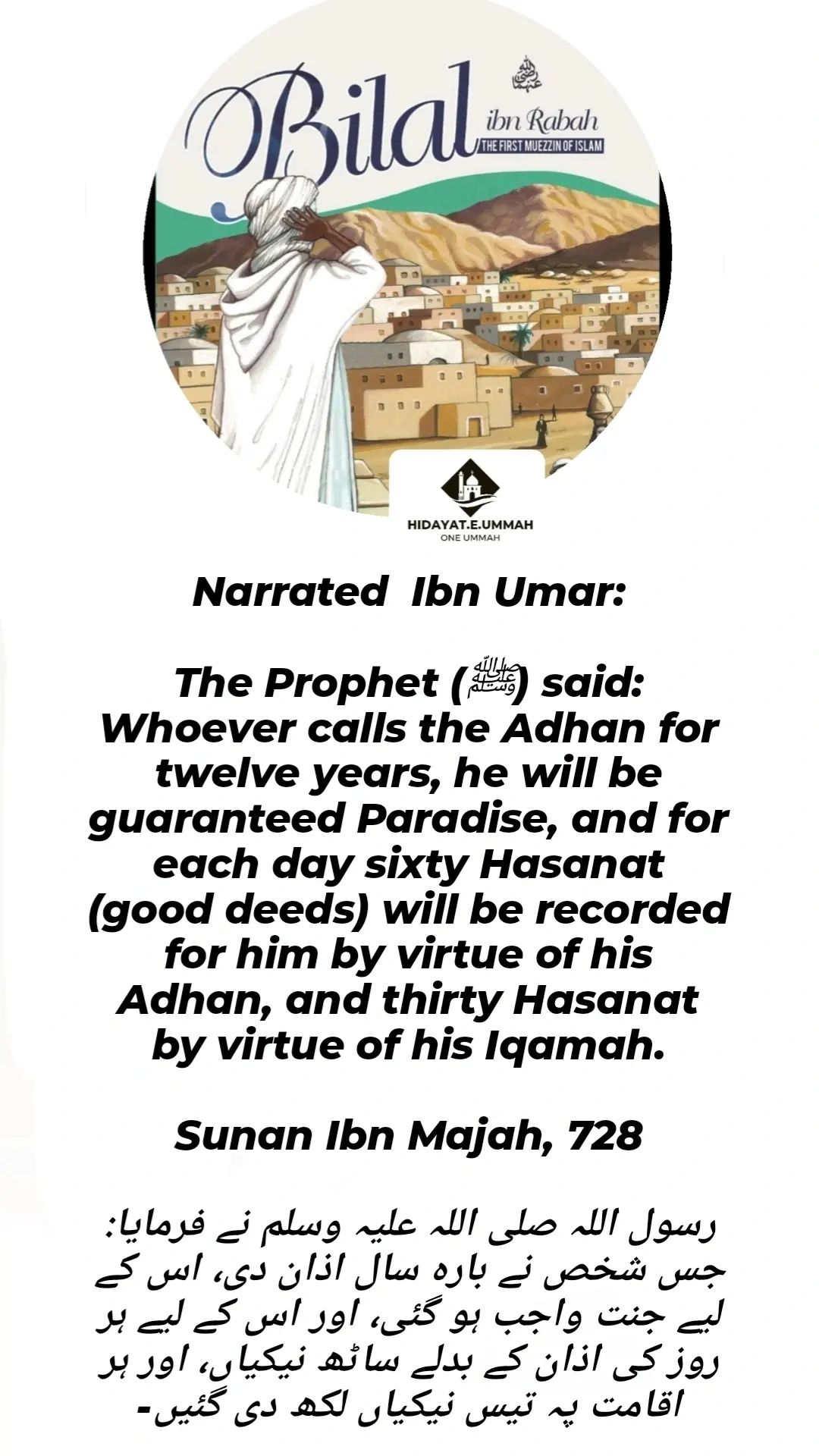
1. This hadith is narrated by Ibn Umar, where the Prophet Muhammad (peace be upon him) highlights the immense rewards for calling the Adhan (the call to prayer).
2. The Prophet mentions that anyone who calls the Adhan consistently for twelve years will be guaranteed a place in Paradise, showing the great honor and blessing of this act.
3. Each day, the person who calls the Adhan will have sixty Hasanat (good deeds) recorded in their account as a reward for their service.
4. Additionally, thirty Hasanat will be recorded for each time they perform the Iqamah (the shorter call signifying the start of the prayer).
5. This hadith serves to encourage Muslims to take up the role of calling to prayer, as it brings both spiritual elevation and immense rewards in the Hereafter.
6. It also reflects the importance of facilitating prayer in the community and the value Islam places on acts that bring people closer to Allah.
Hadith 4
4 of 11
1. This hadith is narrated by Abdullah bin Amr, where the Prophet Muhammad (peace be upon him) gives simple yet important guidance regarding the Adhan (the call to prayer).
2. The Prophet instructs that when Muslims hear the Mu'adhdhin (the person calling to prayer), they should repeat the words of the Adhan after him.
3. This practice strengthens the connection with the act of worship and serves as a way to actively engage in the preparation for prayer.
4. It also highlights the importance of acknowledging and responding to the Adhan, as it is a call to remember Allah and prepare for the obligatory prayers.
5. By following this Sunnah, Muslims can earn rewards and blessings for obeying the instructions of the Prophet and showing readiness for prayer.
6. This hadith emphasizes mindfulness and participation in communal acts of worship, fostering a sense of unity among the believers.
Hadith 5
5 of 11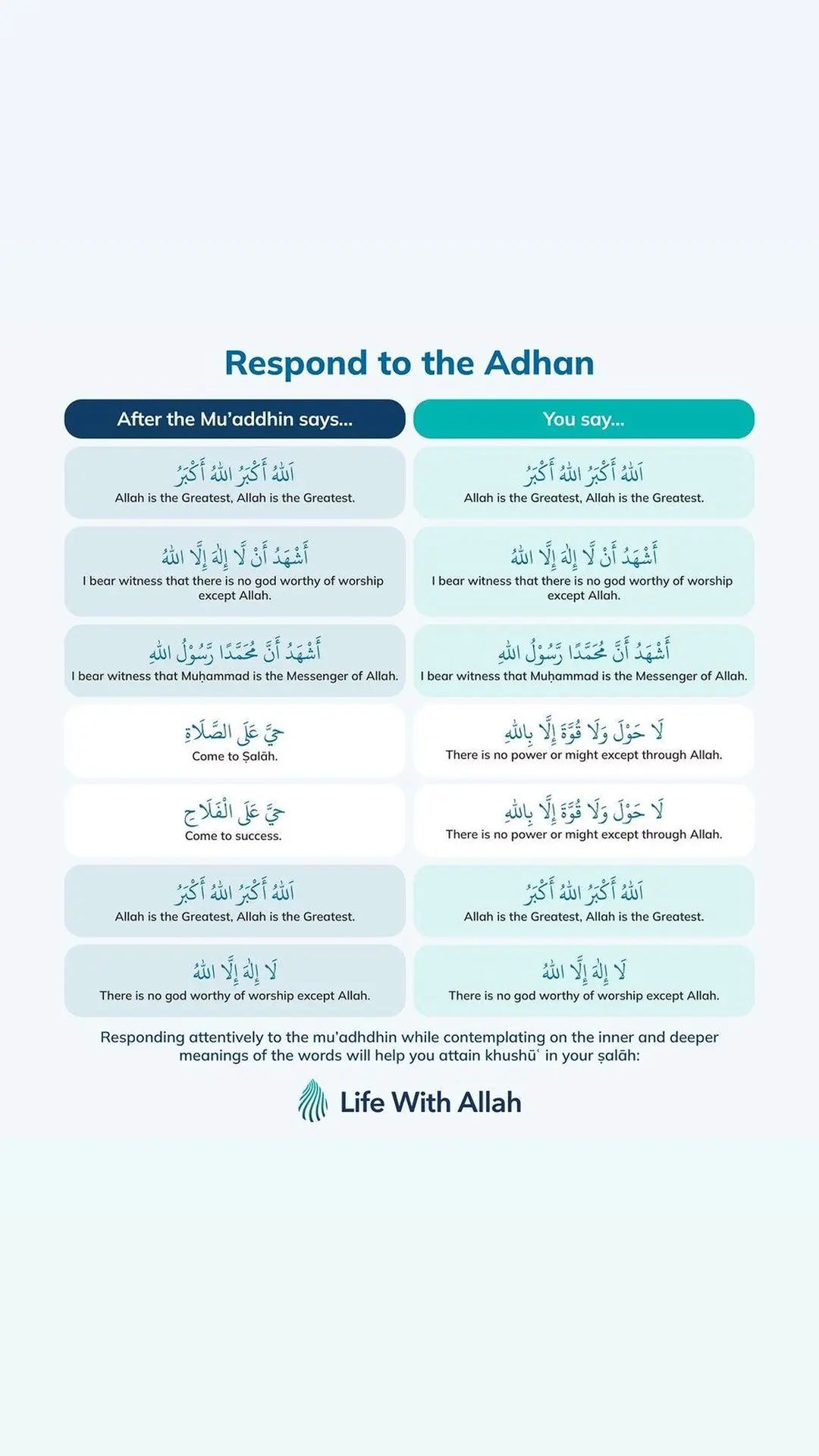
The strong man is not the one who wrestles others, but the one who controls himself when angry. – Prophet Muhammad (peace be upon him)
Hadith 6
6 of 11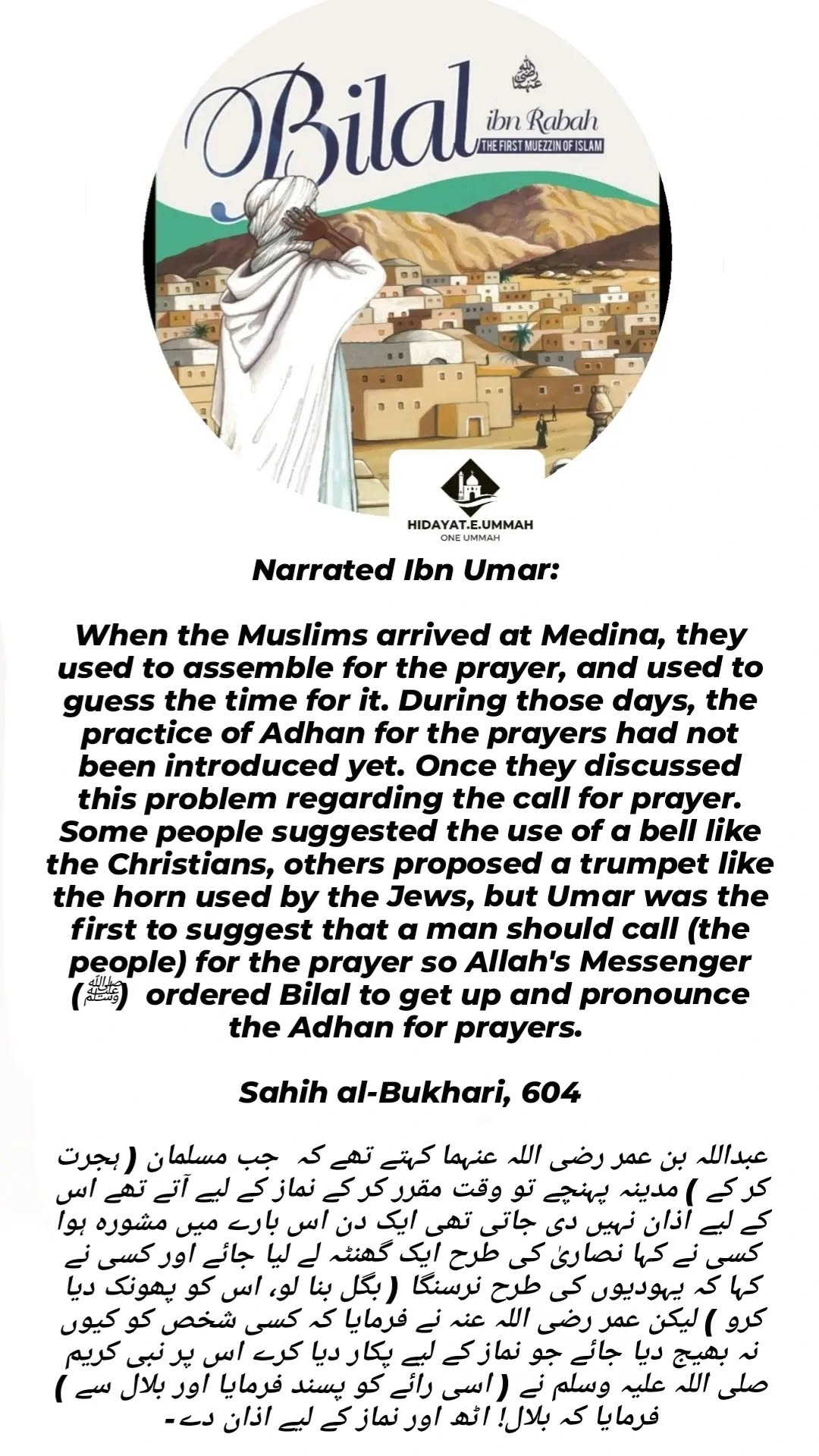
1. This hadith narrated by Ibn Umar describes the events surrounding the introduction of the Adhan (call to prayer) in Islam after the Muslims arrived in Medina.
2. Initially, the Muslims would gather for prayers by estimating the prayer times, as there was no established method to announce the prayer time.
3. A discussion arose among the companions about how to call people to prayer. Some suggested using a bell like Christians, while others proposed using a trumpet similar to the horn used by Jews.
4. Umar ibn al-Khattab suggested a more straightforward and practical solution: appointing a person to announce the prayer verbally.
5. The Prophet Muhammad (peace be upon him) approved Umar’s suggestion and instructed Bilal, a close companion, to call out the Adhan for the prayers.
6. Bilal’s voice was used to announce the prayer times, and this marked the establishment of the Adhan, a unique and iconic call in Islam that continues to this day.
7. This hadith illustrates the practical approach of the Prophet and the companions in solving problems, emphasizing unity and the importance of communal worship.
8. It also highlights the role of consultation (Shura) in decision-making and the wisdom of adopting a practice that distinguishes Islamic identity while avoiding imitating other religious practices.
Hadith 7
7 of 11
1. This hadith, narrated by Jabir bin Abdullah, emphasizes the reward for making a specific supplication after listening to the Adhan (call to prayer).
2. The Prophet Muhammad (peace be upon him) taught a special supplication to be recited after hearing the Adhan: 'Allahumma Rabba hadhihi-dda watit-tammah, was-salatil qa'imah, ati Muhammadan al-wasilata wal-fadilah, wa b'ath-hu maqaman mahmudan-il-ladhi wa'adtahu.'
3. The meaning of this supplication is as follows: 'O Allah, Lord of this perfect call and the established prayer, grant Muhammad the intercession and favor, and raise him to the honored station You have promised him.'
4. The Prophet promised that whoever recites this supplication sincerely after the Adhan will be granted his intercession on the Day of Resurrection.
5. Intercession (Shafa’ah) refers to the Prophet’s plea on behalf of believers for their forgiveness and elevation in rank in the Hereafter.
6. This hadith highlights the importance of utilizing opportunities to earn rewards, as even simple acts like making supplications can lead to significant blessings in the Hereafter.
7. It also underlines the Prophet’s unique status and his concern for the well-being of his followers in the Hereafter.
8. The practice encourages mindfulness and gratitude towards Allah and the Prophet after the call to prayer, fostering a deeper connection to worship and community.
Hadith 8
8 of 11
1. This hadith, narrated by Malik bin Huwairith, involves a situation where two men came to the Prophet Muhammad (peace be upon him) intending to embark on a journey.
2. The Prophet (peace be upon him) gave them guidance on how to conduct their prayer while traveling.
3. He instructed that when the two men begin their journey, they should first call the Adhan (the call to prayer) and then the Iqama (the announcement to begin the prayer).
4. After the Adhan and Iqama, the Prophet (peace be upon him) advised that the oldest of the two men should lead the prayer.
5. This hadith teaches that it is important to maintain the regular practice of prayer, even while traveling, and that certain etiquettes such as the order of leading the prayer should be respected.
6. It also shows the significance of the Adhan and Iqama, as they are not limited to the mosque but can be performed anywhere.
7. By advising the oldest to lead, the Prophet (peace be upon him) highlighted the respect for elders and the importance of leadership in the prayer.
Hadith 9
9 of 11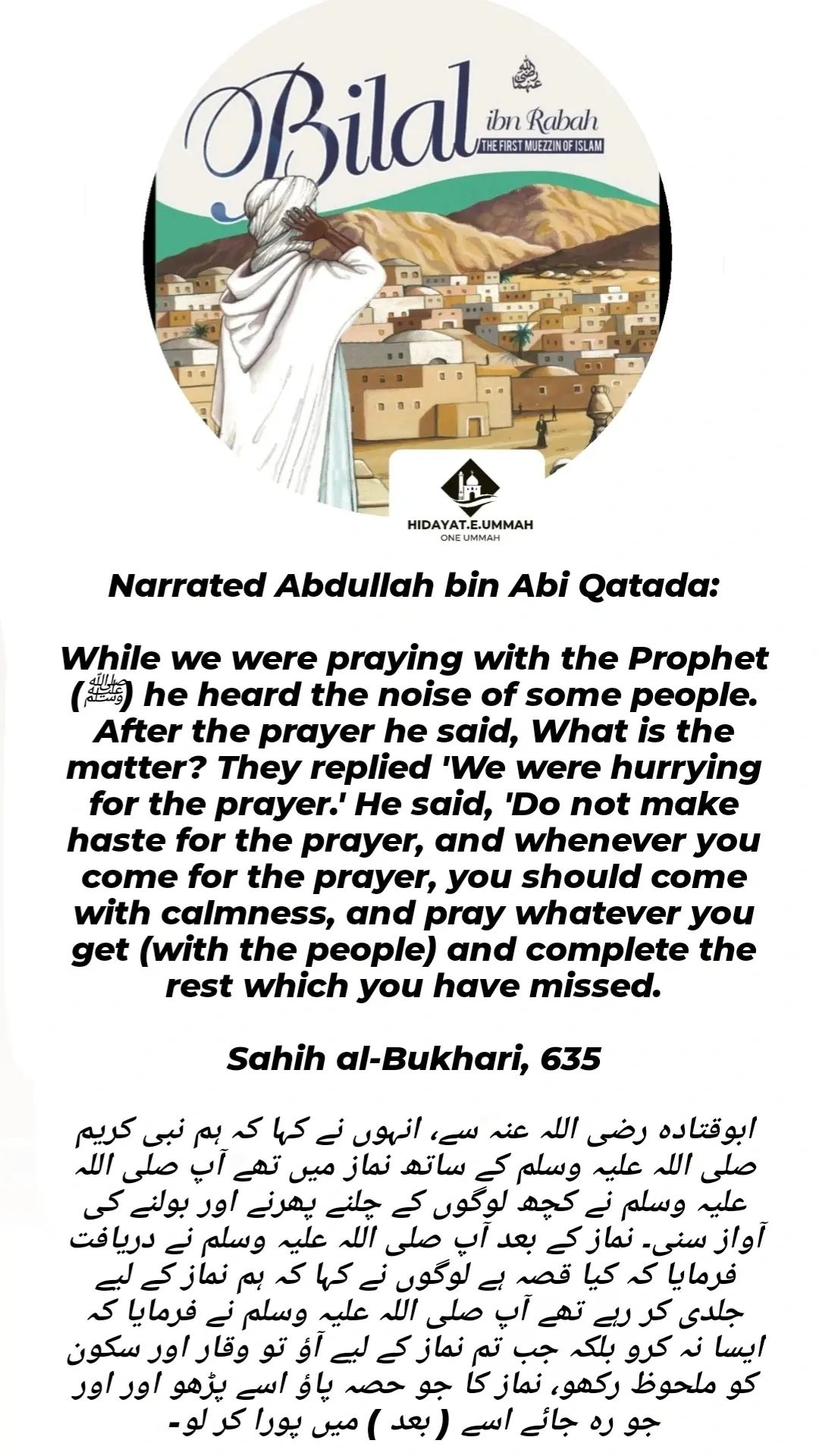
1. This hadith, narrated by Abdullah bin Abi Qatada, describes an incident where some people were hurrying to join the prayer while praying with the Prophet Muhammad (peace be upon him).
2. After the prayer, the Prophet (peace be upon him) asked about the reason for their haste, and they explained that they were trying to catch the prayer in time.
3. The Prophet (peace be upon him) responded by advising them not to rush or hurry when coming for the prayer.
4. He instructed them to approach the prayer with calmness and tranquility, emphasizing that prayer should not be rushed.
5. The Prophet (peace be upon him) further explained that whenever you join the prayer, you should pray whatever part you are able to join with the congregation, and then make up for any part of the prayer that you missed.
6. This hadith teaches the importance of maintaining composure and calmness while performing acts of worship, particularly in prayer.
7. It also highlights the idea that if you miss part of the prayer, you can make up for it and still benefit from the prayer you were able to participate in.
Hadith 10
10 of 11
1. This hadith, narrated by Anas bin Malik, highlights the special importance of the time between the Adhan (call to prayer) and Iqamah (the second call just before prayer begins).
2. The Prophet Muhammad (peace be upon him) said that any supplication made during this time is not rejected by Allah.
3. This means that the time between the Adhan and Iqamah is a blessed and significant moment when Allah is especially likely to accept the prayers and requests made by the believer.
4. The hadith encourages Muslims to make supplications during this time, as it is an opportunity to seek Allah's blessings, forgiveness, and mercy.
5. This teaches us that specific times during the day, like between the Adhan and Iqamah, have unique spiritual benefits and should be used wisely for prayer and supplication.
Hadith 11
11 of 11
1. This hadith, narrated by Aisha, provides guidance from the Prophet Muhammad (peace be upon him) on the proper conduct when both supper and the Iqamah (second call to prayer) occur at the same time.
2. The Prophet (peace be upon him) instructed that when supper is served and the Iqamah is pronounced, one should first eat the supper before proceeding to the prayer.
3. This shows the importance of not rushing into prayer when there is a need for something essential like food, as nourishment is necessary to maintain focus and energy for the prayer.
4. The hadith emphasizes that it is not wrong to prioritize food when it is ready, even though prayer is an important act. The prayer should not be hurried, as it is more beneficial to be well-nourished and focused during worship.
5. It teaches us balance in life, showing that fulfilling our physical needs does not conflict with fulfilling our spiritual duties, as long as it is done in the right order.