
Food
Hadith Collection
34 Hadiths
Hadith 1
1 of 34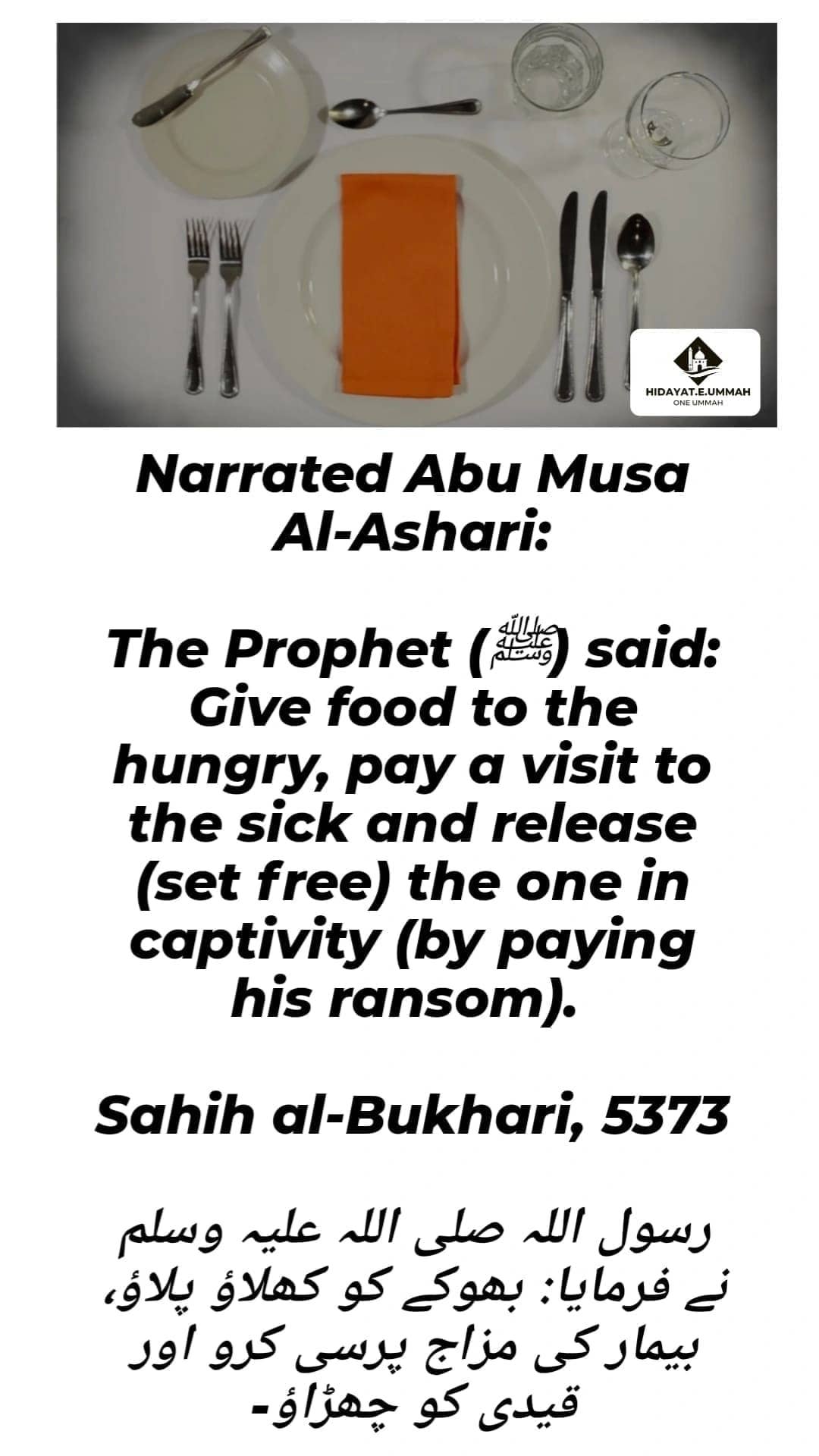
1. This hadith, narrated by Abu Musa Al-Ashari, highlights the compassionate teachings of the Prophet Muhammad (peace be upon him) regarding helping others.
2. The Prophet (peace be upon him) instructed Muslims to provide food to those who are hungry, emphasizing the importance of addressing basic human needs and fighting hunger.
3. He encouraged visiting the sick, which demonstrates the value of showing care, concern, and support for those who are unwell.
4. The hadith also calls for efforts to release captives, such as by paying their ransom, reflecting the emphasis on justice and compassion for those in distress.
5. This hadith teaches Muslims to actively engage in acts of kindness and charity, promoting a sense of community, solidarity, and empathy toward others.
Hadith 2
2 of 34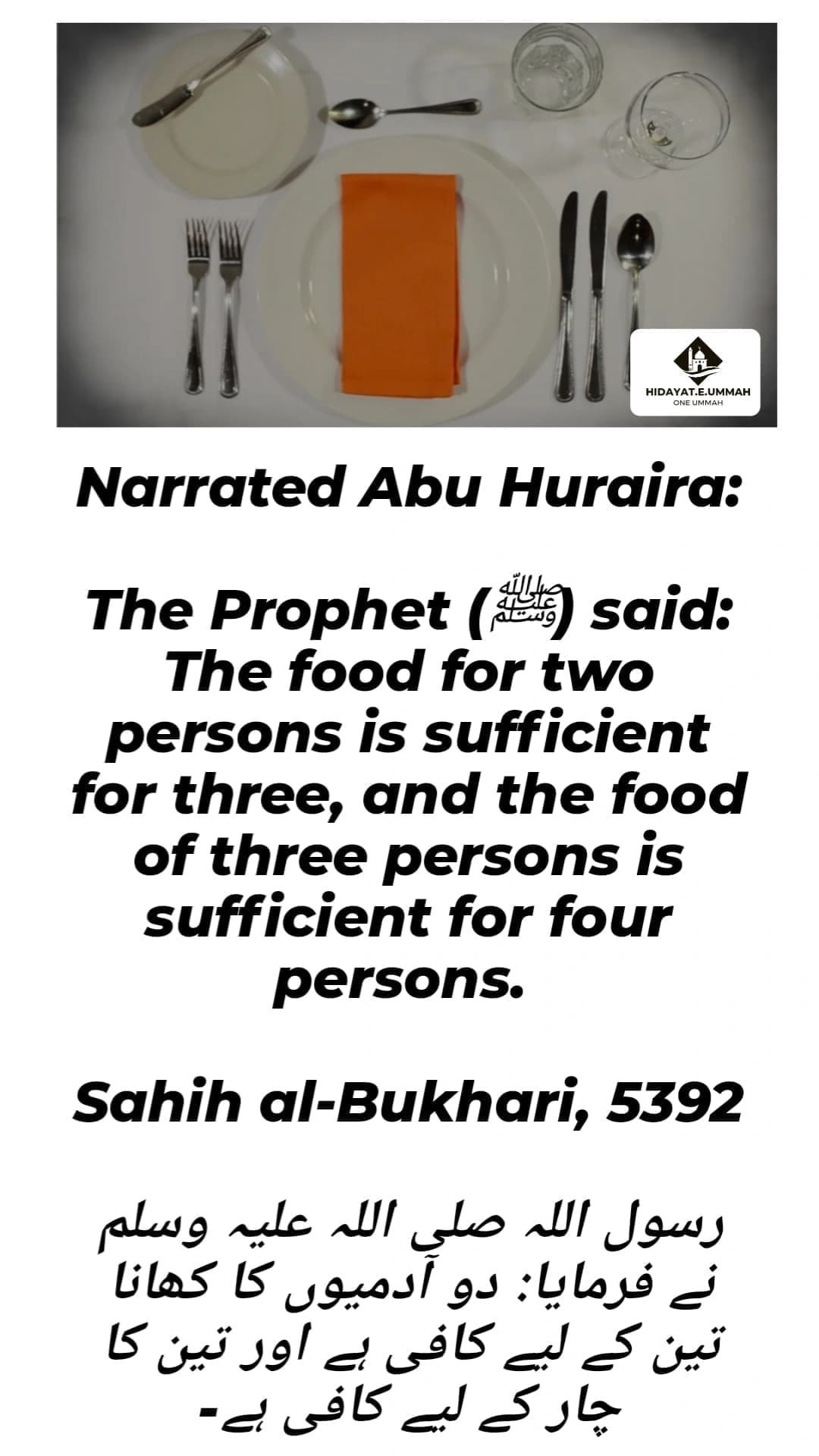
1. This hadith, narrated by Abu Huraira, emphasizes the principle of sharing and generosity in Islam.
2. The Prophet Muhammad (peace be upon him) taught that food prepared for a small number of people can suffice for more when shared with others.
3. It encourages believers to avoid stinginess and cultivate a spirit of hospitality and mutual support.
4. This teaching fosters a sense of community and ensures that no one is left hungry, even during times of limited resources.
5. The hadith reflects the value of barakah (blessings) in shared resources, which can make them more fulfilling and sufficient for everyone.
Hadith 3
3 of 34
1. This hadith, narrated by Aisha (may Allah be pleased with her), highlights a personal preference of the Prophet Muhammad (peace be upon him).
2. The Prophet loved sweet foods and honey, reflecting his appreciation for natural and wholesome nourishment.
3. This shows that enjoying good food is permissible in Islam as long as it is lawful (halal).
4. The mention of his preference helps followers understand the human aspects of the Prophet's life and relate to him more closely.
5. This hadith also subtly encourages gratitude for the blessings of food and the natural provisions granted by Allah.
Hadith 4
4 of 34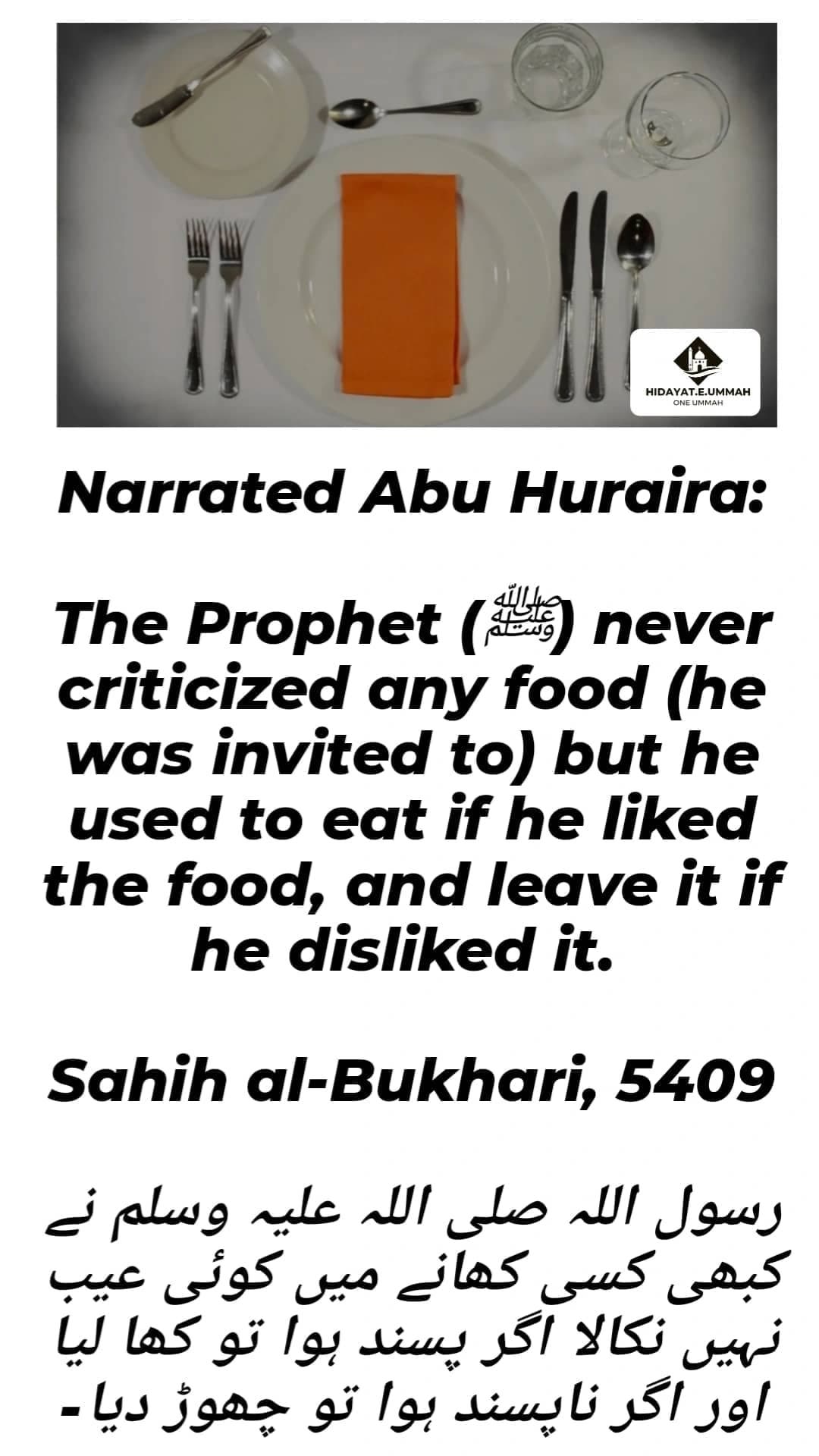
1. This hadith, narrated by Abu Huraira, highlights the Prophet Muhammad's (peace be upon him) gracious and considerate behavior regarding food.
2. The Prophet never criticized any food, even when he was invited to eat, showing his respect for the efforts of others.
3. If he liked the food, he would eat it, and if he disliked it, he would simply leave it without expressing displeasure.
4. This behavior demonstrates his excellent manners and serves as a model for Muslims to show gratitude and avoid offending others.
5. It teaches the importance of maintaining harmony, appreciating hospitality, and refraining from being wasteful or overly critical of blessings.
Hadith 5
5 of 34
1. This hadith, narrated by Aisha (may Allah be pleased with her), reflects the simplicity of the life of the Prophet Muhammad (peace be upon him).
2. Aisha mentions that the Prophet passed away at a time when their household relied on very simple provisions, namely dates and water, referred to as 'the two black things.'
3. It highlights the Prophet's modest lifestyle, even though he had the means to live more luxuriously, choosing instead to live humbly.
4. The hadith serves as a reminder of the importance of contentment, gratitude, and focusing on spiritual wealth over material abundance.
5. It inspires Muslims to adopt a simple and humble approach to life, prioritizing faith and good deeds over worldly possessions.
Hadith 6
6 of 34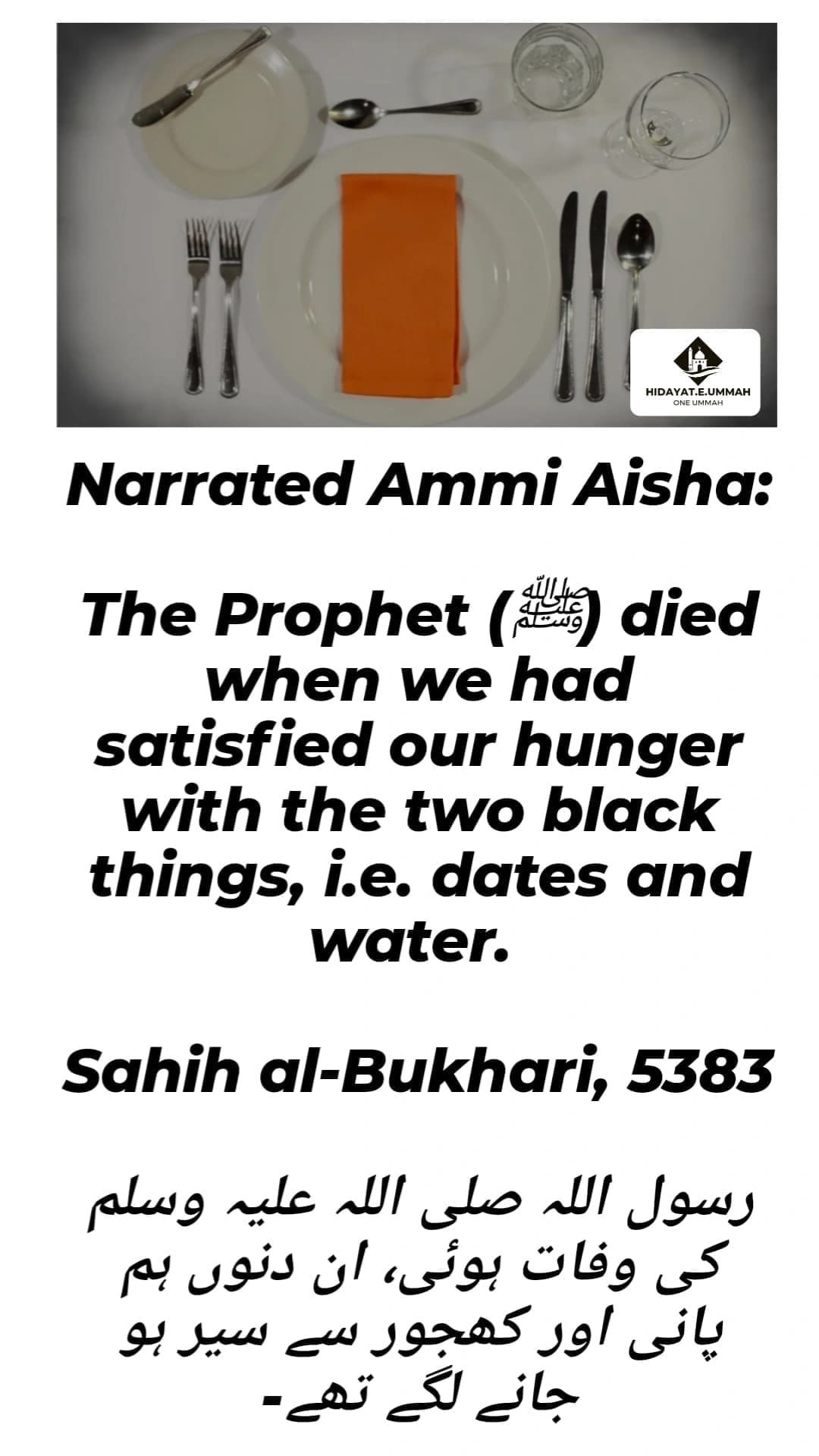
1. This hadith is narrated by Aisha (may Allah be pleased with her), highlighting the simplicity and modesty of the household of the Prophet Muhammad (peace be upon him).
2. Aisha mentions that even during the time of the Prophet's passing, their primary sustenance was simple and basic, consisting of 'the two black things,' which are dates and water.
3. This reflects the humility and minimalistic lifestyle of the Prophet, despite his status as the leader of the Muslims and having access to worldly resources.
4. The hadith serves as an example of contentment, showing that the Prophet valued spiritual wealth and simplicity over material abundance.
5. It encourages Muslims to adopt a lifestyle of gratitude and modesty, focusing on their connection with Allah rather than excessive attachment to worldly luxuries.
Hadith 7
7 of 34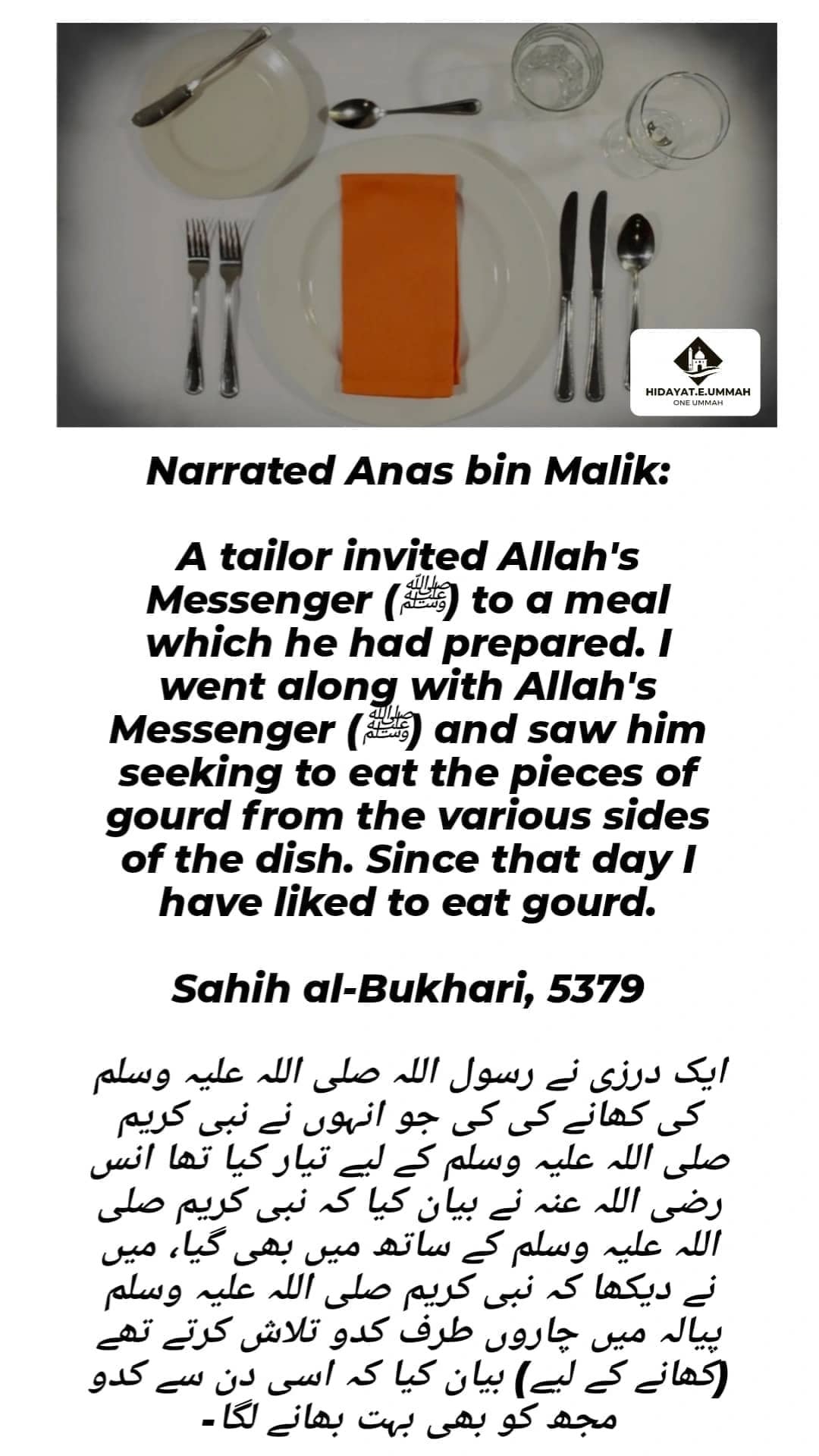
1. This hadith is narrated by Anas bin Malik, who accompanied the Prophet Muhammad (peace be upon him) to a meal prepared by a tailor.
2. During the meal, Anas observed that the Prophet specifically sought out and ate pieces of gourd (a type of vegetable) from the dish.
3. The Prophet’s preference for gourd made a lasting impression on Anas, and from that day onward, Anas developed a liking for gourd as well.
4. This incident reflects the Prophet’s natural, simple, and relatable habits, which often inspired those around him to adopt similar preferences.
5. The hadith highlights how the actions and preferences of a leader or role model, like the Prophet, can positively influence others in their daily lives.
6. It also demonstrates the importance of paying attention to small, everyday moments that can inspire love and appreciation for others' ways of living.
Hadith 8
8 of 34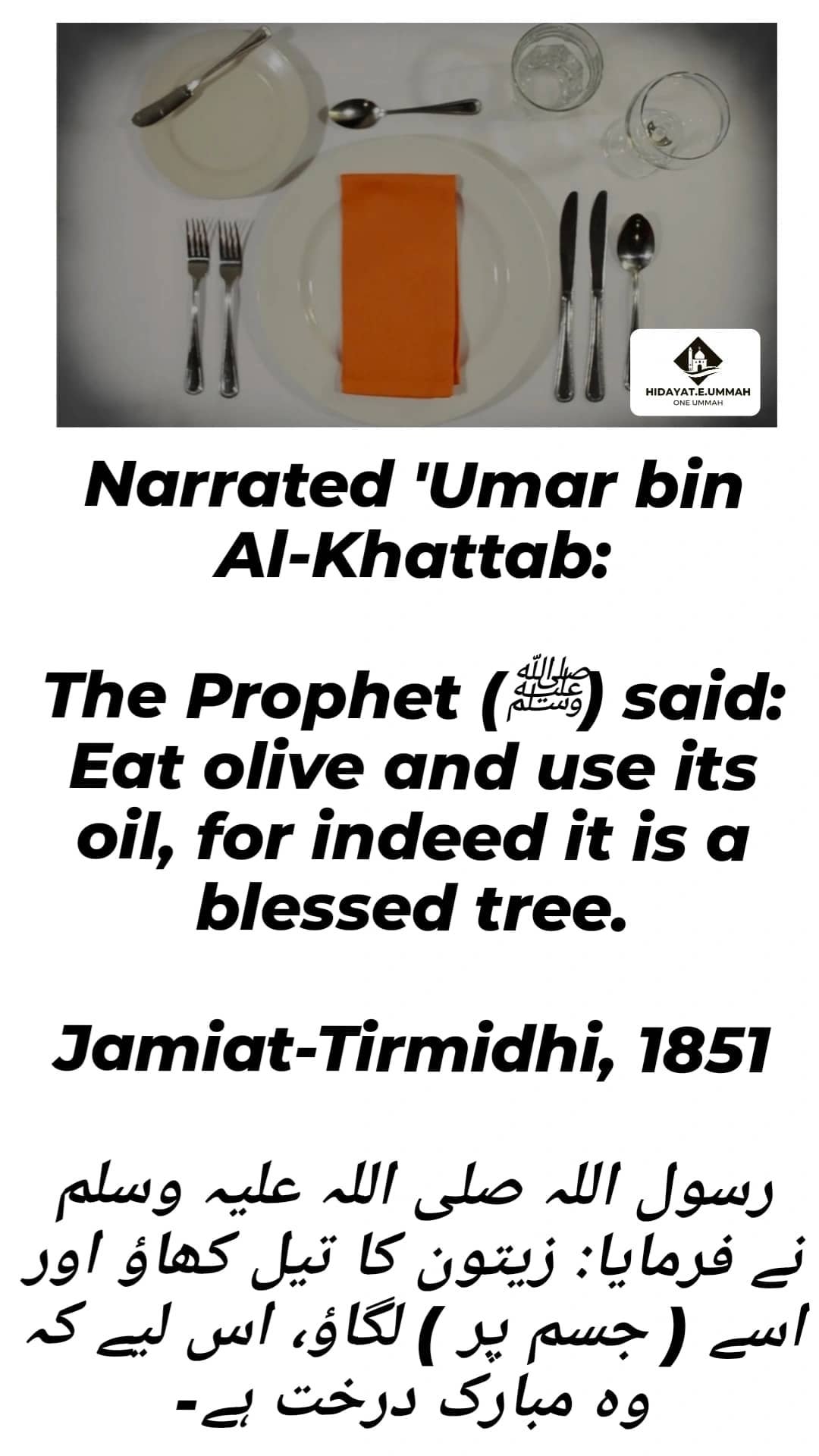
1. This hadith is narrated by Umar bin Al-Khattab, where the Prophet Muhammad (peace be upon him) advises the consumption and use of olive and its oil.
2. The Prophet mentions that the olive tree is a blessed tree, signifying its special place in Islamic teachings and its benefits to humanity.
3. The recommendation to eat olives and use olive oil highlights their nutritional and health benefits, which are now widely recognized.
4. This hadith encourages Muslims to value and incorporate natural and wholesome foods into their diets.
5. It also emphasizes the connection between the blessings mentioned in Islamic teachings and the practical advantages they bring to daily life.
6. The reference to the olive tree as blessed also reminds believers of its symbolic significance in the Quran and the wider Islamic tradition.
Hadith 9
9 of 34
1. This hadith is narrated by Jabir, where the Prophet Muhammad (peace be upon him) praises vinegar as an excellent condiment.
2. The statement highlights the simplicity and humility in the dietary habits of the Prophet, encouraging moderation and appreciation for basic, readily available foods.
3. Vinegar is recognized for its nutritional and medicinal benefits, aligning with the Prophet's guidance to consume wholesome and beneficial foods.
4. The hadith teaches Muslims to value simple blessings in life and to avoid wastefulness or unnecessary extravagance.
5. It also serves as a reminder to be grateful for even the simplest provisions, acknowledging them as blessings from Allah.
6. This hadith promotes a balanced lifestyle and a focus on gratitude and contentment with what is available.
Hadith 10
10 of 34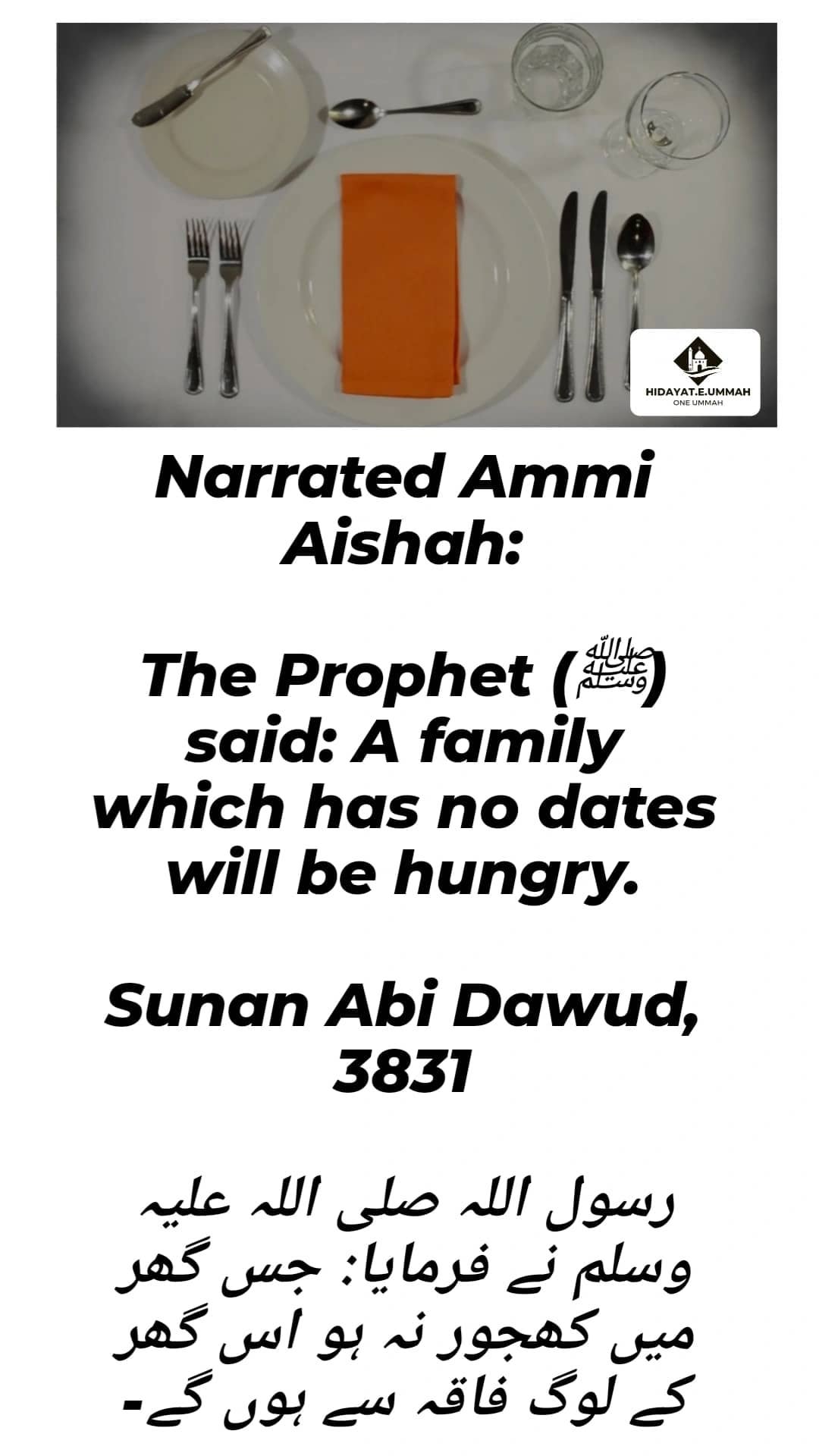
1. This hadith is narrated by Aisha, where the Prophet Muhammad (peace be upon him) emphasizes the importance of dates as a staple food.
2. The statement reflects the cultural and nutritional significance of dates in the Arabian Peninsula, where they were a primary source of sustenance.
3. Dates are rich in essential nutrients and were often a vital food source for many families during the Prophet's time, especially in harsh desert environments.
4. The hadith indicates that dates are a blessing and a provision from Allah that can prevent hunger and sustain a family.
5. It teaches Muslims to recognize the value of simple, nourishing foods and to ensure their availability to avoid hunger and hardship.
6. This hadith also encourages gratitude for the provisions Allah has granted and promotes the preservation and responsible use of such resources.
Hadith 11
11 of 34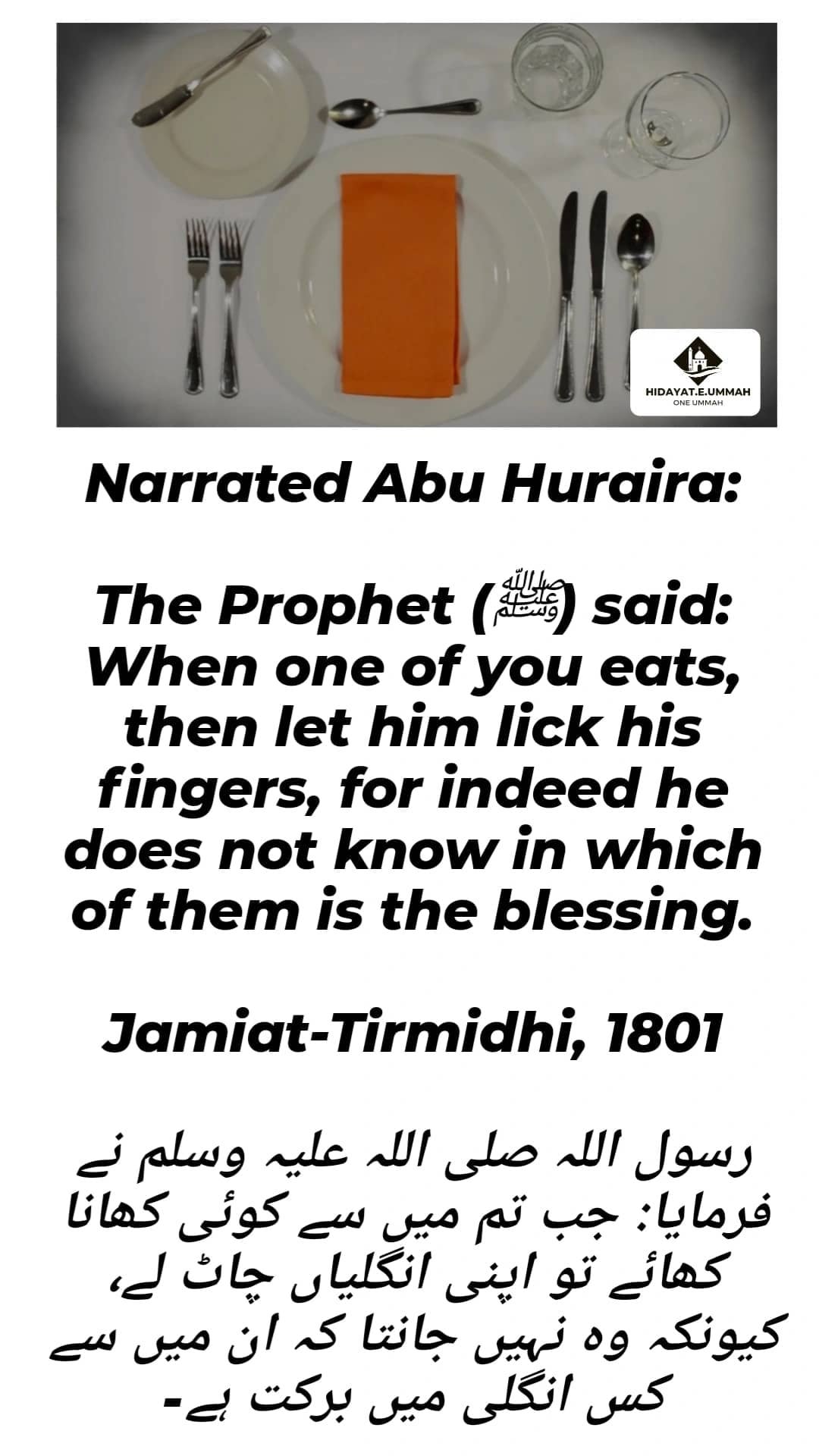
1. This hadith, narrated by Abu Huraira, advises Muslims to lick their fingers after eating.
2. The Prophet Muhammad (peace be upon him) encourages this practice as a way of benefiting from the blessings of food.
3. The reasoning behind this action is that the Prophet ( SAW Peace be upon him) taught that there may be hidden blessings in the food that are found on the fingers, which could have been missed if not properly cleaned.
4. The act of licking fingers is a sign of gratitude and mindfulness about the food Allah has provided.
5. It also emphasizes not wasting any part of the food, encouraging a sense of appreciation for all the nourishment that is consumed.
6. Additionally, this practice helps in maintaining good manners and the humility of not wasting the blessings Allah has granted.
Hadith 12
12 of 34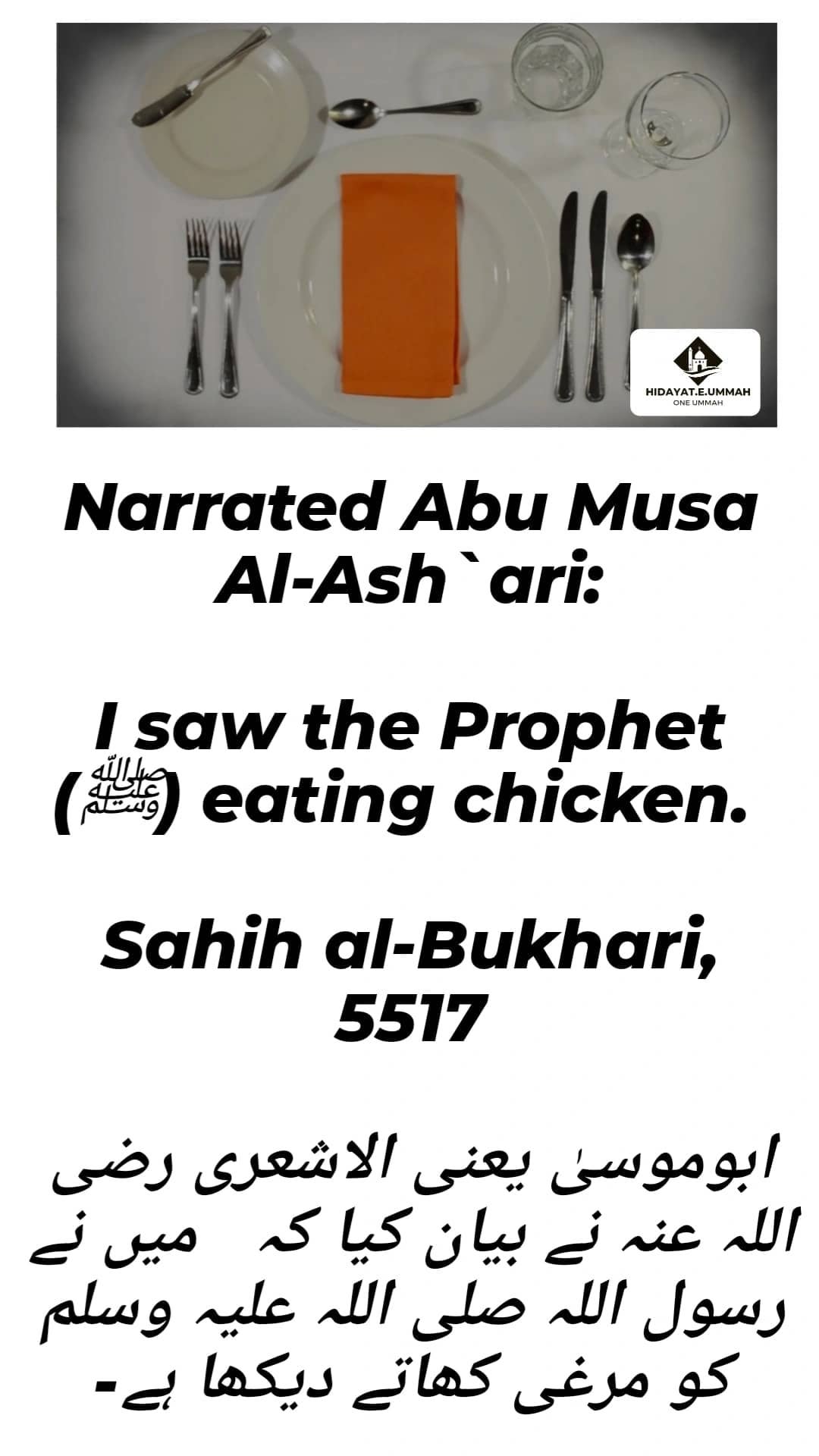
1. This hadith is narrated by Abu Musa Al-Ash'ari, who describes witnessing the Prophet Muhammad (peace be upon him) eating chicken.
2. The mention of the Prophet ( SAW Peace be upon him) eating chicken shows that eating chicken is permissible in Islam, as long as it meets the dietary guidelines.
3. This action also demonstrates the simplicity of the Prophet's ( SAW Peace be upon him) life, where he ate regular food like chicken, just as others did.
4. The hadith emphasizes the normality of consuming halal (permissible) foods within Islamic teachings, as the Prophet ( SAW Peace be upon him) himself followed these practices.
5. There is no mention of any particular significance to eating chicken, meaning it is an ordinary act as long as the food is halal.
6. This hadith serves as a reminder that the Prophet ( SAW Peace be upon him) lived a simple life, setting an example for how Muslims should approach daily matters, including food.
Hadith 13
13 of 34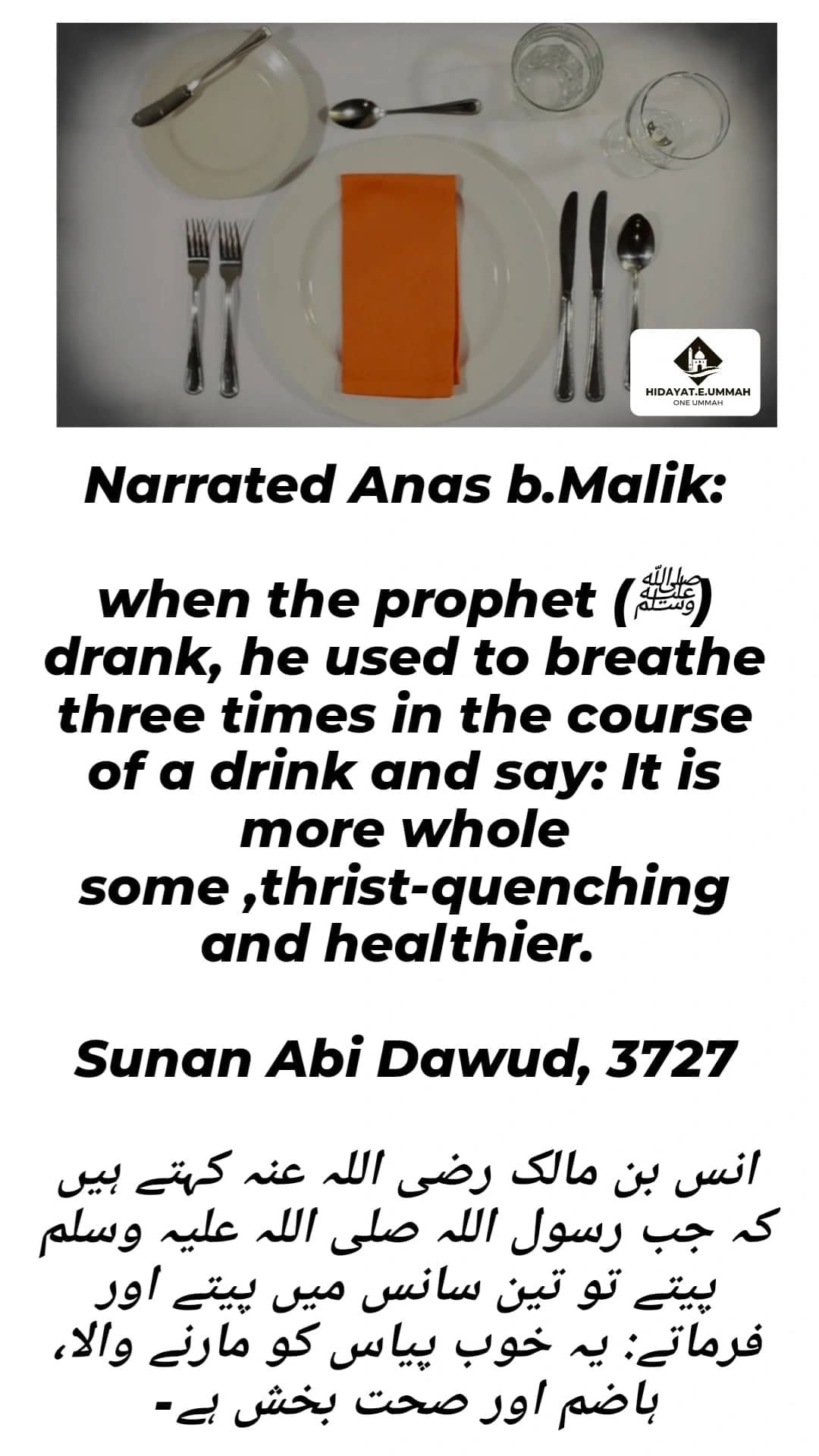
1. This hadith is narrated by Anas bin Malik, who describes how the Prophet Muhammad (peace be upon him) used to drink water.
2. The Prophet ( SAW Peace be upon him) would breathe three times while drinking, taking breaks in between sips.
3. The Prophet ( SAW Peace be upon him) explained that this method of drinking is beneficial because it is more wholesome, thirst-quenching, and healthier.
4. By breathing in between sips, the Prophet ( SAW Peace be upon him) encouraged moderation and caution in drinking, avoiding drinking too quickly.
5. This practice can also help in digesting the drink better and preventing discomfort from drinking too fast.
6. The hadith emphasizes the importance of moderation in everyday actions, including something as simple as drinking, which the Prophet ( SAW Peace be upon him) guided us on for our well-being.
Hadith 14
14 of 34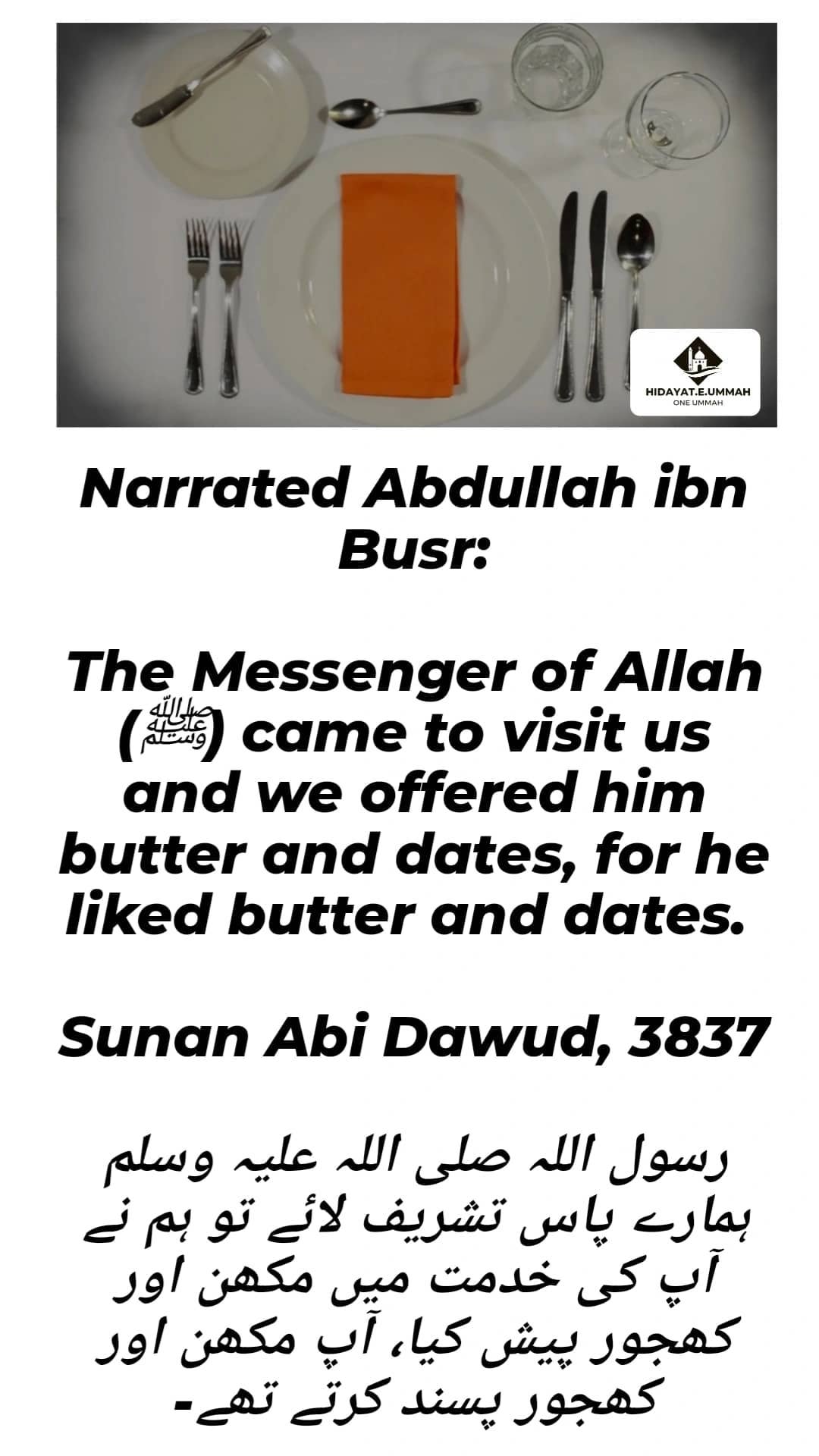
1. This hadith is narrated by Abdullah ibn Busr, who describes an event when the Prophet Muhammad (peace be upon him) visited his home.
2. As a gesture of hospitality, they offered the Prophet ( SAW Peace be upon him) butter and dates.
3. The hadith mentions that the Prophet ( SAW Peace be upon him) liked butter and dates, showing his preference for simple, wholesome foods.
4. This story highlights the importance of offering hospitality and sharing food with others, as the Prophet ( SAW Peace be upon him) appreciated the kindness.
5. The Prophet ( SAW Peace be upon him) accepted what was offered, which demonstrates his simplicity and how he enjoyed humble, nutritious food.
6. From this hadith, we learn about the Prophet's ( SAW Peace be upon him) preferences in food and how he was content with basic, natural foods like butter and dates.
Hadith 15
15 of 34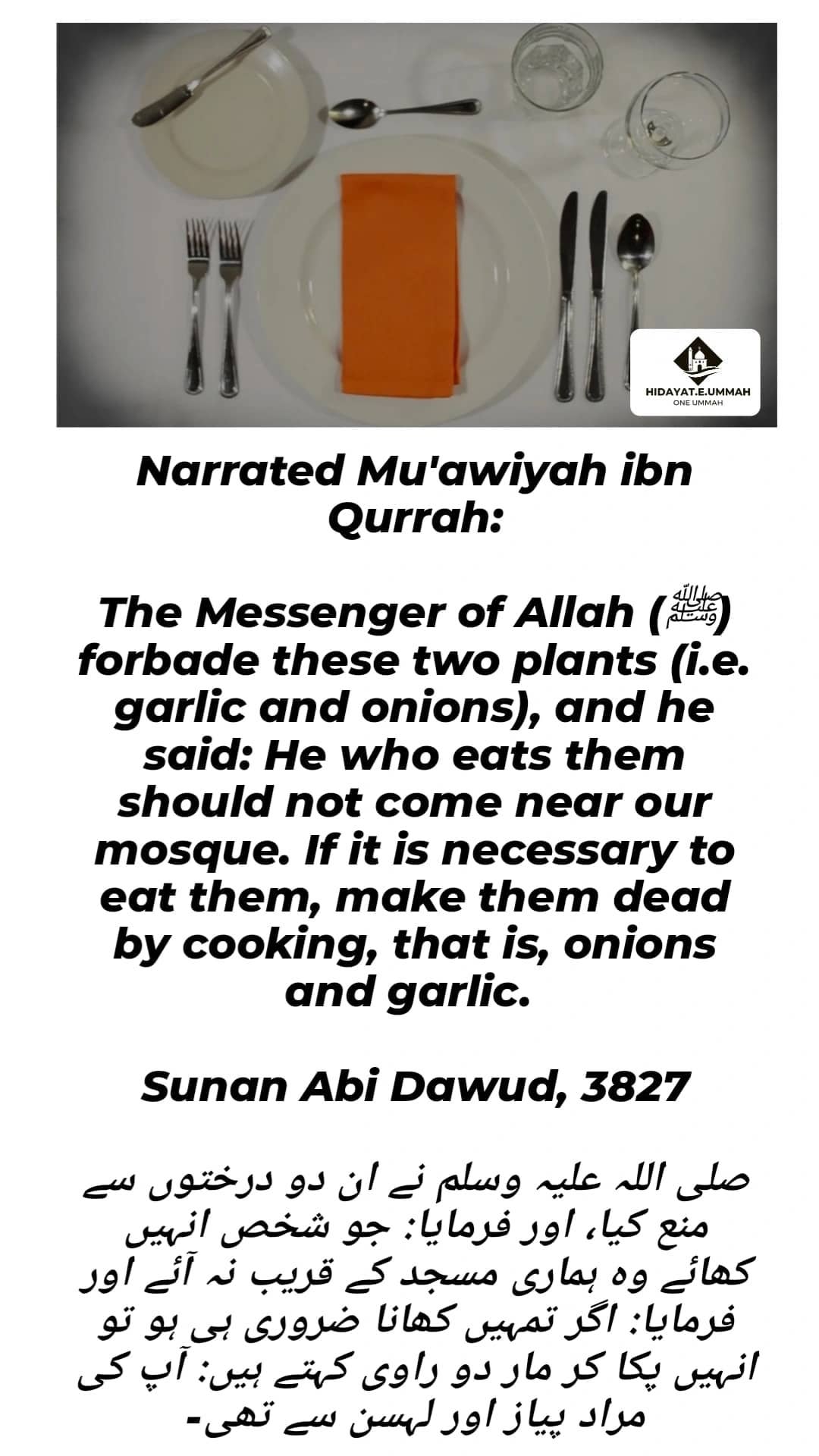
1. This hadith is narrated by Mu'awiyah ibn Qurrah, who reports that the Prophet Muhammad (peace be upon him) forbade the consumption of garlic and onions before coming near the mosque.
2. The Prophet ( SAW Peace be upon him) advised that those who eat garlic and onions should avoid coming to the mosque, as the smell of these foods can be unpleasant to others.
3. However, if it is necessary to consume them, the Prophet ( SAW Peace be upon him) recommended cooking them thoroughly, which would reduce their strong smell.
4. The purpose of this guidance is to maintain respect and comfort for others in the mosque, as the mosque is a place of worship where cleanliness and pleasant surroundings are important.
5. This hadith highlights the Prophet's ( SAW Peace be upon him) concern for the community's well-being and the importance of being considerate of others' comfort in public spaces.
Hadith 16
16 of 34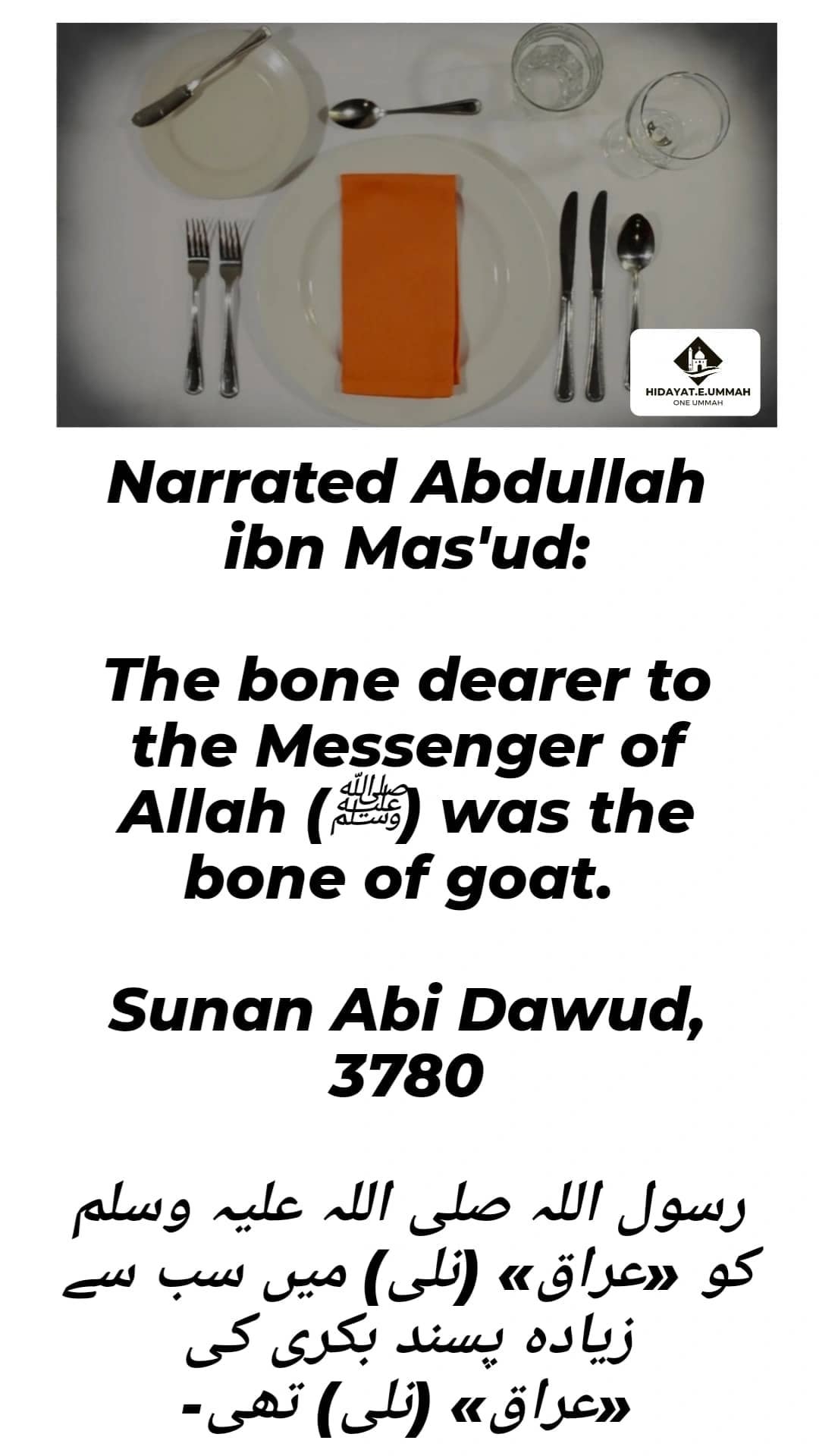
1. This hadith is narrated by Abdullah ibn Mas'ud, who reports that the Prophet Muhammad (peace be upon him) had a preference for the bone of a goat.
2. The Prophet ( SAW Peace be upon him) found the goat's bone to be the dearest to him among other bones.
3. This preference may have been related to the quality or the ease with which it could be consumed or used.
4. The hadith reflects the Prophet's ( SAW Peace be upon him) personal preferences, which provide insight into his lifestyle and habits.
5. It is important to note that this hadith does not establish any religious ruling but rather offers a glimpse into the Prophet's ( SAW Peace be upon him) personal preferences.
Hadith 17
17 of 34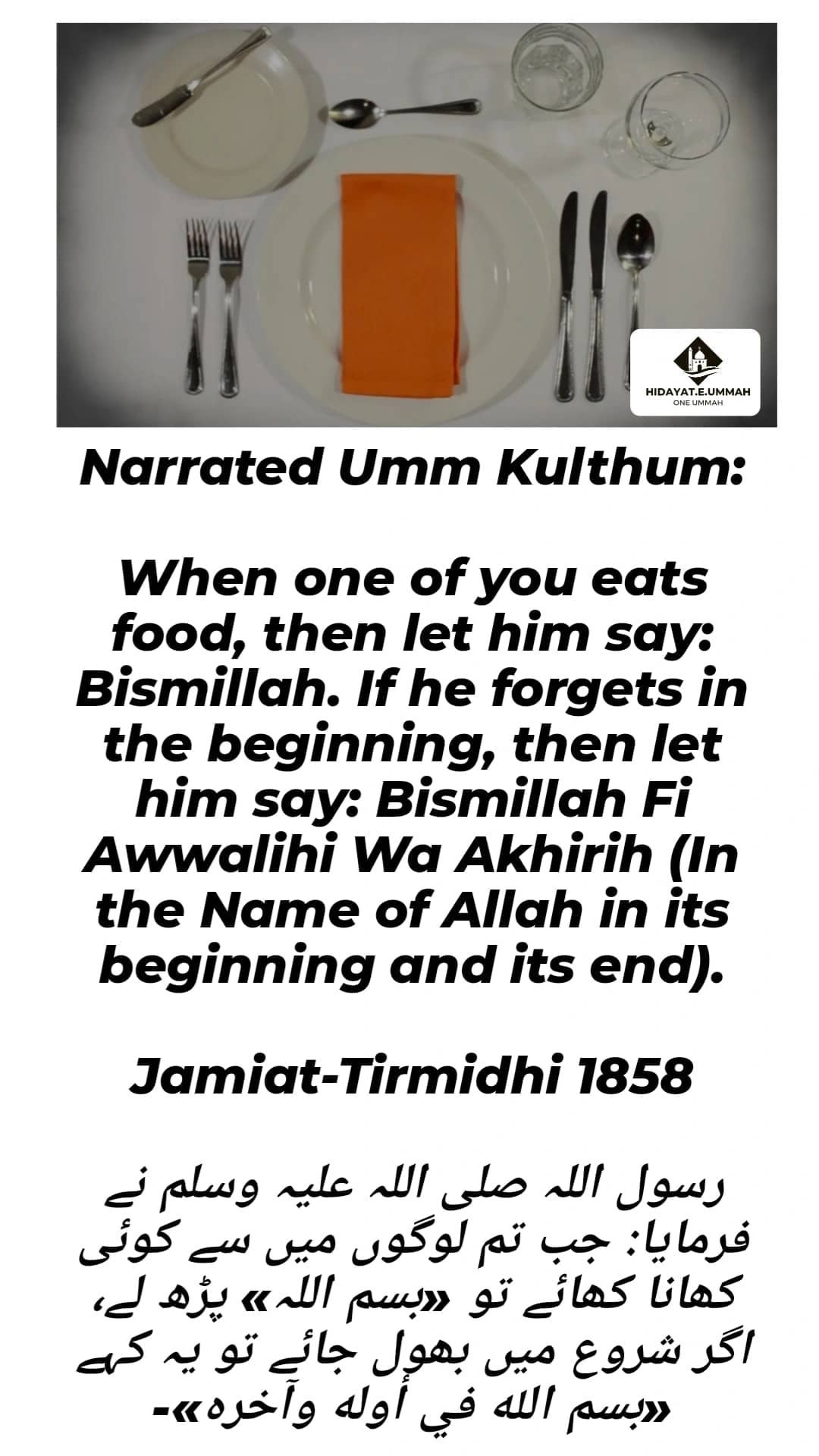
1. This hadith is narrated by Umm Kulthum, who reports that the Prophet Muhammad (peace be upon him) advised saying 'Bismillah' before eating.
2. If a person forgets to say 'Bismillah' at the beginning of their meal, they should say: 'Bismillah Fi Awwalihi Wa Akhirih' (In the Name of Allah in its beginning and its end).
3. This teaches us the importance of starting any action, especially eating, by invoking Allah's name for blessings and protection.
4. The phrase 'Bismillah Fi Awwalihi Wa Akhirih' is a way to make up for the omission and ensure that the meal is still blessed.
5. This hadith highlights the significance of remembering Allah in our daily routines, including eating.
Hadith 18
18 of 34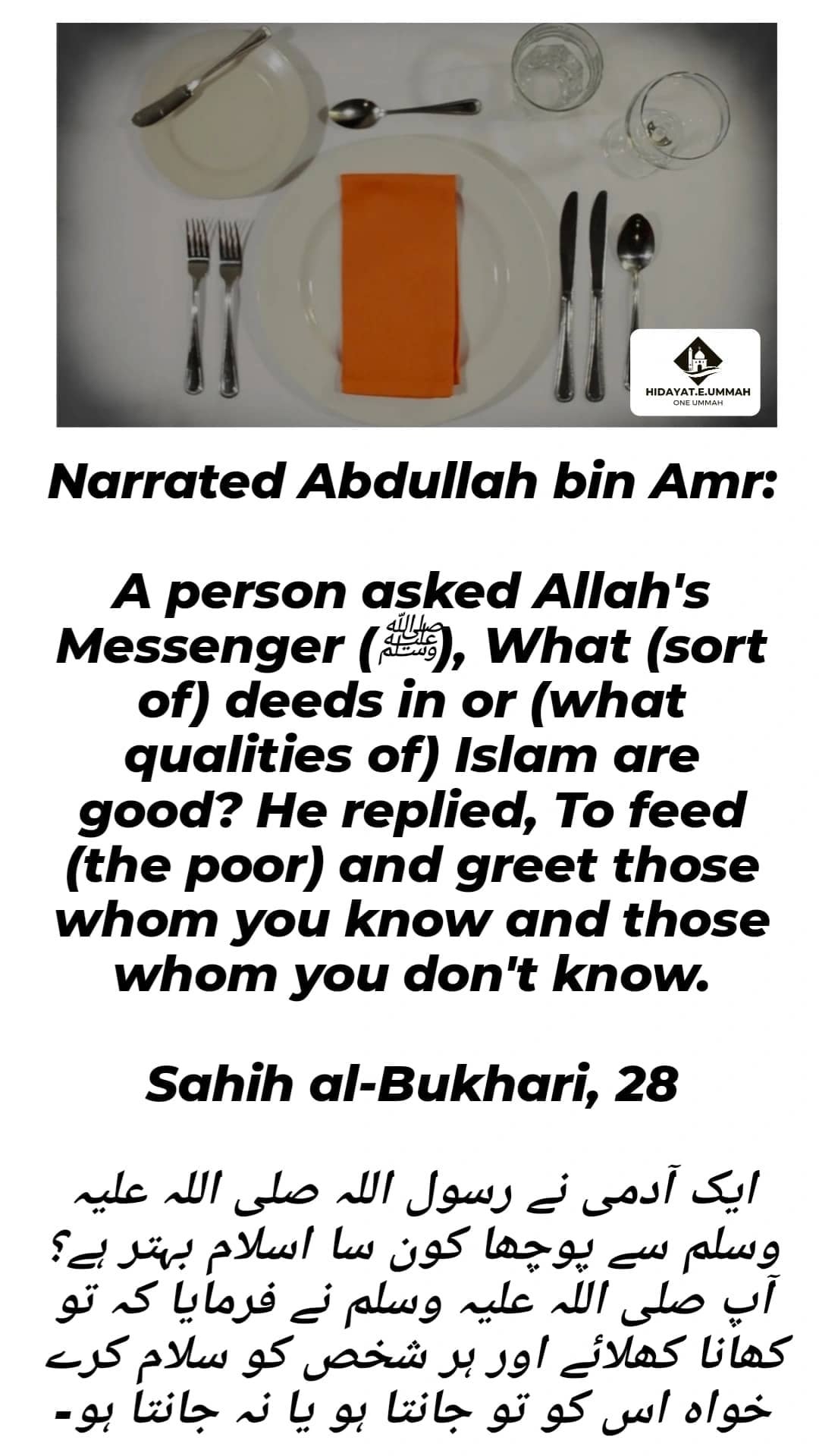
1. In this hadith, a person asks the Prophet Muhammad (peace be upon him) about the good deeds or qualities in Islam.
2. The Prophet (peace be upon him) replies that two key actions are important: feeding the poor and greeting both the people you know and those you don't know.
3. This teaches us the importance of generosity, helping those in need, and maintaining good social relationships by offering greetings to everyone.
4. The act of feeding the poor is emphasized as a highly rewarding action in Islam.
5. The act of greeting everyone, regardless of whether you know them or not, encourages kindness, unity, and peace within the community.
Hadith 19
19 of 34
1. In this hadith, it is mentioned that the Prophet Muhammad (peace be upon him) disapproved of drinking water while standing.
2. The Prophet (peace be upon him) recommended that drinking should be done while sitting, as it is considered more respectful and better for health.
3. This teaches us to follow the Prophet's guidance for good manners and better health practices.
4. The disapproval of drinking water while standing serves as a reminder to adopt proper etiquettes, which are beneficial both spiritually and physically.
5. It is important to take small steps in following the teachings of the Prophet (peace be upon him), which will lead to improvements in our daily lives.
Hadith 20
20 of 34
1. The Prophet Muhammad (peace be upon him) prohibited drinking from utensils made of gold or silver.
2. This hadith emphasizes the harm of using luxurious materials like gold and silver for drinking, as it symbolizes arrogance and pride.
3. The Prophet (peace be upon him) warned that drinking from silver utensils specifically could lead to spiritual consequences, likening it to filling one's abdomen with Hell Fire.
4. The main lesson is to avoid extravagance and to use simple, humble utensils for eating and drinking.
5. This is a reminder to be modest and avoid showing off, especially when it comes to the material possessions we use.
Hadith 21
21 of 34
1. The Prophet Muhammad (peace be upon him) drank water from the Zamzam well while standing.
2. This hadith shows that it is permissible to drink standing, as the Prophet (peace be upon him) did so in this specific situation.
3. However, it is important to note that while standing is allowed, drinking while sitting is generally preferred in Islam.
4. This example highlights that the Prophet's actions serve as a guide, and his choices were based on the circumstances.
5. The key takeaway is that while drinking while standing is allowed in Islam, it is not the usual practice, and the preference is to drink while sitting.
Hadith 22
22 of 34
1. The Prophet Muhammad (peace be upon him) drank milk and then rinsed his mouth after drinking it.
2. After rinsing his mouth, he explained that the reason for rinsing was that milk contains fat.
3. This shows that the Prophet (peace be upon him) was mindful of cleanliness and personal hygiene.
4. Rinsing the mouth after drinking milk can be seen as a way to avoid the lingering taste or fat in the mouth.
5. The lesson from this hadith is the importance of cleanliness and personal care, even after consuming food or drinks like milk.
Hadith 23
23 of 34
1. The Prophet Muhammad (peace be upon him) emphasized that true faith is shown through concern for others.
2. He stated that a person who sleeps comfortably at night, having eaten enough, while knowing that their neighbor is hungry, does not truly have faith in him.
3. This hadith teaches the importance of empathy and generosity towards others, particularly our neighbors.
4. It encourages us to care for the well-being of others and not to ignore the struggles of those who live around us.
5. The message highlights that faith is not just about worship but also about acting with compassion and fulfilling the needs of others.
Hadith 24
24 of 34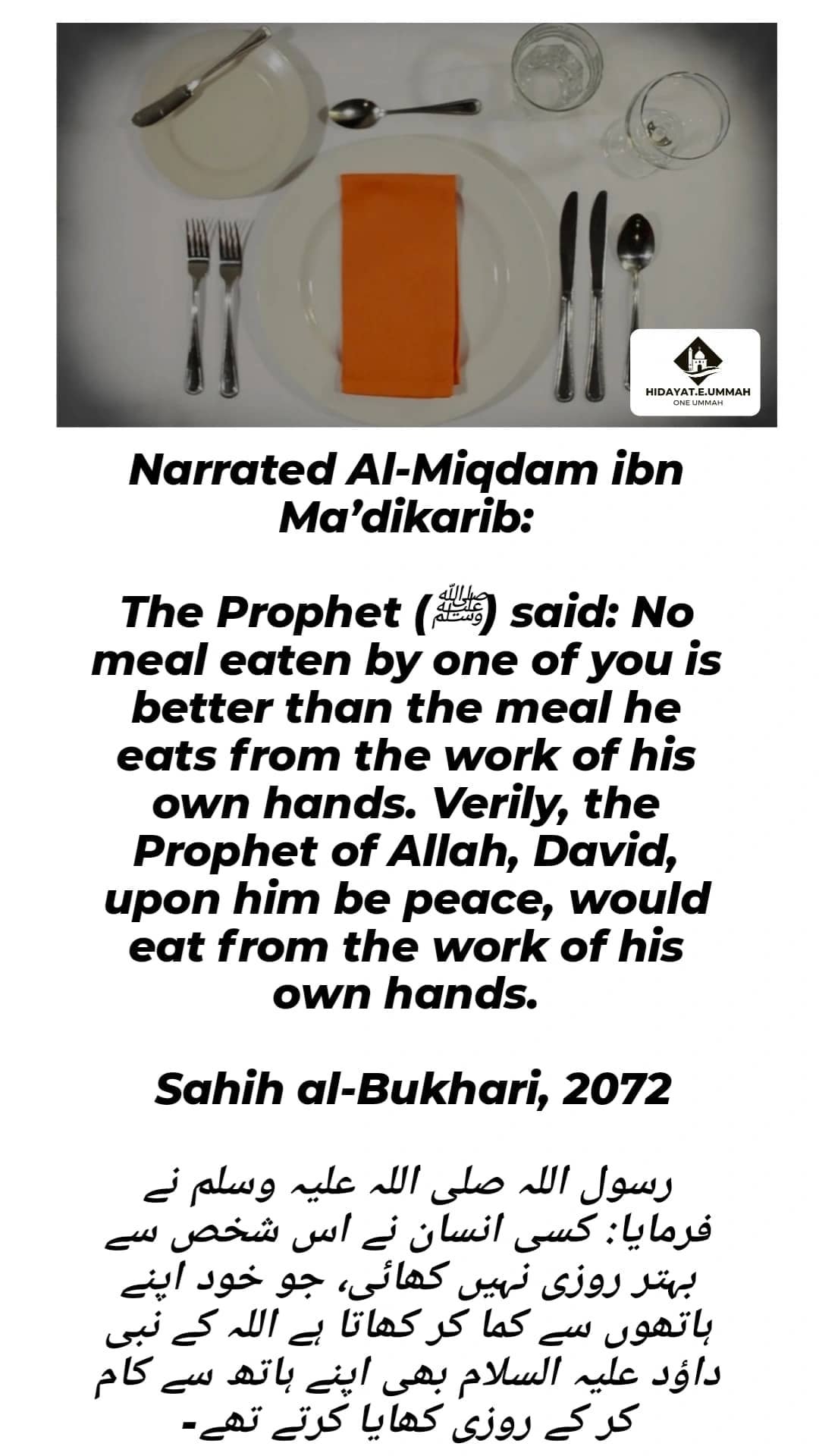
1. The Prophet Muhammad (peace be upon him) said that the best meal a person can have is the one they earn through their own hard work.
2. This teaches us the value of self-reliance and the satisfaction that comes from providing for ourselves.
3. The Prophet also mentioned Prophet David (peace be upon him), who would eat from the work of his own hands, emphasizing the importance of earning a living through one's efforts.
4. This hadith encourages us to work diligently and be content with what we earn through honest labor.
5. It highlights that meals earned through one's own effort carry more blessings than those acquired through other means.
Hadith 25
25 of 34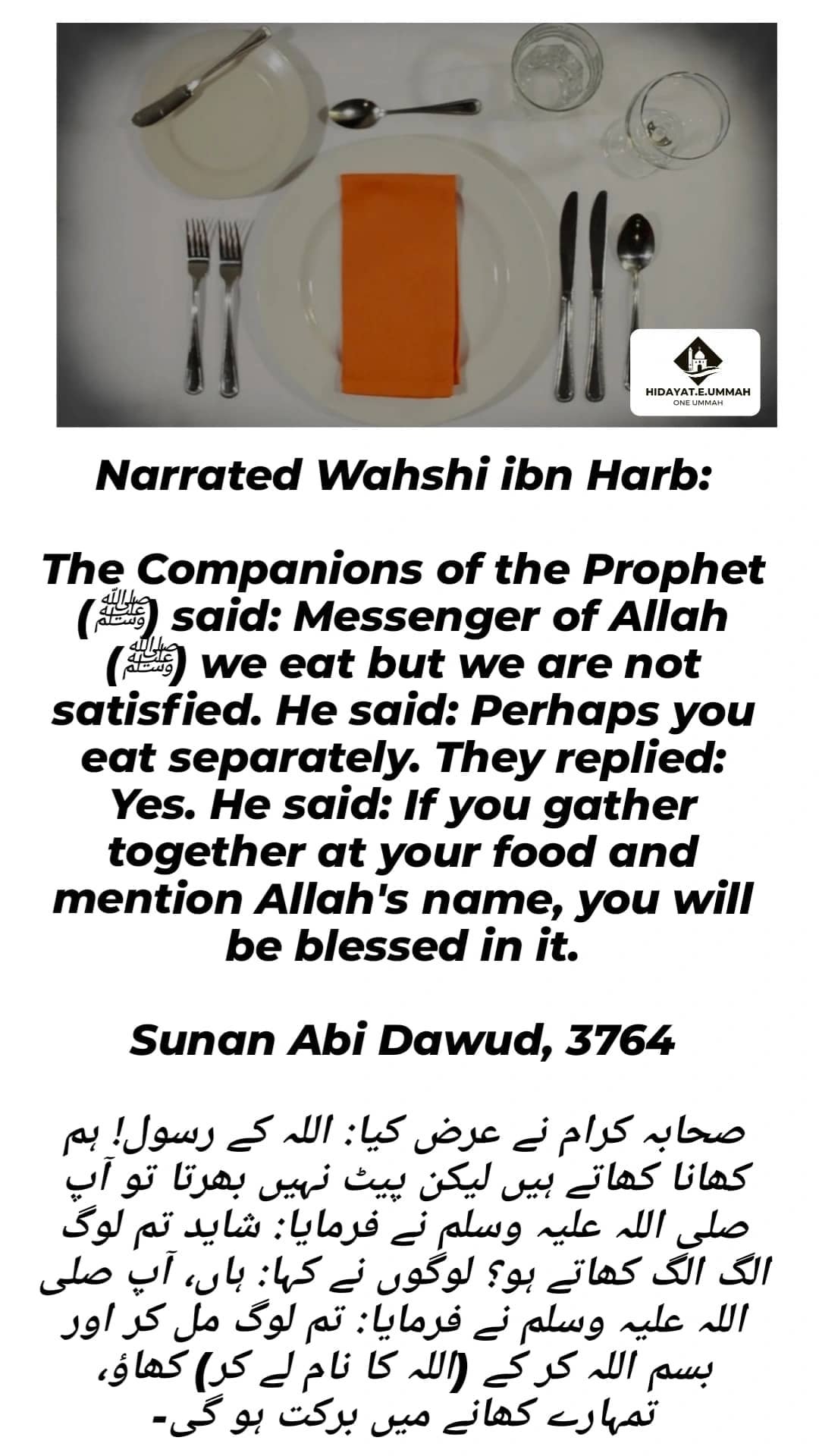
1. The Companions of the Prophet (peace be upon him) mentioned that although they ate, they were not satisfied.
2. The Prophet (peace be upon him) suggested that the reason might be that they were eating separately.
3. When the Companions confirmed that they were eating separately, the Prophet (peace be upon him) advised them to gather together for their meals.
4. He also emphasized the importance of mentioning Allah's name before eating.
5. The Prophet (peace be upon him) said that by gathering together and mentioning Allah's name, the food would be blessed and they would be satisfied.
6. This teaches us the significance of eating together, invoking Allah's name, and sharing meals, as it brings blessings and satisfaction.
Hadith 26
26 of 34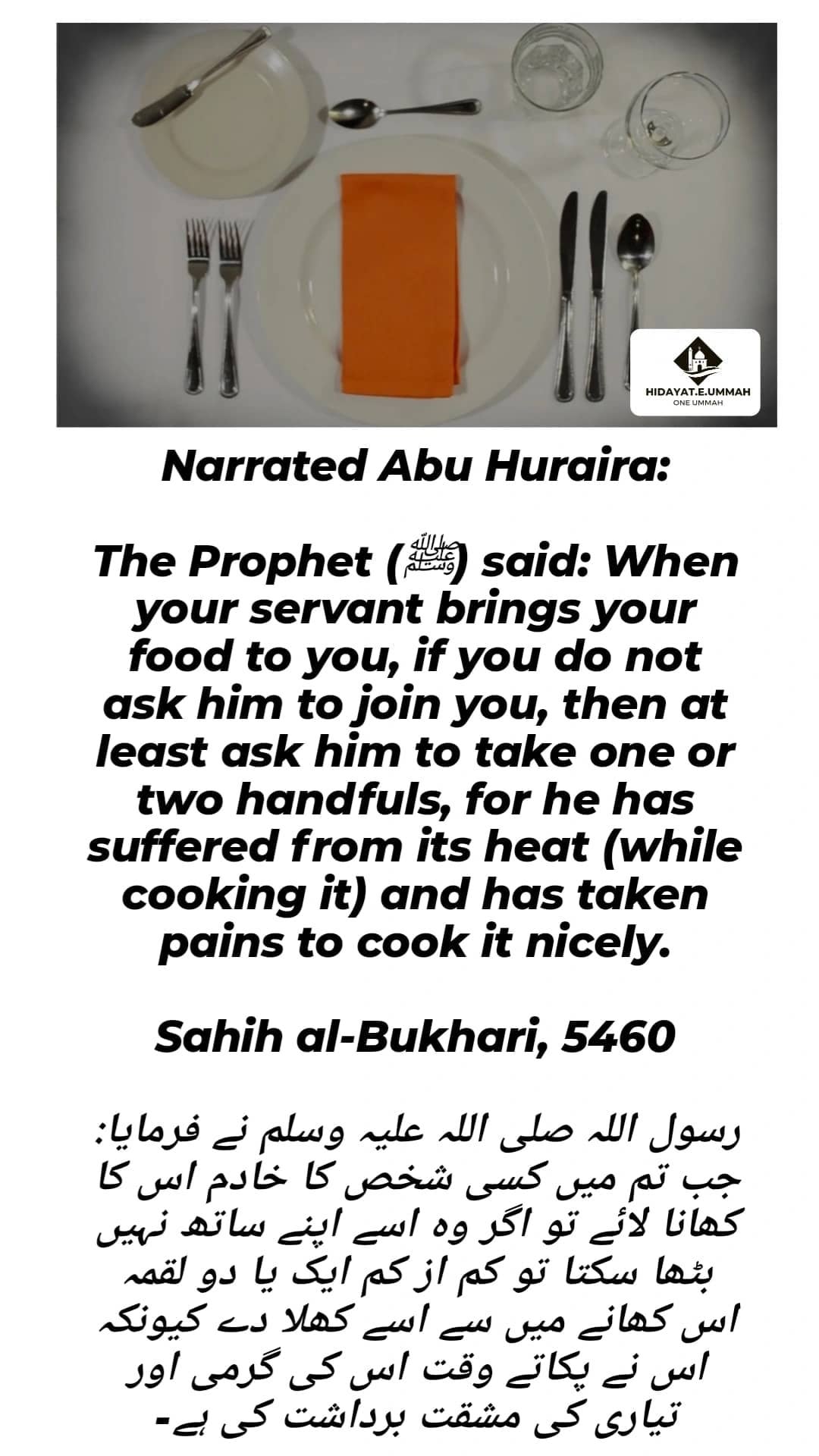
1. The Prophet (peace be upon him) advised showing kindness and consideration to those who prepare and serve food.
2. He instructed that if a servant brings food, the one being served should invite the servant to join them in eating.
3. If it is not possible to invite the servant to share the meal, then they should at least allow the servant to take one or two handfuls of the food.
4. The Prophet (peace be upon him) explained that this is because the servant has endured the heat while cooking the food.
5. The servant also took care to prepare the food nicely, which deserves appreciation and consideration.
6. This hadith emphasizes the importance of gratitude, fairness, and compassion towards those who serve us.
Hadith 27
27 of 34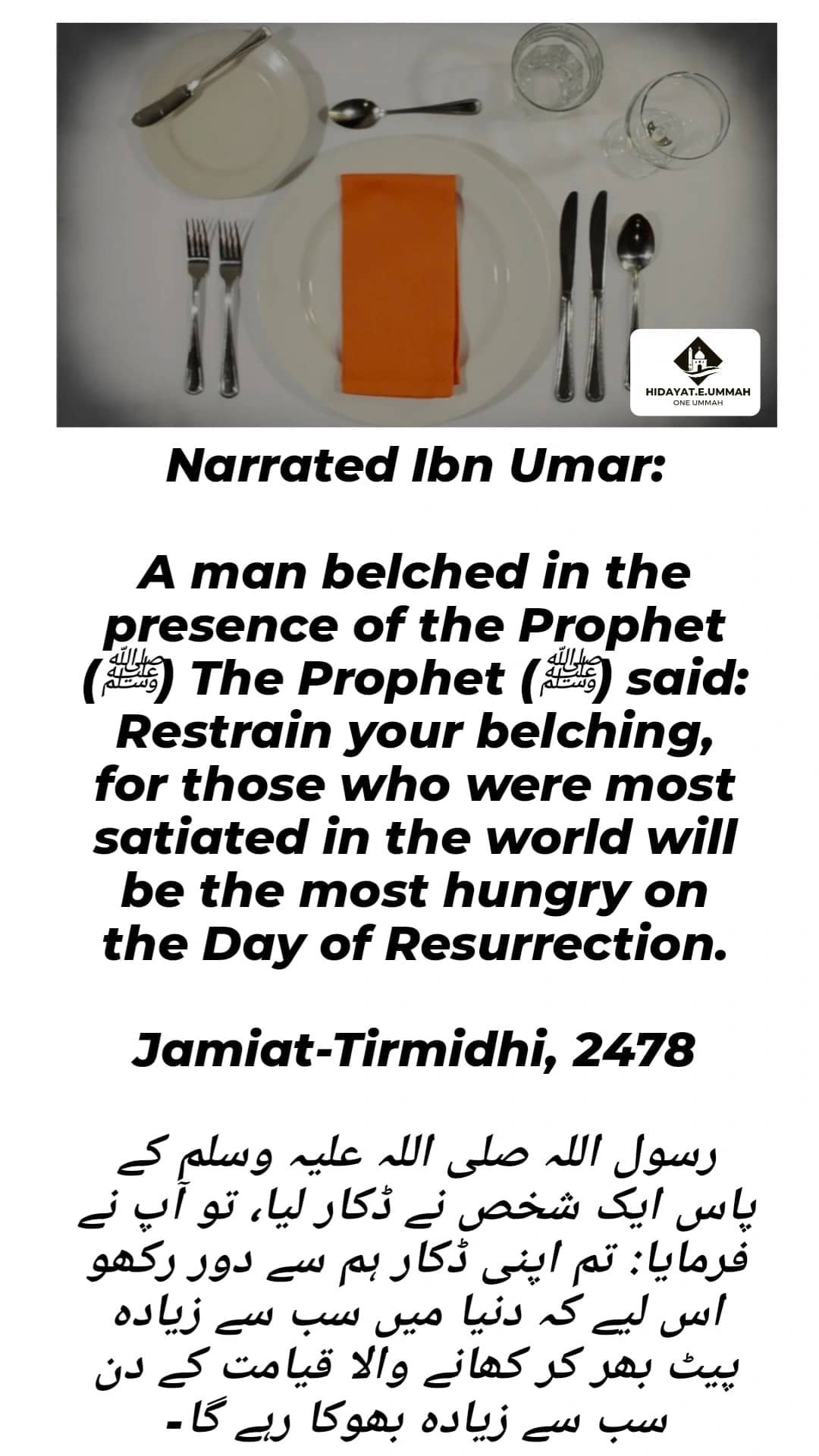
1. The Prophet (peace be upon him) taught good manners and self-control, even in matters of eating and social behavior.
2. When a man belched in his presence, the Prophet (peace be upon him) advised him to restrain his belching, indicating that excessive eating or indulgence is not encouraged.
3. The Prophet (peace be upon him) warned that those who overindulge and are most satiated in this worldly life will face greater hunger and deprivation on the Day of Resurrection.
4. This hadith highlights the importance of moderation in eating and avoiding excess, as well as the value of humility and self-restraint.
5. It also serves as a reminder to focus on spiritual well-being and preparing for the Hereafter rather than being overly consumed by worldly pleasures.
Hadith 28
28 of 34
1. The strong man is not the one who wrestles others, but the one who controls himself when angry. – Prophet Muhammad (peace be upon him)
Hadith 29
29 of 34
1. This hadith highlights the eating habits of the Prophet Muhammad (peace be upon him) and his preference for combining foods with complementary qualities.
2. The Prophet (peace be upon him) would eat melon along with fresh dates, noting that their differing properties balanced each other.
3. The heat or intensity of the dates was softened by the coolness of the melon, while the coolness of the melon was complemented by the warmth of the dates.
4. This demonstrates the Prophet's (peace be upon him) wisdom in promoting moderation and balance, even in dietary habits.
5. It serves as a reminder to approach food with mindfulness, seeking balance and harmony in what we consume.
Hadith 30
30 of 34
1. This hadith advises on eating etiquette and the respectful sharing of food.
2. The Prophet (peace be upon him) taught that blessings are concentrated in the middle of the food. To preserve those blessings for all, he instructed people to eat from the edges instead of the center.
3. Eating from the edges shows consideration for others, as it allows everyone to benefit equally from the meal.
4. This practice promotes good manners, respect for shared food, and an understanding of the concept of barakah (blessings) in sustenance.
5. The guidance emphasizes mindful eating and gratitude for the provisions given by Allah.
Hadith 31
31 of 34
1. This hadith highlights the negative impact of overeating, comparing the stomach to a container that should not be overfilled.
2. It teaches moderation in eating, emphasizing that humans should consume only enough food to maintain their strength and support their daily activities.
3. The Prophet (peace be upon him) recommended a balanced approach: one-third of the stomach for food, one-third for drink, and one-third for air. This balance ensures physical health and comfort.
4. The guidance encourages self-control, promotes a healthy lifestyle, and discourages excessiveness, which can lead to health problems and wastefulness.
5. This hadith reflects the wisdom of Islam in caring for both spiritual and physical well-being through moderation and mindfulness.
Hadith 32
32 of 34
1. This hadith teaches the importance of not wasting food, as even a small morsel has value.
2. If a piece of food falls, it should be cleaned of any dirt or harmful substances and then eaten, instead of leaving it for waste or neglect.
3. Leaving food unnecessarily is discouraged as it could be consumed by the devil, a symbolic reference to wastefulness and ingratitude.
4. The Prophet (peace be upon him) encouraged cleaning the dish completely after eating, as blessings may be present in any part of the food.
5. This guidance promotes gratitude, mindfulness, and respect for the blessings provided by Allah, emphasizing the ethical and sustainable use of resources.
Hadith 33
33 of 34
1. This hadith emphasizes the importance of focusing on practical needs before engaging in acts of worship.
2. The Prophet (peace be upon him) instructed that if supper is served at the same time as the call to prayer (Iqama), one should begin by eating supper first.
3. The reasoning behind this guidance is to ensure that a person can pray with full concentration and without distraction, such as hunger.
4. It highlights Islam's balanced approach to life, where physical and spiritual needs are both acknowledged and respected.
5. This practice promotes mindfulness during prayer, as addressing immediate physical needs helps individuals focus better on their worship.
Hadith 34
34 of 34
1. This hadith describes the practice of the Prophet (peace be upon him) after finishing a meal.
2. When the dining sheet was removed, signifying the end of a meal, the Prophet (peace be upon him) would praise and thank Allah by reciting a specific supplication.
3. The supplication he recited translates to: 'Praise be to Allah, abundant, pure, and blessed, unceasing, and not forsaken, our Lord.'
4. This supplication reflects gratitude to Allah for the blessing of food and acknowledges Allah as the ultimate provider.
5. The hadith teaches us to express gratitude to Allah after eating and to remember Him as the source of all sustenance.
6. It also serves as a reminder to be mindful of the blessings we receive daily and not to take them for granted.