
Masjid
Hadith Collection
20 Hadiths
Hadith 1
1 of 20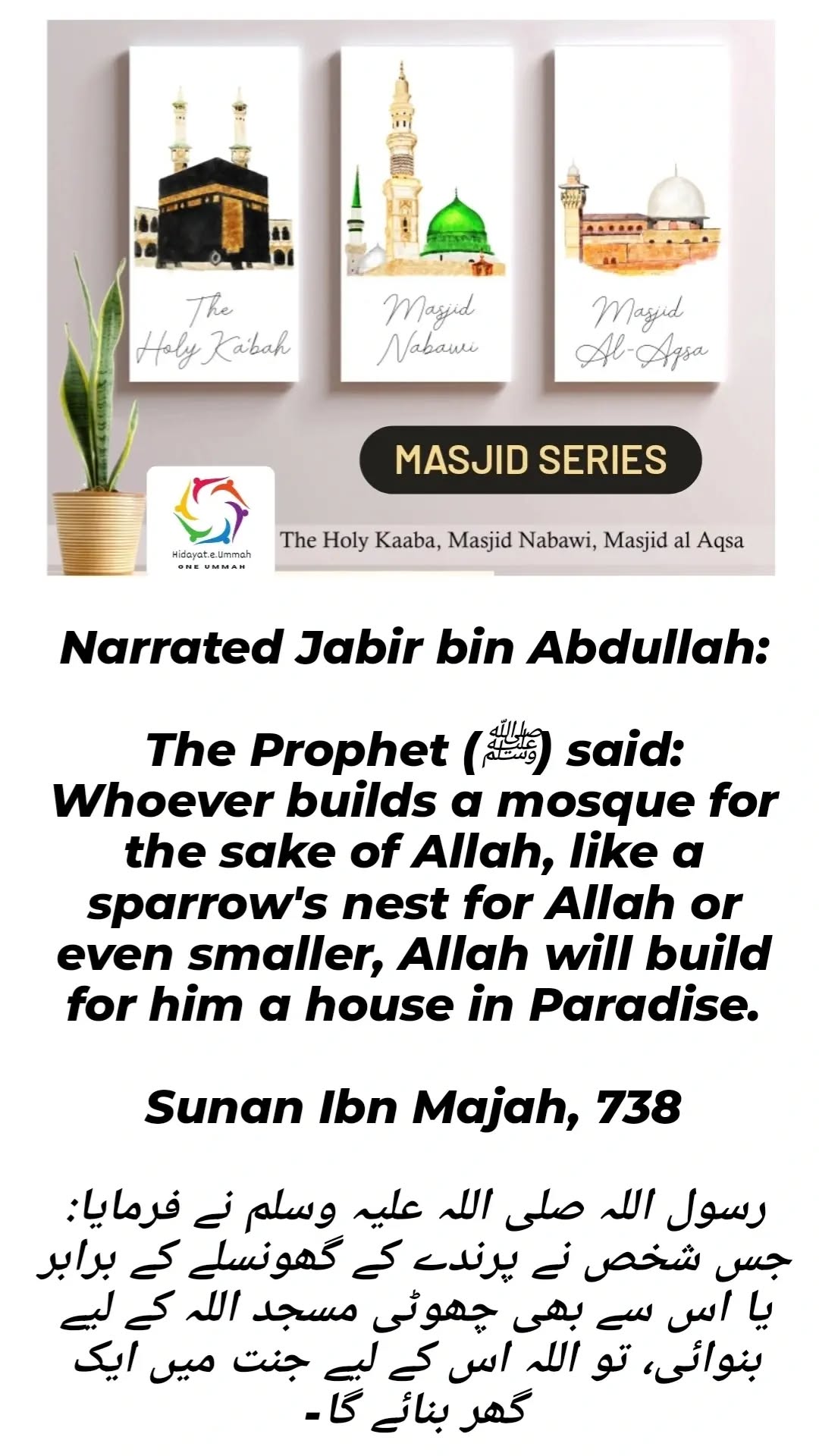
1. This hadith tells us about the reward for building a mosque for the sake of Allah.
2. The Prophet Muhammad (peace be upon him) compares the size of the mosque to a sparrow's nest, meaning that even a small mosque, built for Allah's sake, brings great reward.
3. Whoever builds such a mosque, no matter how small, will have a house built for them in Paradise by Allah.
4. This shows how much Allah rewards acts done with sincerity for His sake, even if they seem small or humble.
Hadith 2
2 of 20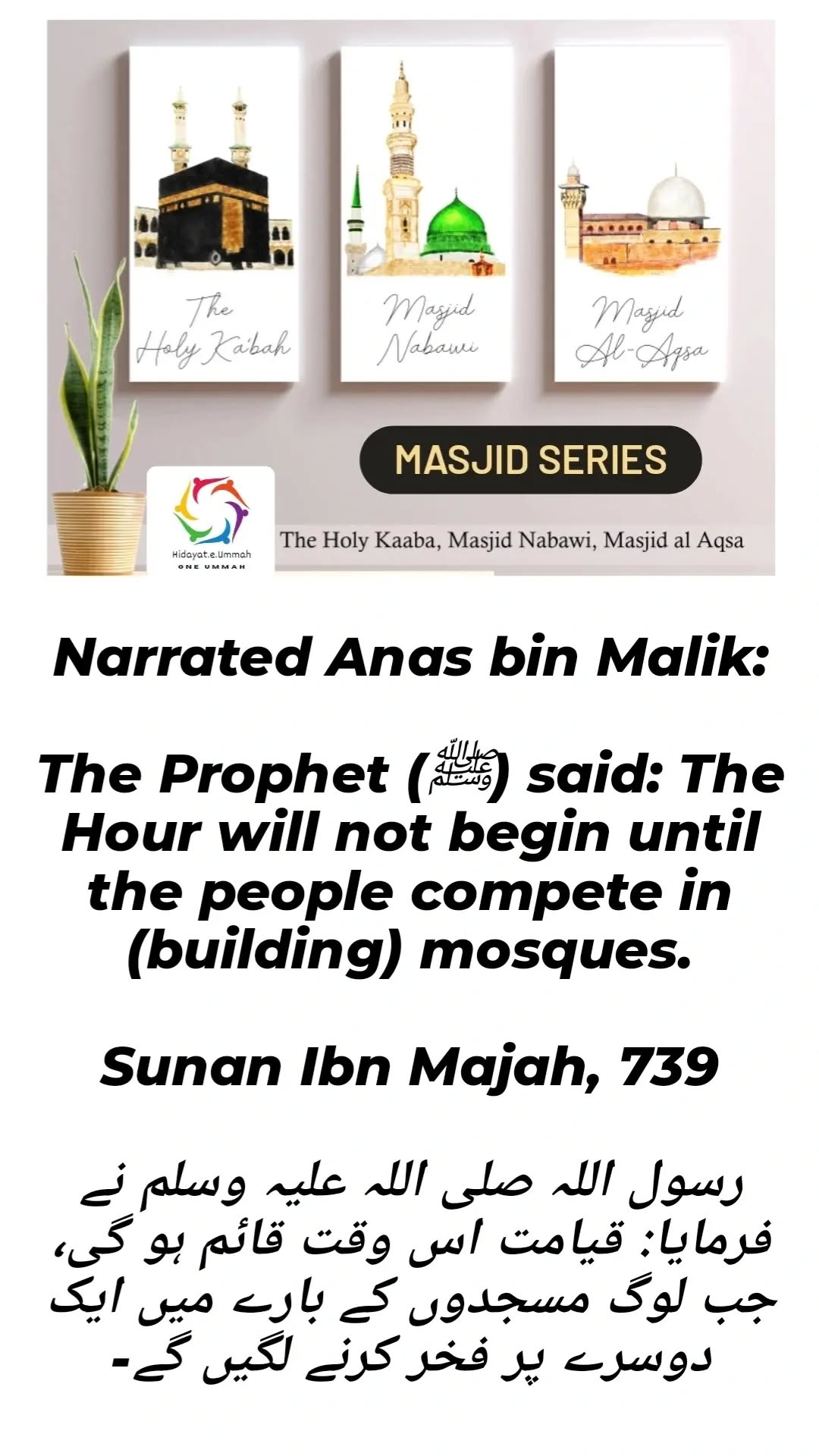
1. This hadith talks about a sign that will occur before the Day of Judgment (the Hour).
2. The Prophet Muhammad (peace be upon him) mentions that one of the signs of the coming of the Hour is that people will compete with each other in building mosques.
3. This shows the importance and value of mosques in Islam, and that people will put effort into constructing them, seeking Allah's reward.
4. It also implies that as the time for the Day of Judgment approaches, people will become more concerned with worship and righteous deeds, such as building mosques.
Hadith 3
3 of 20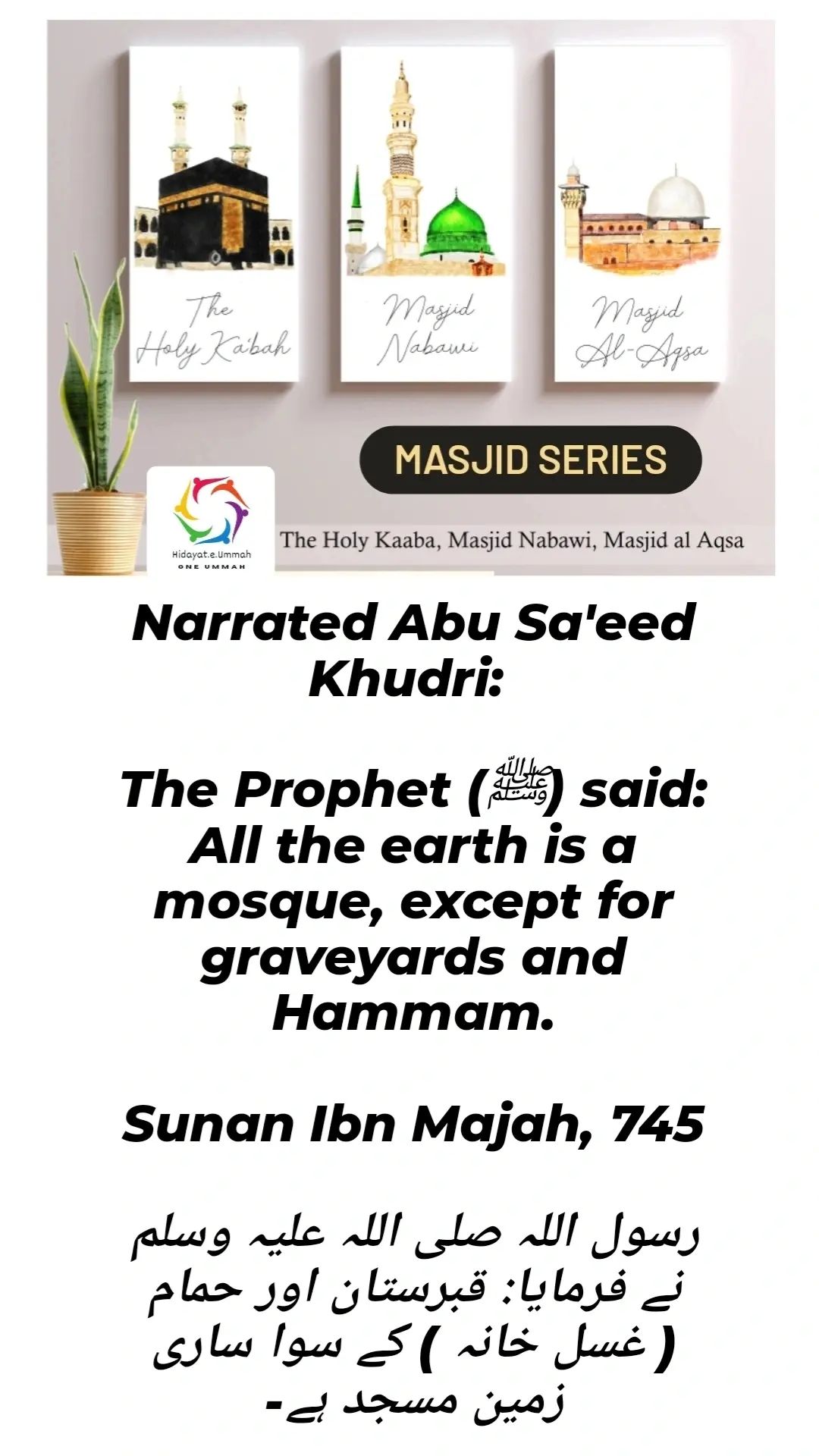
1. This hadith explains that, in Islam, all of the earth is considered a place of prayer (a mosque), except for certain areas.
2. The Prophet Muhammad (peace be upon him) specifies that graveyards and hammams (bathhouses) are exceptions and are not suitable for prayer.
3. This highlights the sacredness of the earth in Islam, where Muslims are encouraged to pray anywhere, as long as the space is clean and free from impurity.
4. The hadith reminds believers to seek purity and respect for the spaces where they worship, as some places are considered inappropriate for prayer due to their nature.
Hadith 4
4 of 20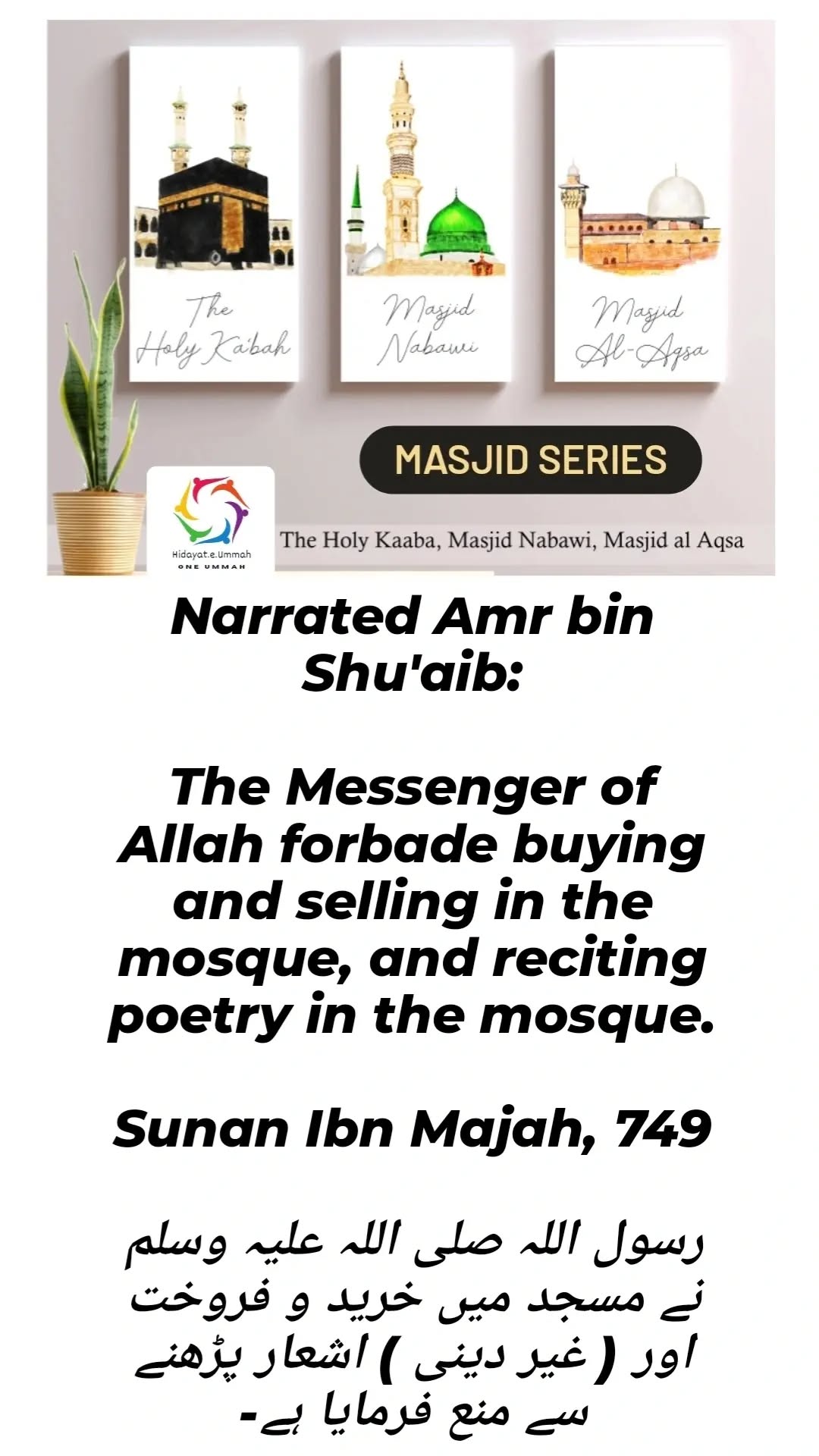
1. This hadith tells us that the Prophet Muhammad (peace be upon him) prohibited certain activities inside the mosque.
2. The two activities specifically forbidden are buying and selling, as well as reciting poetry in the mosque.
3. The mosque is a place of worship and spiritual reflection, so it should not be used for worldly transactions or entertainment, as it may distract people from their prayers and connection with Allah.
4. The hadith highlights the importance of preserving the sanctity and focus of the mosque, making it a place solely for worship and religious activities.
Hadith 5
5 of 20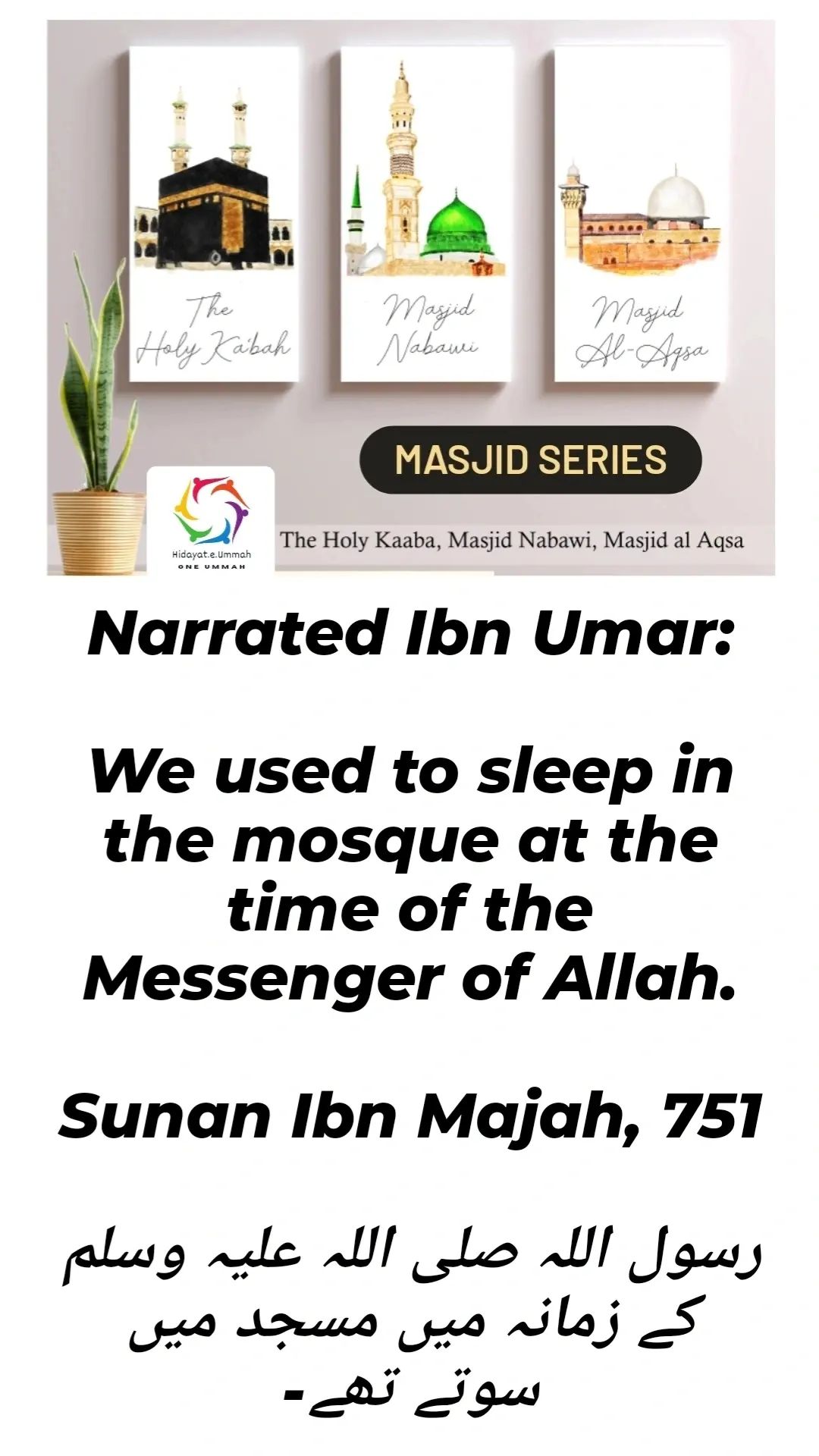
1. This hadith shows that during the time of the Prophet Muhammad (peace be upon him), it was common for people to sleep in the mosque.
2. The Prophet allowed certain companions to sleep in the mosque when needed, particularly those who came to the mosque for religious gatherings or to learn.
3. The mosque was not only a place of prayer but also a place of knowledge, reflection, and sometimes rest.
4. However, this practice should be done with respect for the mosque's sanctity and should not interfere with its primary purpose of worship.
Hadith 6
6 of 20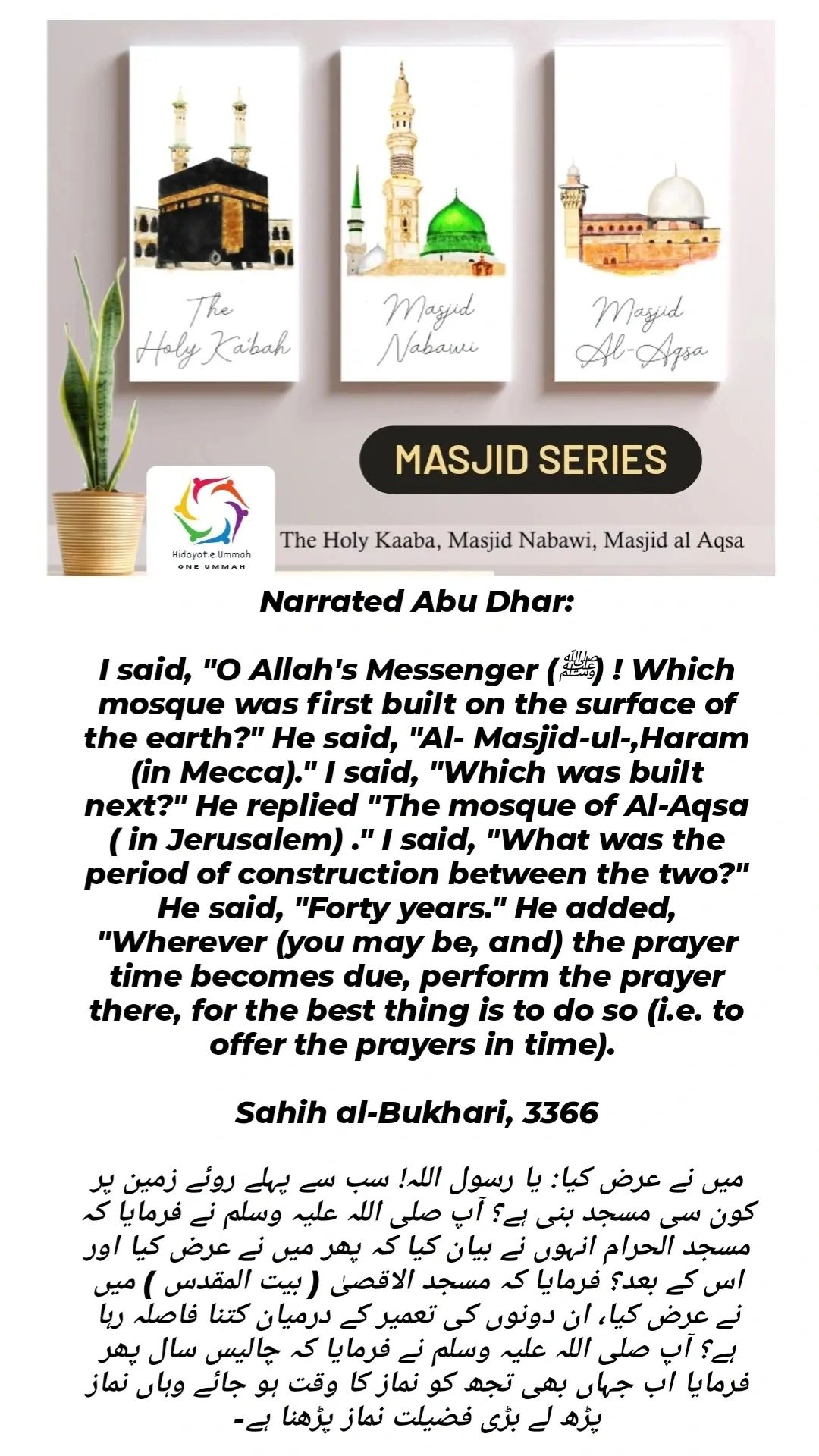
1. In this hadith, the Prophet Muhammad (peace be upon him) is asked about the first mosque ever built on Earth, and he responds that it was Al-Masjid al-Haram in Mecca, the holiest mosque in Islam.
2. The second mosque to be built was Al-Aqsa in Jerusalem, and there was a gap of forty years between the construction of these two sacred mosques.
3. The Prophet also advises that wherever you are, when the time for prayer arrives, you should perform the prayer there. The emphasis is on the importance of praying on time, as the best thing is to offer prayers as soon as their time begins.
Hadith 7
7 of 20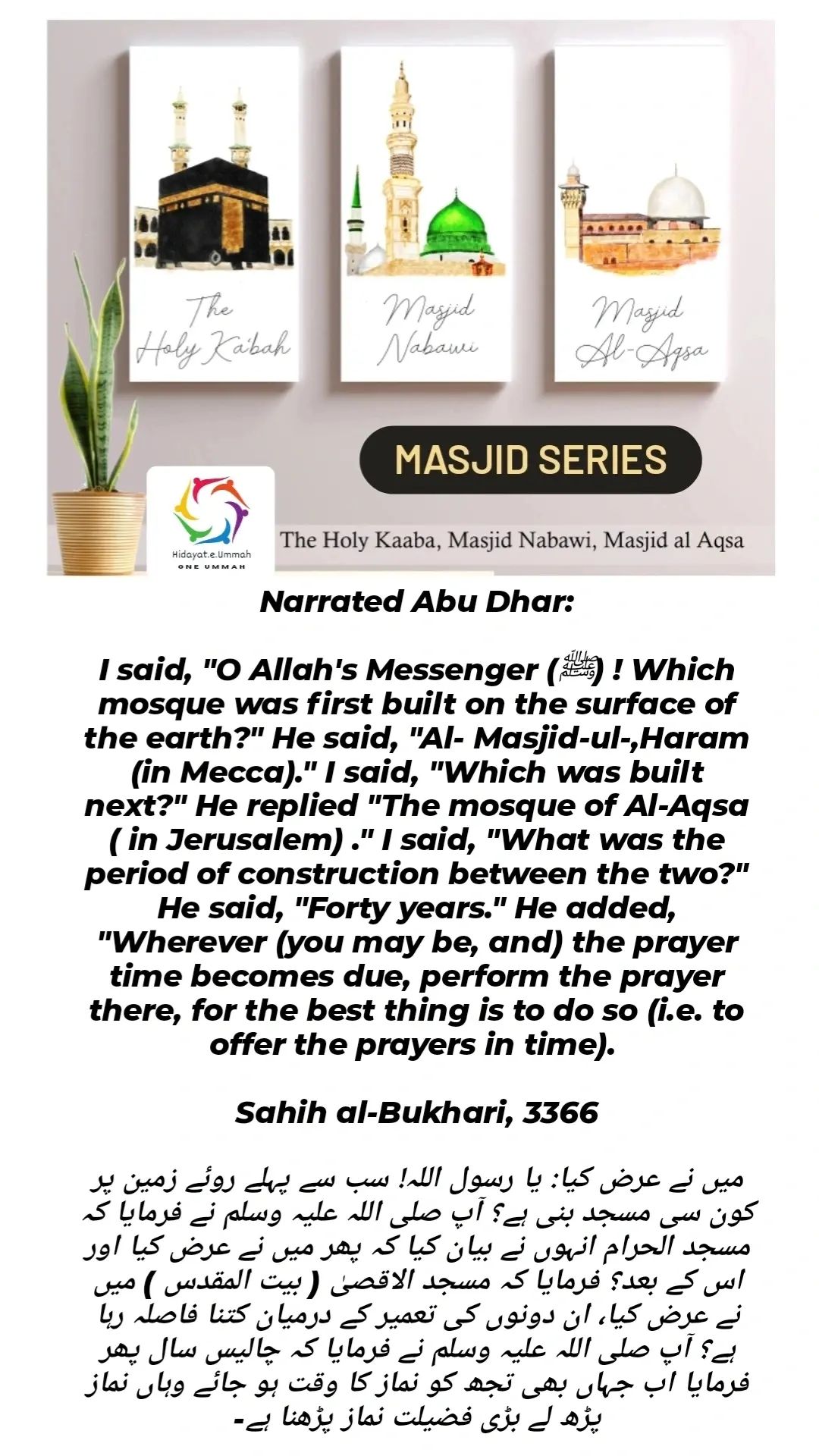
1. In this hadith, Abu Dhar asks the Prophet Muhammad (peace be upon him) about the first mosque ever built on Earth. The Prophet replies that it was Al-Masjid al-Haram in Mecca, the holiest mosque in Islam.
2. Abu Dhar then asks about the second mosque, and the Prophet answers that it was the mosque of Al-Aqsa in Jerusalem.
3. When Abu Dhar asks about the time difference between the construction of the two mosques, the Prophet informs him that the period between the construction of Al-Masjid al-Haram and Al-Aqsa was forty years.
4. Lastly, the Prophet advises that wherever you are, when the time for prayer arrives, you should perform the prayer there. The best thing is to pray on time, emphasizing the importance of timely prayers.
Hadith 8
8 of 20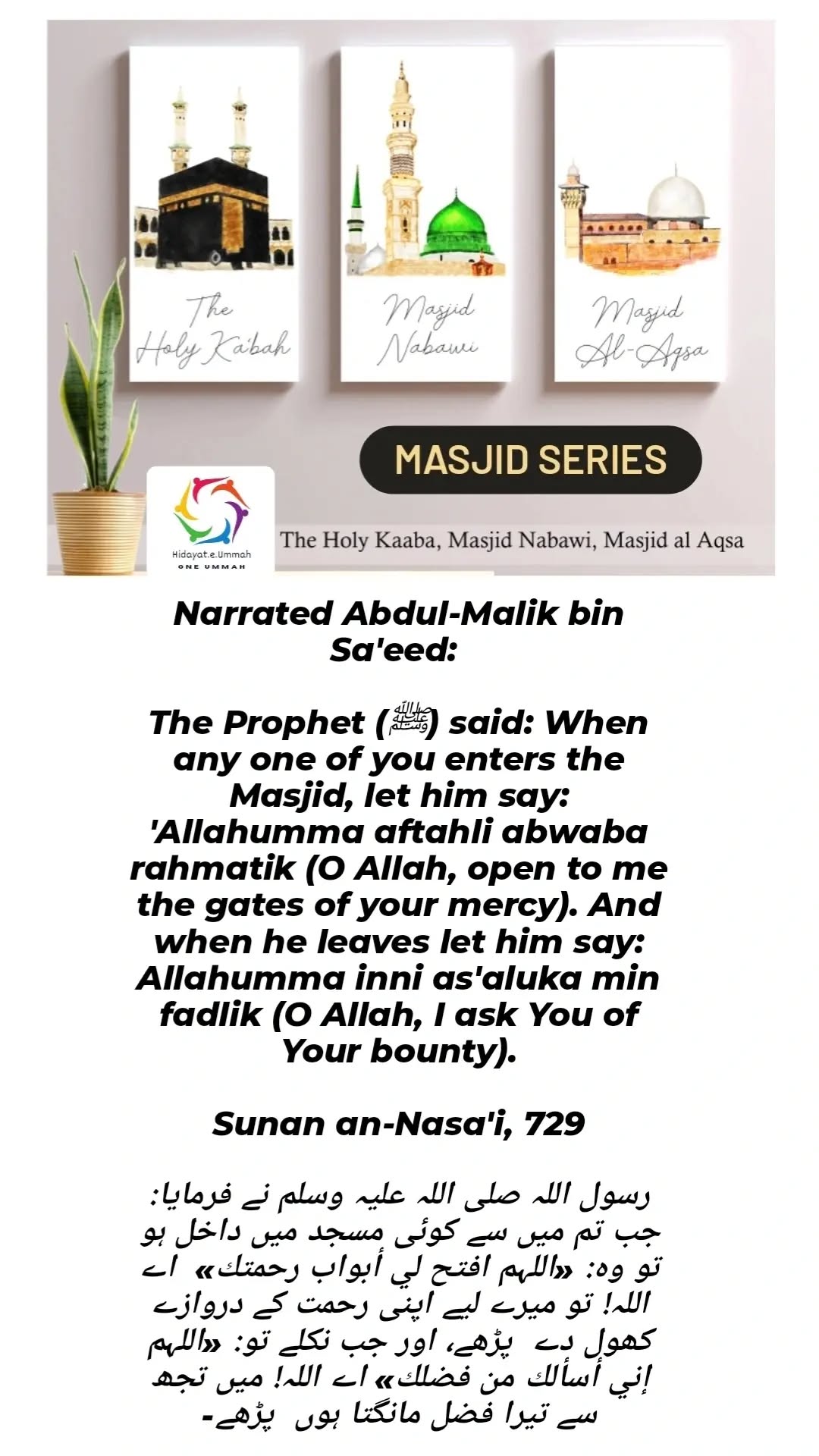
1. In this hadith, the Prophet Muhammad (peace be upon him) teaches a supplication for when entering and leaving the mosque.
2. When a person enters the mosque, they should say: 'Allahumma aftahli abwaba rahmatik', which means, 'O Allah, open to me the gates of Your mercy.' This is a prayer asking Allah for His mercy as you enter the place of worship.
3. When leaving the mosque, the person should say: 'Allahumma inni as'aluka min fadlik', which means, 'O Allah, I ask You of Your bounty.' This is a prayer asking Allah for His blessings and favors as you leave the mosque.
4. The purpose of these supplications is to seek Allah's mercy and blessings in both entering and leaving the mosque, reminding the believer of the importance of invoking Allah's help at all times.
Hadith 9
9 of 20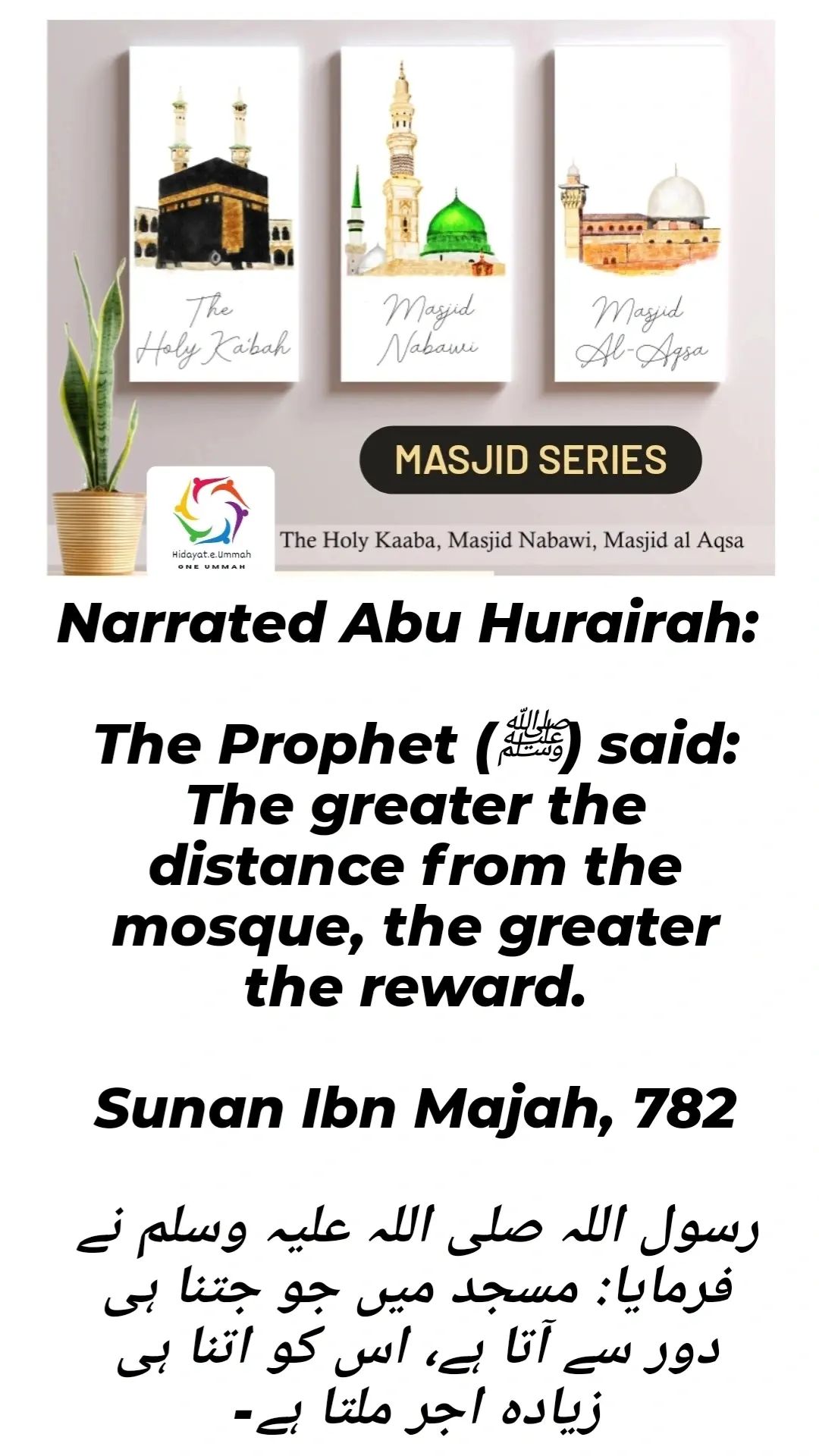
1. In this hadith, the Prophet Muhammad (peace be upon him) emphasizes that the farther a person lives from the mosque, the greater the reward they will receive for attending it.
2. This is because traveling a longer distance to pray at the mosque involves more effort and hardship, and the reward from Allah for such acts of devotion is greater.
3. The hadith encourages Muslims to persevere and make an effort to attend the mosque for prayers, as even the difficulty of the journey is rewarded.
4. This shows the significance of prayer in congregation and the high status Allah grants those who strive to attend despite challenges.
Hadith 10
10 of 20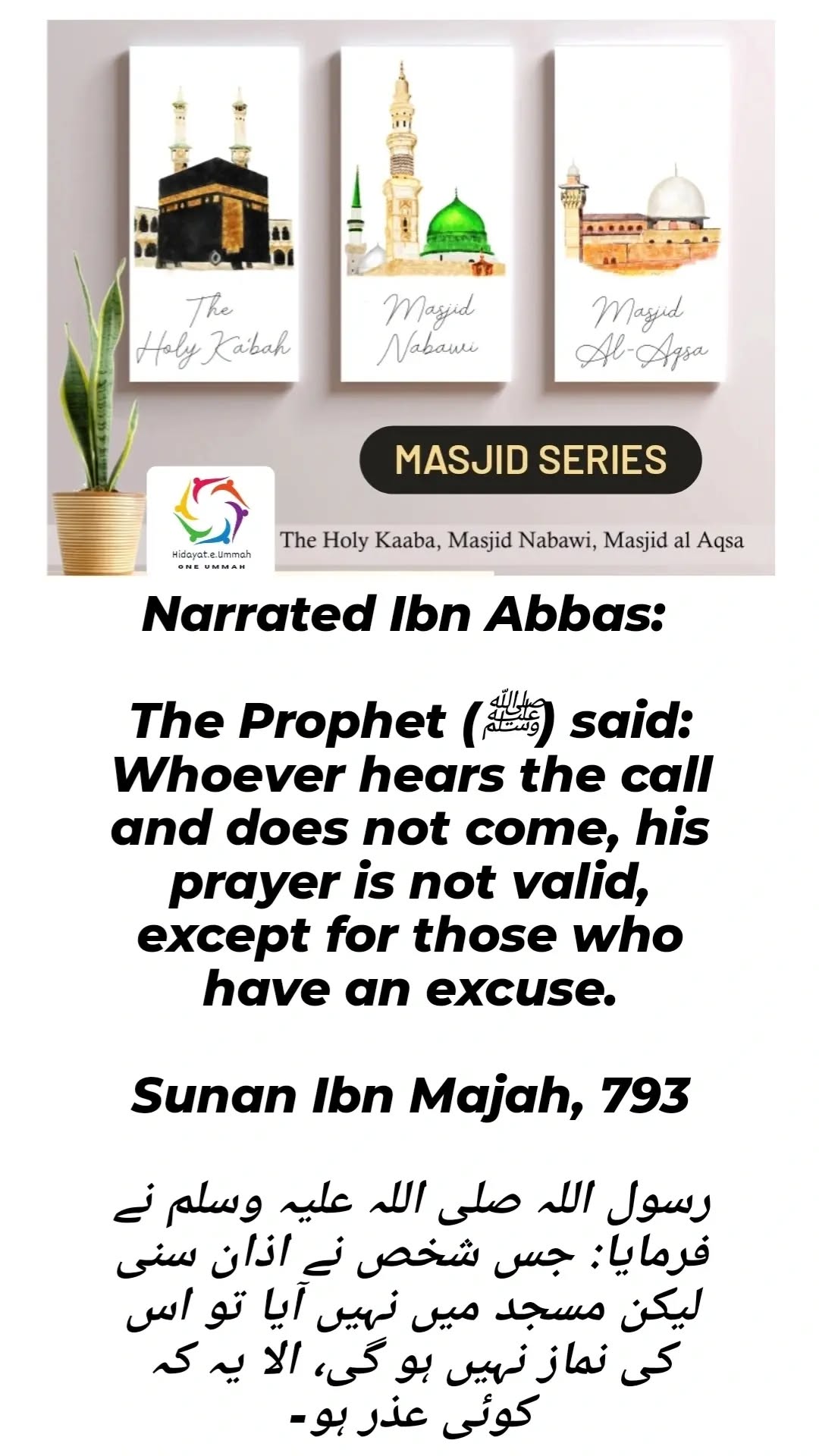
1. In this hadith, the Prophet Muhammad (peace be upon him) warns that if a person hears the call to prayer (adhan) but does not attend the mosque to pray, their prayer will not be valid.
2. However, there is an exception for those who have a valid excuse, such as illness or being far away from the mosque.
3. The hadith emphasizes the importance of attending the mosque for congregational prayer when able, as this is a key practice in Islam.
4. The message is to motivate Muslims to prioritize attending prayers and not neglect them without a legitimate reason.
Hadith 11
11 of 20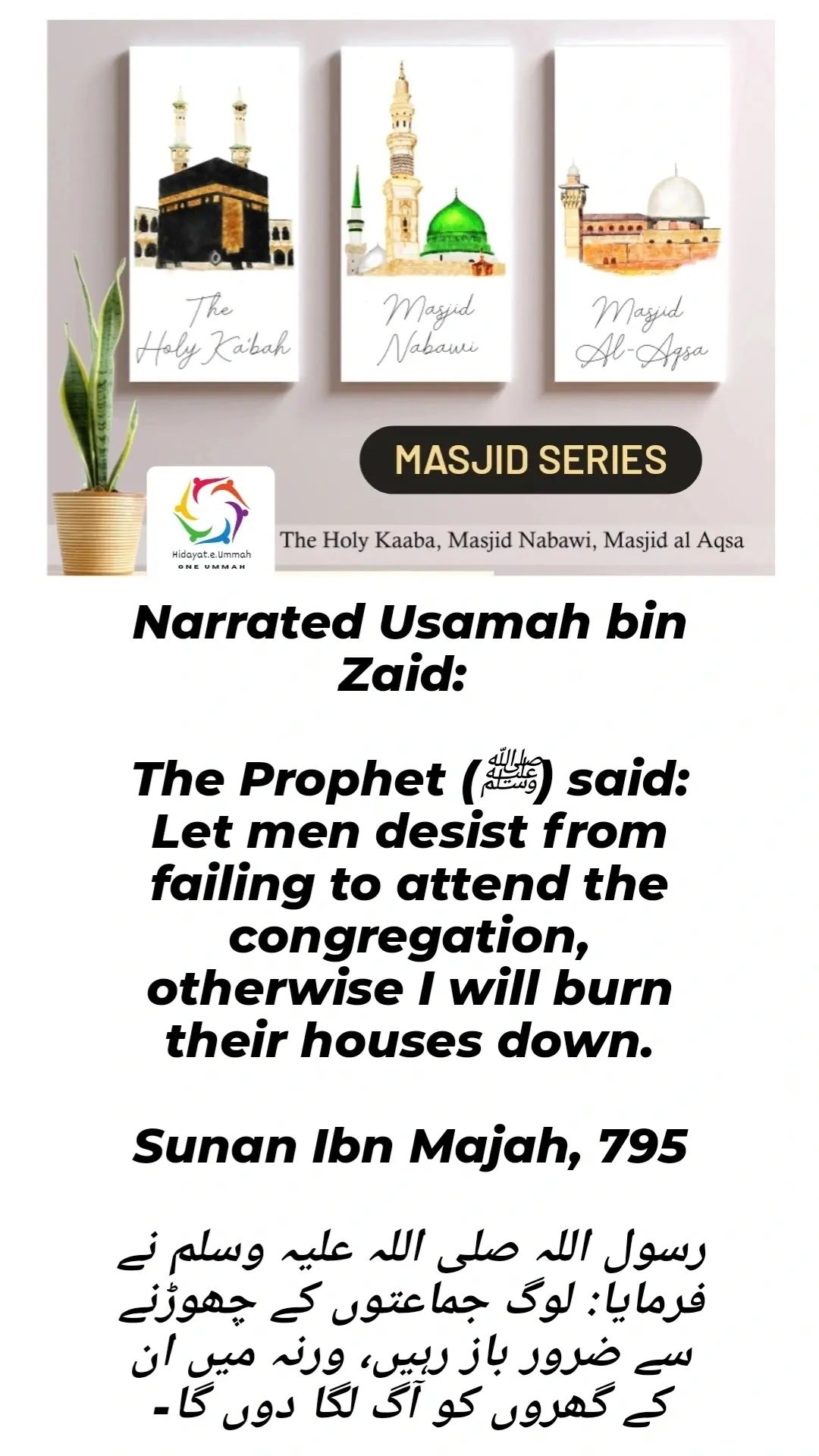
1. In this hadith, the Prophet Muhammad (peace be upon him) strongly warns men about the importance of attending congregational prayers at the mosque.
2. He says that if men continue to neglect attending the prayers in congregation, he will take severe action, even threatening to burn their houses down.
3. The hadith emphasizes the seriousness of attending the mosque for congregational prayers, highlighting its importance in Islam.
4. It is a reminder that neglecting communal prayers is a significant issue, and there are consequences for not fulfilling this religious obligation.
Hadith 12
12 of 20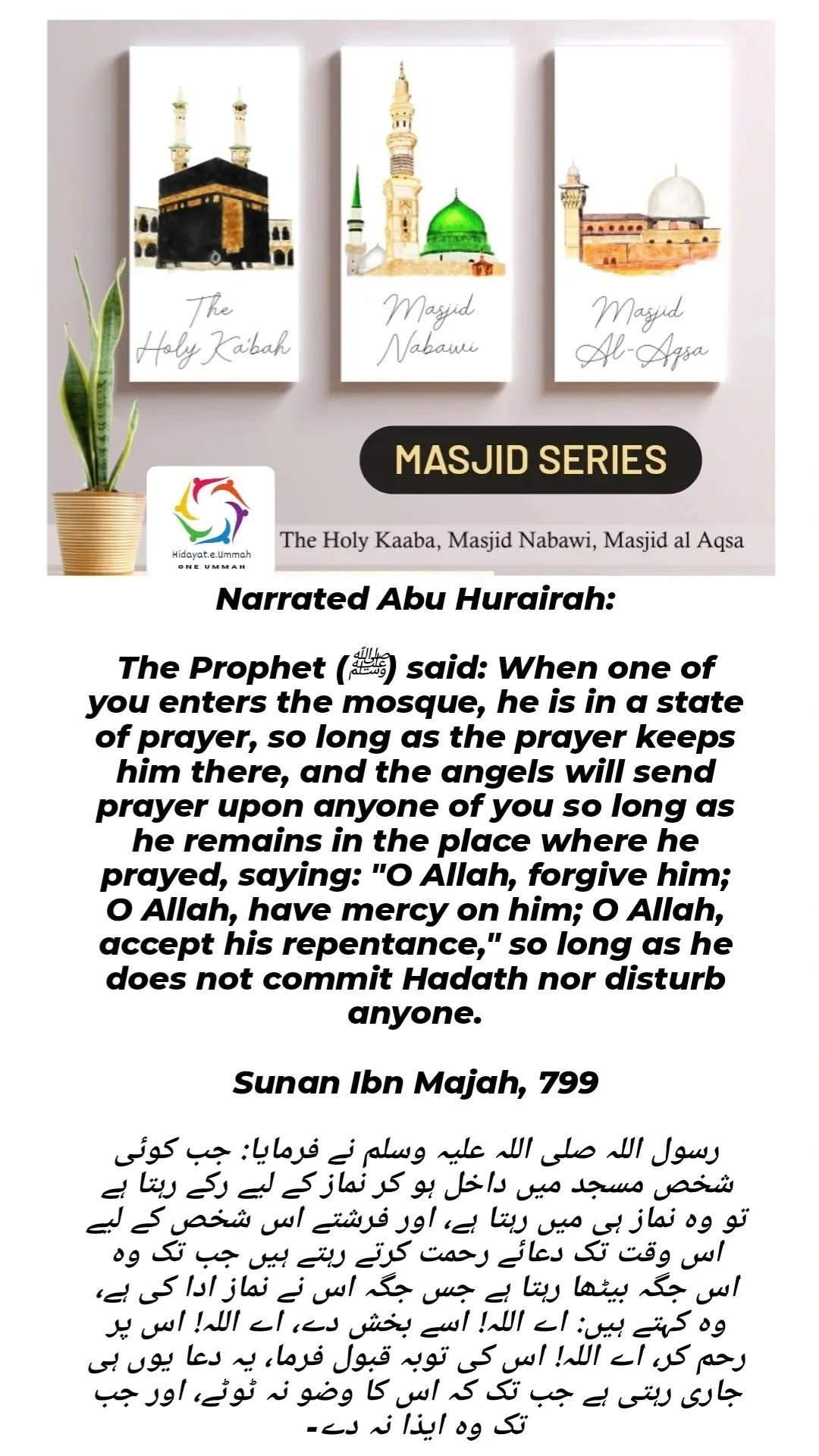
1. In this hadith, the Prophet Muhammad (peace be upon him) explains the reward for someone who stays in the mosque after performing a prayer.
2. As long as a person remains in the mosque in a state of prayer (whether in a formal prayer or waiting for the next prayer), the angels will send blessings and prayers upon him.
3. The angels ask Allah to forgive, have mercy on, and accept the repentance of the person who stays in the mosque.
4. However, this continues as long as the person does not invalidate their state of prayer by breaking wudu (Hadath) or disturbing others in the mosque.
5. This hadith highlights the spiritual benefits of staying in the mosque after prayer, emphasizing the mercy and forgiveness of Allah for those who remain in this sacred place.
Hadith 13
13 of 20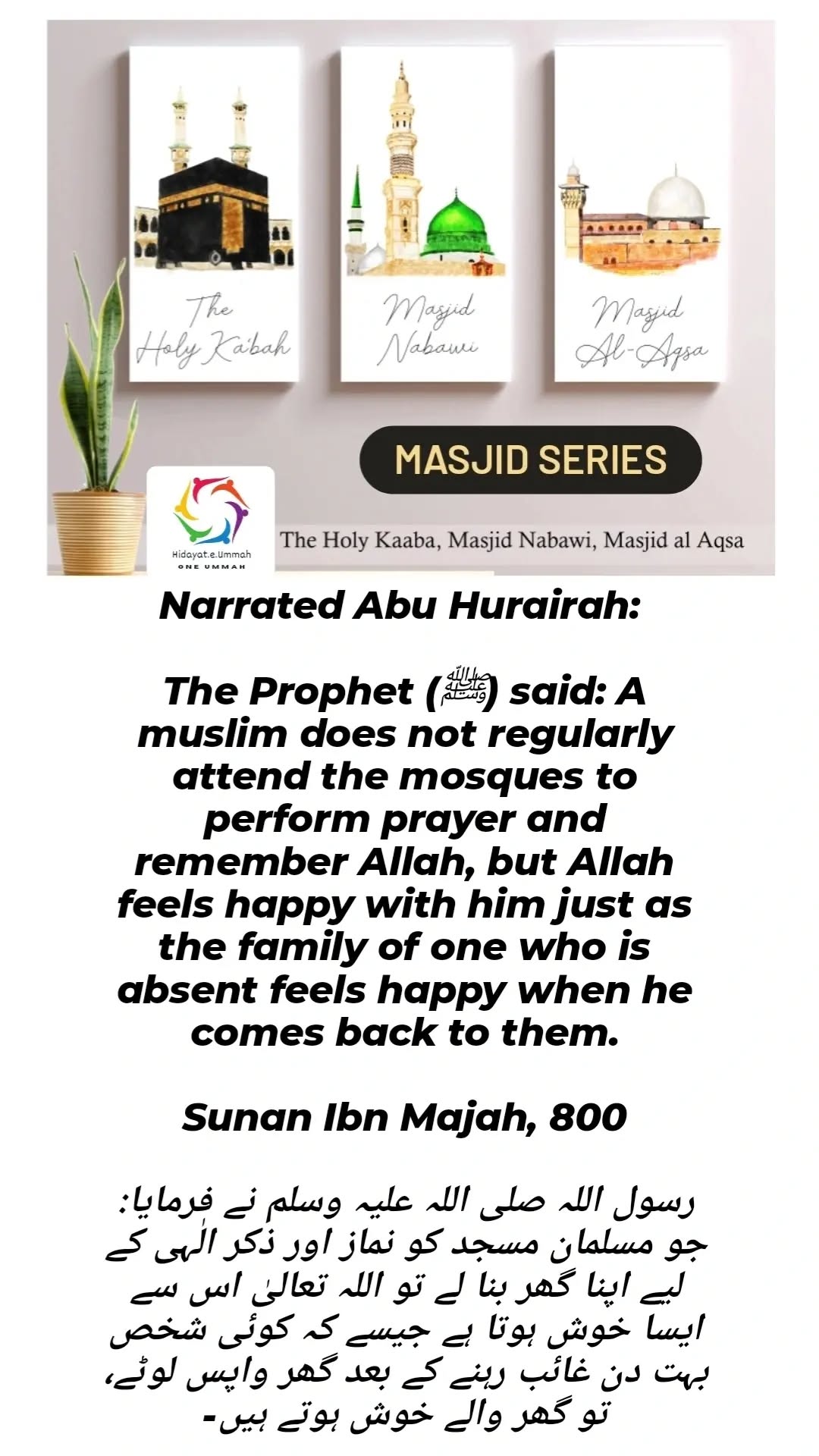
1. In this hadith, the Prophet Muhammad (peace be upon him) compares the joy of a Muslim who regularly attends the mosque for prayer and remembrance of Allah to the joy of a family member when a loved one returns home after being absent.
2. The hadith emphasizes the importance of being consistent in attending the mosque for prayers and engaging in the remembrance of Allah (dhikr).
3. Just as the family eagerly awaits and feels happy when a member returns, Allah feels happy with the person who remains dedicated to worshiping Him in the mosque.
4. This illustrates the special bond between a Muslim and Allah, and how Allah appreciates and rewards those who continuously strive to keep their connection with Him strong.
Hadith 14
14 of 20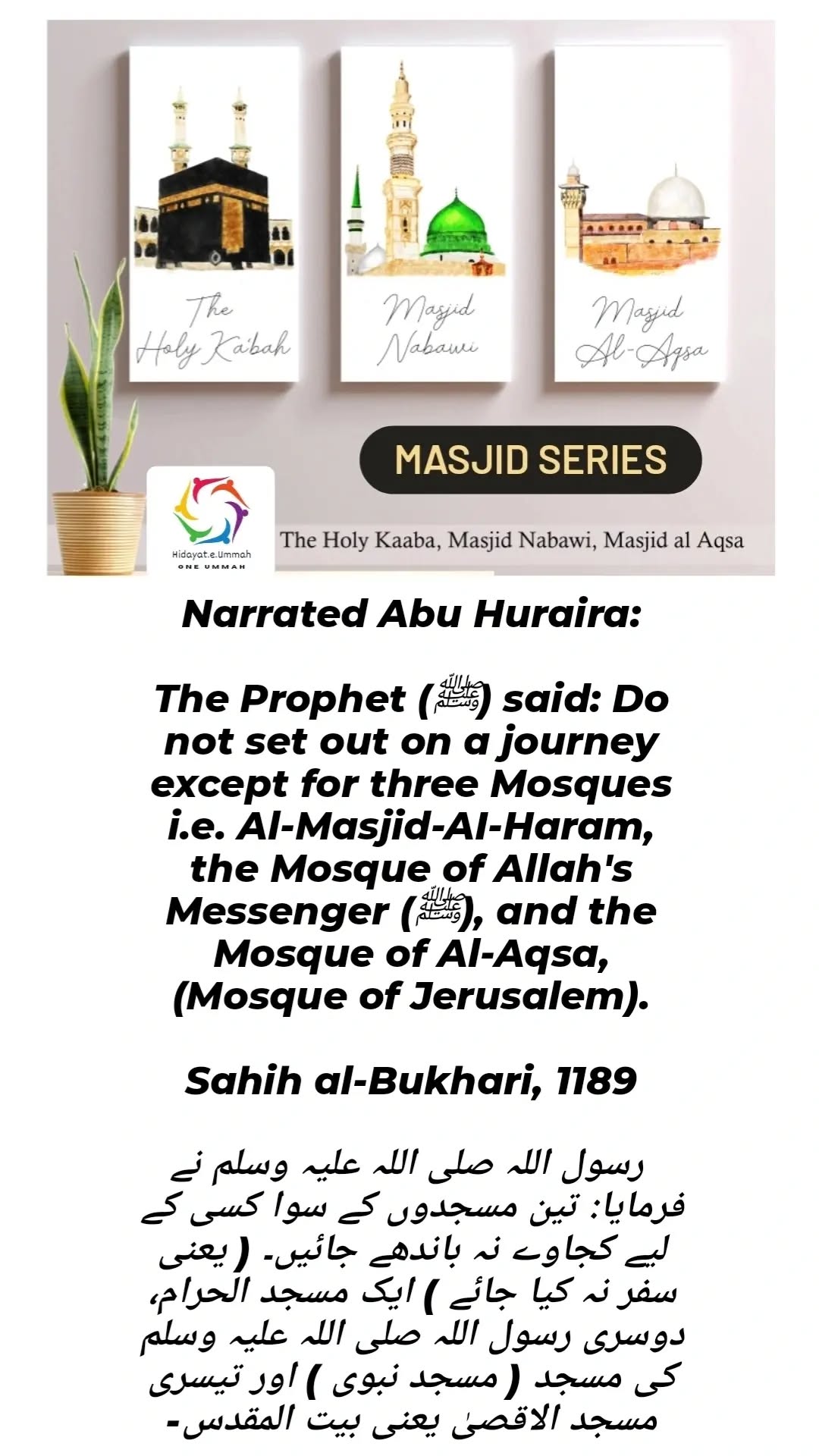
1. In this hadith, the Prophet Muhammad (peace be upon him) advises that a Muslim should not set out on a journey specifically for the purpose of visiting any mosque except for three special mosques.
2. The three mosques mentioned are: Al-Masjid-Al-Haram in Mecca, the mosque of the Prophet Muhammad (peace be upon him) in Medina, and Al-Masjid-Al-Aqsa in Jerusalem.
3. These mosques are considered the holiest and most significant places for Muslims, and visiting them is a highly encouraged act of worship.
4. The hadith emphasizes the spiritual value and importance of these mosques, and how they hold a unique status in the hearts of Muslims.
Hadith 15
15 of 20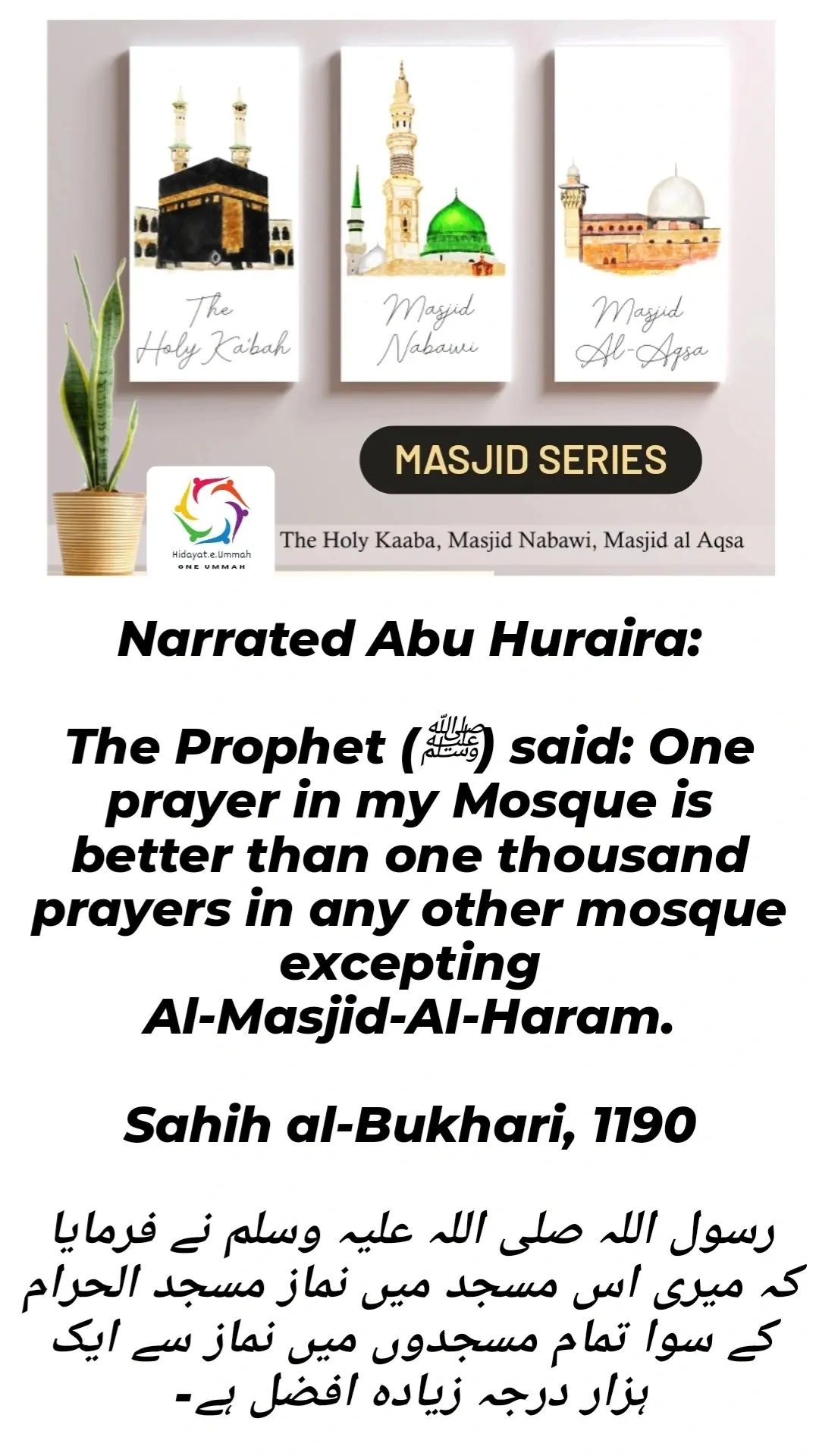
1. In this hadith, the Prophet Muhammad (peace be upon him) highlights the great reward of praying in his mosque (Al-Masjid-an-Nabawi in Medina).
2. He says that one prayer performed in his mosque is better than one thousand prayers in any other mosque.
3. However, there is an exception for Al-Masjid-Al-Haram (the mosque in Mecca), as it holds even greater significance and reward.
4. The hadith encourages Muslims to appreciate the importance of these sacred places of worship and emphasizes the immense rewards of praying in the mosque of the Prophet Muhammad (peace be upon him).
Hadith 16
16 of 20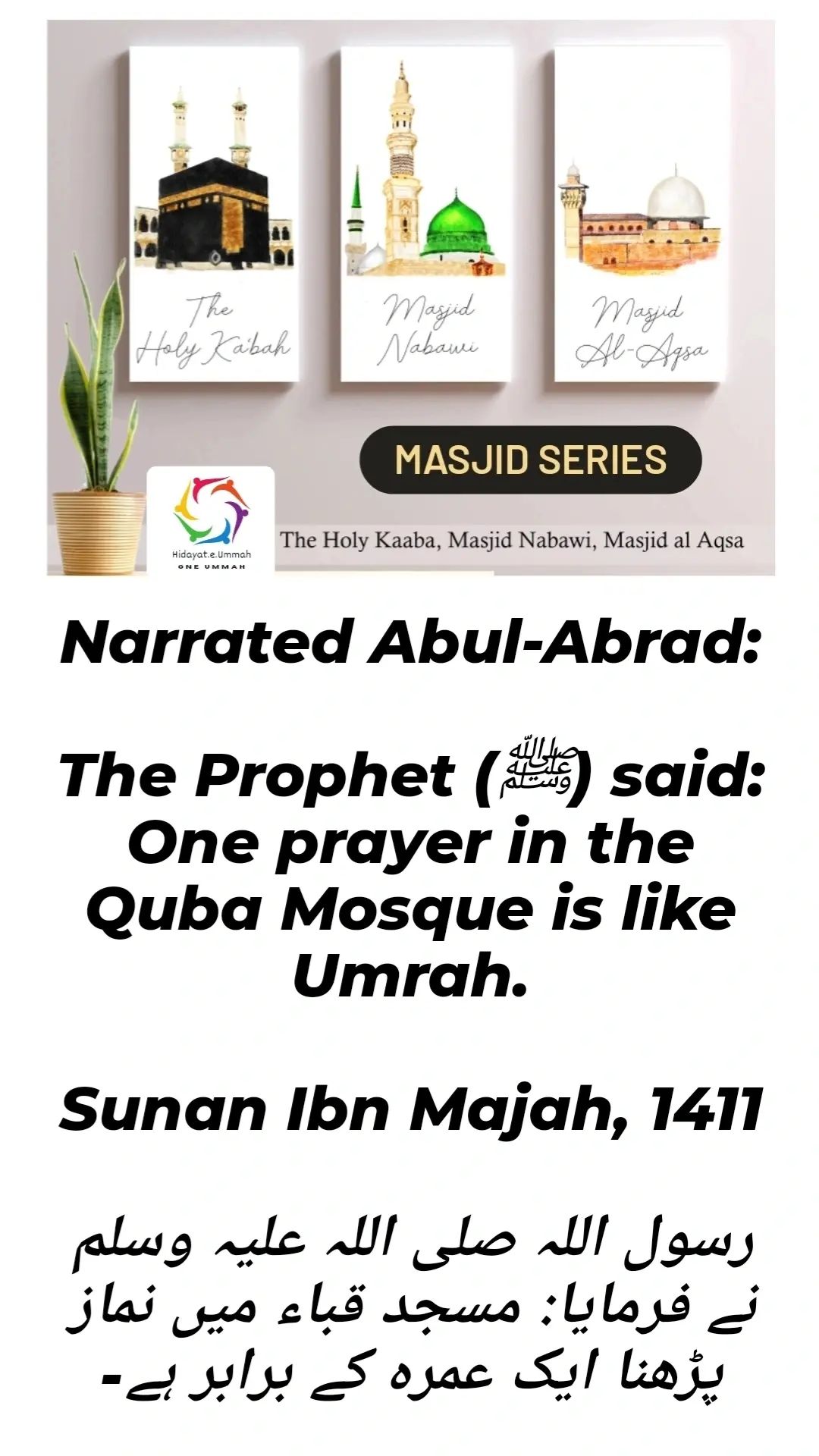
1. In this hadith, the Prophet Muhammad (peace be upon him) speaks about the special reward of praying in the Quba Mosque, which is located just outside Medina.
2. He says that performing one prayer in the Quba Mosque is like performing an Umrah, which is a pilgrimage to Mecca.
3. This highlights the great spiritual value of praying in the Quba Mosque, showing that even a regular prayer there is equivalent to the significant act of Umrah.
4. The hadith encourages Muslims to visit and pray in the Quba Mosque, as it offers an immense reward and a unique connection to the Prophet Muhammad (peace be upon him).
Hadith 17
17 of 20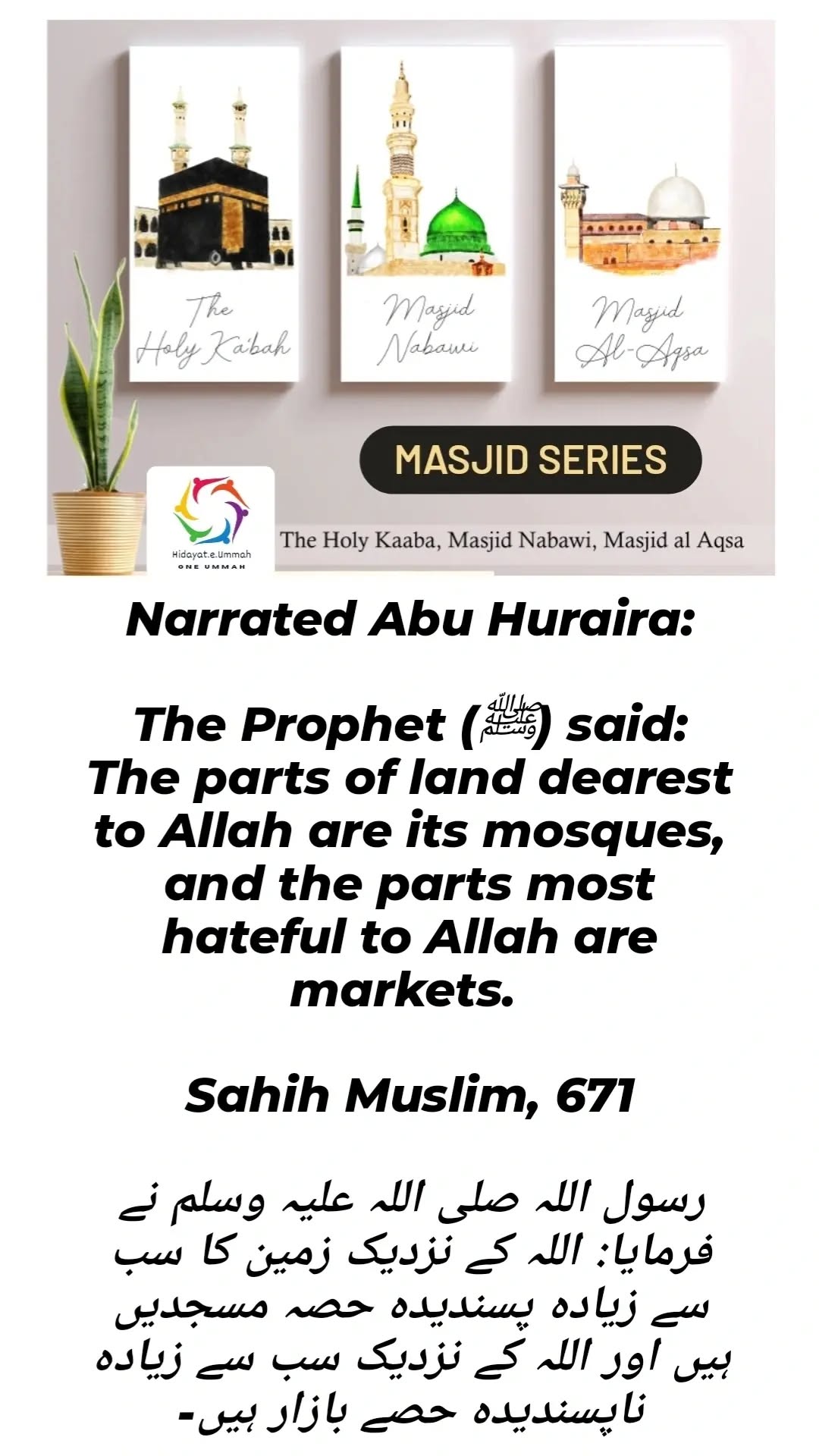
1. In this hadith, the Prophet Muhammad (peace be upon him) explains the spiritual significance of different places on earth.
2. He mentions that the places dearest to Allah are the mosques, which are dedicated spaces for worship, prayer, and remembrance of Allah.
3. On the other hand, the places most hateful to Allah are the markets, which are often associated with distractions, worldly pursuits, and materialism.
4. This hadith encourages Muslims to prioritize places of worship and remind them to avoid becoming too absorbed in the material world, focusing instead on their connection with Allah.
Hadith 18
18 of 20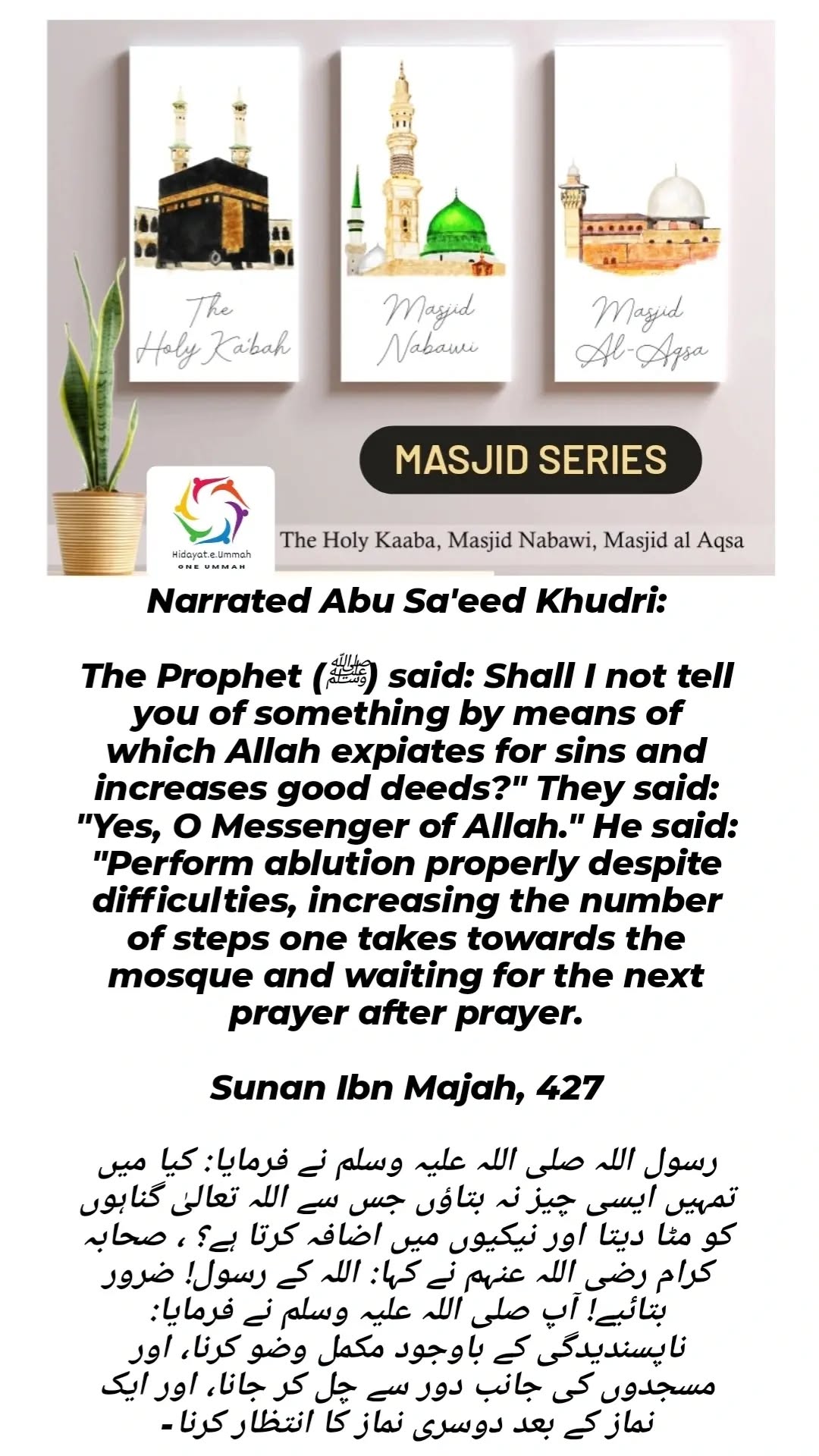
1. In this hadith, the Prophet Muhammad (peace be upon him) shares a valuable method for expiating sins and increasing good deeds.
2. He encourages Muslims to perform ablution (wudu) properly, even when it is difficult, as this act purifies and earns reward.
3. Additionally, he advises taking extra steps towards the mosque for prayer, highlighting the reward of walking in the path of worship.
4. Waiting for the next prayer after completing one prayer also earns a great reward, as it shows dedication and commitment to continuous worship.
5. Overall, these actions are ways of increasing one's closeness to Allah, earning forgiveness for sins, and gaining more good deeds.
Hadith 19
19 of 20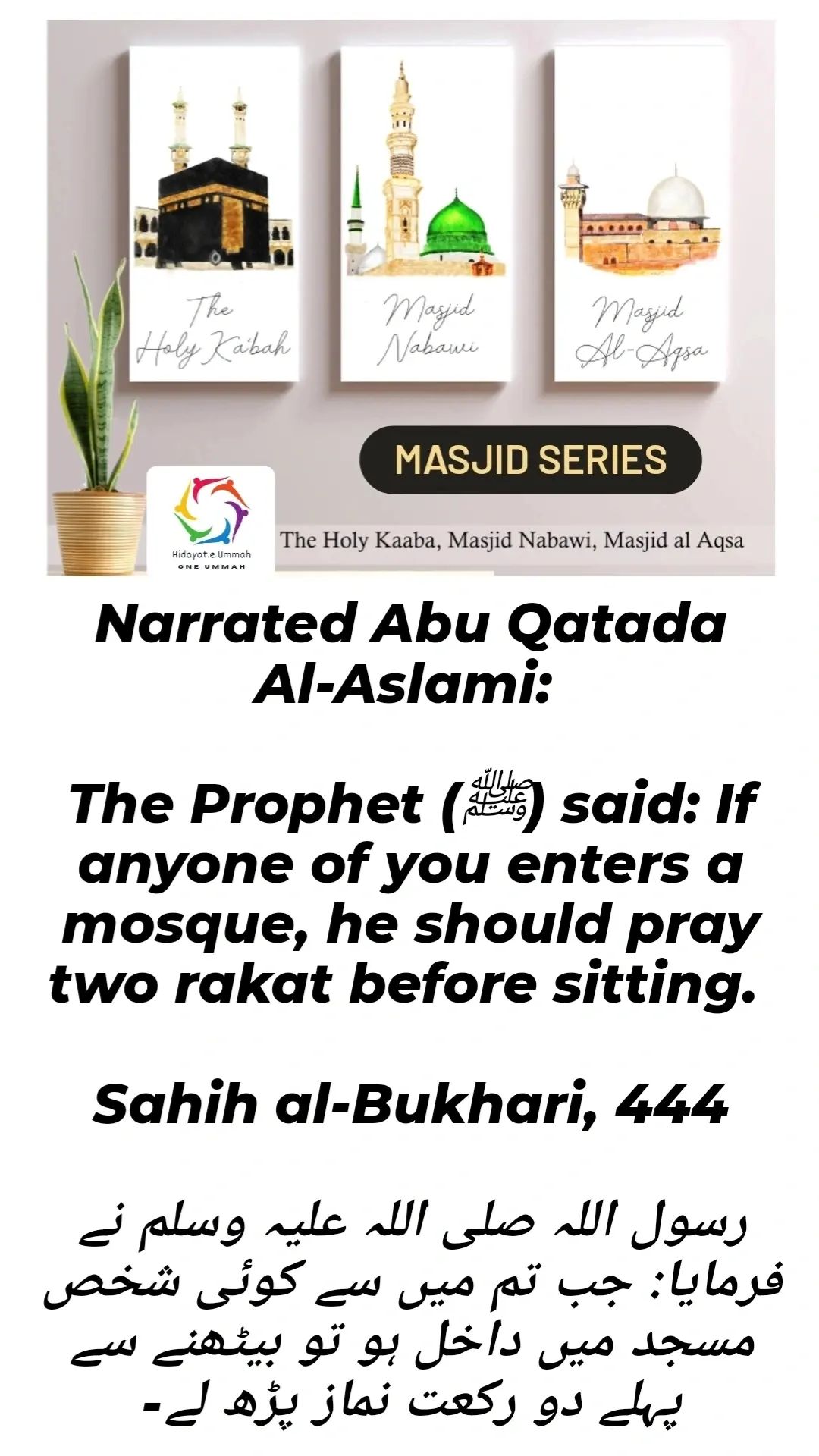
1. This hadith teaches the proper etiquette for entering a mosque.
2. The Prophet Muhammad (peace be upon him) recommended that when a person enters the mosque, they should offer two rak'ahs (units of prayer) before sitting down.
3. These two rak'ahs are a way of showing respect to the mosque and Allah, and they help to spiritually prepare oneself before sitting and engaging in further acts of worship.
4. This practice is a Sunnah (recommended action) for Muslims and can be done whenever entering the mosque for any prayer time.
Hadith 20
20 of 20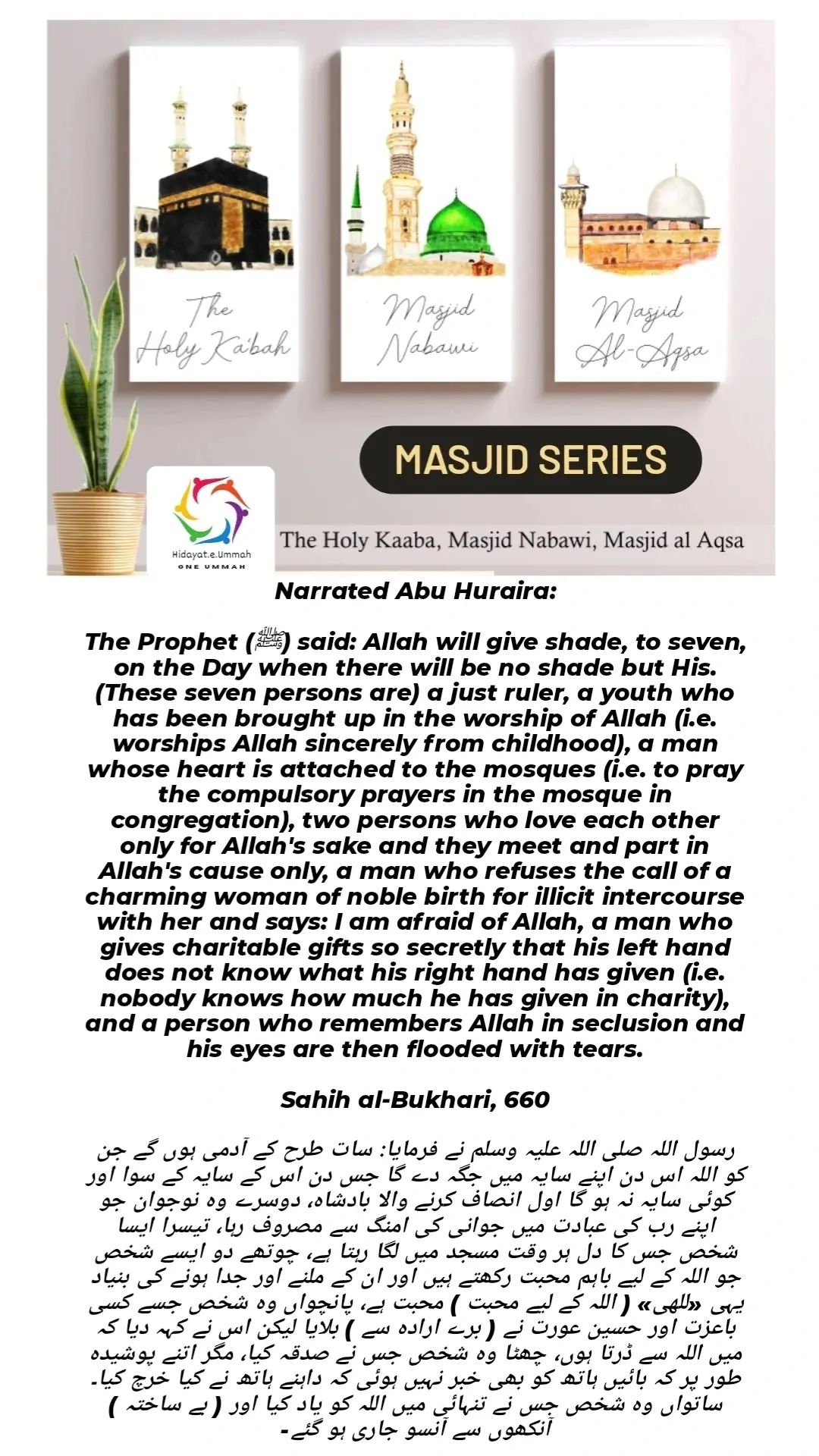
1. This hadith mentions seven types of people who will be granted Allah's special shade on the Day of Judgment, when there will be no shade except His.
2. The first person is a just ruler, who rules with fairness and justice.
3. The second person is a youth who has grown up worshipping Allah sincerely and remains devoted to His worship from childhood.
4. The third person is someone whose heart is attached to the mosque, meaning they regularly attend the mosque for prayers in congregation.
5. The fourth person is two individuals who love each other purely for the sake of Allah, and they meet and part only for Allah's cause.
6. The fifth person is a man who refuses the temptation of a beautiful woman calling him to commit illicit acts, and instead, he responds, 'I fear Allah.'
7. The sixth person is one who gives charity so secretly that even their left hand does not know what their right hand has given, showing humility and sincerity in their acts of kindness.
8. The seventh person is someone who remembers Allah in private, and as a result of this deep remembrance, their eyes overflow with tears, showing a sincere connection with Allah.