
Quran
Hadith Collection
68 Hadiths
Hadith 1
1 of 68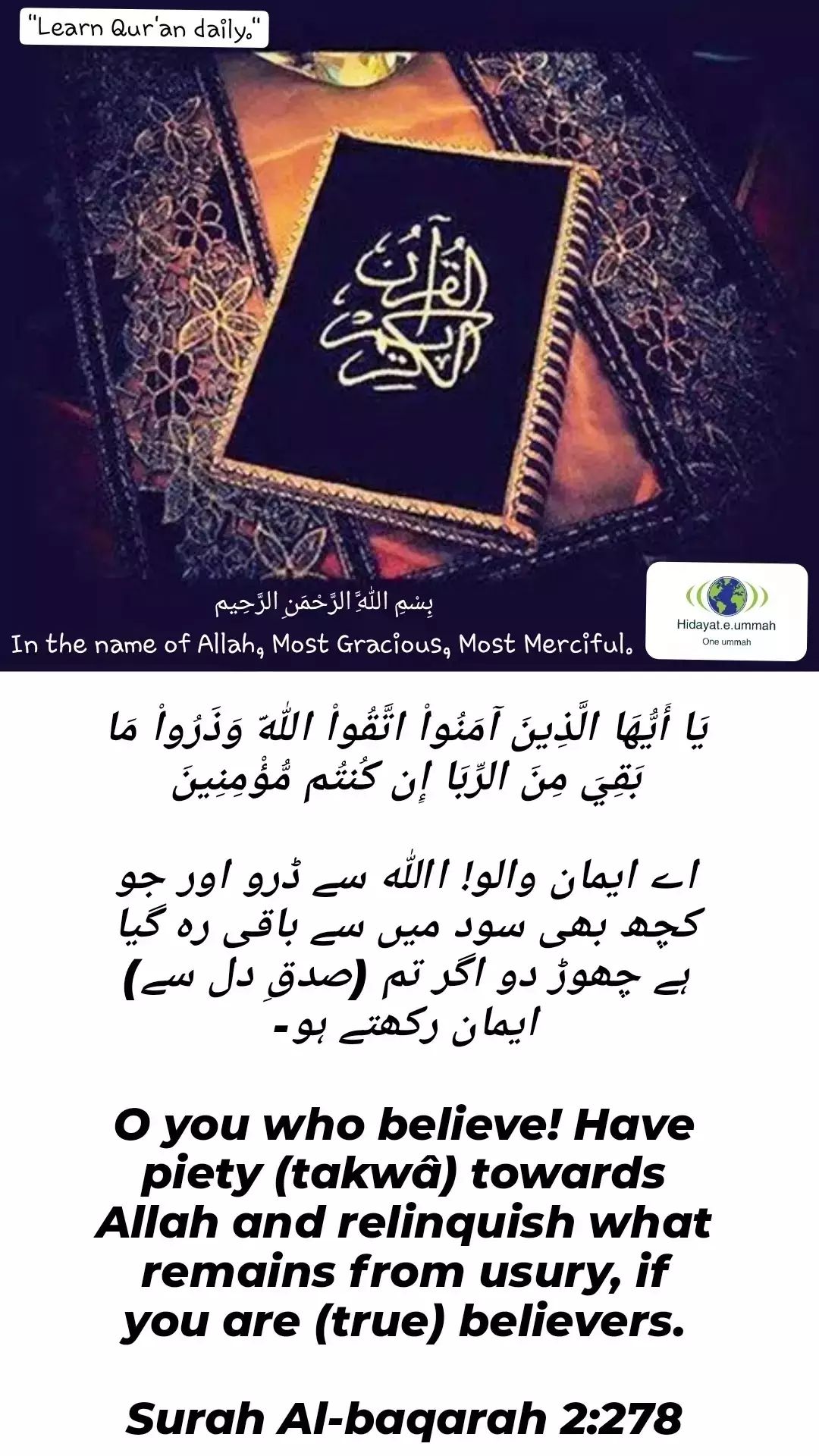
Surah Al-Baqarah 2:278
**Translation:**
_O you who believe! Have piety (taqwa) towards Allah and relinquish what remains from usury, if you are (true) believers._
**Explanation:**
This verse commands believers to develop taqwa (consciousness and fear of Allah) and to abandon any dealings involving interest (riba). Islam strictly prohibits usury because it leads to exploitation and injustice in economic transactions.
**Key Lessons:**
1. **Taqwa as a Foundation:**
- Believers are reminded to always prioritize Allah's commands by having awareness and accountability toward Him in all aspects of life.
2. **Prohibition of Usury:**
- The verse clearly instructs Muslims to distance themselves from any remaining interest-based financial activities.
3. **Test of Faith:**
- Avoiding riba is presented as a criterion for true belief.
**Practical Application:**
- Muslims are encouraged to engage in just and ethical financial dealings.
- Pursuing interest-free financial options such as Islamic banking can help comply with this directive.
- Developing financial systems that promote fairness and mutual benefit aligns with the Islamic economic ethos.
Hadith 2
2 of 68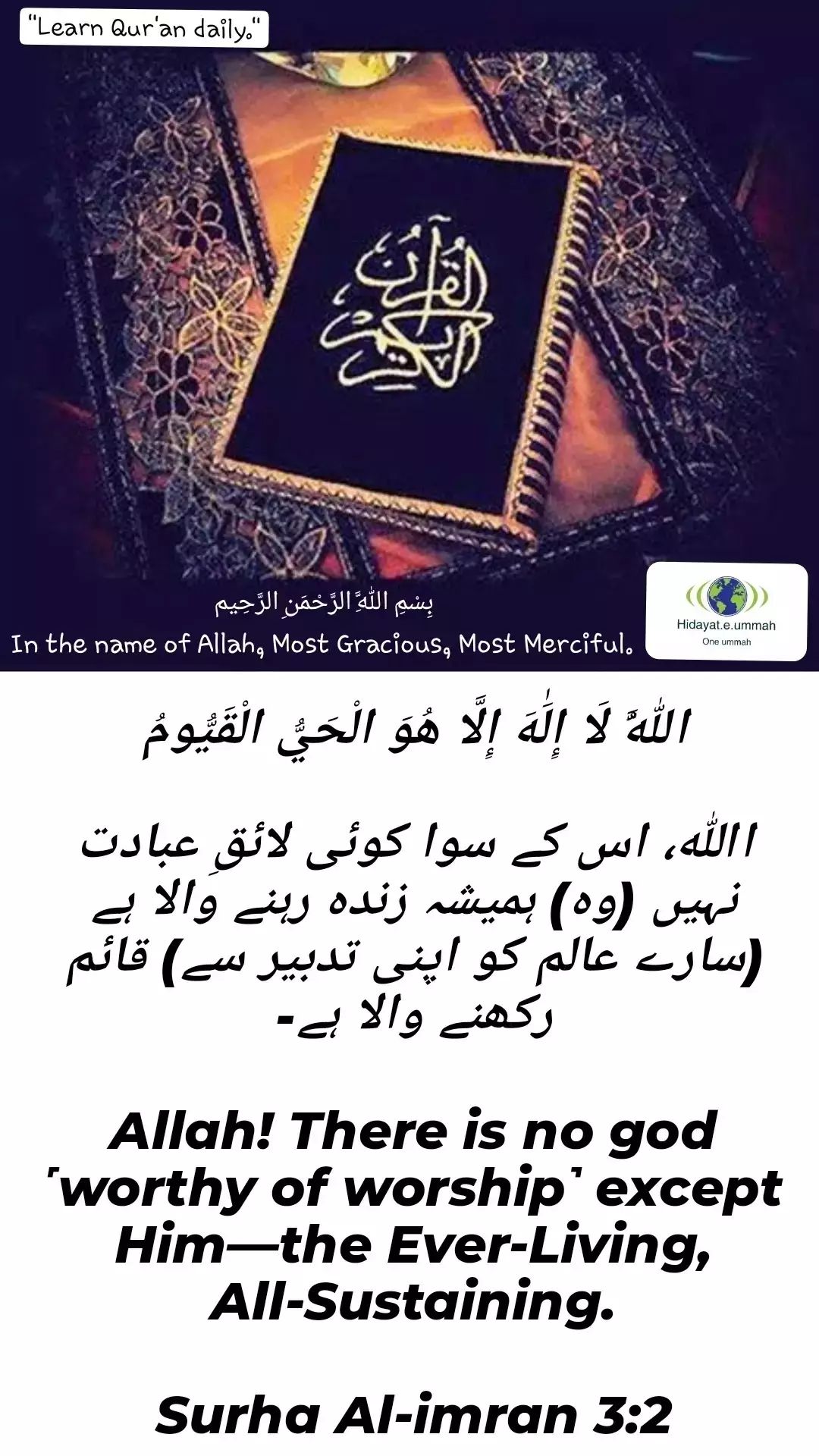
Surah Aal-e-Imran 3:2
**Translation:**
_Allah! There is no god worthy of worship except Him—the Ever-Living, the All-Sustaining._
**Explanation:**
This verse highlights the core belief of Tawheed (Oneness of Allah) in Islam, affirming that Allah alone deserves worship, devotion, and obedience.
**Key Attributes of Allah:**
1. **Ever-Living (Al-Hayy):**
- Allah is eternal, without beginning or end. He is self-sustaining and never dies.
2. **All-Sustaining (Al-Qayyum):**
- Allah upholds the entire universe, managing and maintaining all affairs without any need or dependency.
**Key Lessons:**
- Believers are reminded to recognize and submit to Allah as the only true deity.
- Worship, reliance, and trust should be directed to Allah alone, who is eternal and sustains all existence.
**Practical Reflection:**
- Strengthen your relationship with Allah by deepening your understanding of His attributes.
- Regular acts of worship, such as Salah (prayer) and Dhikr (remembrance), reinforce acknowledgment of Allah's supreme status.
Hadith 3
3 of 68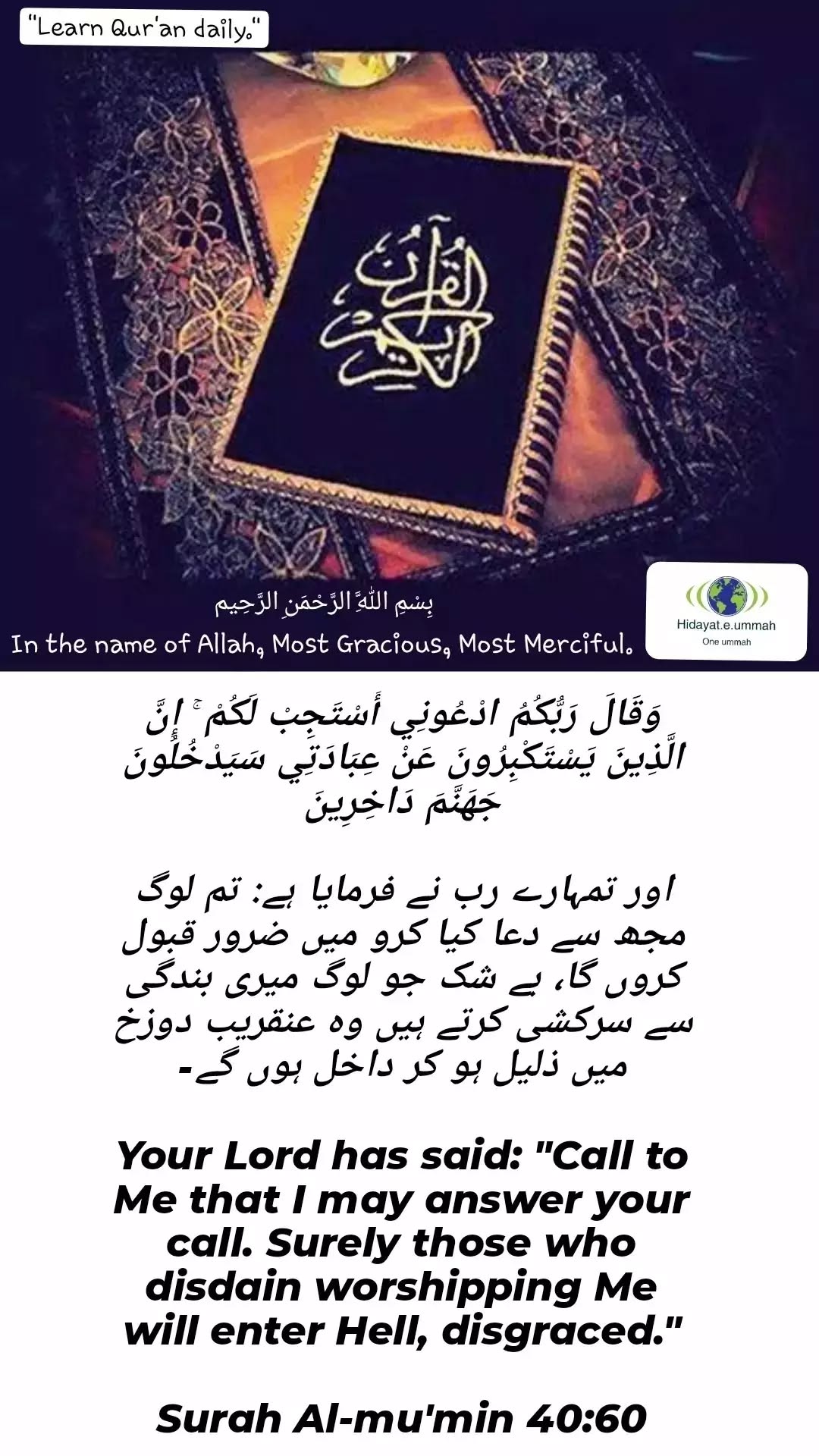
Surah Al-Mu'min 40:60
**Translation:**
_Your Lord has said: 'Call upon Me, and I will respond to you. Indeed, those who are too proud to worship Me will enter Hell in humiliation.'_
**Explanation:**
This verse emphasizes the importance of supplicating to Allah and affirms His promise to answer the prayers of His servants.
**Key Points:**
1. **Command to Supplicate:**
- Allah encourages His servants to turn to Him in prayer, expressing their needs and seeking guidance.
2. **Promise of Response:**
- Allah assures that He will respond to the sincere calls of those who seek His help.
3. **Warning Against Arrogance:**
- Those who refuse to worship Allah out of arrogance or heedlessness are warned of a humiliating punishment in Hell.
**Key Lessons:**
- Dua (supplication) is a form of worship and a means to build a stronger connection with Allah.
- Believers are encouraged to never hesitate in seeking Allah’s help and forgiveness.
- Pride and arrogance that prevent people from acknowledging Allah's authority are condemned.
**Practical Reflection:**
- Make dua part of your daily routine, even for the smallest matters.
- Approach Allah with humility, acknowledging your dependence on Him.
- Avoid arrogance and always be grateful for Allah's blessings.
Hadith 4
4 of 68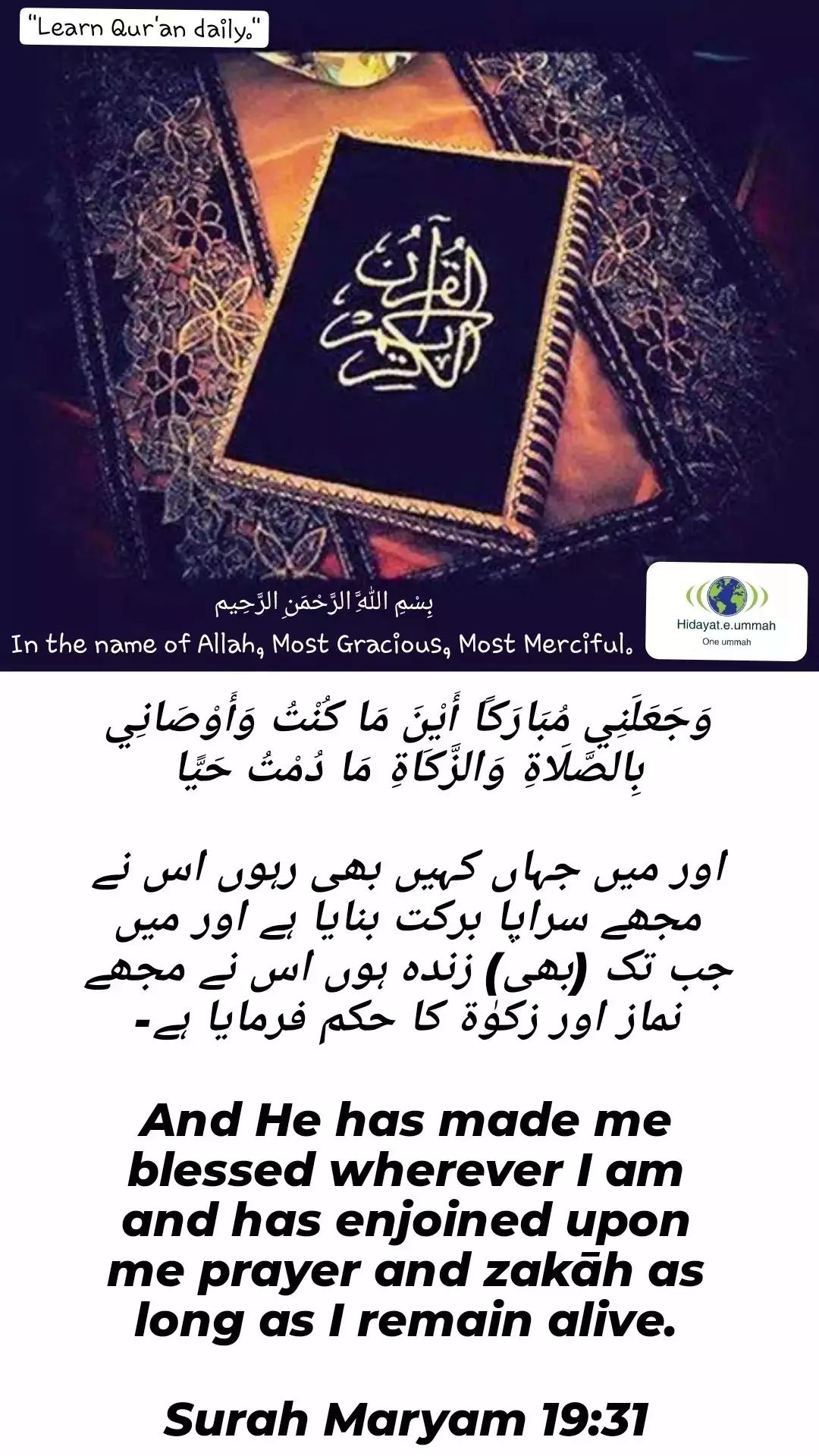
Surah Maryam 19:31
**Translation:**
_And He has made me blessed wherever I am and enjoined upon me prayer and zakah (charity) as long as I live._
**Explanation:**
This verse speaks about the words of Prophet Isa (Jesus, peace be upon him) as he describes the responsibilities given to him by Allah.
**Key Points:**
1. **Blessed Presence:**
- Being blessed means being a source of goodness, positivity, and guidance for others wherever one goes.
2. **Obligations of Prayer and Zakah:**
- Isa (AS) highlights that devotion to Allah through prayer and supporting others through zakah are lifelong obligations.
3. **Lifelong Devotion:**
- The verse emphasizes the importance of maintaining acts of worship until the very end of one’s life.
**Key Lessons:**
- True blessing lies in being beneficial to others and living a righteous life.
- Prayer connects us to Allah and strengthens our faith.
- Zakah (charity) promotes compassion and social responsibility.
**Practical Reflection:**
- Strive to be a positive influence in your community.
- Uphold prayer and contribute to society through acts of charity.
- Recognize that spiritual responsibilities are lifelong commitments.
Hadith 5
5 of 68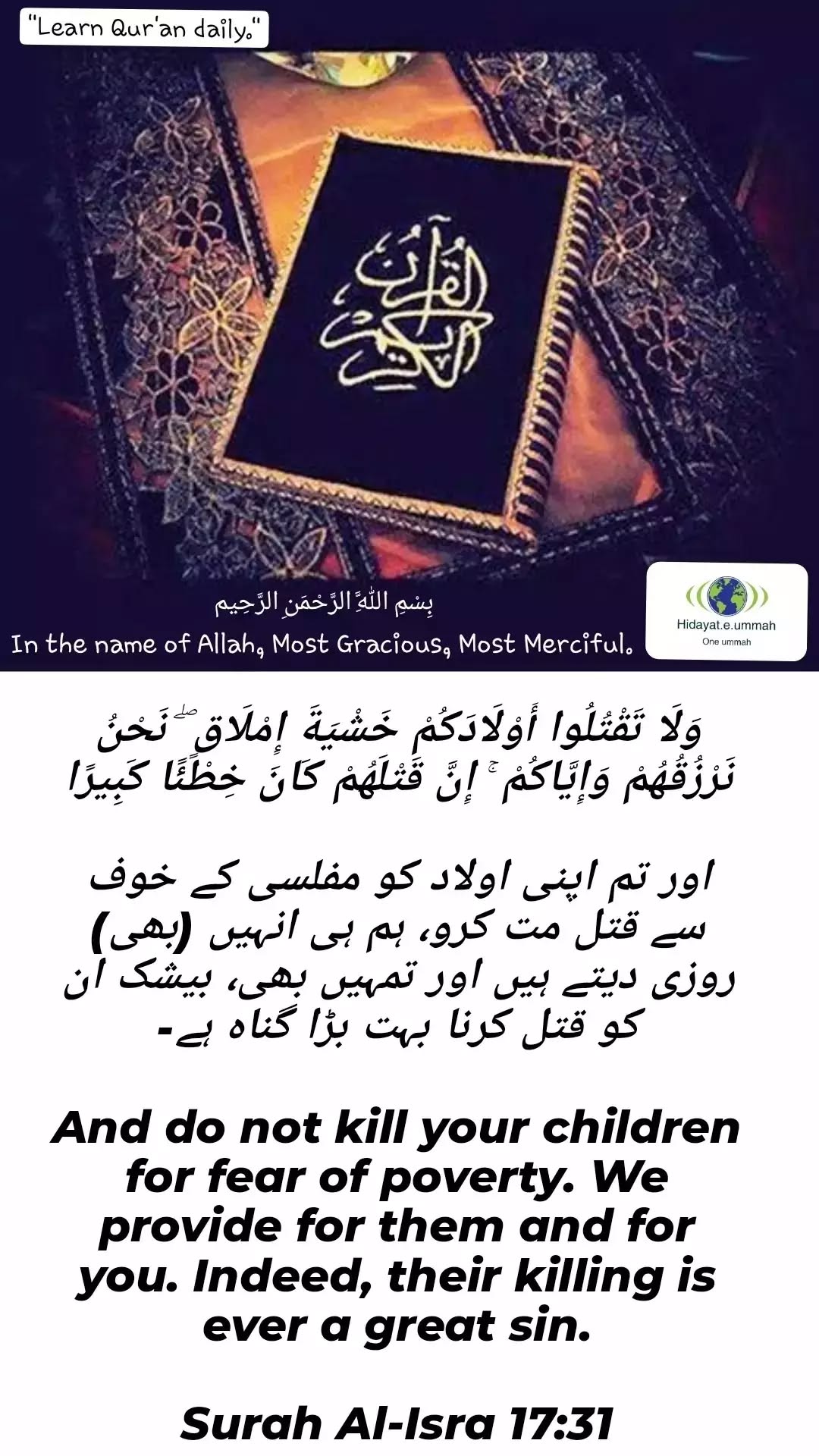
Surah Al-Isra 17:31
**Translation:**
_And do not kill your children for fear of poverty. We provide for them and for you. Indeed, their killing is ever a great sin._
**Explanation:**
This verse firmly condemns the practice of killing children due to fear of financial difficulties. It reflects Allah's assurance of provision and highlights the sanctity of life.
**Key Points:**
1. **Prohibition of Infanticide:**
- Historically, some pre-Islamic societies practiced the killing of children, especially daughters, due to economic concerns.
- Islam abolished this cruel practice, asserting that Allah is the Sustainer.
2. **Divine Provision:**
- Allah reminds us that He provides sustenance not only for parents but also for their children.
3. **The Sanctity of Life:**
- Taking an innocent life is deemed a grievous sin in Islam.
**Key Lessons:**
- Trust in Allah's provision and mercy.
- Value and protect all forms of life, including vulnerable children.
- Avoid making life decisions based on fear or worldly concerns.
**Practical Reflection:**
- Show compassion and support to families facing financial difficulties.
- Raise awareness about the importance of valuing and protecting children's lives.
- Rely on Allah's promise of provision while striving for lawful means of sustenance.
Hadith 6
6 of 68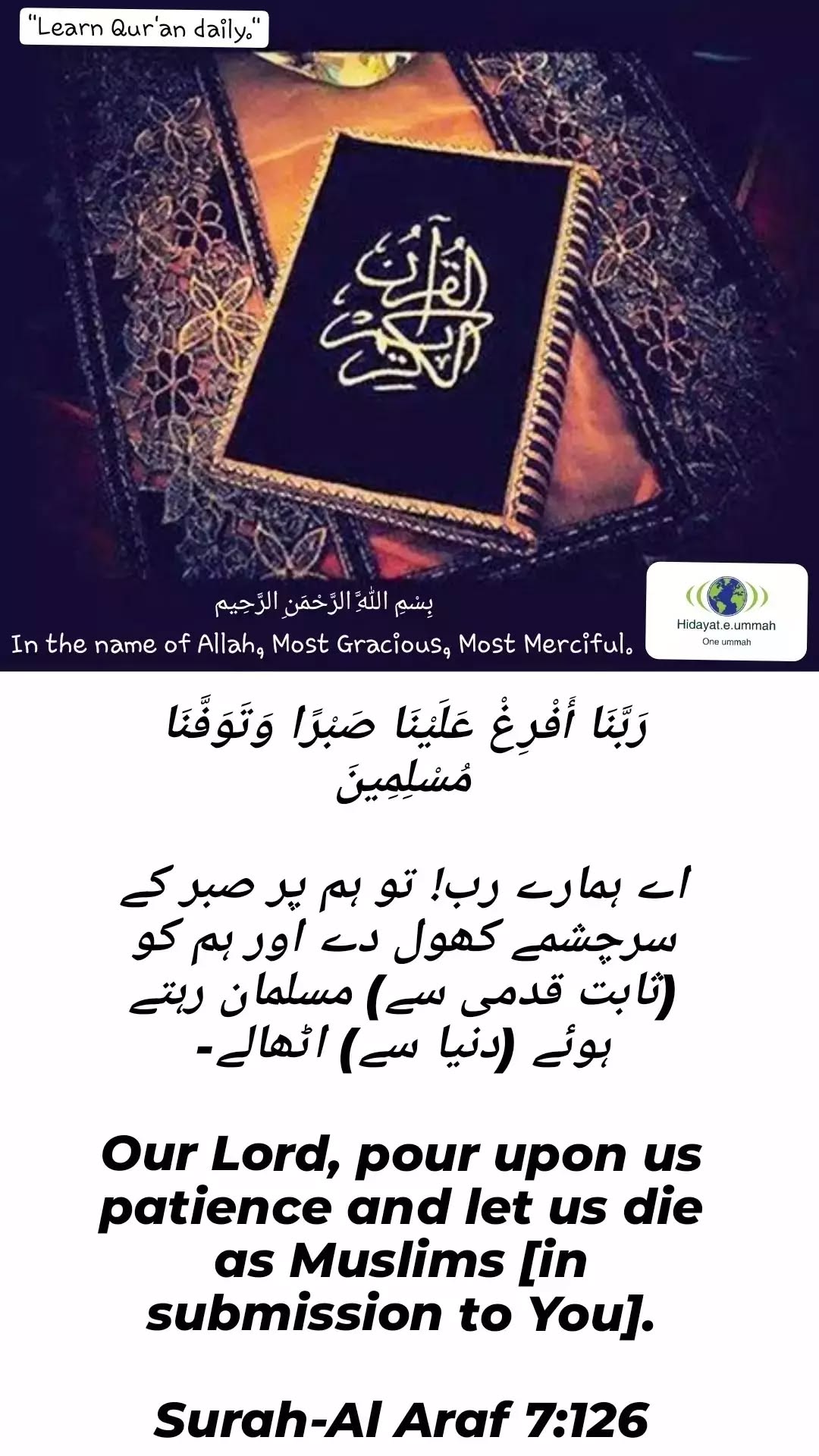
Surah Al-A'raf 7:126
**Translation:**
_Our Lord, pour upon us patience and let us die as Muslims [in submission to You]._
**Explanation:**
This verse captures a powerful supplication made by the magicians who believed in Prophet Musa (Moses, peace be upon him) after witnessing his truthfulness. Despite the threats from Pharaoh, they chose faith over worldly safety.
**Key Points:**
1. **Seeking Patience:**
- Patience (Sabr) is essential during times of trials and challenges.
- The believers ask Allah to grant them steadfastness in facing adversity.
2. **Desiring a Righteous End:**
- Dying as a Muslim is regarded as a great blessing.
- This supplication reflects the importance of maintaining faith until the last moment.
3. **Complete Submission:**
- The magicians' transformation from disbelief to sincere submission demonstrates the power of Allah's guidance.
**Key Lessons:**
- Always seek Allah’s help to remain patient during hardships.
- Prioritize maintaining and strengthening faith above all else.
- Make du'as (supplications) for a righteous death.
**Practical Reflection:**
- Recite and reflect upon this supplication during personal prayers.
- Encourage others to seek patience and trust in Allah during difficult times.
- Strengthen your relationship with Allah by continuously striving to submit to His will.
Hadith 7
7 of 68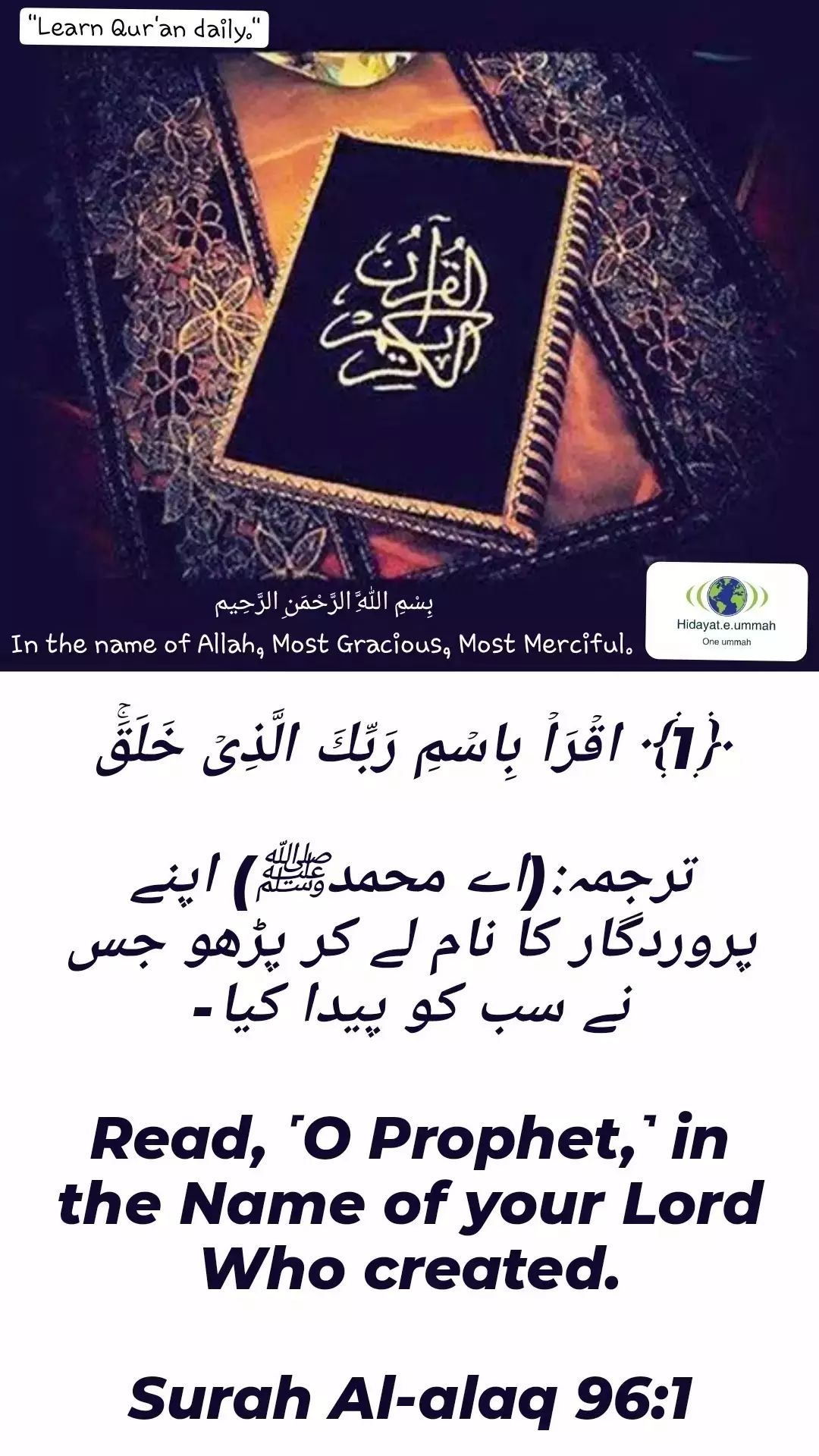
Surah Al-'Alaq 96:1
**Translation:**
_Read, [O Prophet], in the Name of your Lord Who created._
**Explanation:**
This is the first verse revealed to Prophet Muhammad (peace be upon him) through Angel Jibreel (Gabriel) in the Cave of Hira. It marks the beginning of prophethood and emphasizes the importance of knowledge.
**Key Points:**
1. **The Command to Read:**
- Despite being unlettered, the Prophet ( SAW Peace be upon him) was commanded to read.
- This highlights the significance of divine guidance over worldly abilities.
2. **In the Name of the Lord:**
- Knowledge should be pursued with the recognition of Allah's supremacy and blessings.
- True learning connects one to the Creator.
3. **Allah as the Creator:**
- The verse reminds us that Allah is the Creator of all existence, underscoring His unmatched power and authority.
**Key Lessons:**
- Seeking knowledge is a noble act and encouraged in Islam.
- Always begin tasks with Allah's Name for success and blessings.
- Knowledge should lead to humility and recognition of Allah’s greatness.
**Practical Reflection:**
- Develop a habit of saying “Bismillah” (In the Name of Allah) before starting anything important.
- Seek both religious and worldly knowledge while maintaining gratitude toward Allah.
- Encourage a culture of learning and enlightenment in the community.
Hadith 8
8 of 68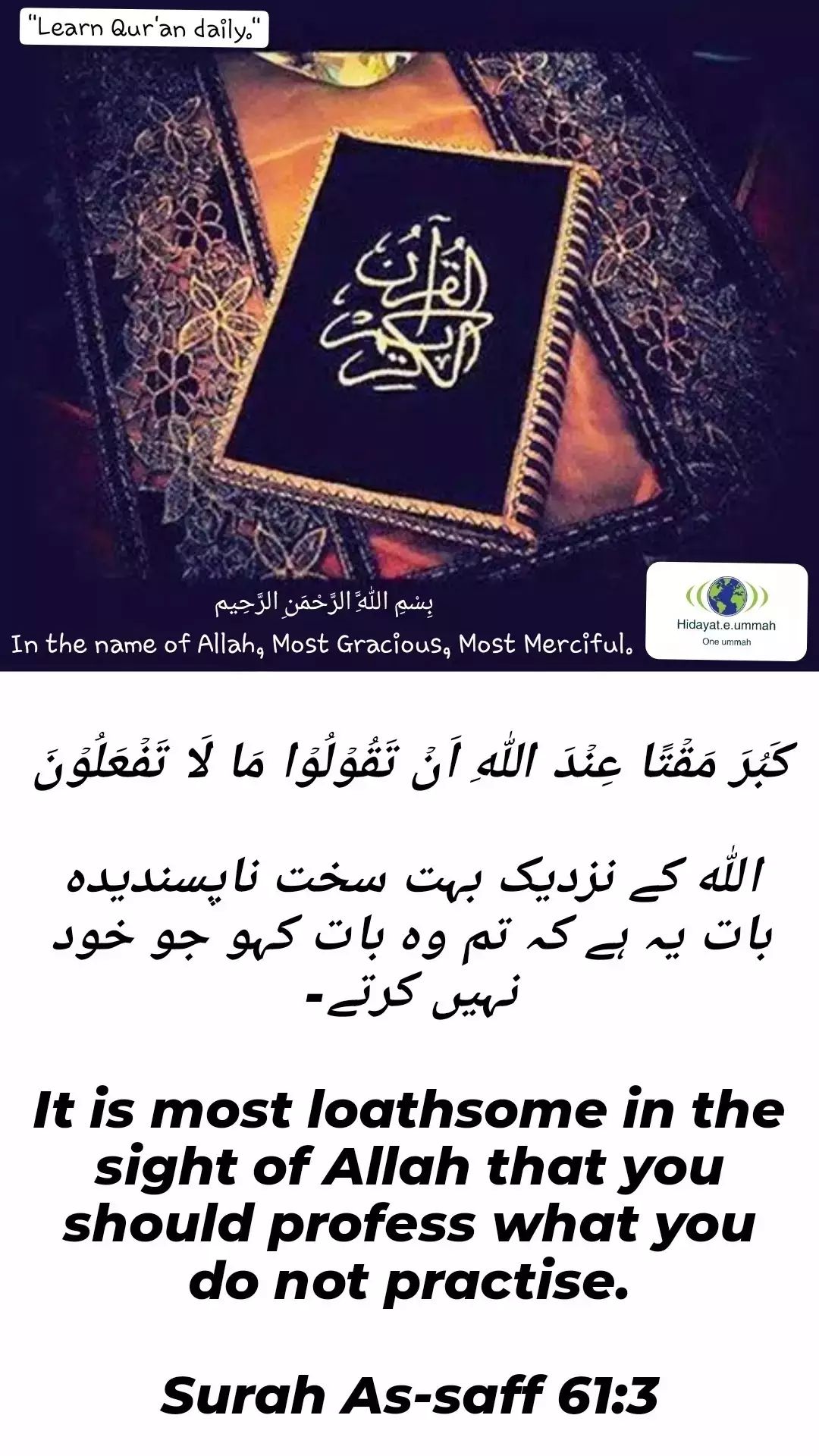
Surah As-Saff 61:3
**Translation:**
_It is most loathsome in the sight of Allah that you should profess what you do not practice._
**Explanation:**
This verse is a strong admonition against hypocrisy and insincerity. Allah dislikes when individuals claim righteousness or make promises yet fail to follow through in their actions.
**Key Points:**
1. **Condemnation of Hypocrisy:**
- The verse emphasizes that actions must align with words.
- False claims without sincerity undermine moral integrity.
2. **Accountability in Speech and Deeds:**
- Islam values sincerity and consistency.
- Believers are encouraged to fulfill their promises and commitments.
3. **A Call for Integrity:**
- Leaders and those in positions of influence must embody what they teach or preach.
- Practicing what one preaches is a hallmark of true faith.
**Key Lessons:**
- Avoid making claims that you cannot fulfill.
- Practice sincerity in worship, relationships, and daily conduct.
- Strive to embody Islamic values rather than merely speaking about them.
**Practical Reflection:**
- Conduct regular self-reflection to ensure that your actions align with your words.
- Seek forgiveness from Allah when you fall short and make sincere efforts to improve.
- Encourage honest communication and responsibility within your family and community.
Hadith 9
9 of 68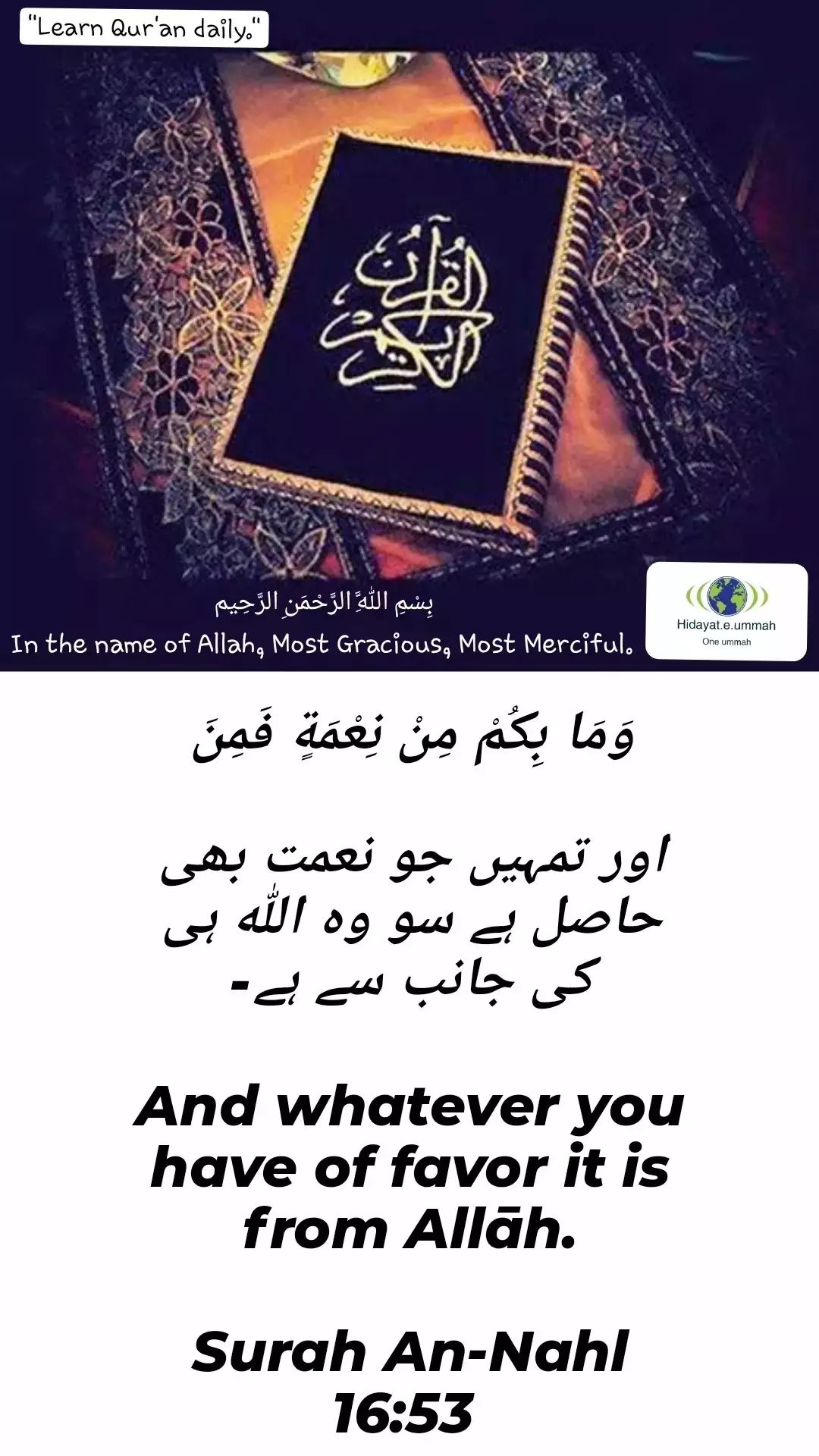
Surah An-Nahl 16:53
**Translation:**
_And whatever you have of favor, it is from Allah._
**Explanation:**
This verse reminds believers that every blessing, privilege, and success they enjoy originates from Allah alone. It calls for gratitude and humility.
**Key Points:**
1. **Source of Blessings:**
- Everything good—wealth, health, knowledge, or peace—is a direct favor from Allah.
- People are not the ultimate creators of their success; they are instruments through which Allah's decree unfolds.
2. **Encouragement to Be Grateful:**
- Acknowledging Allah as the source of all goodness fosters gratitude and contentment.
- Gratitude strengthens the relationship between the servant and the Creator.
3. **Counter to Arrogance:**
- The verse counters pride and arrogance that stem from assuming success is purely due to one’s own efforts.
**Key Lessons:**
- Recognize and thank Allah for every small and big blessing.
- Avoid attributing your achievements solely to yourself.
- Gratitude brings barakah (divine blessings) into life.
**Practical Reflection:**
- Keep a gratitude journal where you note Allah's favors each day.
- Say *Alhamdulillah* (All Praise is due to Allah) frequently.
- Use the favors granted to you to help and uplift others as a form of gratitude to Allah.
Hadith 10
10 of 68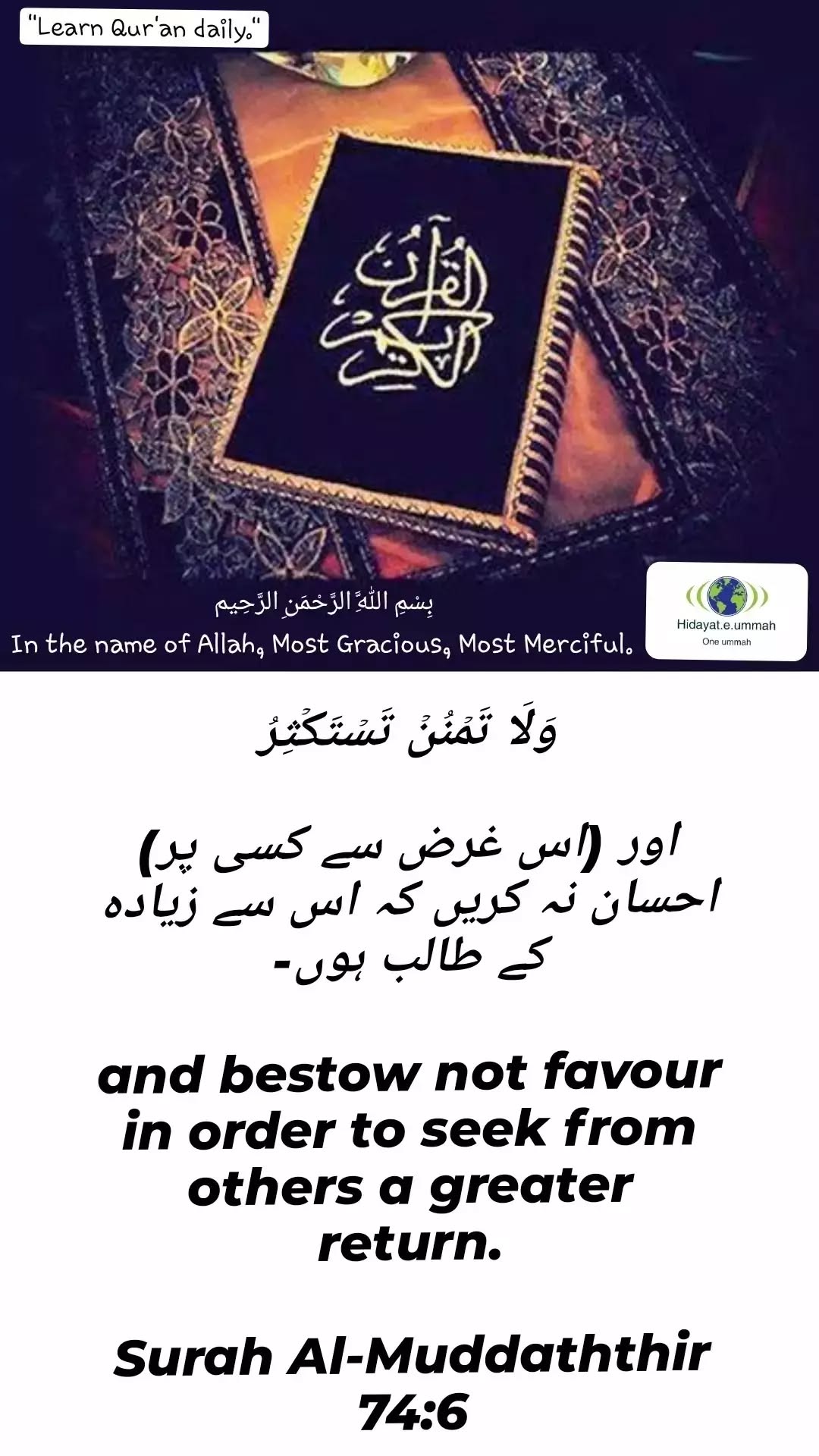
Surah Al-Muddaththir 74:6
**Translation:**
_And bestow not favor in order to seek from others a greater return._
**Explanation:**
This verse instructs believers to give sincerely for the sake of Allah, without ulterior motives such as expecting worldly gains, recognition, or reciprocation.
**Key Points:**
1. **Pure Intentions in Giving:**
- Acts of kindness, charity, or favor should not be transactional.
- The focus should be on seeking Allah’s pleasure rather than material benefits or personal gain.
2. **Sincerity in Worship:**
- Giving or helping with the sole intention of being noticed or rewarded undermines sincerity.
- True believers act selflessly, seeking only Allah’s reward.
3. **Cultivating a Humble Heart:**
- This verse encourages humility by teaching that kindness should not breed entitlement or expectations.
- A Muslim should find contentment in Allah’s blessings rather than seeking worldly compensation.
**Key Lessons:**
- Give with sincerity for the sake of Allah, without hidden intentions.
- Avoid boasting about your kindness or seeking praise.
- Trust that Allah will reward your deeds, even if people do not.
**Practical Reflection:**
- Donate to charity anonymously whenever possible.
- Help someone in need without expecting a thank-you.
- Remind yourself daily that the ultimate reward comes from Allah, not people.
Hadith 11
11 of 68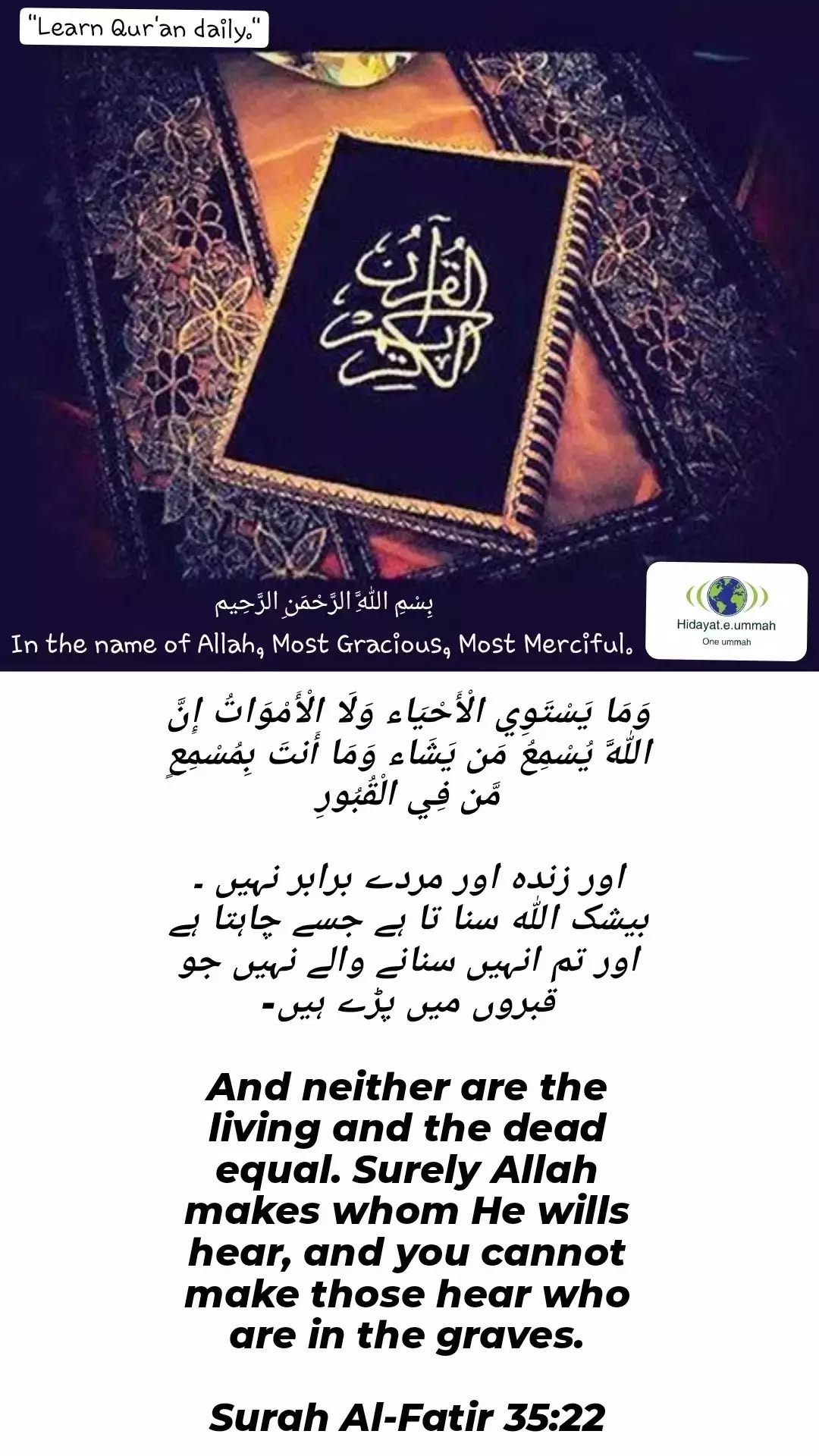
Surah Al-Fatir 35:22
**Translation:**
_And neither are the living and the dead equal. Surely Allah makes whom He wills hear, and you cannot make those hear who are in the graves._
**Explanation:**
This verse highlights the distinction between the living and the dead, illustrating that while the living can hear and understand, the dead are not able to respond. It emphasizes that Allah has control over whom He allows to hear and understand the message, and humans cannot force someone to hear the truth if Allah has not permitted it.
**Key Points:**
1. **The Power of Allah's Will:**
- Allah decides who will hear the message of truth and guidance, whether alive or dead.
- Human efforts cannot force someone to understand or accept the message unless Allah wills it.
2. **Living vs Dead:**
- The verse contrasts the abilities of the living to perceive and understand with the inability of the dead to do so.
- It metaphorically points to spiritual deafness, where some people, though alive, may not respond to guidance due to their hearts being closed.
3. **Limitations of Human Ability:**
- Humans cannot control the hearts and minds of others; it is Allah who guides whom He wills.
- The verse encourages believers to focus on their own faith and trust in Allah’s power to guide others.
**Key Lessons:**
- Accept that Allah's will is supreme, and that guidance is in His hands.
- Do not despair if others do not accept the message of Islam, as it is not in your control.
- Be mindful of the spiritual state of others, understanding that guidance is a gift from Allah.
**Practical Reflection:**
- Be patient and gentle in inviting others to Islam, knowing that guidance is ultimately up to Allah.
- Strengthen your own faith and be thankful for the guidance you have received from Allah.
Hadith 12
12 of 68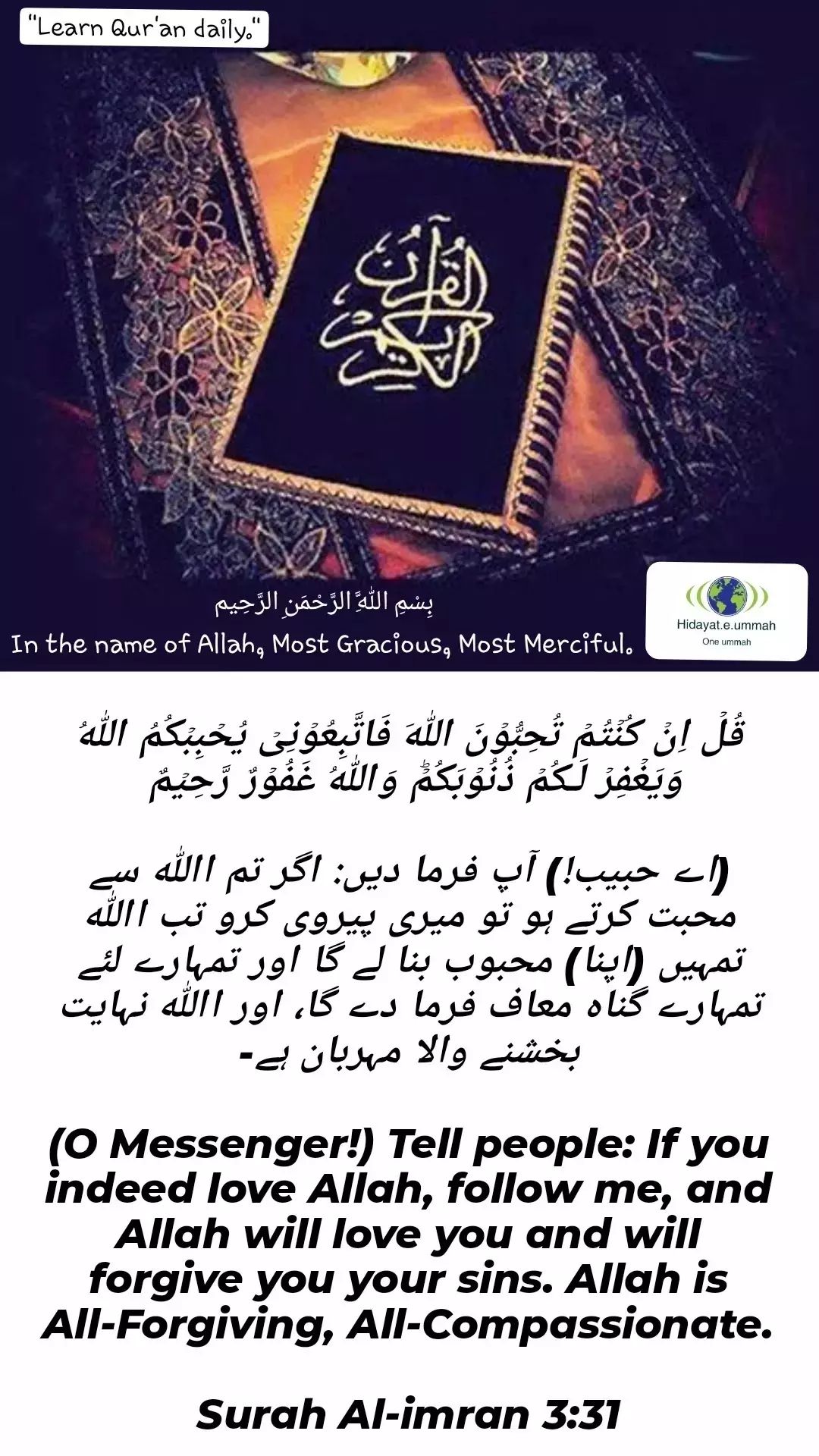
Surah Al-Imran 3:31
**Translation:**
_(O Messenger!) Tell people: If you indeed love Allah, follow me, and Allah will love you and will forgive you your sins. Allah is All-Forgiving, All-Compassionate._
**Explanation:**
This verse calls people to show their love for Allah by following the example of Prophet Muhammad (PBUH). It emphasizes that true love for Allah is demonstrated through obedience to His guidance as conveyed by His Messenger. By following the Prophet, one earns Allah's love, forgiveness, and mercy, as He is always ready to pardon those who sincerely repent.
**Key Points:**
1. **True Love for Allah:**
- Loving Allah is not just an emotion but is proven through actions, particularly by following the teachings of the Prophet Muhammad (PBUH).
- Love for Allah should reflect in obedience to His commands and emulating the Prophet’s way of life.
2. **Following the Prophet Muhammad (PBUH):**
- The verse makes it clear that following the Prophet is a key condition for receiving Allah's love and forgiveness.
- The Prophet's life and teachings serve as a guide for Muslims in their daily lives.
3. **Allah’s Mercy:**
- Allah’s love is accompanied by forgiveness for sins, showing that His mercy is vast and encompassing.
- No matter the sin, Allah’s forgiveness is always available to those who sincerely repent and seek His mercy.
**Key Lessons:**
- To truly love Allah, one must follow the teachings and example of Prophet Muhammad (PBUH).
- Trust in Allah’s boundless mercy and forgiveness, knowing that He is ready to pardon sincere believers.
- Strengthen your relationship with Allah by aligning your actions with the guidance of the Prophet.
**Practical Reflection:**
- Review your daily actions and see if they reflect the teachings of the Prophet Muhammad (PBUH).
- Seek forgiveness regularly, knowing that Allah is compassionate and forgiving.
- Share the teachings of the Prophet with others to help them follow the right path.
Hadith 13
13 of 68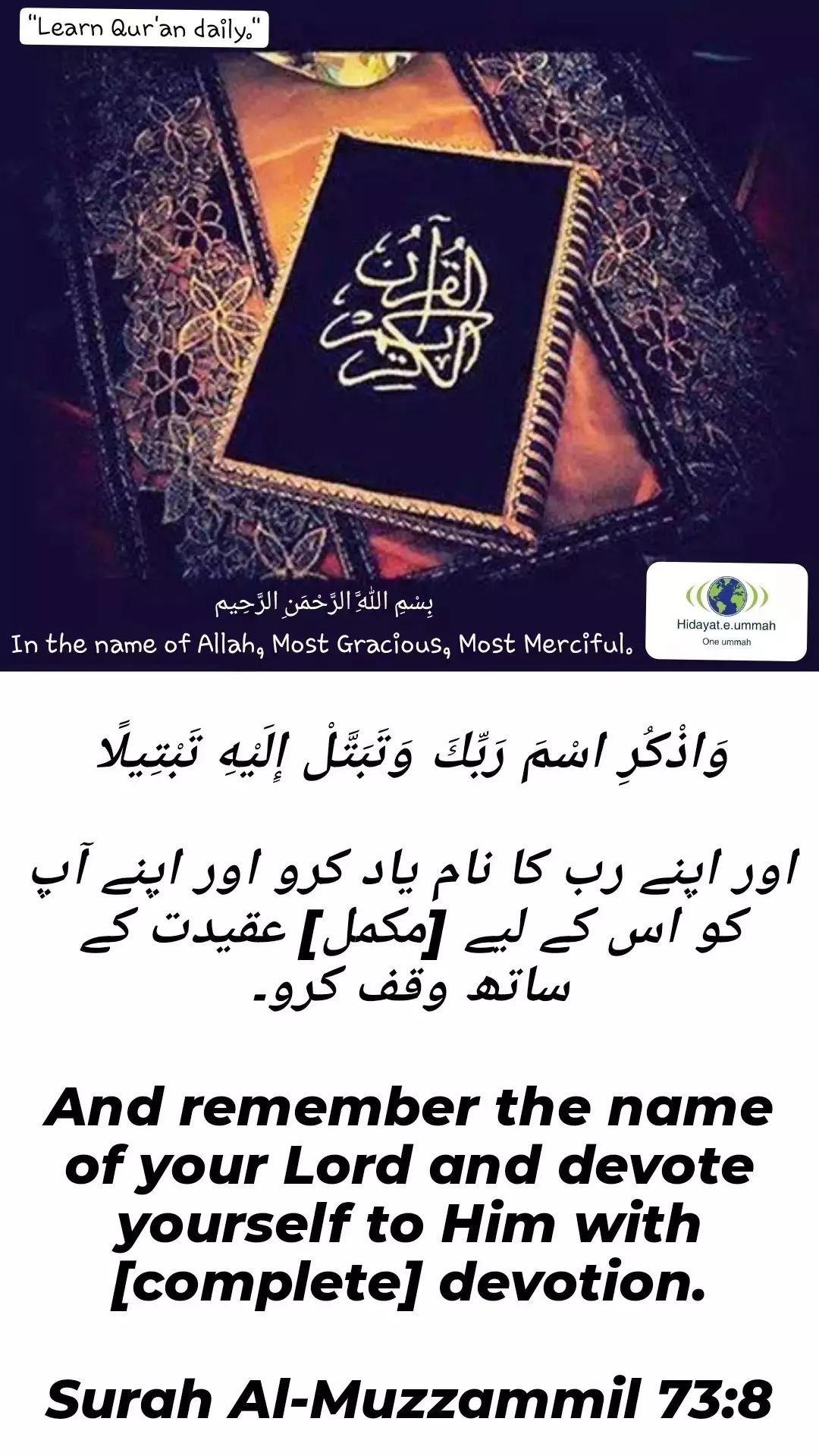
Surah Al-Muzzammil 73:8
**Translation:**
_And remember the name of your Lord and devote yourself to Him with complete devotion._
**Explanation:**
This verse emphasizes the importance of remembering Allah and dedicating yourself fully to Him. It encourages sincerity and focus in worship and devotion to Allah alone.
**Key Points:**
1. **Constant Remembrance of Allah:**
- Keep Allah’s name on your lips and in your heart.
2. **Complete Devotion:**
- Devote your actions, time, and life to pleasing Allah.
**Key Lessons:**
- Make remembrance of Allah a daily habit.
- Ensure that your worship is sincere and for Allah alone.
**Practical Reflection:**
- Take moments throughout the day to remember Allah through prayer or reflection.
Hadith 14
14 of 68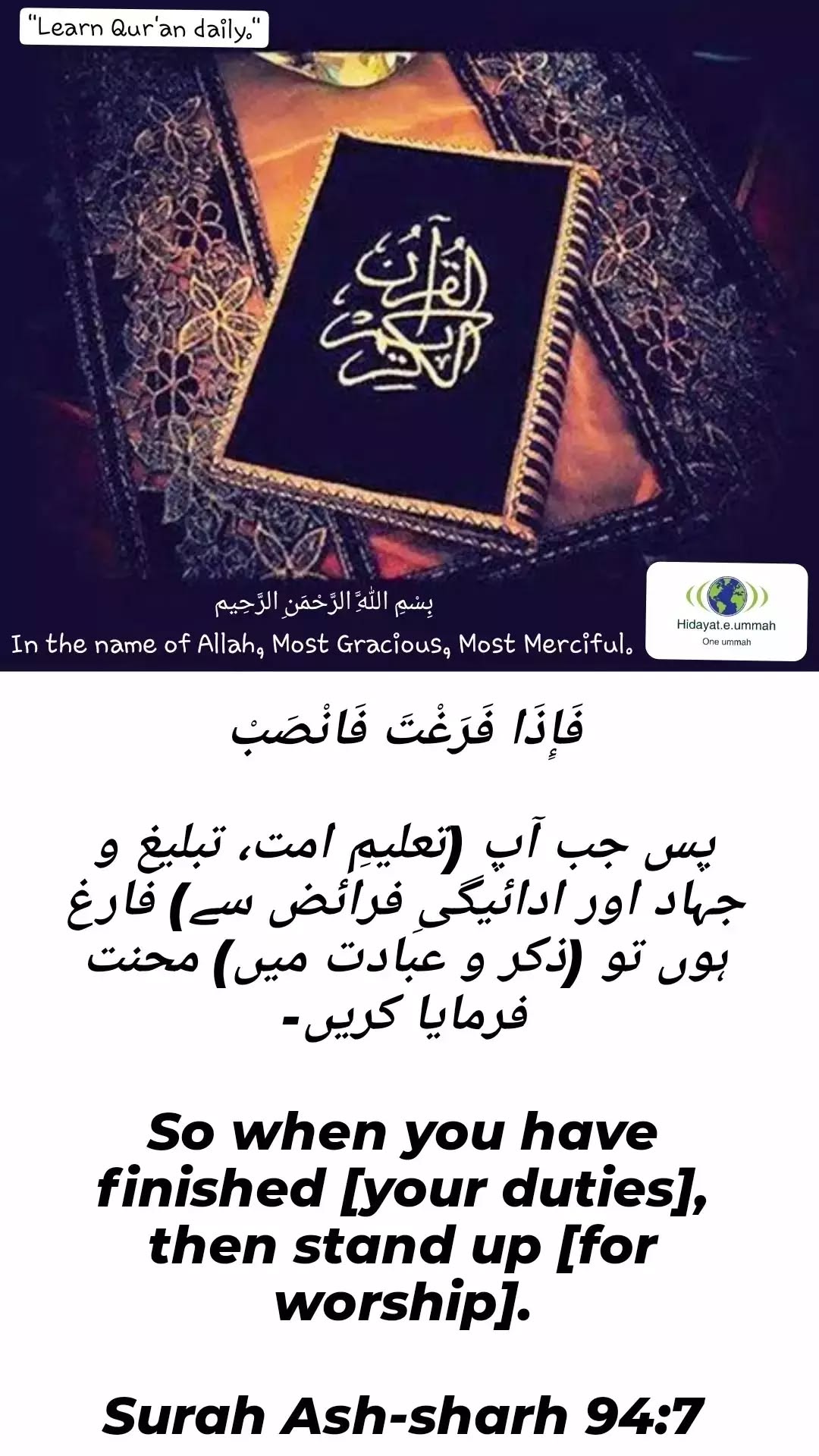
Surah Ash-Sharh 94:7
**Translation:**
_So when you have finished your duties, then stand up [for worship]._
**Explanation:**
This verse reminds us to prioritize worship after completing our daily tasks. It teaches that after fulfilling our worldly responsibilities, we should turn to Allah in devotion.
**Key Points:**
1. **Balance Between Duties and Worship:**
- Complete your daily tasks, then dedicate time for prayer and worship.
2. **Worship is a Priority:**
- Even after work, make time for connecting with Allah.
**Key Lessons:**
- Keep a balance between worldly responsibilities and spiritual duties.
- Make worship a regular part of your routine.
**Practical Reflection:**
- Set aside time for prayer after completing your work or daily activities.
Hadith 15
15 of 68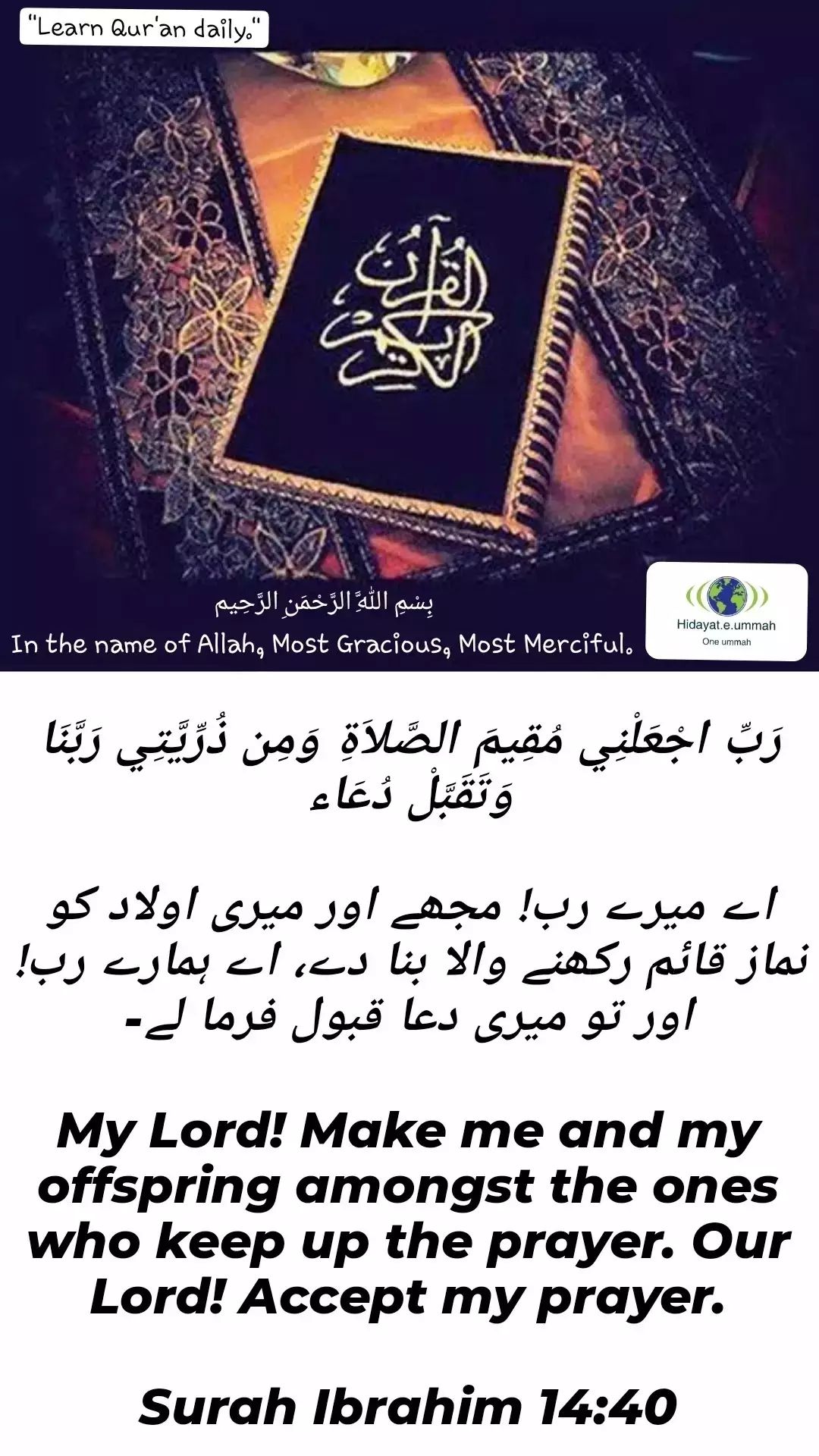
Surah Ibrahim 14:40
**Translation:**
_My Lord! Make me and my offspring amongst the ones who keep up the prayer. Our Lord! Accept my prayer._
**Explanation:**
This verse is a heartfelt supplication made by Prophet Ibrahim (Abraham), asking Allah to make him and his descendants among those who establish regular prayers. It also emphasizes the importance of asking Allah to accept one's prayers and efforts.
**Key Points:**
1. **Prayer as a Key Priority:**
- The verse highlights the significance of regular prayer (Salah) for both oneself and future generations.
2. **Asking for Acceptance:**
- It teaches the importance of seeking Allah’s acceptance in our worship and efforts.
**Key Lessons:**
- Pray for guidance and for your children to be committed to worship.
- Always seek Allah’s approval and acceptance in all your prayers.
**Practical Reflection:**
- Regularly pray for your family’s guidance and commitment to worship.
- Ask Allah to accept your prayers and efforts to strengthen your relationship with Him.
Hadith 16
16 of 68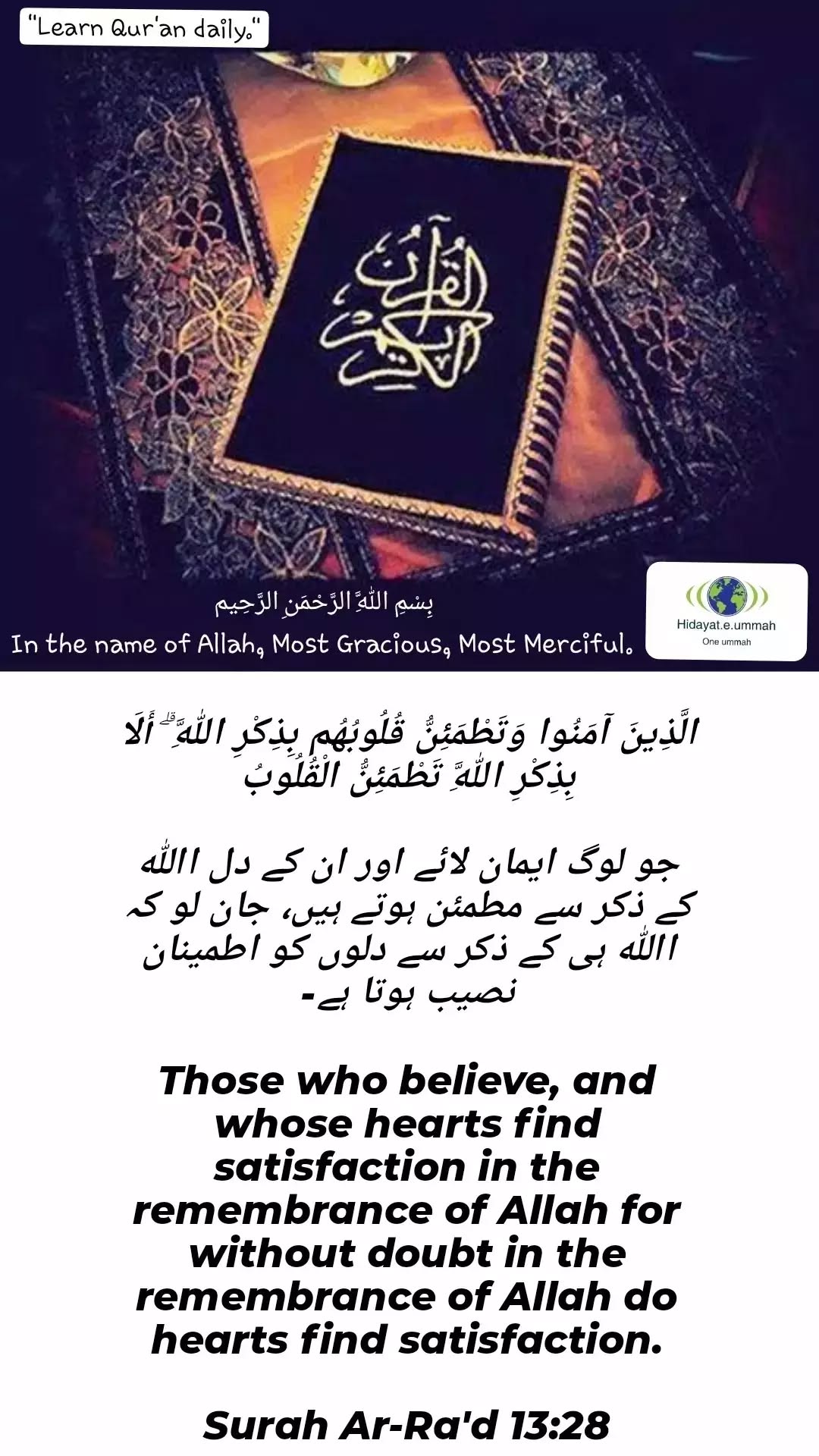
Surah Ar-Ra'd 13:28
**Translation:**
_Those who believe, and whose hearts find satisfaction in the remembrance of Allah. For without doubt, in the remembrance of Allah do hearts find satisfaction._
**Explanation:**
This verse emphasizes that true peace and contentment come from remembering Allah. It shows that belief in Allah and constant remembrance provide inner tranquility and fulfillment that nothing else can offer.
**Key Points:**
1. **Peace Through Remembrance:**
- True satisfaction and peace of mind are found in remembering Allah regularly.
2. **Spiritual Fulfillment:**
- Believers experience contentment when they make Allah’s remembrance a central part of their lives.
**Key Lessons:**
- Make time for Dhikr (remembrance of Allah) to calm and fulfill your heart.
- Trust that nothing in this world can provide lasting peace except through a connection with Allah.
**Practical Reflection:**
- Incorporate moments of remembrance of Allah into your daily routine, like saying SubhanAllah or Alhamdulillah
Hadith 17
17 of 68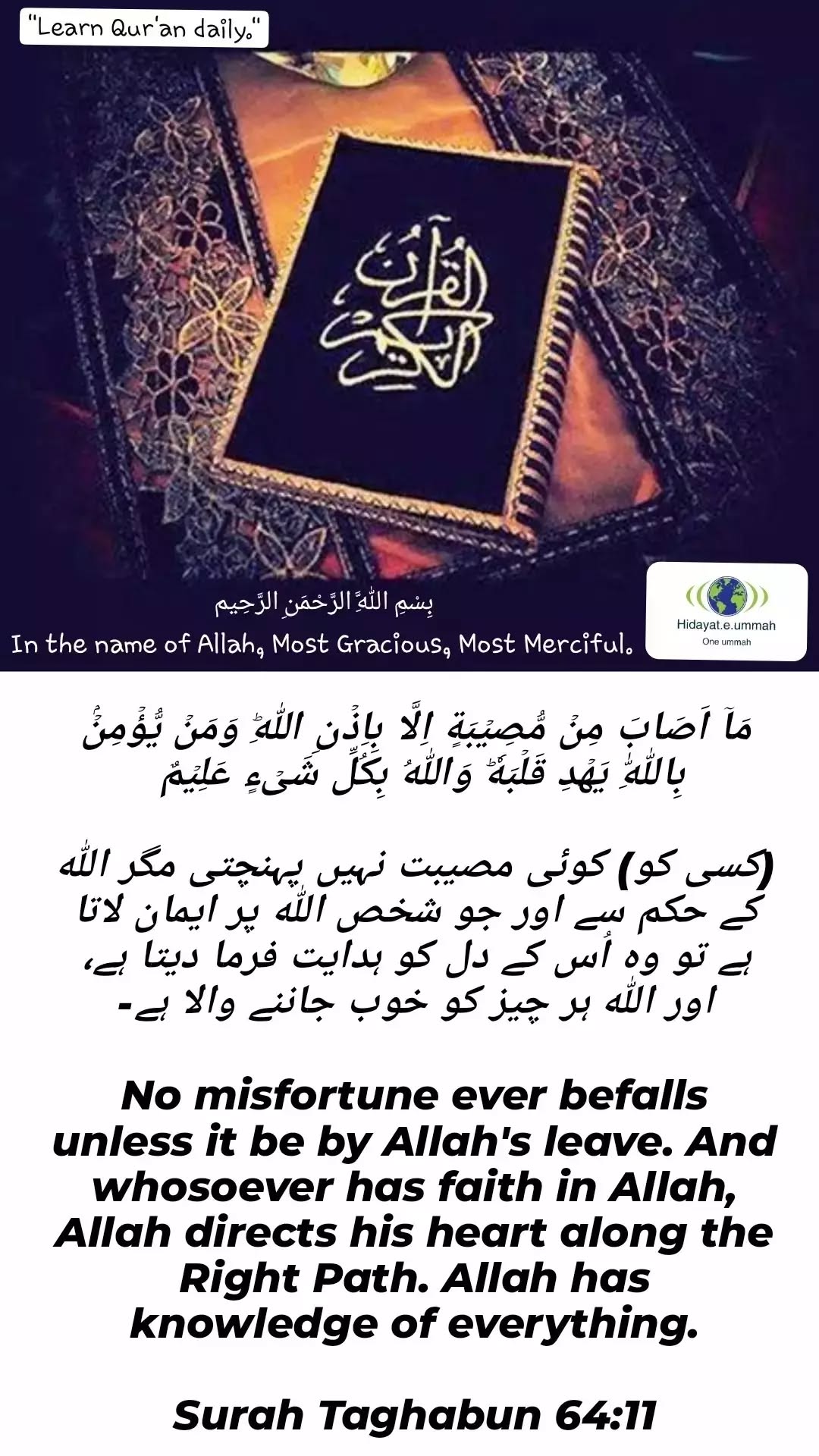
Surah At-Taghabun 64:11
**Translation:**
_No misfortune ever befalls unless it be by Allah's leave. And whosoever has faith in Allah, Allah directs his heart along the Right Path. Allah has knowledge of everything._
**Explanation:**
This verse reminds us that nothing happens without Allah’s permission, and all difficulties and misfortunes are part of His will. It assures that those who have faith in Allah will find guidance through life's trials. Allah’s knowledge encompasses everything, and He knows what is best for His creation.
**Key Points:**
1. **Divine Will:**
- Every misfortune or difficulty happens by Allah’s will, reminding us to trust in His plan.
2. **Guidance Through Faith:**
- Those who maintain faith in Allah will be guided to the right path, even during challenging times.
3. **Allah’s Infinite Knowledge:**
- Allah knows everything that happens, and His wisdom is beyond our understanding.
**Key Lessons:**
- Trust in Allah’s plan and know that every hardship has a purpose.
- Strengthen your faith to receive Allah’s guidance in every situation.
**Practical Reflection:**
- Reflect on how past hardships have guided you to grow stronger in your faith.
- During times of difficulty, remind yourself that Allah is in control and trust His plan.
Hadith 18
18 of 68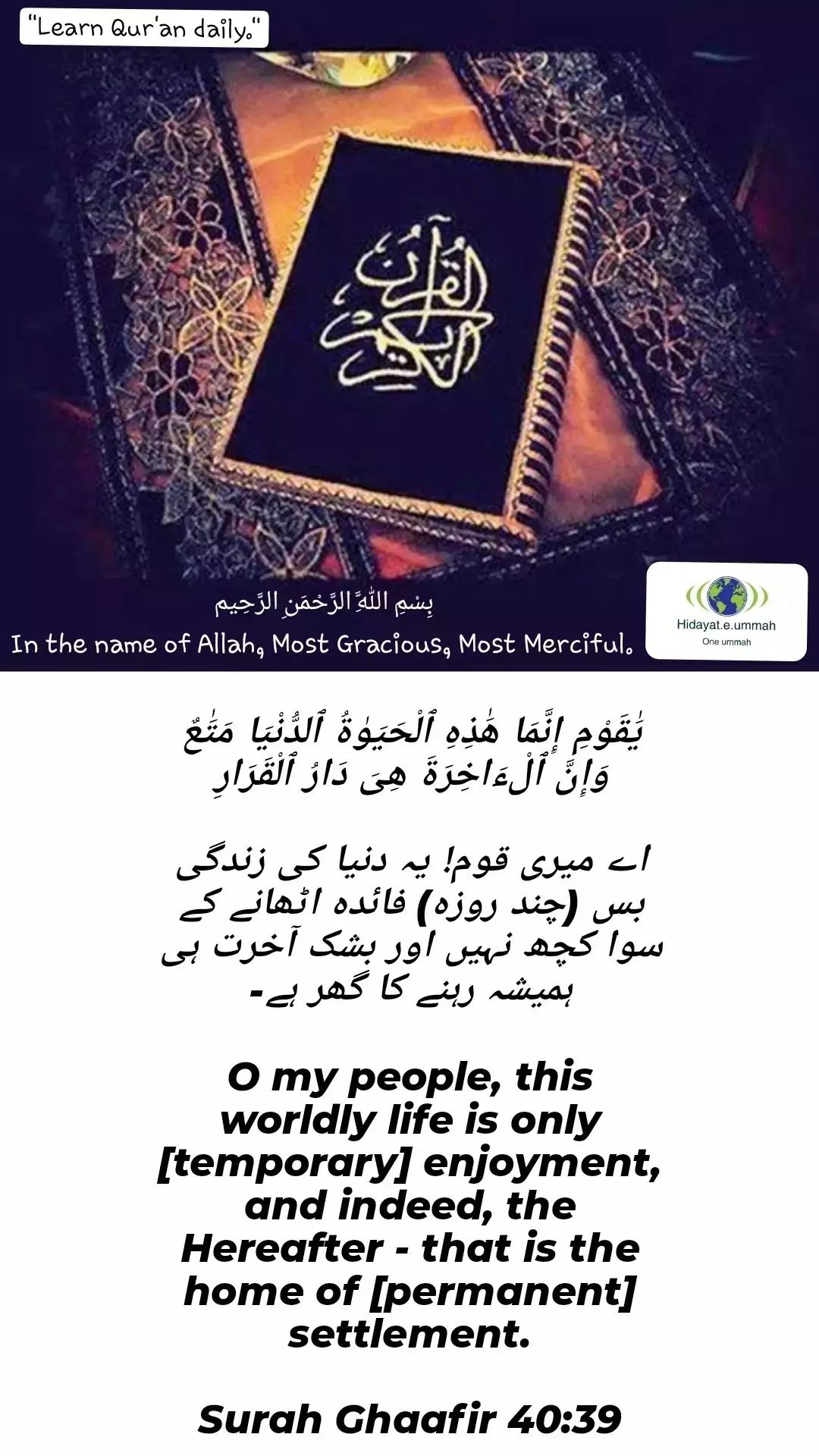
Surah Ghafir 40:39
**Translation:**
_O my people, this worldly life is only [temporary] enjoyment, and indeed, the Hereafter – that is the home of [permanent] settlement._
**Explanation:**
This verse reminds us that life in this world is temporary, and the true, everlasting home is in the Hereafter. It encourages prioritizing the eternal life over the fleeting pleasures of this world.
**Key Points:**
1. **Worldly Life is Temporary:**
- The joys and comforts of this world are short-lived.
2. **The Hereafter is Permanent:**
- True and lasting fulfillment is found in the Hereafter.
**Key Lessons:**
- Don’t get overly attached to worldly pleasures.
- Focus on preparing for the eternal life in the Hereafter.
**Practical Reflection:**
- Reflect on how you can prioritize your spiritual life and the Hereafter in your daily actions.
Hadith 19
19 of 68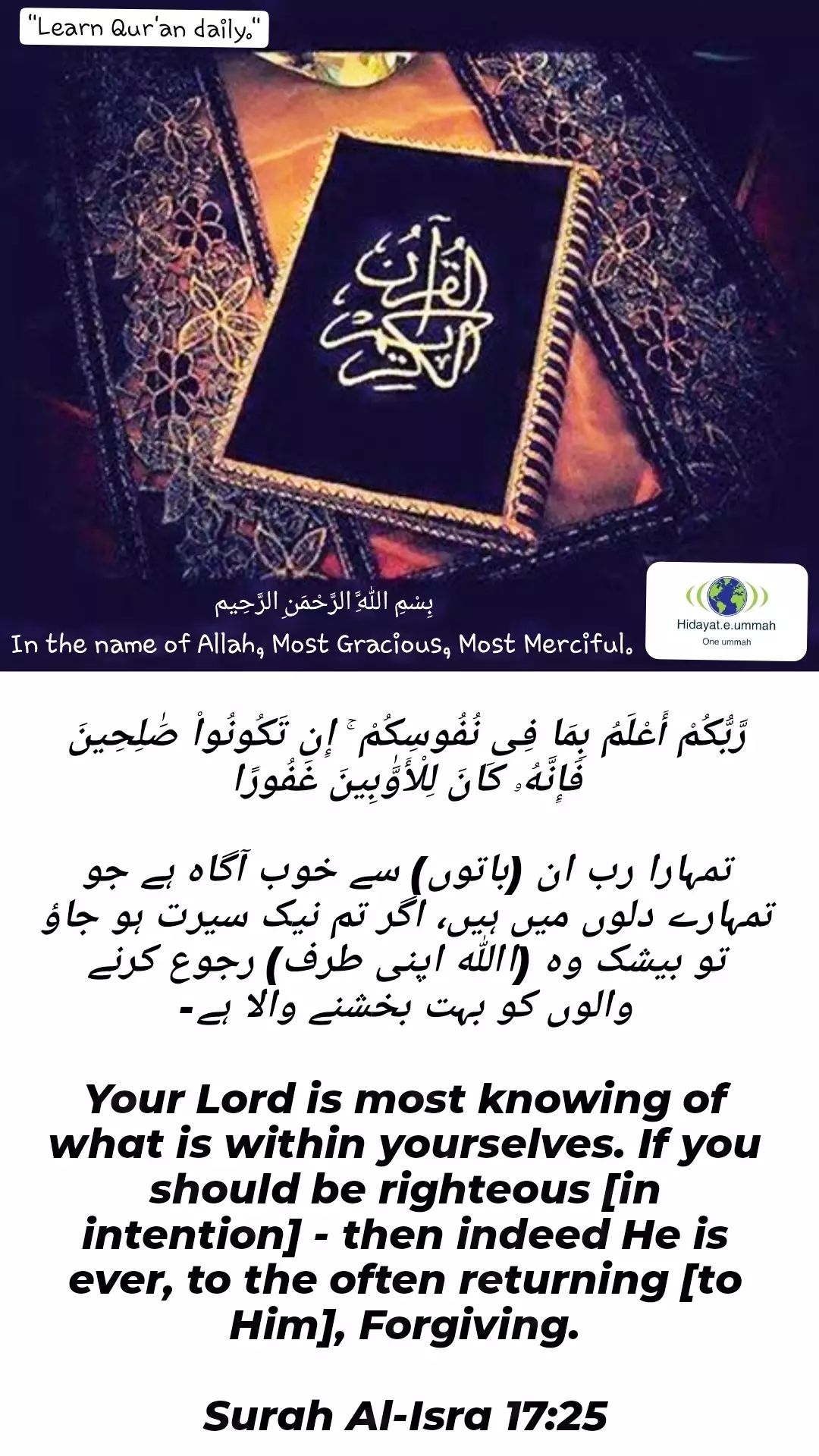
Surah Al-Isra 17:25
**Translation:**
_Your Lord is most knowing of what is within yourselves. If you should be righteous [in intention], then indeed He is ever, to the often returning [to Him], Forgiving._
**Explanation:**
This verse emphasizes that Allah knows what is in our hearts, including our intentions. If our intentions are sincere and we strive for righteousness, Allah, in His mercy, is always ready to forgive us when we turn to Him in repentance.
**Key Points:**
1. **Allah Knows Our Inner Intentions:**
- Allah understands what is in our hearts, even when others may not.
2. **Sincerity and Repentance:**
- If our intentions are pure, Allah will forgive us when we seek His forgiveness.
**Key Lessons:**
- Always aim for sincerity in your intentions and actions.
- Turn to Allah frequently in repentance, knowing He is forgiving.
**Practical Reflection:**
- Check your intentions before taking any action, making sure they are for Allah’s sake.
- Make repentance a regular habit, trusting in Allah's boundless mercy.
Hadith 20
20 of 68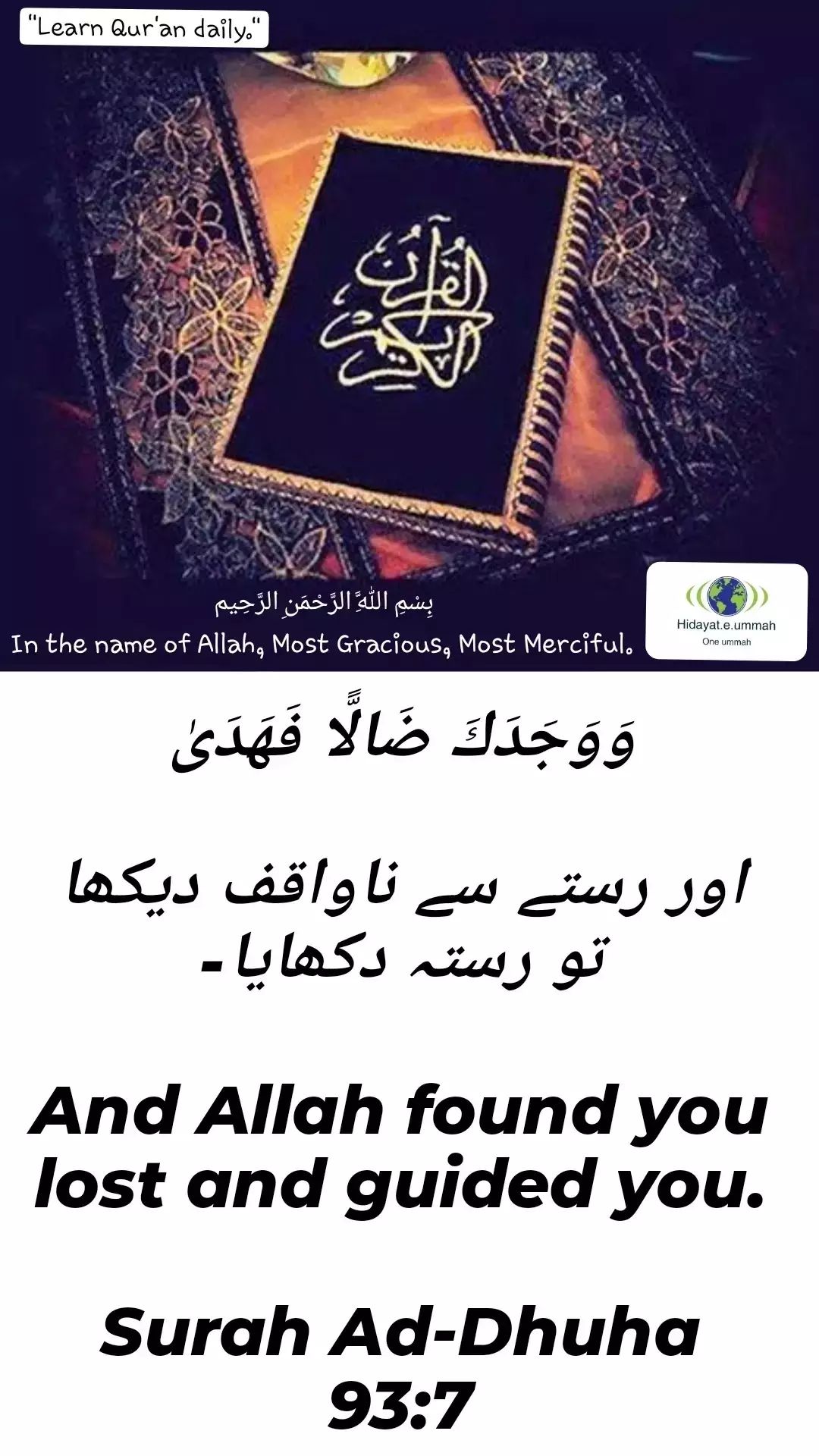
Surah Ad-Dhuha 93:7
**Translation:**
_And Allah found you lost and guided you._
**Explanation:**
This verse reminds us that Allah, in His mercy, guides us when we are lost, whether spiritually or in any part of life. It emphasizes the divine guidance that leads us to the right path.
**Key Points:**
1. **Divine Guidance:**
- Allah provides guidance to those who are lost or seeking direction.
2. **Gratitude for Allah's Guidance:**
- Acknowledge and be grateful for the guidance Allah has given you.
**Key Lessons:**
- Trust in Allah’s ability to guide you when you feel lost.
- Be thankful for the guidance you have received from Allah.
**Practical Reflection:**
- Reflect on moments in your life where Allah has guided you through difficult times.
Hadith 21
21 of 68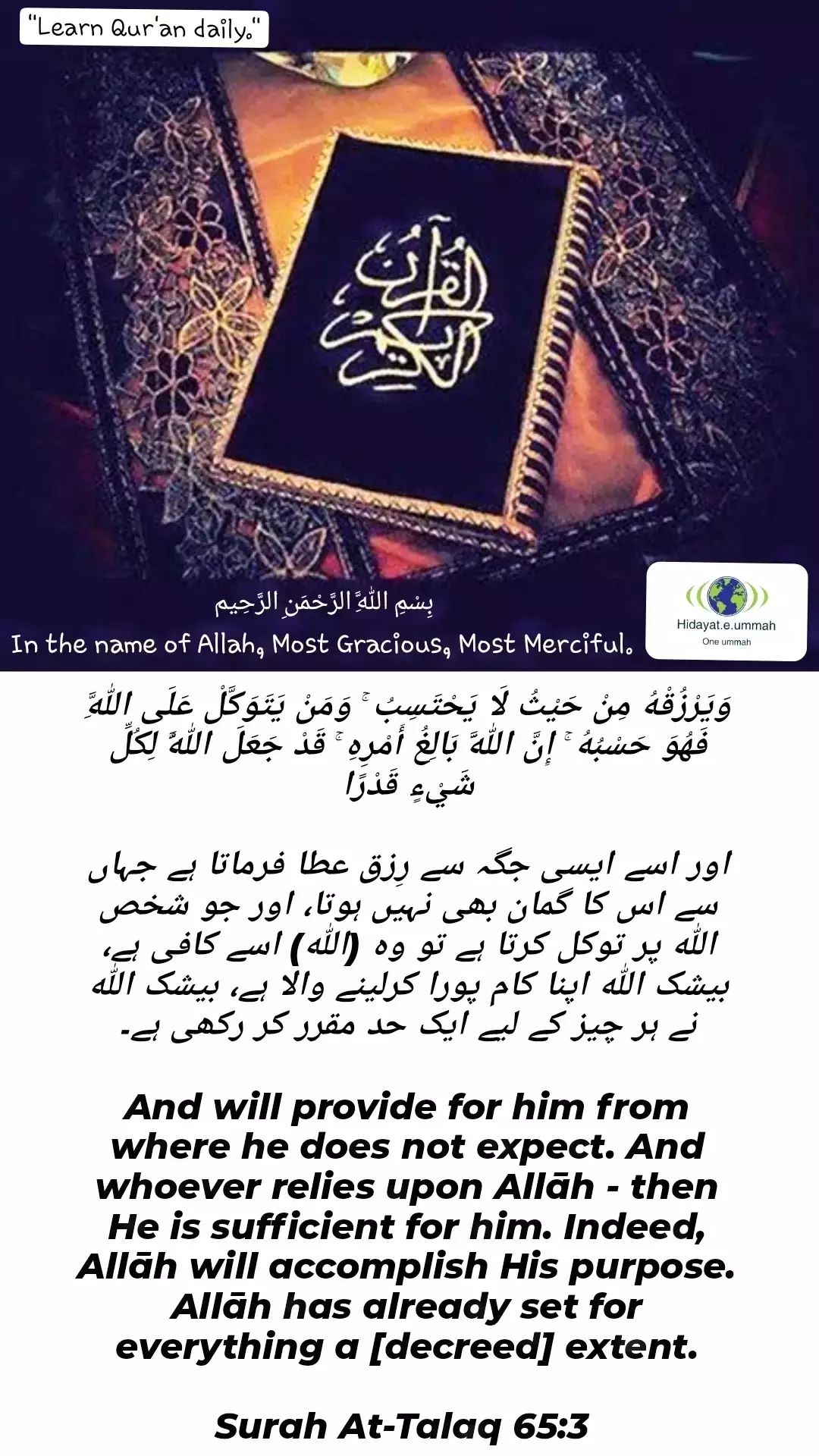
Surah At-Talaq 65:3
**Translation:**
_And will provide for him from where he does not expect. And whoever relies upon Allah - then He is sufficient for him. Indeed, Allah will accomplish His purpose. Allah has already set for everything a [decreed] extent._
**Explanation:**
This verse assures that if someone puts their full trust in Allah, He will provide for them in unexpected ways. Allah is sufficient for those who rely on Him, and His plan for everything is already set with divine wisdom.
**Key Points:**
1. **Unseen Provision:**
- Allah provides in ways we may not foresee, and His blessings are beyond our imagination.
2. **Reliance on Allah:**
- Trusting Allah and relying on Him brings peace and assurance that He will fulfill His plan for you.
3. **Divine Decree:**
- Allah has a plan for everything, and His will is certain and accomplished in due time.
**Key Lessons:**
- Always rely on Allah in every situation, trusting that He will take care of you.
- Be patient and have faith that Allah’s plan for you is always best.
**Practical Reflection:**
- Trust Allah’s timing and provisions, even when things seem uncertain.
Hadith 22
22 of 68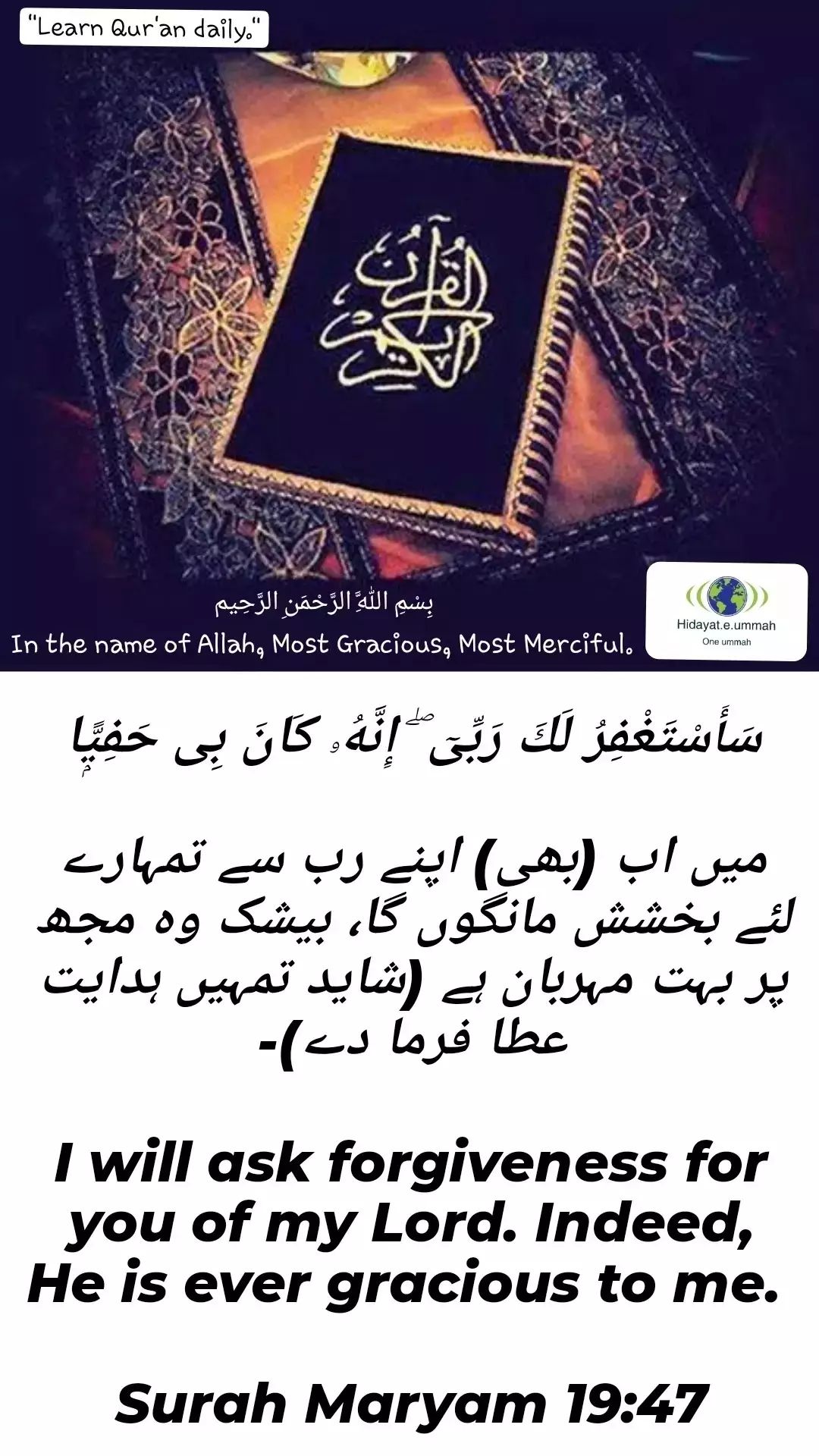
Surah Maryam 19:47
**Translation:**
_I will ask forgiveness for you of my Lord. Indeed, He is ever gracious to me._
**Explanation:**
In this verse, Prophet Ibrahim (Abraham) expresses his intention to seek Allah's forgiveness for his father, acknowledging Allah's grace and mercy. It highlights the power of seeking forgiveness and the endless mercy of Allah.
**Key Points:**
1. **Seeking Forgiveness:**
- Prophet Ibrahim shows the importance of interceding for others through prayer.
2. **Allah’s Grace:**
- Allah is always merciful and ready to forgive those who repent.
**Key Lessons:**
- Intercede for others in your prayers, asking Allah to forgive them.
- Be mindful of Allah’s endless grace and mercy.
**Practical Reflection:**
- Pray for the forgiveness of others and trust in Allah’s mercy.
Hadith 23
23 of 68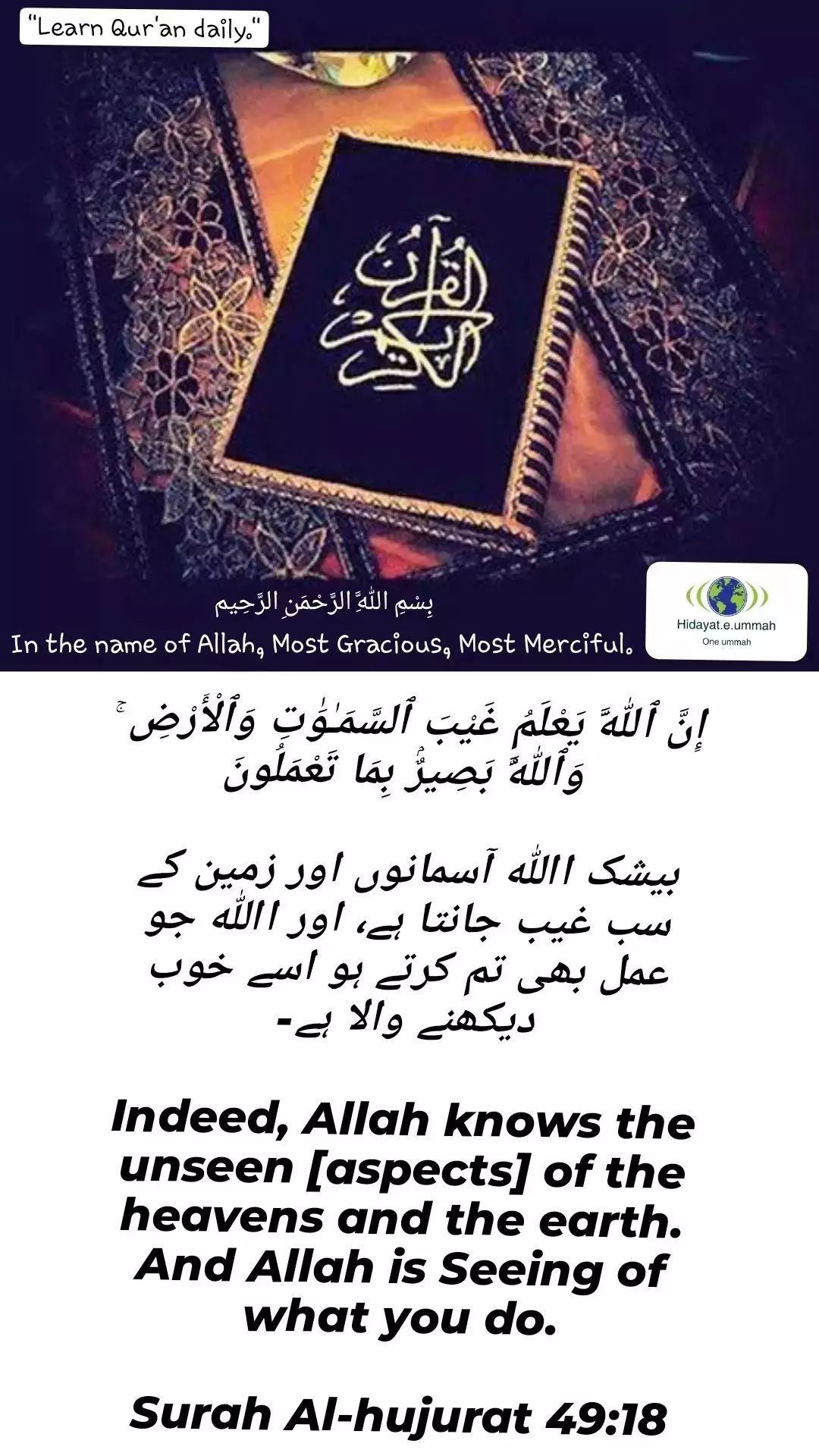
Surah Al-Hujurat 49:78
**Translation:**
_Indeed, Allah knows the unseen [aspects] of the heavens and the earth. And Allah is Seeing of what you do._
**Explanation:**
This verse emphasizes that Allah knows all that is hidden in the heavens and earth, including everything that is beyond human perception. Allah also sees and knows all our actions, both outward and inward.
**Key Points:**
1. **Knowledge of the Unseen:**
- Allah has complete knowledge of everything, including what is hidden from us.
2. **Awareness of Actions:**
- Allah sees and knows all our deeds and intentions.
**Key Lessons:**
- Be mindful of your actions, knowing that Allah is aware of everything.
- Trust in Allah’s perfect knowledge and wisdom.
**Practical Reflection:**
- Remember that your actions are seen by Allah, and strive to act with sincerity and righteousness.
Hadith 24
24 of 68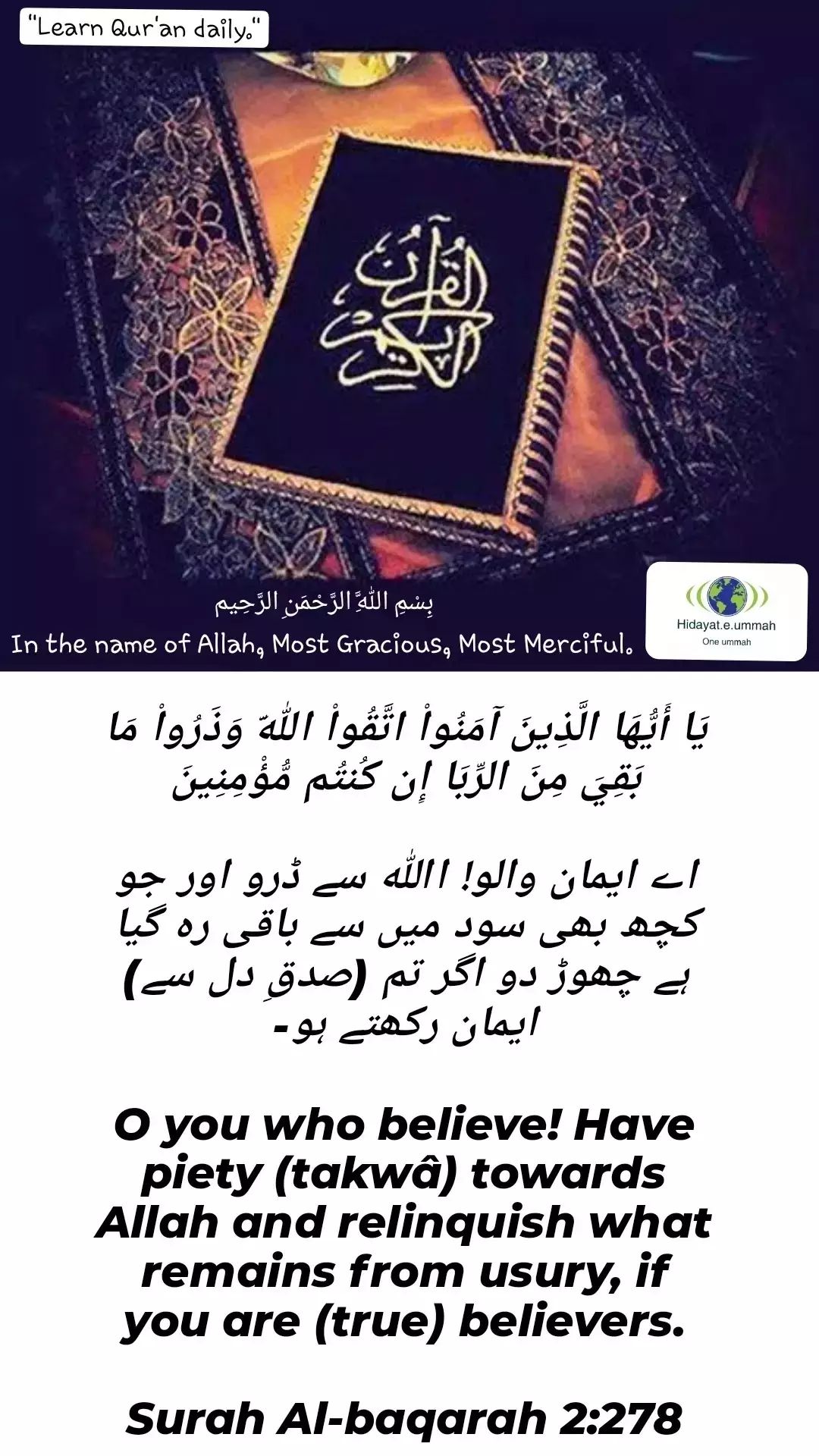
Surah Al-Baqarah 2:278
**Translation:**
_O you who believe! Have piety (taqwa) towards Allah and relinquish what remains from usury, if you are (true) believers._
**Explanation:**
This verse calls upon believers to be mindful of Allah and to give up any remaining dealings with usury (riba). It emphasizes that true faith in Allah involves avoiding forbidden practices like usury and acting in accordance with His commands.
**Key Points:**
1. **Taqwa (Piety) Towards Allah:**
- Be conscious of Allah and avoid actions that displease Him.
2. **Rejection of Usury (Riba):**
- Usury is prohibited in Islam, and believers are commanded to give it up completely.
**Key Lessons:**
- True belief requires obeying Allah’s commands, including avoiding usury.
- Strengthen your faith by adhering to ethical financial practices.
**Practical Reflection:**
- Review your financial dealings and avoid any involvement in usury or unethical practices.
Hadith 25
25 of 68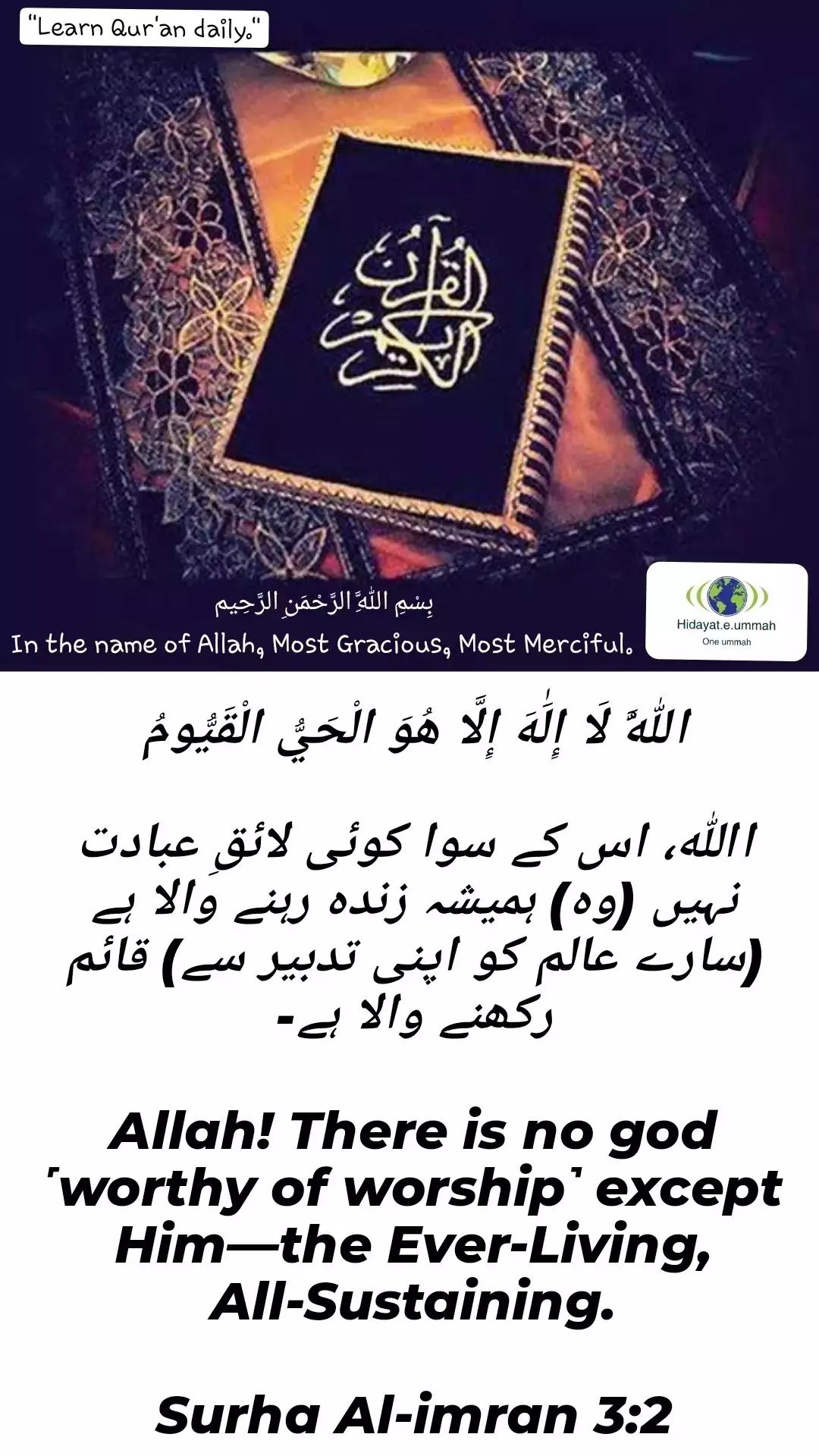
Surah Al-Imran 3:2
**Translation:**
_Allah! There is no god 'worthy of worship' except Him—the Ever-Living, All-Sustaining._
**Explanation:**
This verse emphasizes the absolute oneness of Allah, declaring that He is the only one worthy of worship. Allah is eternal and self-sustaining, meaning He has no beginning or end and depends on nothing and no one.
**Key Points:**
1. **Tawhid (Oneness of Allah):**
- The core belief of Islam is that Allah is the only one worthy of worship.
2. **Allah’s Eternal Nature:**
- Allah is Ever-Living, meaning He exists beyond time, and All-Sustaining, meaning He sustains everything in creation.
**Key Lessons:**
- Strengthen your faith by recognizing and affirming the oneness of Allah.
- Turn to Allah alone for guidance, support, and sustenance.
**Practical Reflection:**
- Reflect on the greatness of Allah and make Him the focus of your worship and trust.
Hadith 26
26 of 68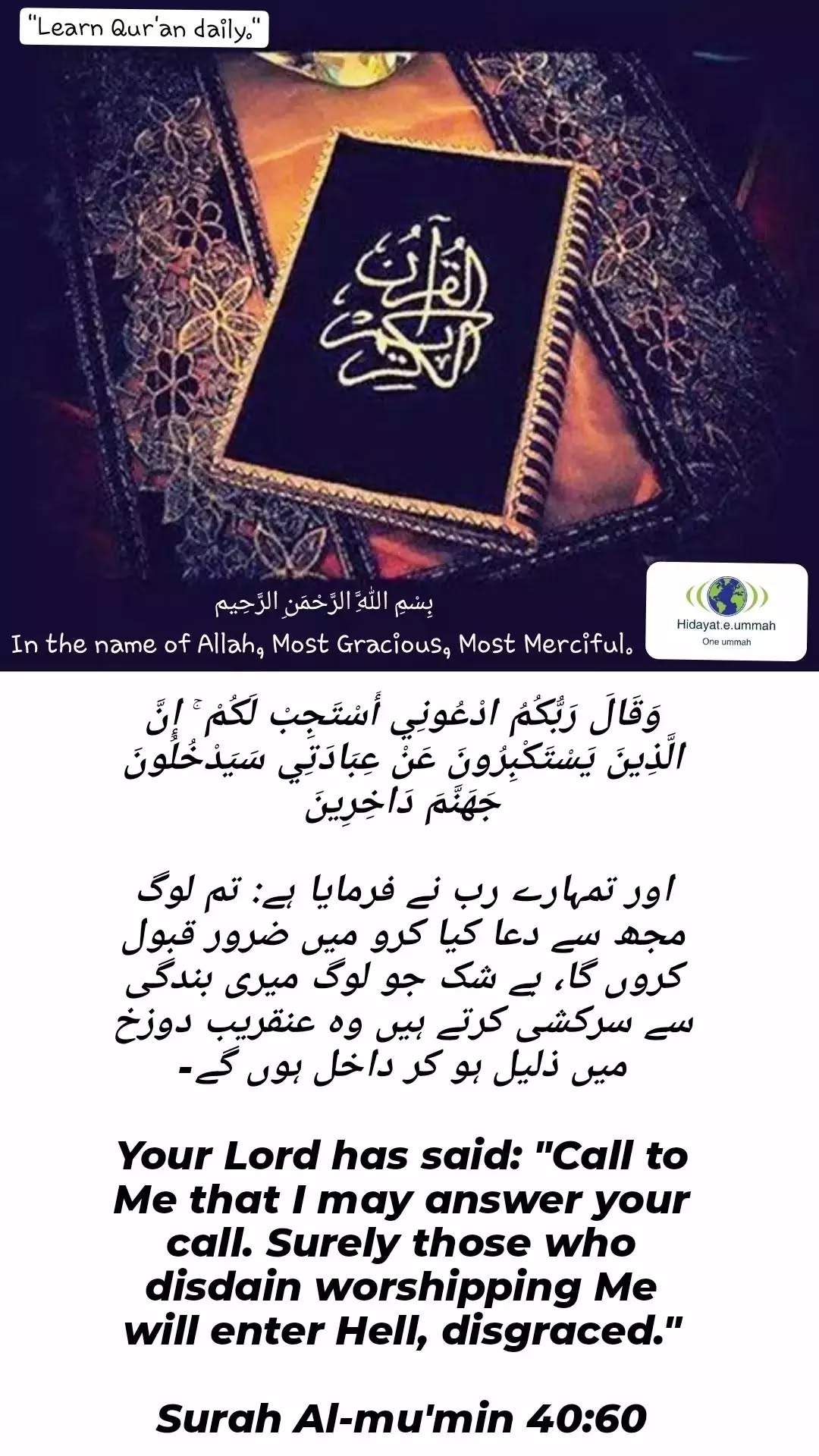
Surah Al-Mu'min 40:60
**Translation:**
_Your Lord has said: 'Call to Me that I may answer your call. Surely those who disdain worshipping Me will enter Hell, disgraced.'_
**Explanation:**
This verse highlights the importance of making dua (supplication) and calling upon Allah. Allah promises to respond to those who sincerely call on Him. The verse also warns that those who refuse to worship Allah will face disgrace in the Hereafter.
**Key Points:**
1. **The Power of Supplication:**
- Allah encourages believers to call upon Him, promising to answer their prayers.
2. **Rejection of Worship:**
- Disdaining worship and ignoring Allah’s call leads to severe consequences in the Hereafter.
**Key Lessons:**
- Make supplication a regular part of your life, trusting that Allah will respond.
- Worship Allah sincerely, knowing that refusal to do so leads to harm in the Hereafter.
**Practical Reflection:**
- Increase your supplications, asking Allah for guidance and help in all matters.
Hadith 27
27 of 68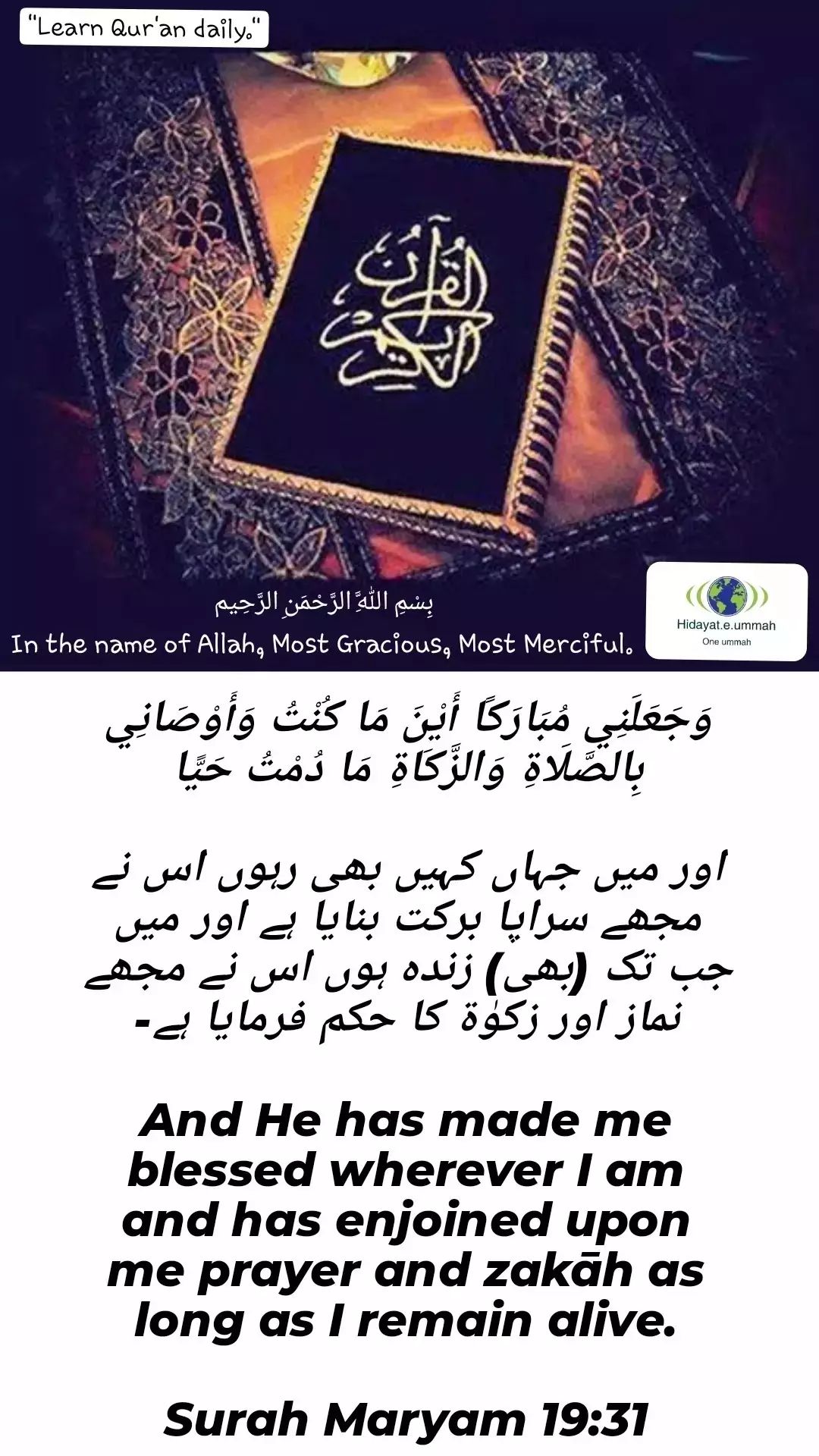
Surah Maryam 19:37
**Translation:**
_And He has made me blessed wherever I am and has enjoined upon me prayer and zakah as long as I remain alive._
**Explanation:**
In this verse, Prophet Isa (Jesus) speaks of the blessings Allah has granted him wherever he is. Allah has also commanded him to perform regular acts of worship, including prayer (Salah) and charity (Zakah), as long as he is alive.
**Key Points:**
1. **Blessings in Every Place:**
- Allah’s blessings accompany a believer wherever they are.
2. **Obligatory Worship:**
- Prayer and zakah are essential acts of worship that must be performed throughout one’s life.
**Key Lessons:**
- Recognize the blessings Allah bestows on you in all situations.
- Stay committed to your acts of worship, including prayer and charity.
**Practical Reflection:**
- Incorporate regular prayer and charity into your life as acts of gratitude for Allah’s blessings.
Hadith 28
28 of 68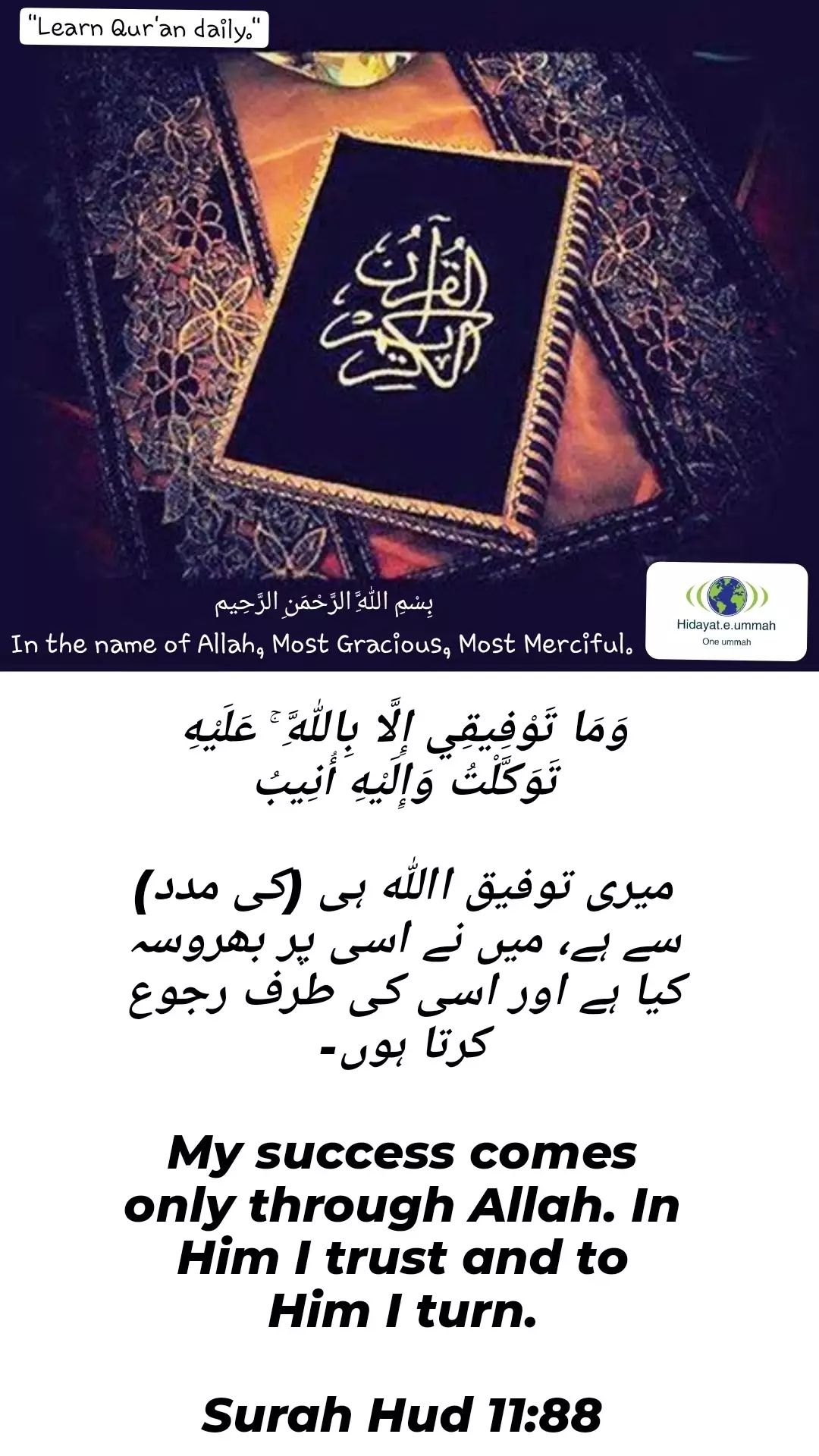
Surah Hud 11:88
**Translation:**
_My success comes only through Allah. In Him I trust and to Him I turn._
**Explanation:**
In this verse, Prophet Hud acknowledges that all success is a result of Allah's will. He expresses his complete trust in Allah and his reliance on Him for guidance and support in every aspect of life.
**Key Points:**
1. **Allah as the Source of Success:**
- True success is achieved only through Allah’s will and guidance.
2. **Complete Trust and Reliance on Allah:**
- Trusting in Allah and turning to Him in times of need is essential for a believer.
**Key Lessons:**
- Recognize that all achievements are through Allah’s grace.
- Place your trust in Allah, knowing He is the best source of guidance and help.
**Practical Reflection:**
- Before embarking on any task, seek Allah’s assistance through prayer and trust in His plan.
Hadith 29
29 of 68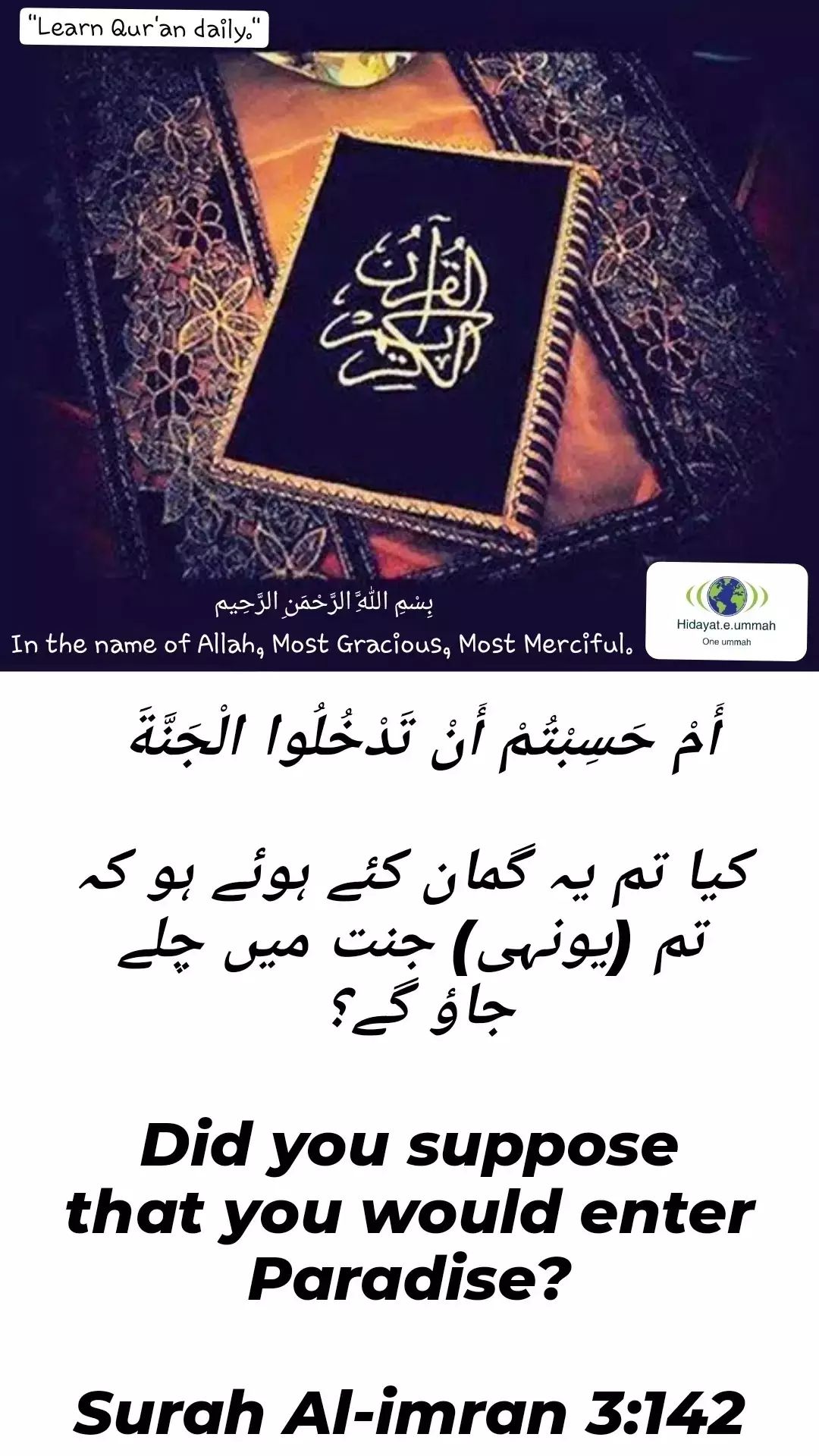
Surah Al-Imran 3:142
**Translation:**
_Did you suppose that you would enter Paradise?_
**Explanation:**
This verse addresses the believers, challenging them to reflect on the true nature of Paradise and the trials one must endure to attain it. It serves as a reminder that entering Paradise is not guaranteed without facing challenges and persevering in faith.
**Key Points:**
1. **Trials Before Paradise:**
- Believers must face tests, hardships, and trials before entering Paradise.
2. **Endurance in Faith:**
- Attaining Paradise requires patience, struggle, and sincere devotion to Allah.
**Key Lessons:**
- Understand that life’s difficulties are part of the path to Paradise.
- Stay committed to your faith and trust that the reward in the Hereafter is worth the struggle.
**Practical Reflection:**
- Remind yourself that enduring difficulties with patience and faith leads to eternal reward.
Hadith 30
30 of 68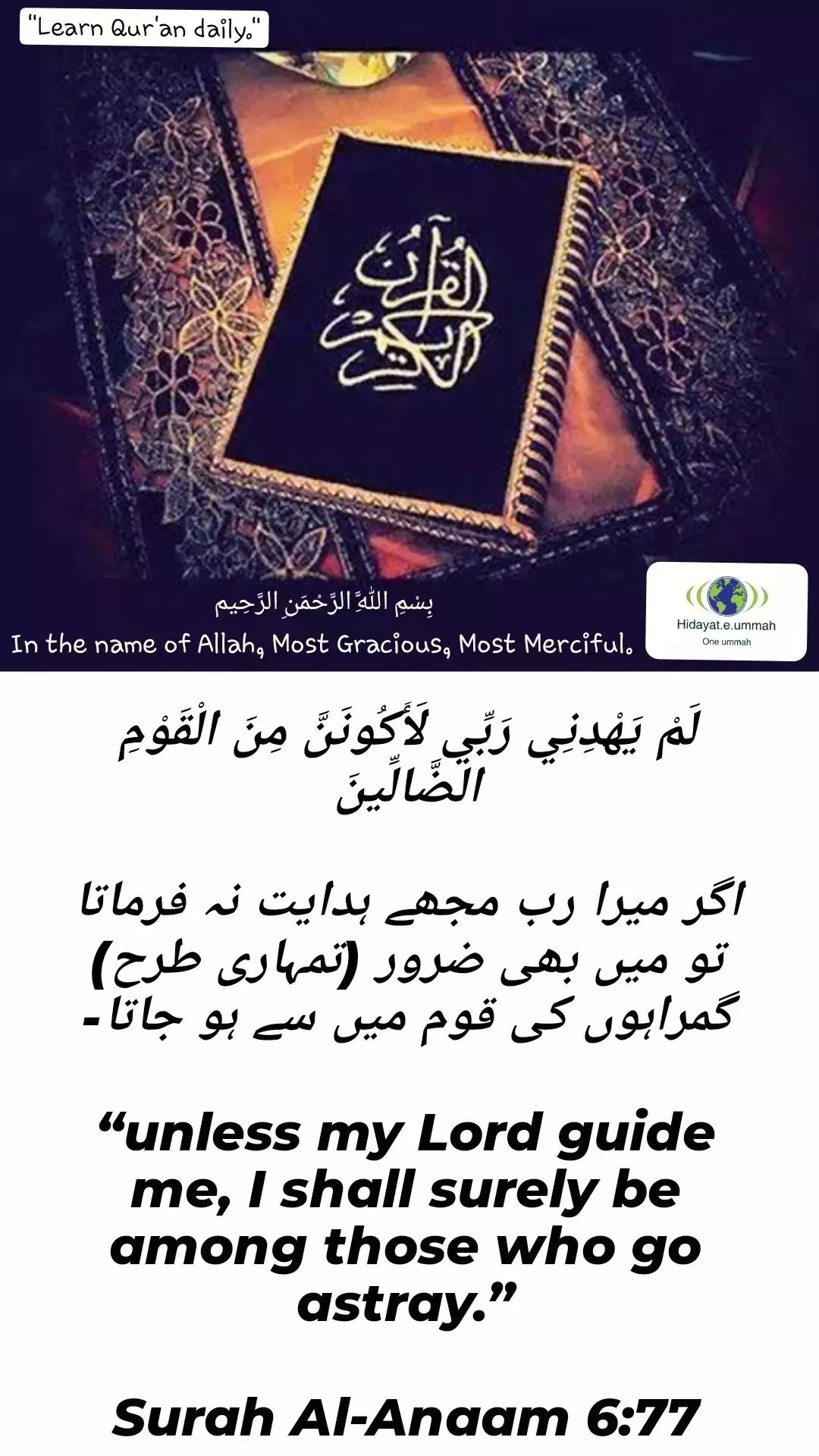
Surah Al-Anaam 6:77
**Translation:**
_Unless my Lord guide me, I shall surely be among those who go astray._
**Explanation:**
In this verse, Prophet Ibrahim (Abraham) acknowledges his complete dependence on Allah for guidance. He recognizes that without Allah’s guidance, he would be lost and misguided. This highlights the importance of seeking Allah's direction in every aspect of life.
**Key Points:**
1. **Dependence on Allah’s Guidance:**
- True guidance comes only from Allah, and it’s essential to seek it earnestly.
2. **Awareness of Human Weakness:**
- We are all vulnerable to going astray without Allah’s help.
**Key Lessons:**
- Always turn to Allah for guidance, recognizing your reliance on Him.
- Be humble and aware of your need for Allah’s direction.
**Practical Reflection:**
- Regularly make du'a (supplication) asking Allah to guide you in your decisions and actions.
Hadith 31
31 of 68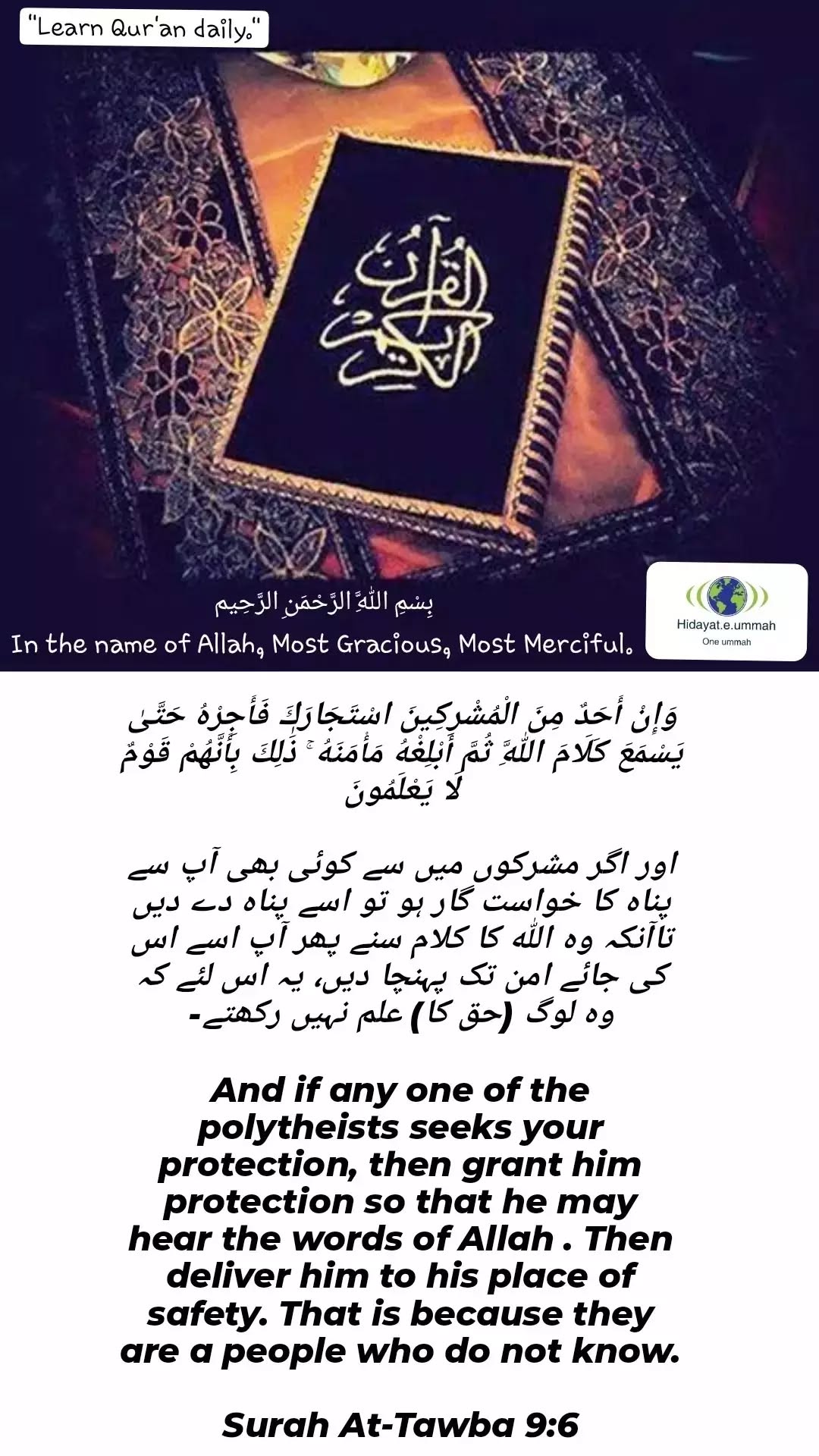
Surah At-Tawba 9:6
**Translation:**
_And if any one of the polytheists seeks your protection, then grant him protection so that he may hear the words of Allah. Then deliver him to his place of safety. That is because they are a people who do not know._
**Explanation:**
This verse teaches Muslims to show kindness and hospitality to non-Muslims who seek refuge, allowing them to hear the message of Islam. It emphasizes the importance of guiding others towards understanding, and ensuring their safety once they’ve been given the opportunity to learn.
**Key Points:**
1. **Protection and Refuge for the Opponents:**
- Muslims are encouraged to grant protection to those who seek it, even if they are non-believers.
2. **Sharing the Message of Islam:**
- One of the main reasons for providing protection is to give them a chance to hear Allah’s words.
3. **Respect for the Ignorant:**
- The verse acknowledges that those who do not know are deserving of guidance, not harm.
**Key Lessons:**
- Show compassion and offer protection, even to those who oppose you, if they seek peace.
- The goal is to guide others towards the truth, not to harm or fight them.
**Practical Reflection:**
- Consider how you can share knowledge of Islam peacefully and respectfully with those who do not understand it.
Hadith 32
32 of 68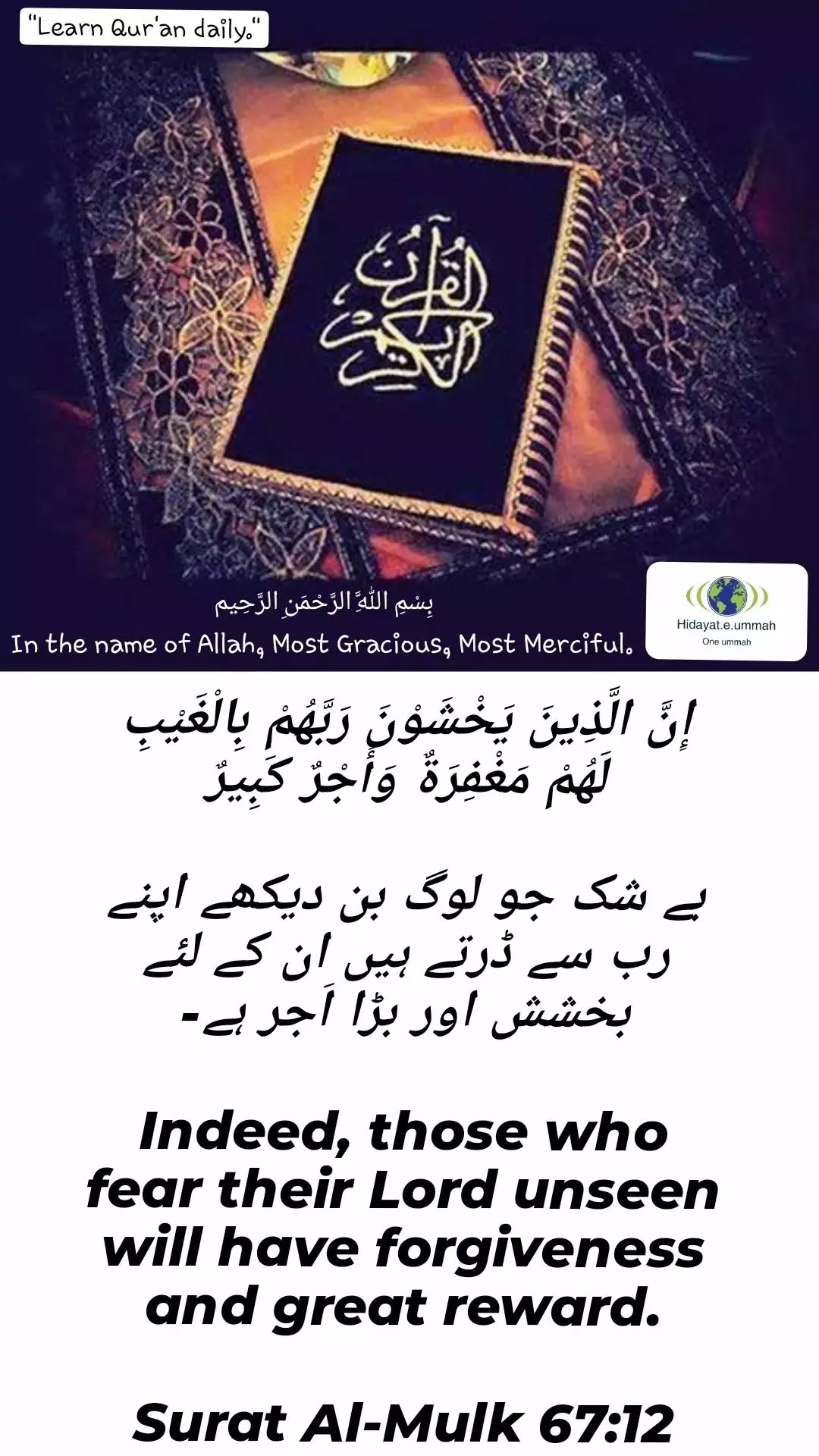
Surah Al-Mulk 67:72
**Translation:**
_Indeed, those who fear their Lord unseen will have forgiveness and great reward._
**Explanation:**
This verse emphasizes the reward for those who possess true fear (reverence) of Allah, even when He is unseen. Their sincerity in worshiping and obeying Allah, without the need for visible reminders, brings them forgiveness and immense rewards in the Hereafter.
**Key Points:**
1. **Fear of Allah in the Unseen:**
- True fear of Allah comes from a sincere belief in His presence and power, even though He is not physically visible.
2. **Forgiveness and Great Reward:**
- Allah promises forgiveness and great rewards to those who sincerely worship Him out of reverence and awe.
**Key Lessons:**
- Strive to develop a sincere connection with Allah, even when you cannot see Him.
- Cultivate a fear of Allah that leads to obedience, even in private or unseen moments.
**Practical Reflection:**
- Reflect on your actions when no one is watching, remembering that Allah is always aware.
Hadith 33
33 of 68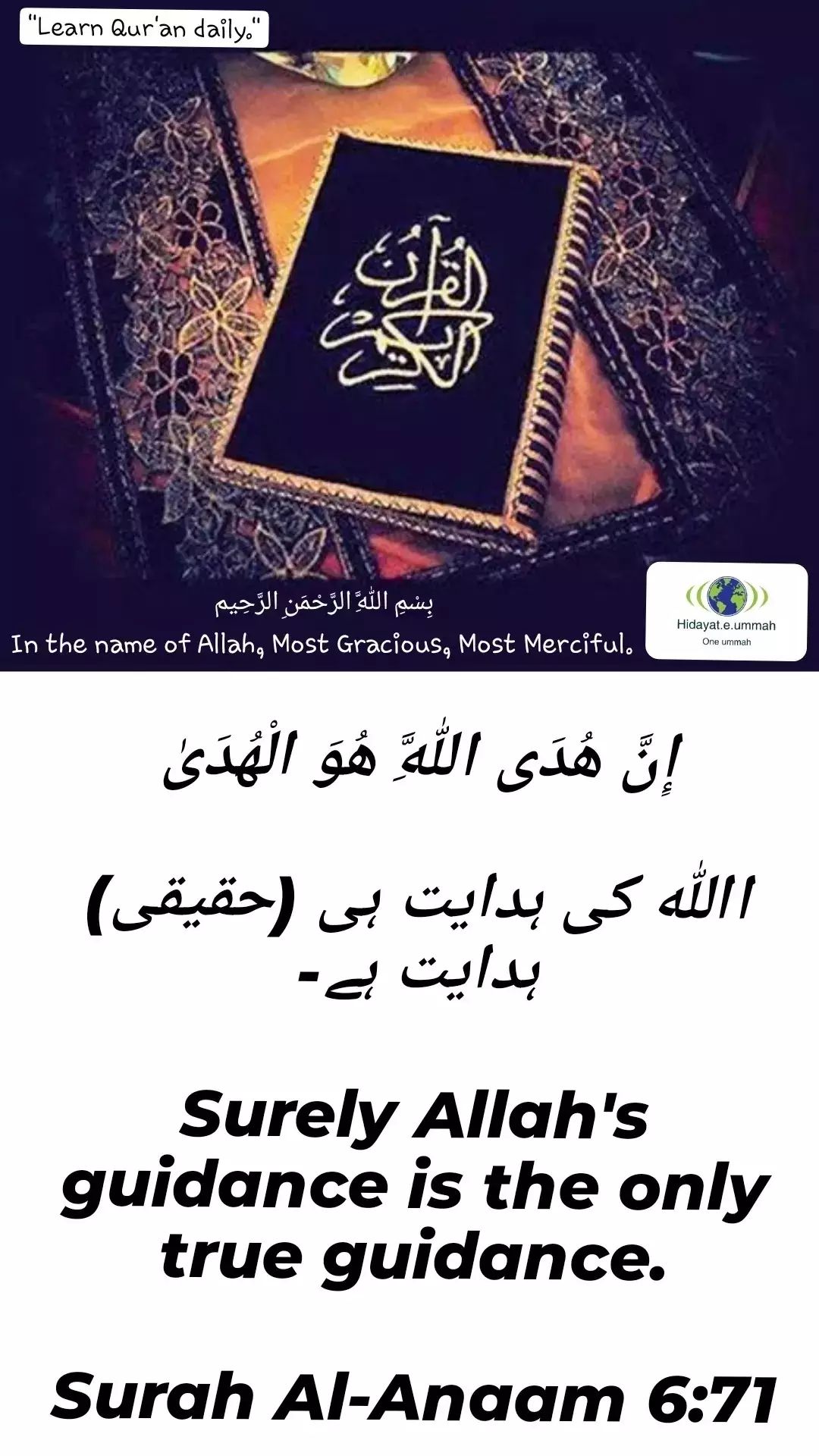
Surah Al-Anaam 6: Guide
**Translation:**
_Surely Allah's guidance is the only true guidance._
**Explanation:**
This verse highlights that Allah's guidance is the ultimate and truest form of direction in life. No matter the source, guidance that leads us away from Allah’s path is not true. The verse emphasizes that only the guidance provided by Allah can truly lead to success in this life and the Hereafter.
**Key Points:**
1. **Allah's Guidance is the True Path:**
- The guidance from Allah is the only real and reliable source for a righteous and fulfilling life.
2. **Rejecting False Guidance:**
- Any other form of guidance, if not in line with Allah’s will, is not the true path.
**Key Lessons:**
- Seek Allah's guidance in all matters, trusting that it is the most trustworthy direction.
- Be aware of false influences or misguidance and turn back to the truth.
**Practical Reflection:**
- Regularly make du'a (supplication) to ask Allah to guide you on the straight path.
Hadith 34
34 of 68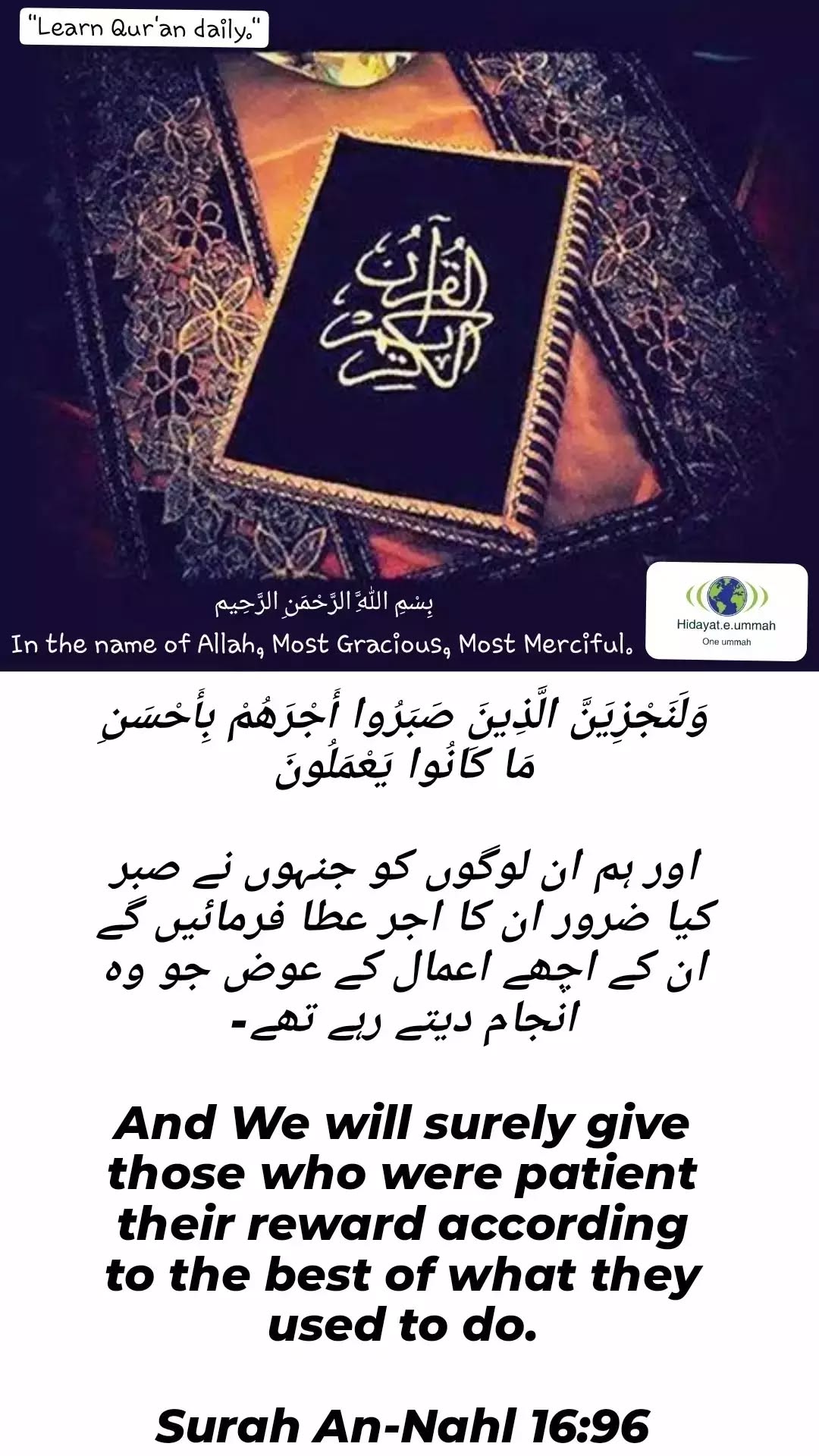
Surah An-Nahl 16:96
**Translation:**
_And We will surely give those who were patient their reward according to the best of what they used to do._
**Explanation:**
This verse promises that those who display patience in their trials and hardships will be rewarded by Allah with the best of rewards, greater than anything they could have imagined. Their patience and perseverance in doing good will be acknowledged and rewarded in the Hereafter.
**Key Points:**
1. **Reward for Patience:**
- Patience in the face of difficulties is highly valued and will be rewarded by Allah.
2. **Better than Their Deeds:**
- The reward for patience will exceed the value of the actions that required patience.
**Key Lessons:**
- Be patient during trials, knowing that Allah will reward you in ways beyond your expectations.
- Remember that enduring hardship with faith brings great rewards.
**Practical Reflection:**
- When facing difficulty, remind yourself that patience will bring you the best rewards from Allah.
Hadith 35
35 of 68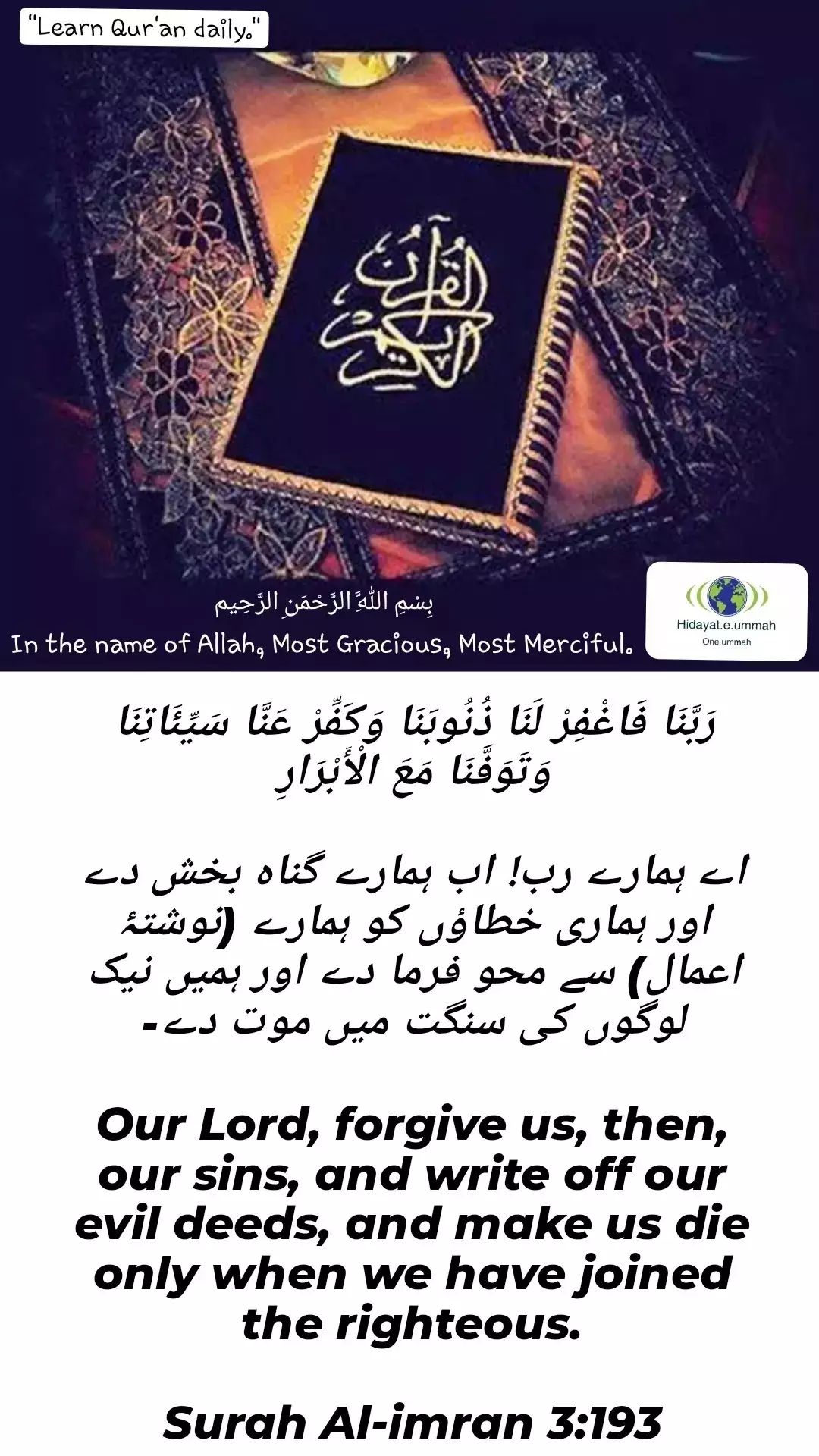
Surah Al-Imran 3:193
**Translation:**
_Our Lord, forgive us, then, our sins, and write off our evil deeds, and make us die only when we have joined the righteous._
**Explanation:**
This verse is a supplication made by the believers, asking Allah for forgiveness for their sins, for the removal of their evil deeds, and for a good ending in life, where they join the righteous. It reflects the believers’ deep desire for Allah's mercy and protection throughout their lives and in the Hereafter.
**Key Points:**
1. **Seeking Forgiveness:**
- The believers acknowledge their sins and seek Allah's forgiveness and mercy.
2. **Desire for Righteousness:**
- They ask Allah to grant them an honorable death, one that comes after living a life of righteousness.
**Key Lessons:**
- Always seek forgiveness from Allah, no matter the amount of sins.
- Pray for a good ending, where you are counted among the righteous.
**Practical Reflection:**
- Make this supplication a regular part of your prayers, asking Allah for forgiveness and a life full of righteousness.
Hadith 36
36 of 68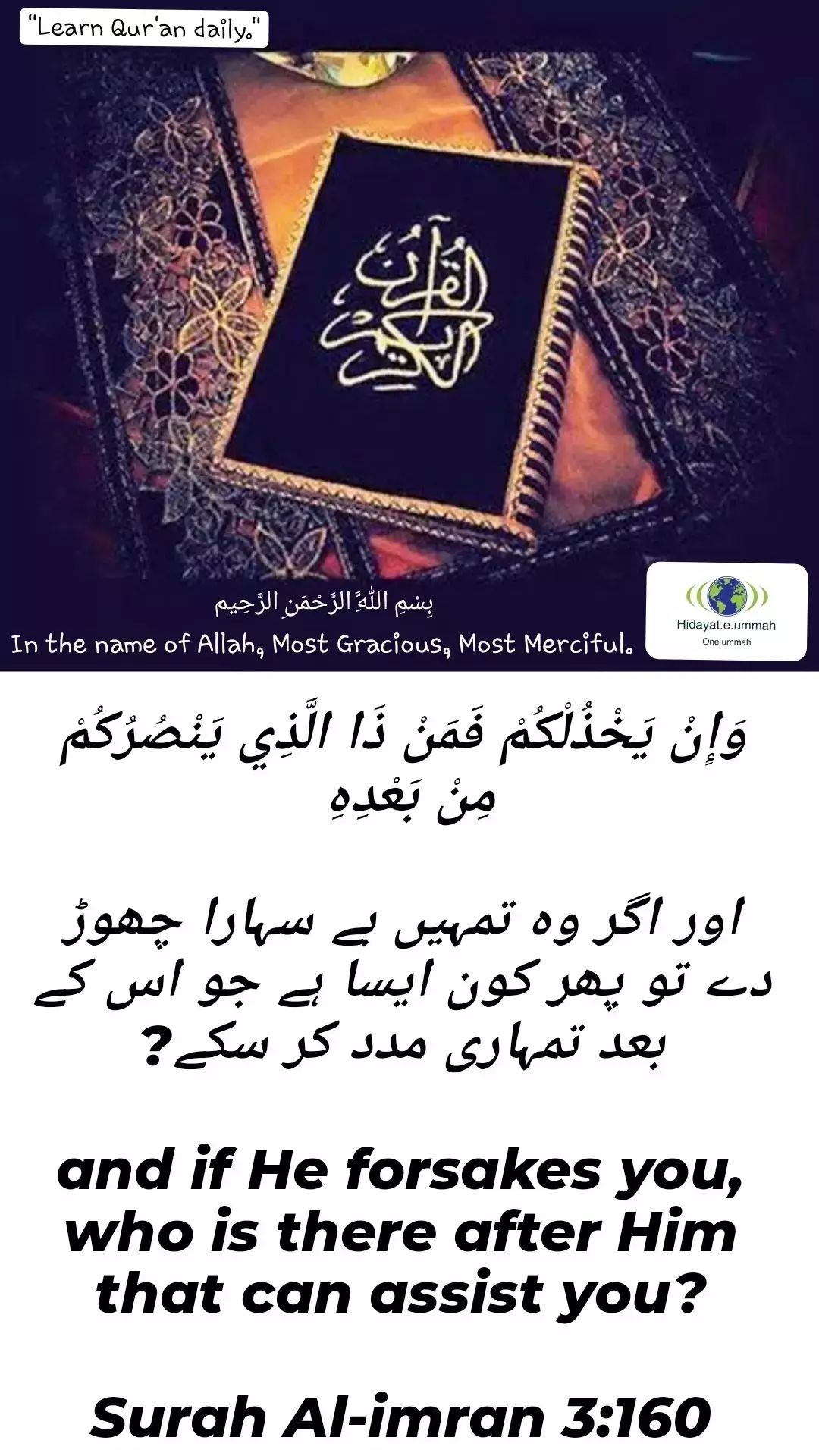
Surah Al-Imran 3:160
**Translation:**
_And if He forsakes you, who is there after Him that can assist you?_
**Explanation:**
This verse emphasizes the absolute reliance on Allah for help and support. If Allah chooses not to help, there is no one else who can provide true assistance. It reminds believers to turn to Allah alone in times of need and hardship.
**Key Points:**
1. **Reliance on Allah Alone:**
- Allah is the ultimate source of help; no one else can truly assist in times of need.
2. **The Inevitability of Allah’s Will:**
- If Allah withdraws His support, no one else can aid you, highlighting His supreme power.
**Key Lessons:**
- Place your trust in Allah completely, as He is the only one who can truly assist.
- Remember that all help and support are from Allah, and turn to Him in times of distress.
**Practical Reflection:**
- Reflect on your reliance on Allah in your daily life, and make sure to seek His help in all matters.
Hadith 37
37 of 68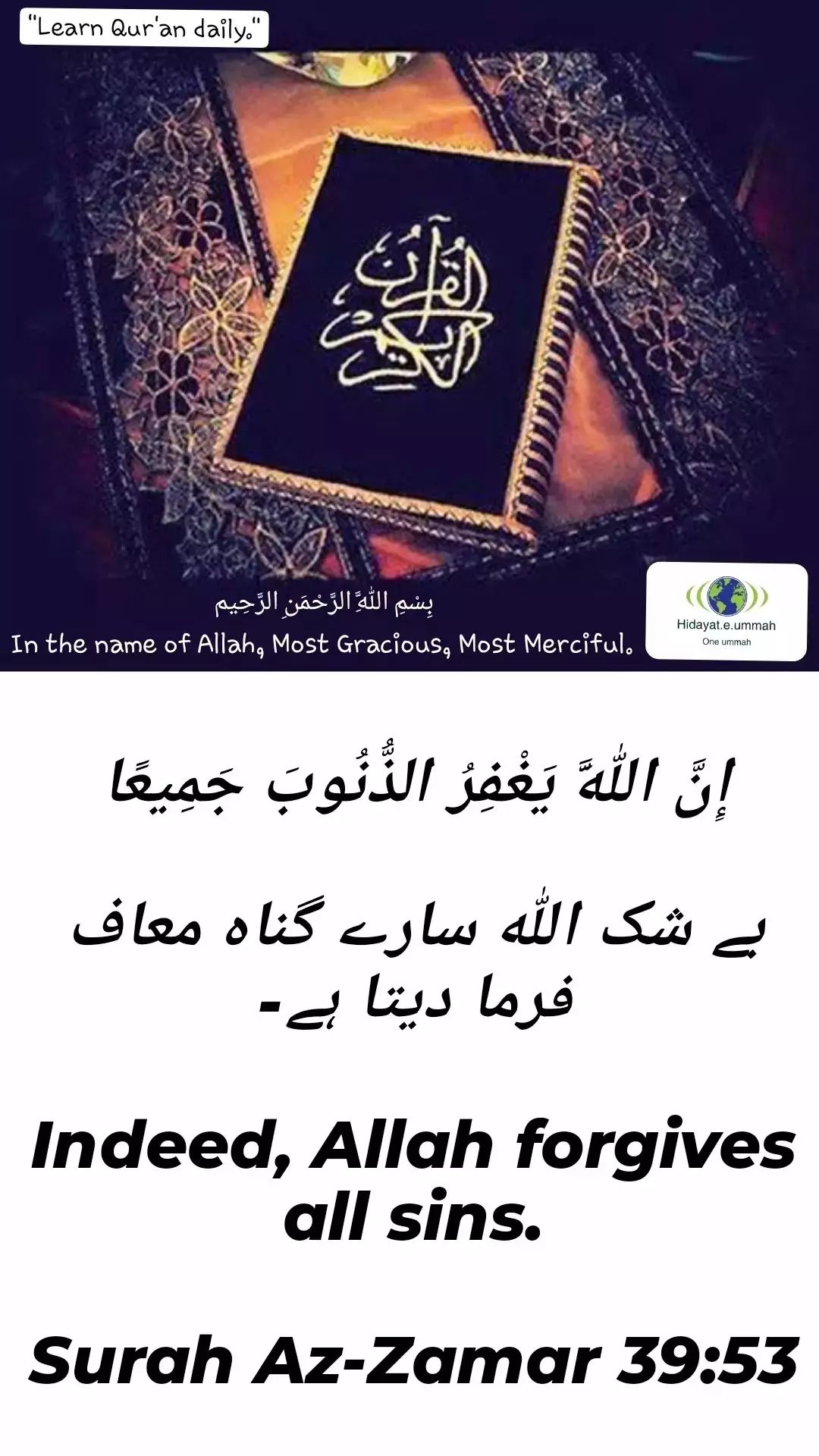
Surah Az-Zumar 39:53
**Translation:**
_Indeed, Allah forgives all sins._
**Explanation:**
This verse highlights Allah’s immense mercy and His ability to forgive every sin, no matter how great or small, if the sinner repents sincerely. It offers hope to all believers that no matter their past, they can always turn to Allah for forgiveness.
**Key Points:**
1. **Allah’s Boundless Mercy:**
- Allah is capable of forgiving all sins, reflecting His limitless mercy and grace.
2. **Repentance is Key:**
- True repentance, with a sincere heart, opens the door to forgiveness from Allah.
**Key Lessons:**
- Never despair of Allah’s mercy, as He is always willing to forgive.
- Repent sincerely and turn back to Allah no matter what sins you may have committed.
**Practical Reflection:**
- Whenever you make a mistake, seek forgiveness from Allah immediately, knowing that He will forgive you if you truly repent.
Hadith 38
38 of 68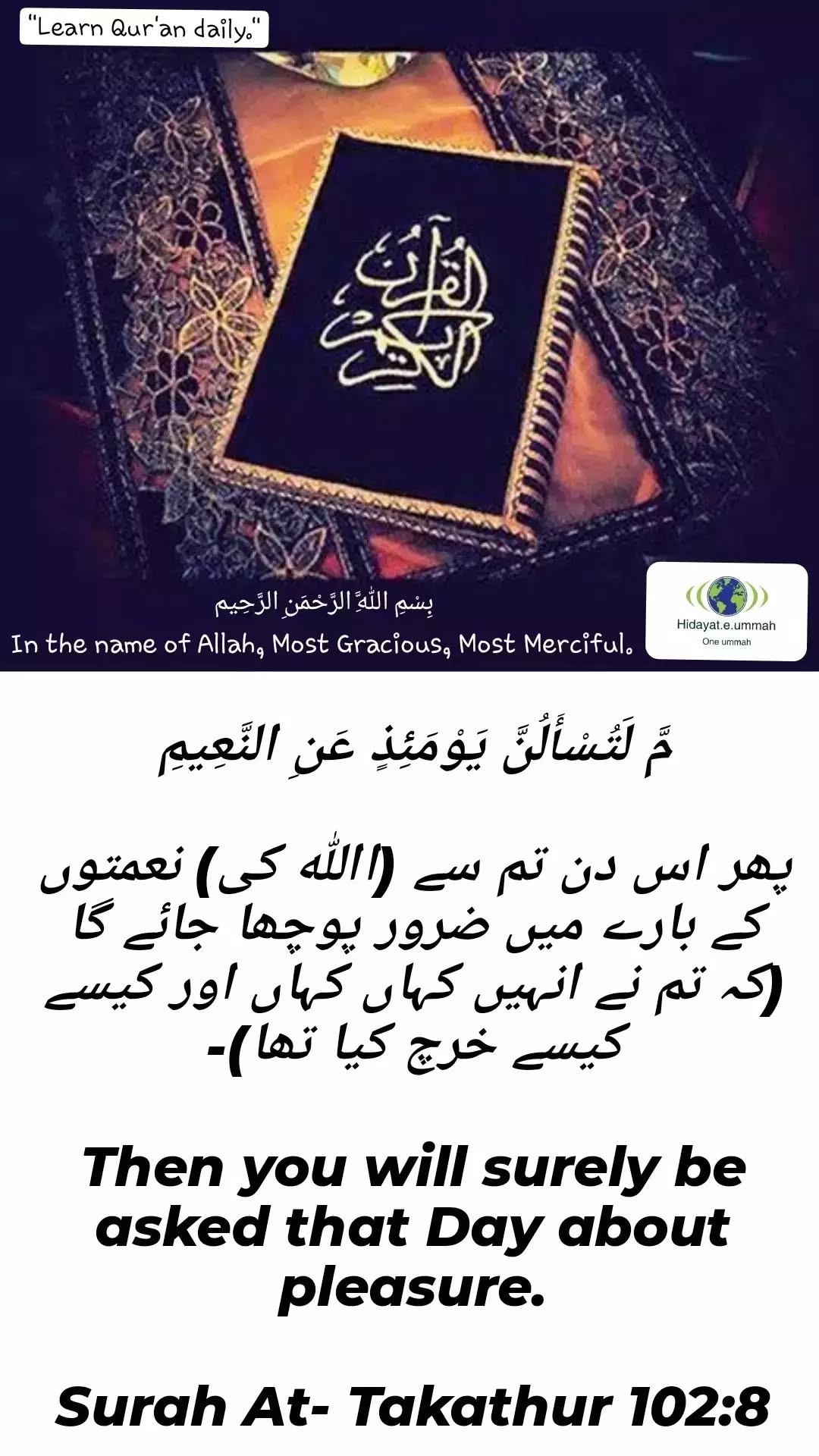
Surah At-Takathur 102:8
**Translation:**
_Then you will surely be asked that Day about pleasure._
**Explanation:**
This verse serves as a reminder that on the Day of Judgment, individuals will be held accountable for how they spent their lives, particularly how they pursued and used the pleasures of this world. It calls believers to reflect on the transient nature of worldly pleasures and the importance of using them in ways that please Allah.
**Key Points:**
1. **Accountability for Worldly Pleasures:**
- We will be questioned about how we used the blessings and pleasures Allah gave us in this life.
2. **Temporary Nature of Worldly Pleasures:**
- The pleasures of this world are temporary and should not distract us from our ultimate goal of pleasing Allah.
**Key Lessons:**
- Use the pleasures and blessings of this life in a way that aligns with Allah’s guidance.
- Reflect on how you use your time, wealth, and resources, keeping in mind your accountability to Allah.
**Practical Reflection:**
- Take moments to evaluate how you are using your blessings, and make efforts to seek Allah’s pleasure in all aspects of life.
Hadith 39
39 of 68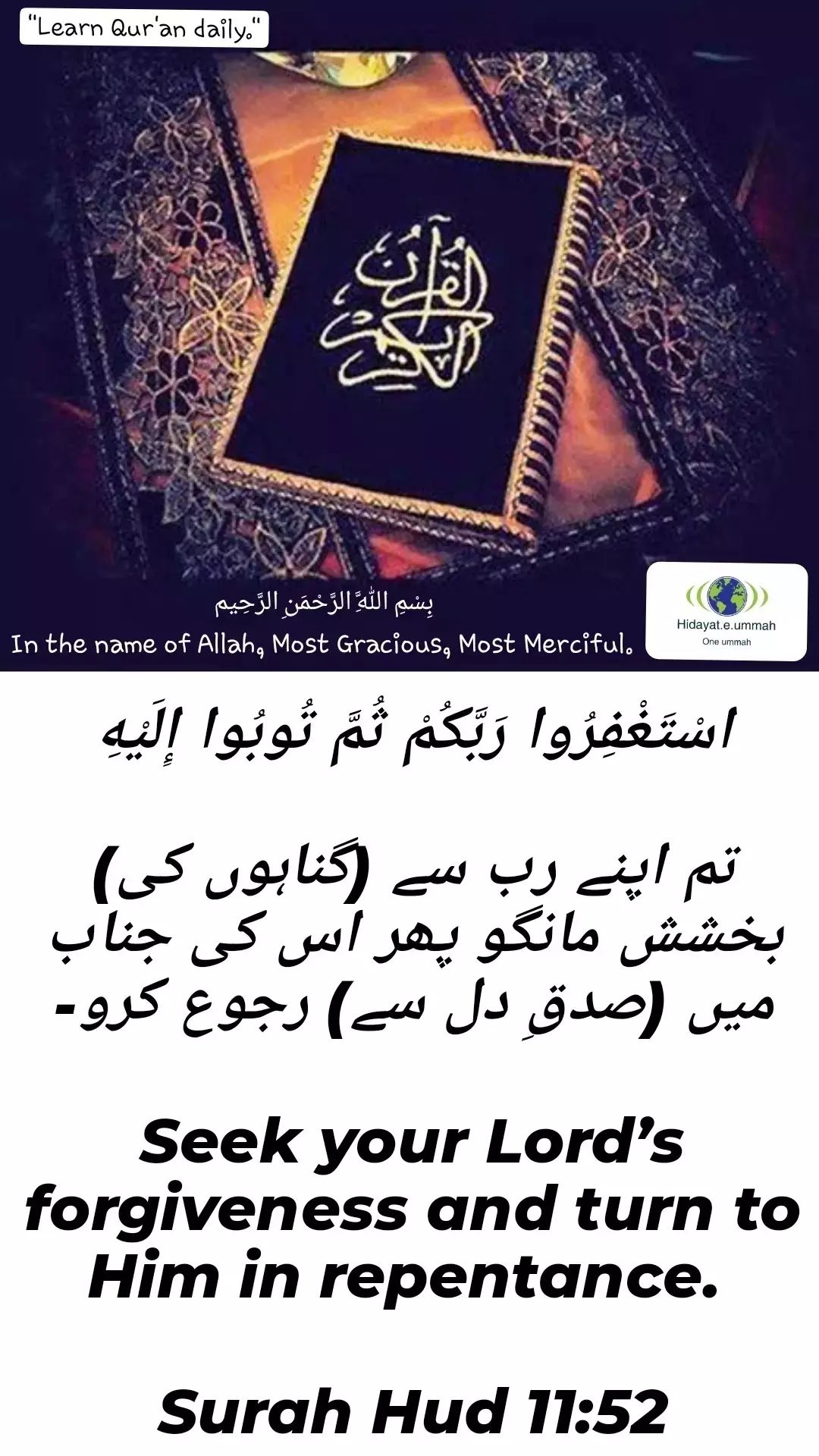
Surah Hud 11:52
**Translation:**
_Seek your Lord's forgiveness and turn to Him in repentance._
**Explanation:**
This verse encourages individuals to seek Allah’s forgiveness and to sincerely turn back to Him through repentance. It emphasizes the importance of acknowledging one’s wrongdoings and seeking Allah’s mercy and guidance, which leads to spiritual renewal and peace.
**Key Points:**
1. **The Importance of Seeking Forgiveness:**
- Acknowledging one’s sins and seeking Allah’s forgiveness is a key step in returning to Him.
2. **Repentance as a Turning Point:**
- True repentance involves not just asking for forgiveness but also turning away from sinful behavior and striving to improve.
**Key Lessons:**
- Never lose hope in Allah’s mercy, as He is always ready to forgive those who repent.
- Repentance should be sincere, and it should lead to a commitment to avoid sin in the future.
**Practical Reflection:**
- Whenever you make a mistake, turn to Allah immediately in repentance, seeking His forgiveness and mercy.
Hadith 40
40 of 68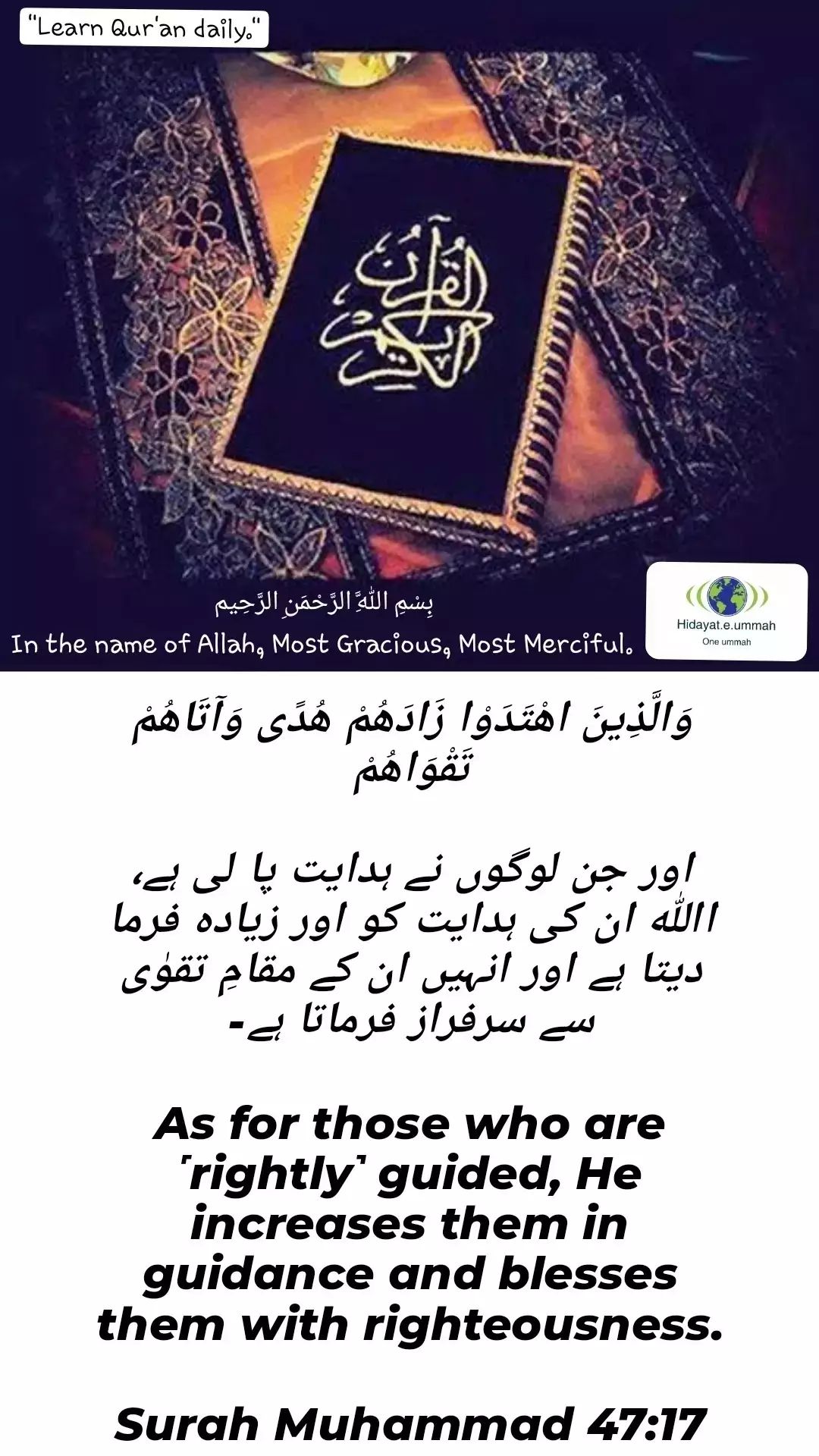
Surah Muhammad 47:17
**Translation:**
_As for those who are 'rightly' guided, He increases them in guidance and blesses them with righteousness._
**Explanation:**
This verse highlights the special favor of Allah for those who are guided on the right path. Not only does Allah guide them, but He also continues to increase their guidance and blesses them with greater righteousness. This verse emphasizes that those who strive to follow Allah's guidance will receive continuous support and blessings.
**Key Points:**
1. **Continuous Guidance:**
- Allah’s guidance is a process that continues, becoming stronger for those who remain on the right path.
2. **Blessings of Righteousness:**
- As guidance increases, righteousness in actions and character is also enhanced.
**Key Lessons:**
- Strive to remain steadfast on the right path, knowing that Allah will increase your guidance.
- Seek righteousness, and trust that Allah will bless your efforts to live rightly.
**Practical Reflection:**
- Regularly seek Allah’s guidance through prayer, supplication, and reflection, knowing that it leads to continued blessings.
Hadith 41
41 of 68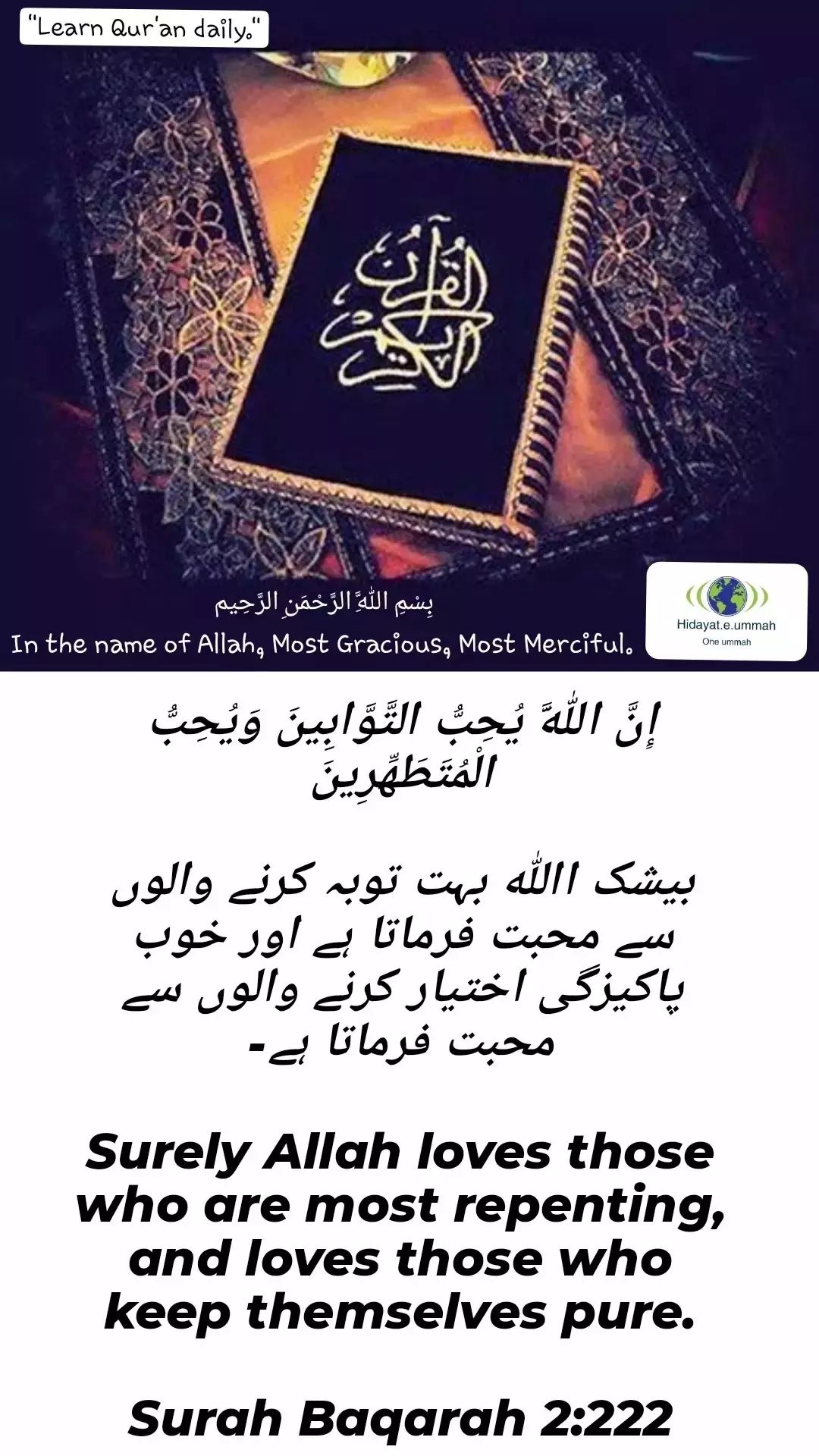
Surah Al-Baqarah 2:222
**Translation:**
_Surely Allah loves those who are most repenting, and loves those who keep themselves pure._
**Explanation:**
This verse emphasizes two qualities that are dear to Allah: sincere repentance and purity. Allah loves those who constantly repent for their sins and turn back to Him, as well as those who strive to maintain cleanliness, both physically and spiritually. It highlights the importance of self-reflection, purity, and humility before Allah.
**Key Points:**
1. **Sincerity in Repentance:**
- Allah loves those who continuously seek His forgiveness and strive to purify themselves from sin.
2. **Purity of Heart and Action:**
- Maintaining both physical and spiritual purity is an act of devotion and is loved by Allah.
**Key Lessons:**
- Strive to repent regularly, asking Allah for forgiveness and turning away from sinful behavior.
- Keep your body, soul, and actions pure for the sake of Allah, aiming to please Him.
**Practical Reflection:**
- Incorporate regular acts of repentance into your daily life and maintain cleanliness in both your outward and inward actions.
Hadith 42
42 of 68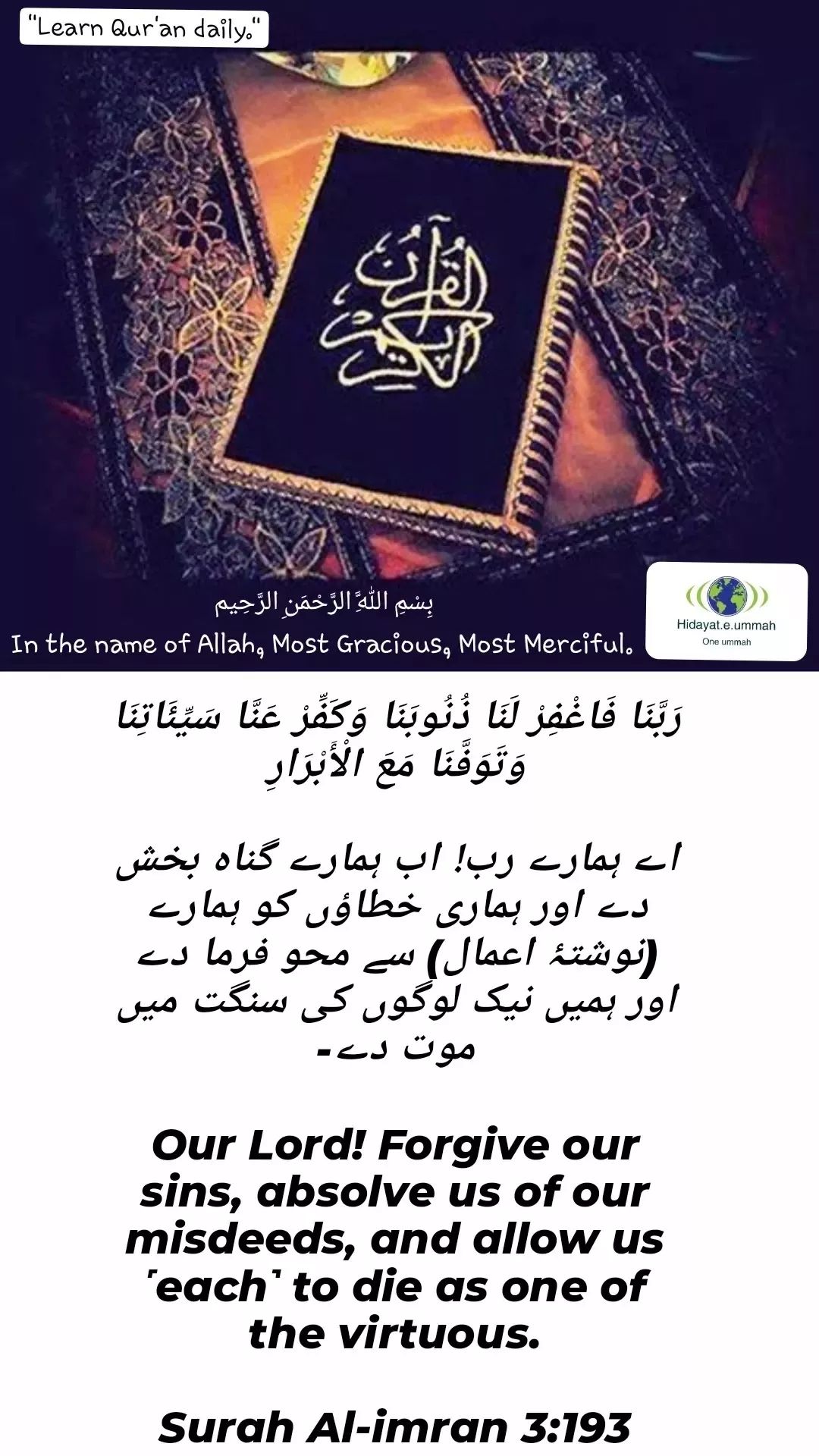
Surah Al-Imran 3:193
**Translation:**
_Our Lord! Forgive our sins, absolve us of our misdeeds, and allow us to die as one of the virtuous._
**Explanation:**
This verse is a supplication asking Allah for forgiveness, the removal of one’s misdeeds, and a virtuous end. It reflects the believers' desire to purify themselves and to be granted a righteous and honorable death, joining the virtuous in the Hereafter. The verse highlights the importance of repentance and the pursuit of virtue throughout life.
**Key Points:**
1. **Seeking Forgiveness and Purification:**
- The believers ask Allah to forgive their sins and absolve them of past mistakes.
2. **Desire for Righteousness:**
- They ask to be among the virtuous, indicating a lifelong pursuit of goodness and piety.
3. **A Good End:**
- The supplication includes the hope for a righteous death, which is a reflection of one’s good life.
**Key Lessons:**
- Always seek forgiveness from Allah, knowing that He is the Most Merciful.
- Strive for righteousness throughout your life, with the hope that you will die in a state of virtue.
**Practical Reflection:**
- Make this supplication part of your daily prayers, asking Allah for forgiveness and guidance to live a virtuous life.
Hadith 43
43 of 68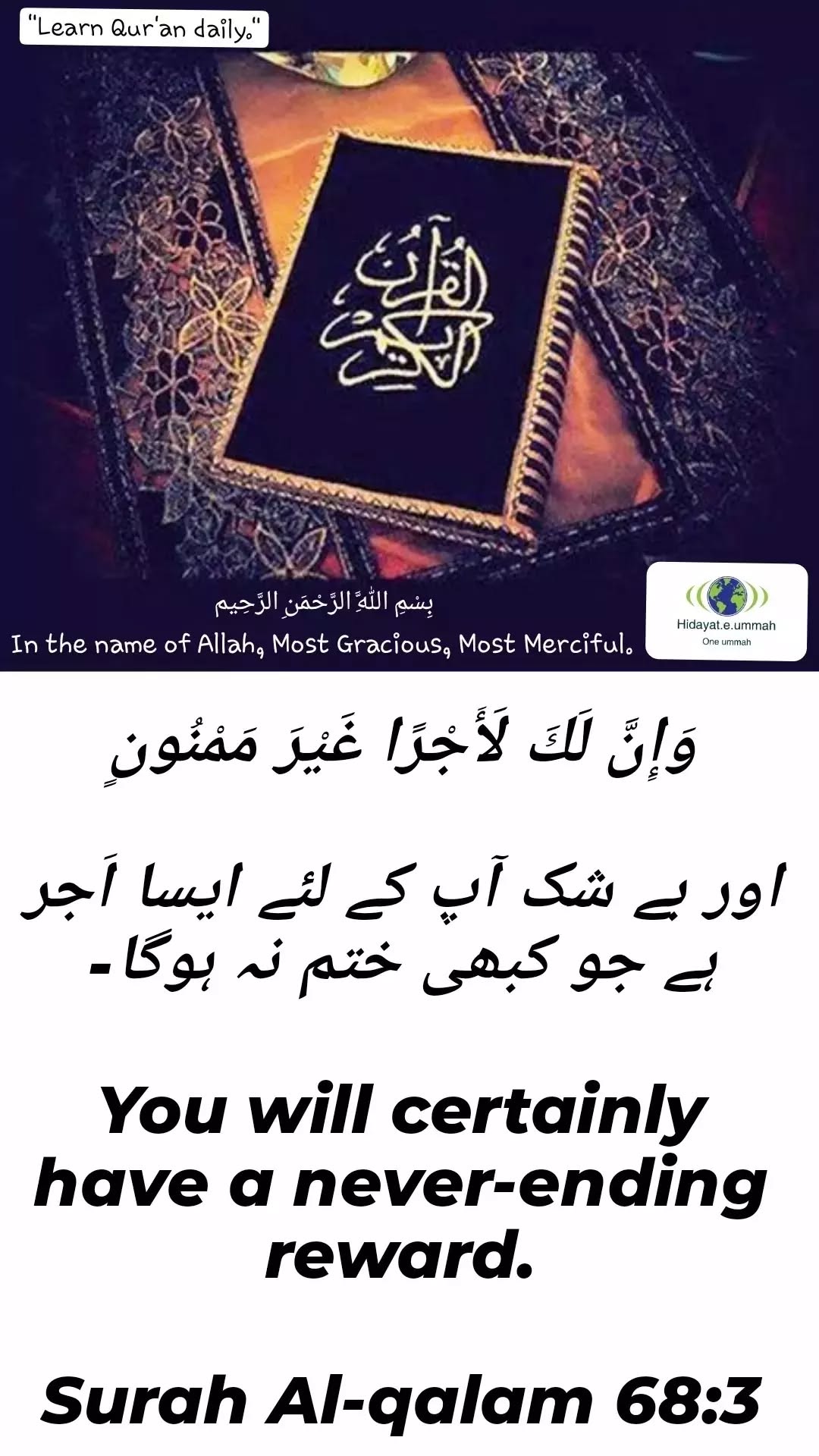
Surah Al-Qalam 68:3
**Translation:**
_You will certainly have a never-ending reward._
**Explanation:**
This verse assures the believers that their efforts in seeking the pleasure of Allah will be rewarded with an eternal, never-ending reward. It emphasizes that the reward from Allah for righteous deeds, especially those done with sincerity, is everlasting in the Hereafter. It serves as encouragement for perseverance in doing good, knowing that the reward is not temporary but eternal.
**Key Points:**
1. **Eternal Reward:**
- The reward from Allah for good deeds is everlasting, a source of comfort for believers.
2. **Encouragement to Persevere:**
- Knowing that the reward is eternal should motivate individuals to remain steadfast in their faith and actions.
**Key Lessons:**
- Keep striving to do good and seek Allah’s pleasure, as the reward will never end.
- Do not be discouraged by temporary hardships, as the eternal reward from Allah is much greater.
**Practical Reflection:**
- Remind yourself that every act of goodness, no matter how small, leads to an eternal reward with Allah.
Hadith 44
44 of 68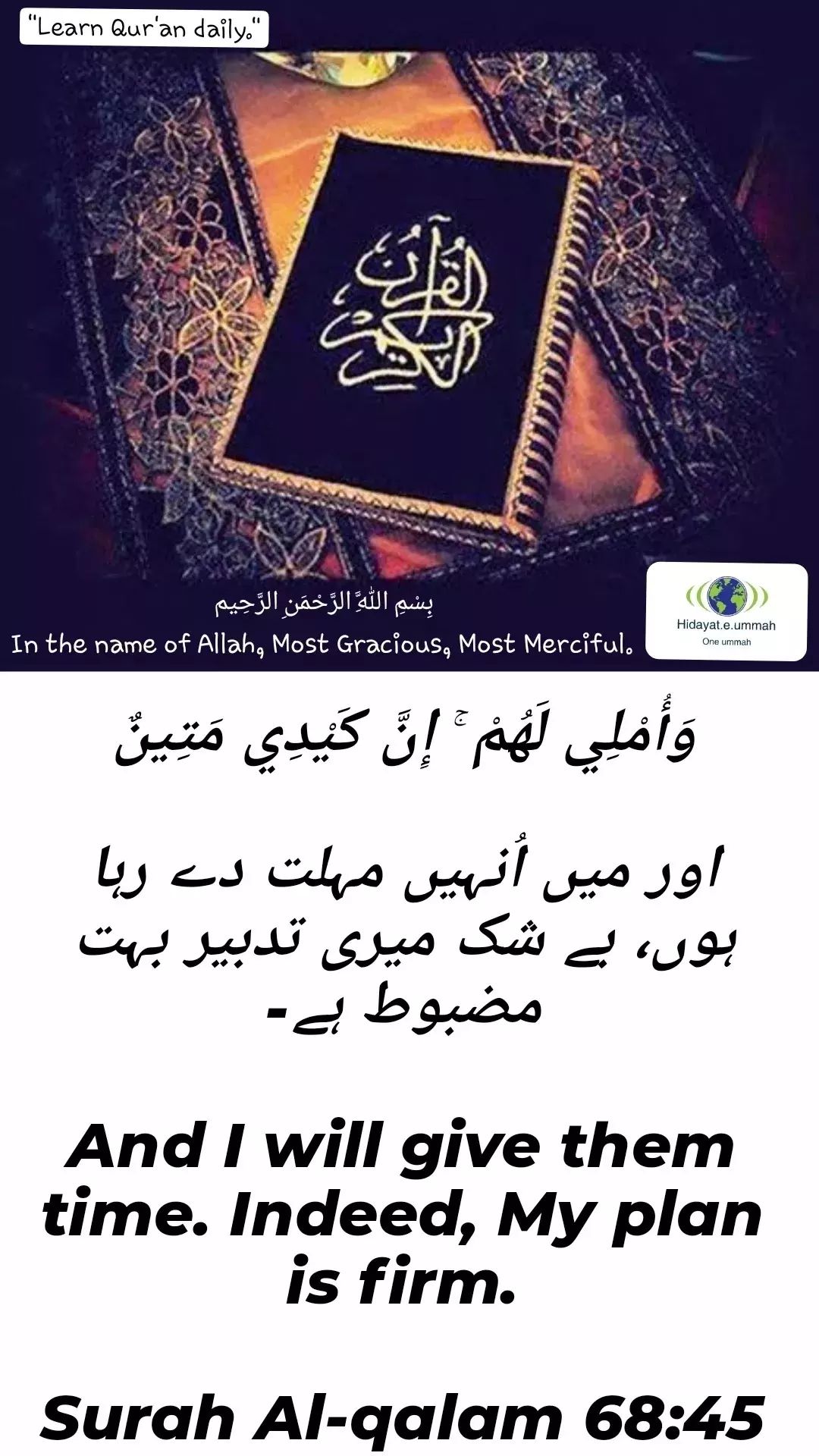
Surah Al-Qalam 68:45
**Translation:**
_And I will give them time. Indeed, My plan is firm._
**Explanation:**
This verse refers to Allah’s wisdom in allowing the disbelievers and wrongdoers time to repent and change, even as they persist in their misdeeds. Allah’s plan is always just and firm, meaning that He gives people opportunities for repentance, but His ultimate will and plan will be executed at the right time. It serves as a reminder that Allah’s judgment is certain and precise.
**Key Points:**
1. **Allah's Wisdom and Patience:**
- Allah allows time for individuals to turn back to Him, but His plan will ultimately prevail.
2. **Certainty of Allah's Plan:**
- No matter how long it takes, Allah's plan is inevitable, and His wisdom is beyond human understanding.
**Key Lessons:**
- Trust that Allah’s plan is just and perfectly timed.
- Do not be disheartened by the temporary delay in judgment or the apparent success of wrongdoers.
**Practical Reflection:**
- Keep faith that Allah is in control, and His plans are always best for His creation.
Hadith 45
45 of 68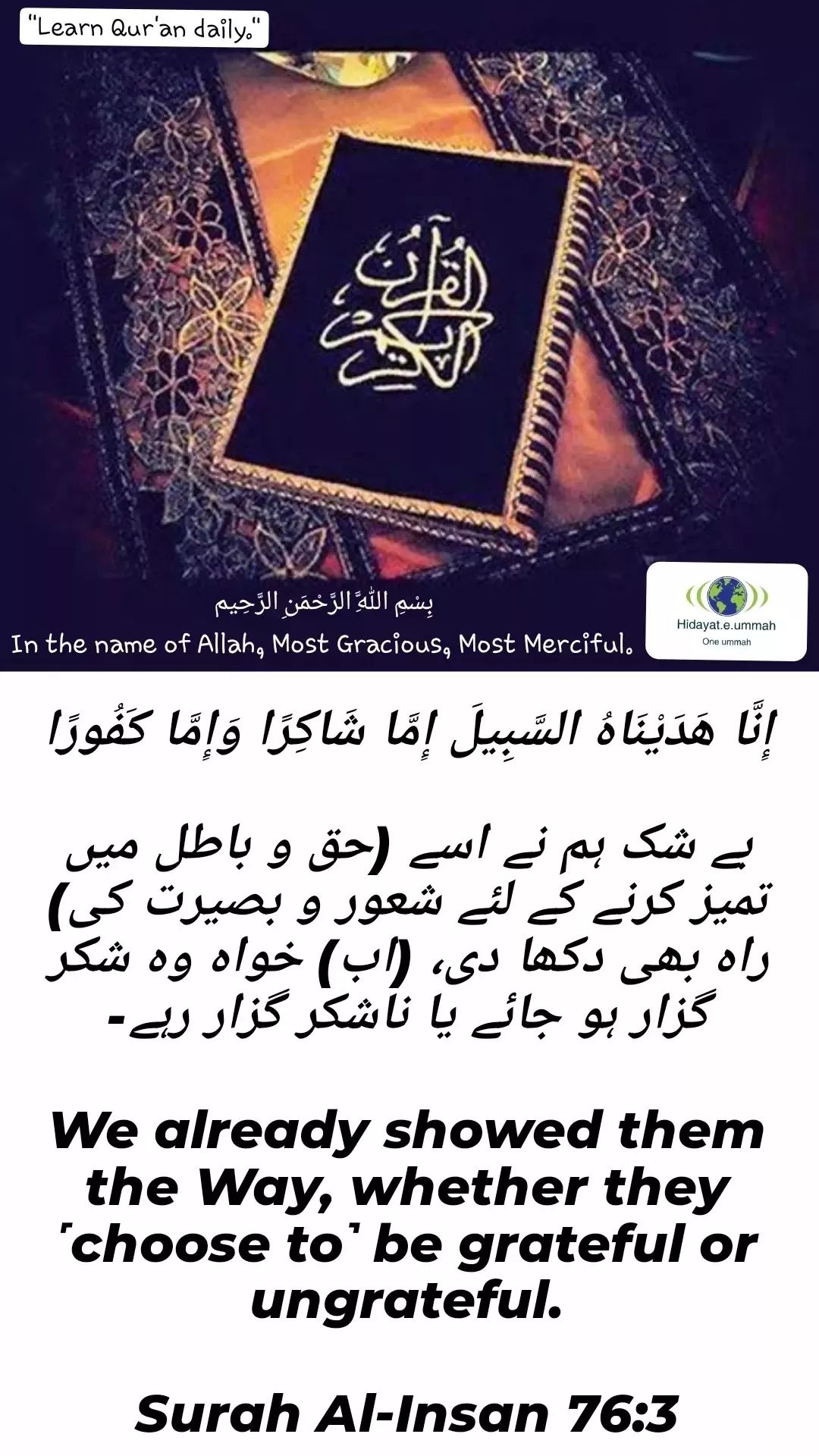
Surah Al-Insan 76:3
**Translation:**
_We already showed them the Way, whether they 'choose to' be grateful or ungrateful._
**Explanation:**
This verse highlights that Allah has clearly shown the path of guidance to all human beings. However, each individual has the free will to choose whether to be grateful for this guidance and follow it or to reject it and be ungrateful. It underscores the concept of free will and personal responsibility in accepting or rejecting the guidance of Allah.
**Key Points:**
1. **Divine Guidance:**
- Allah has provided clear guidance for all, but it is up to each person to choose their response.
2. **Free Will:**
- Humans have the free will to either accept or reject Allah’s guidance.
**Key Lessons:**
- Appreciate the guidance of Allah and strive to follow it with gratitude.
- Acknowledge the responsibility of personal choice in your faith journey.
**Practical Reflection:**
- Reflect on how you are responding to the guidance in your life and make a conscious effort to be grateful for Allah’s direction.
Hadith 46
46 of 68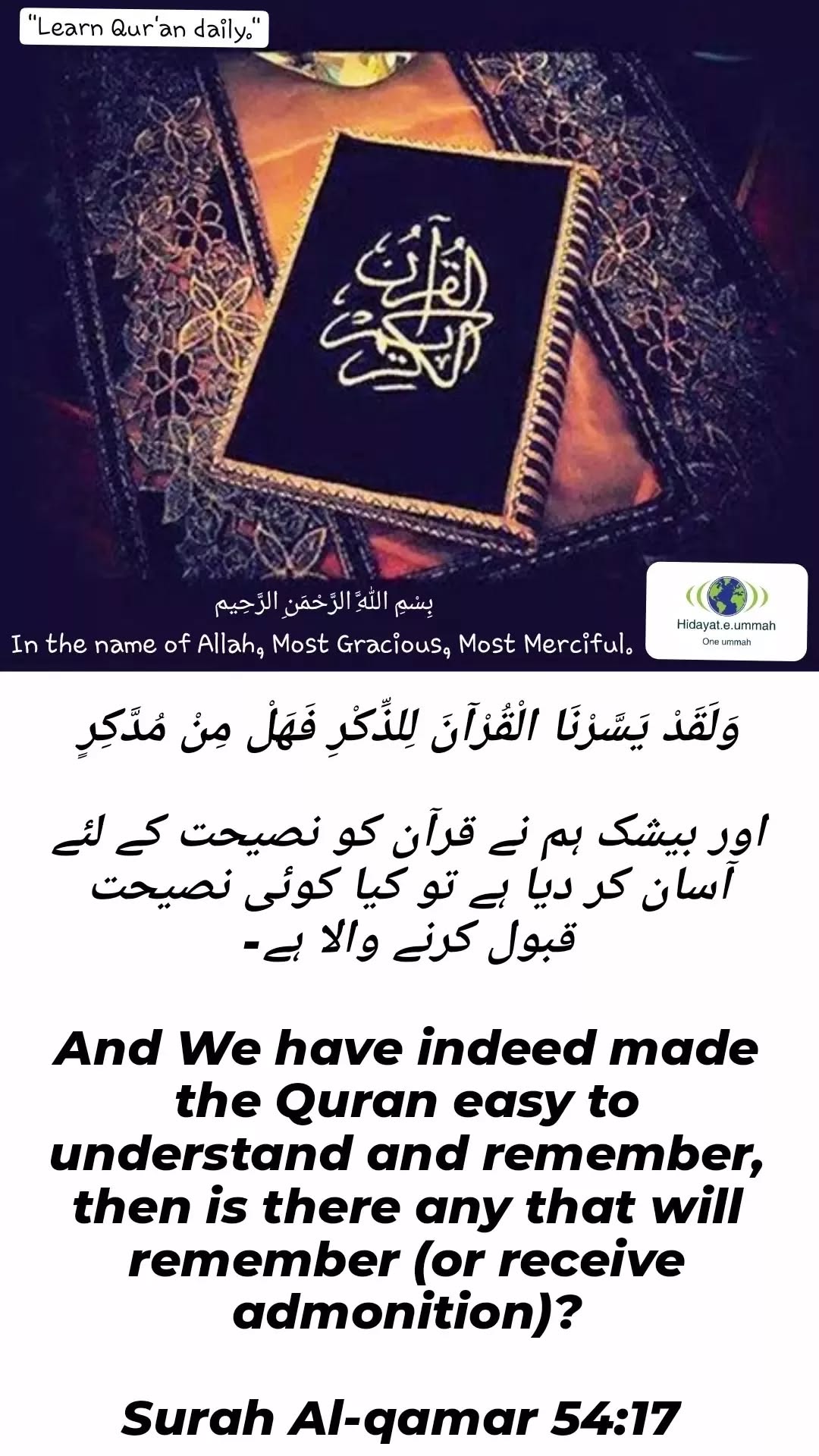
Surah Al-Qamar 54:40
**Translation:**
_And We have indeed made the Quran easy to understand and remember, then is there any that will remember (or receive admonition)?_
**Explanation:**
This verse emphasizes that the Quran has been made easy to understand and remember, yet it invites reflection on whether people will choose to heed its message and act upon it. Allah's guidance is clear and accessible, but it is up to individuals to reflect, understand, and take it to heart. The verse encourages believers to actively engage with the Quran and apply its teachings in their lives.
**Key Points:**
1. **Clarity of the Quran:**
- The Quran is made easy to understand for those who seek to reflect on it sincerely.
2. **Call to Reflection:**
- The verse challenges people to consider whether they will heed the message and take it to heart.
**Key Lessons:**
- Take time to understand and reflect on the Quran, as its teachings are clear and accessible.
- Strive to remember and apply the Quran’s guidance in daily life.
**Practical Reflection:**
- Dedicate time daily to reading and reflecting on the Quran to better understand its message and apply it in your life.
Hadith 47
47 of 68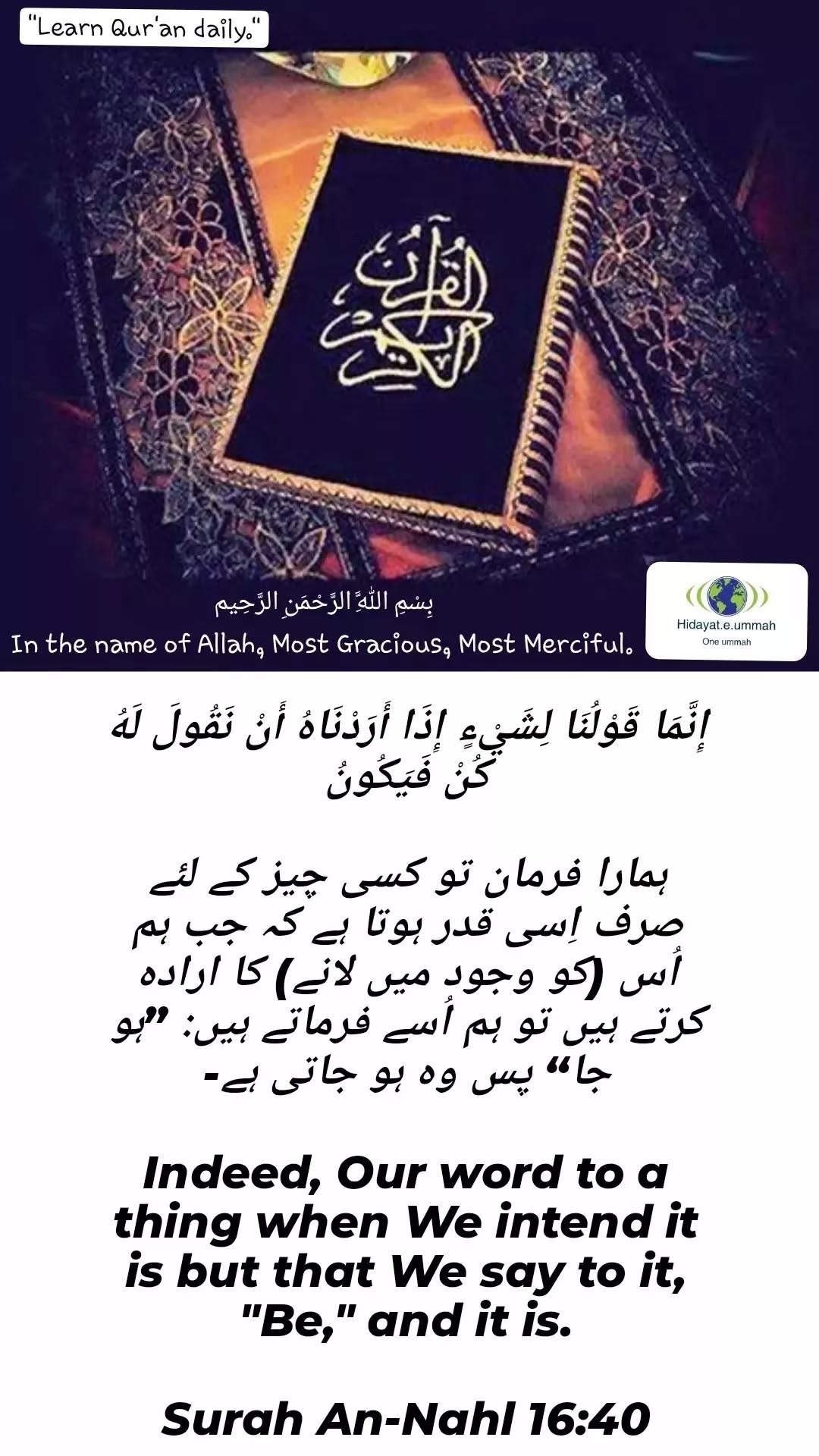
Surah An-Nahl 16:40
**Translation:**
_Indeed, Our word to a thing when We intend it is but that We say to it, 'Be,' and it is._
**Explanation:**
This verse highlights Allah’s absolute power and control over everything in existence. When Allah intends something, He simply commands it to exist by saying, 'Be,' and it comes into being immediately. This reflects the infinite authority and capability of Allah over His creation, and serves as a reminder of His omnipotence.
**Key Points:**
1. **Divine Command:**
- Allah's will is absolute, and His command is enough to bring anything into existence.
2. **Omnipotence of Allah:**
- The verse demonstrates the supreme power of Allah, who does not need effort or time to accomplish His will.
**Key Lessons:**
- Trust in Allah’s power to bring about His will, and recognize the limitations of human control.
- Reflect on the vastness of Allah’s authority over all creation.
**Practical Reflection:**
- Remind yourself daily that Allah’s power is limitless and that He can accomplish anything by His command.
Hadith 48
48 of 68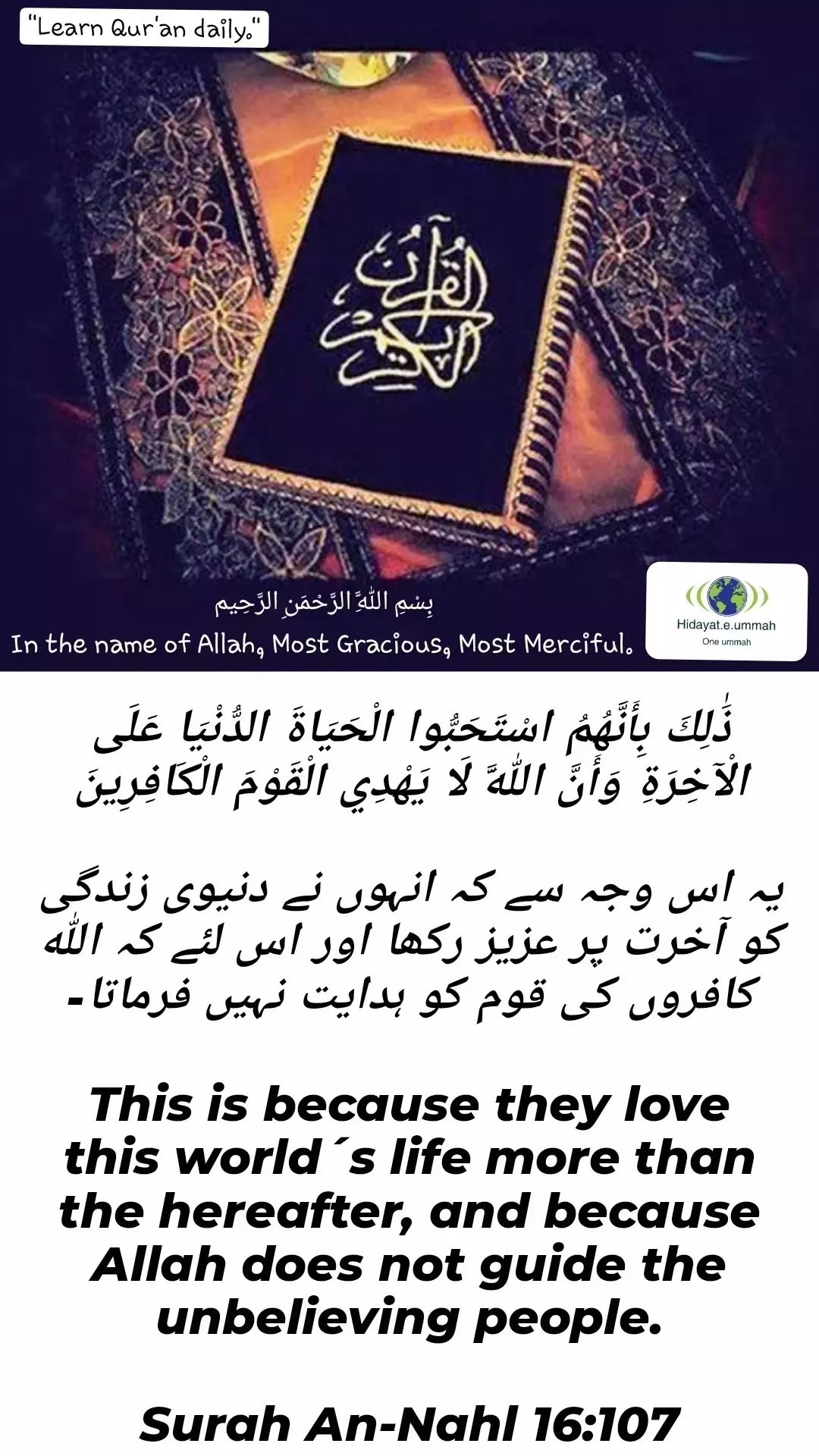
Surah An-Nahl 16:107
**Translation:**
_This is because they love this world's life more than the Hereafter, and because Allah does not guide the unbelieving people._
**Explanation:**
This verse explains that those who reject faith prioritize the temporary pleasures of this world over the eternal rewards of the Hereafter. Their love for worldly desires leads them to ignore the truth and guidance of Allah. Allah’s guidance is reserved for those who sincerely seek it, and those who turn away from belief remain lost. The verse warns against excessive attachment to this world, which can blind one to the higher purpose of life.
**Key Points:**
1. **Attachment to Worldly Life:**
- The love for worldly pleasures can distract individuals from seeking the eternal rewards of the Hereafter.
2. **Divine Guidance:**
- Allah guides those who seek His path, while those who reject faith remain without guidance.
**Key Lessons:**
- Do not become overly attached to worldly pleasures at the expense of your spiritual goals.
- Seek Allah’s guidance earnestly to find the right path.
**Practical Reflection:**
- Reflect on your priorities and ensure that your actions align with seeking the Hereafter rather than just fleeting worldly desires.
Hadith 49
49 of 68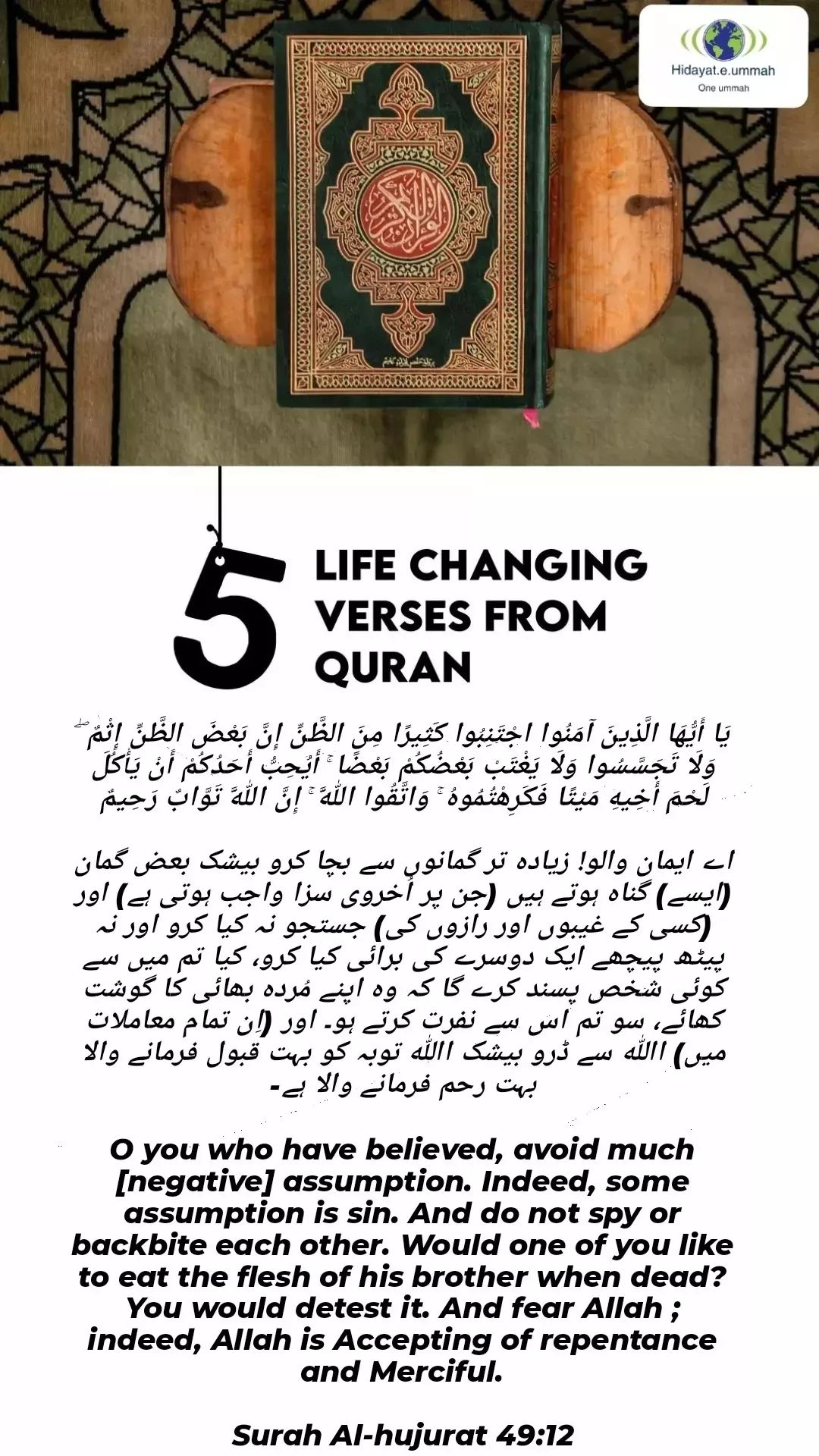
Surah Al-Hujurat 49:12
**Translation:**
_O you who have believed, avoid much [negative] assumption. Indeed, some assumption is sin. And do not spy or backbite each other. Would one of you like to eat the flesh of his brother when dead? You would detest it. And fear Allah; indeed, Allah is Accepting of repentance and Merciful._
**Explanation:**
This verse advises the believers to avoid negative assumptions, spying, and backbiting, all of which harm relationships and create division. The metaphor of eating the flesh of a dead brother illustrates the deep repugnance of backbiting. It emphasizes that such behavior is sinful, and Allah warns the believers to fear Him and be mindful of their actions. However, Allah is merciful and will accept repentance from those who turn to Him in sincerity.
**Key Points:**
1. **Avoid Negative Assumptions:**
- Negative thinking and making assumptions about others can lead to sin and discord.
2. **Do Not Backbite or Spy:**
- Backbiting and spying on others are highly discouraged in Islam and are likened to a repulsive act.
3. **Allah's Mercy:**
- Allah is merciful and will accept repentance from those who seek forgiveness.
**Key Lessons:**
- Be cautious of making assumptions or speaking ill of others behind their backs.
- Foster positive relationships based on trust and understanding.
- Turn to Allah for forgiveness if you fall into these sins, knowing He is Merciful.
**Practical Reflection:**
- Check your thoughts and words before acting on assumptions or engaging in gossip.
- Practice speaking well of others and avoid the temptation to backbite or spy.
Hadith 50
50 of 68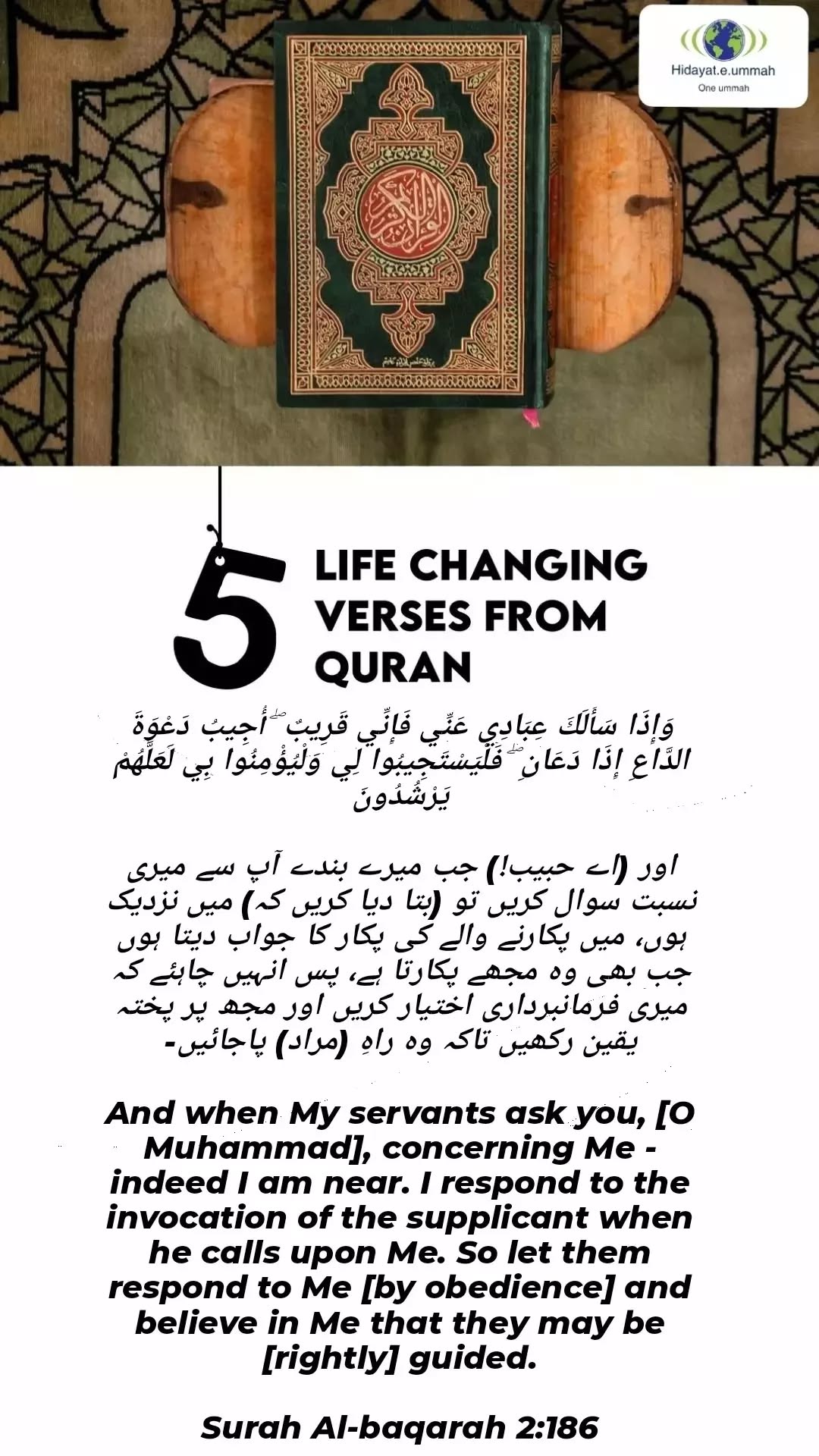
Surah Al-Baqarah 2:186
**Translation:**
_And when My servants ask you, O Muhammad, concerning Me – indeed, I am near. I respond to the invocation of the supplicant when he calls upon Me. So let them respond to Me [by obedience] and believe in Me that they may be [rightly] guided._
**Explanation:**
This verse assures the believers of Allah's closeness and His readiness to respond to their supplications. Allah is always near to His servants and listens to their prayers. It emphasizes the importance of both calling upon Allah in sincere supplication and responding to His guidance through obedience and belief. True guidance is found through submission to Allah and trust in His mercy.
**Key Points:**
1. **Allah’s Proximity:**
- Allah is near to His believers and listens to their prayers, always ready to respond.
2. **Obedience and Belief:**
- In order to receive Allah’s guidance, believers must respond to His call with obedience and faith.
**Key Lessons:**
- Trust in the nearness of Allah and approach Him in supplication with sincerity.
- Obey Allah’s commands and believe in His guidance to be rightly guided in life.
**Practical Reflection:**
- Make a habit of turning to Allah with your supplications, knowing He is always near and ready to answer.
- Strengthen your faith and strive to live in obedience to Allah's guidance.
Hadith 51
51 of 68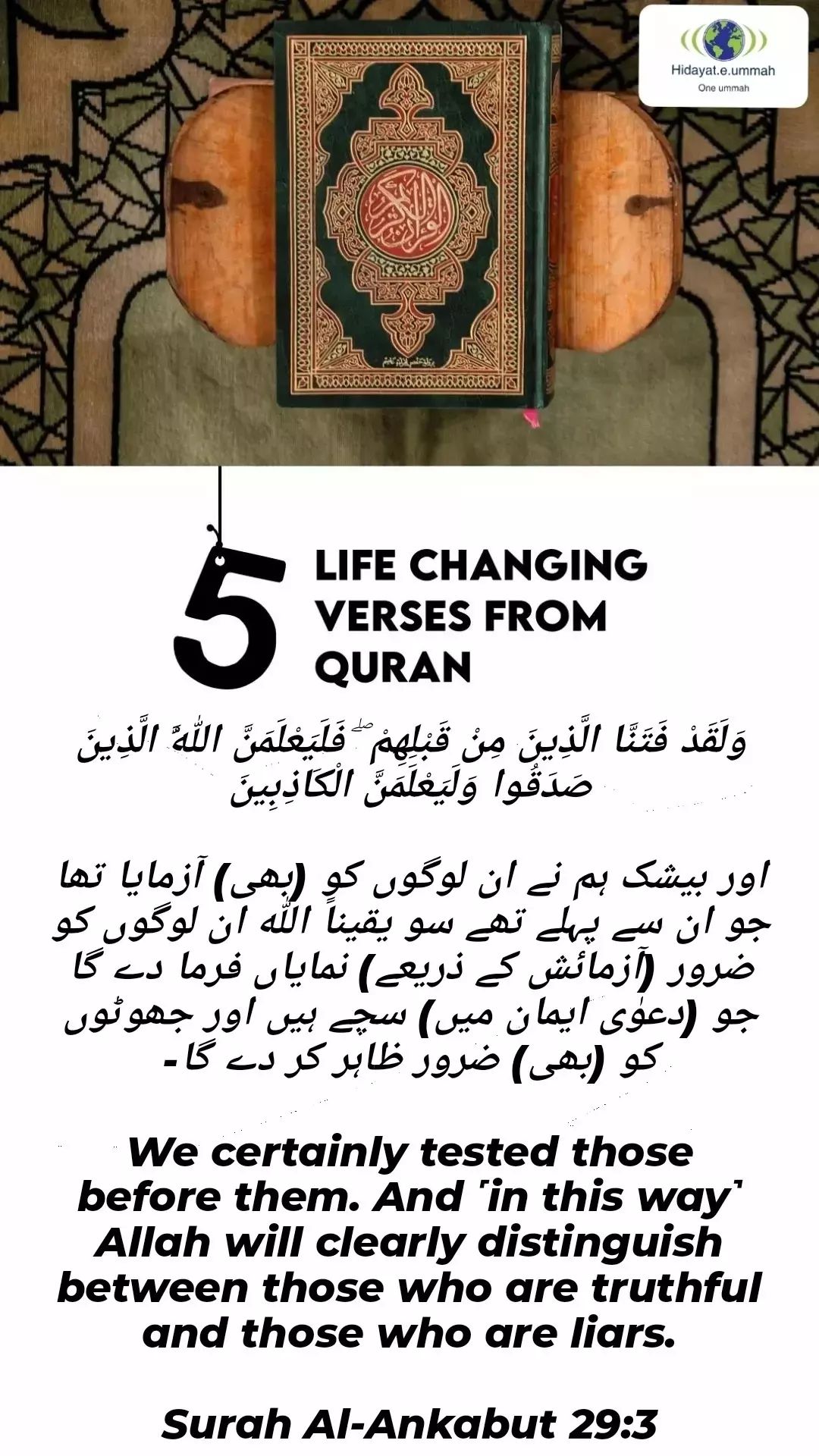
Surah Al-Ankabut 29:3
**Translation:**
_We certainly tested those before them. And in this way, Allah will clearly distinguish between those who are truthful and those who are liars._
**Explanation:**
This verse highlights that Allah tests all believers through challenges and trials. These tests are not only a means of purification but also serve to distinguish between those who are sincere in their faith and those who are insincere. Just as previous communities were tested, the true nature of people's faith becomes clear through these trials. The verse encourages patience and sincerity in facing difficulties, knowing that Allah sees and rewards the truth.
**Key Points:**
1. **Trials as a Test of Faith:**
- Life’s challenges are tests that help distinguish the true believers from the ones who lack sincerity.
2. **Allah’s Wisdom in Testing:**
- Allah uses trials to purify His servants and reveal the sincerity of their faith.
**Key Lessons:**
- Understand that trials are a part of life and a means to strengthen your faith.
- Be patient and steadfast, knowing that Allah will reward those who remain truthful.
**Practical Reflection:**
- When faced with difficulty, remember that it is an opportunity to prove your sincerity to Allah.
- Reflect on your response to challenges and strive to remain truthful in your faith and actions.
Hadith 52
52 of 68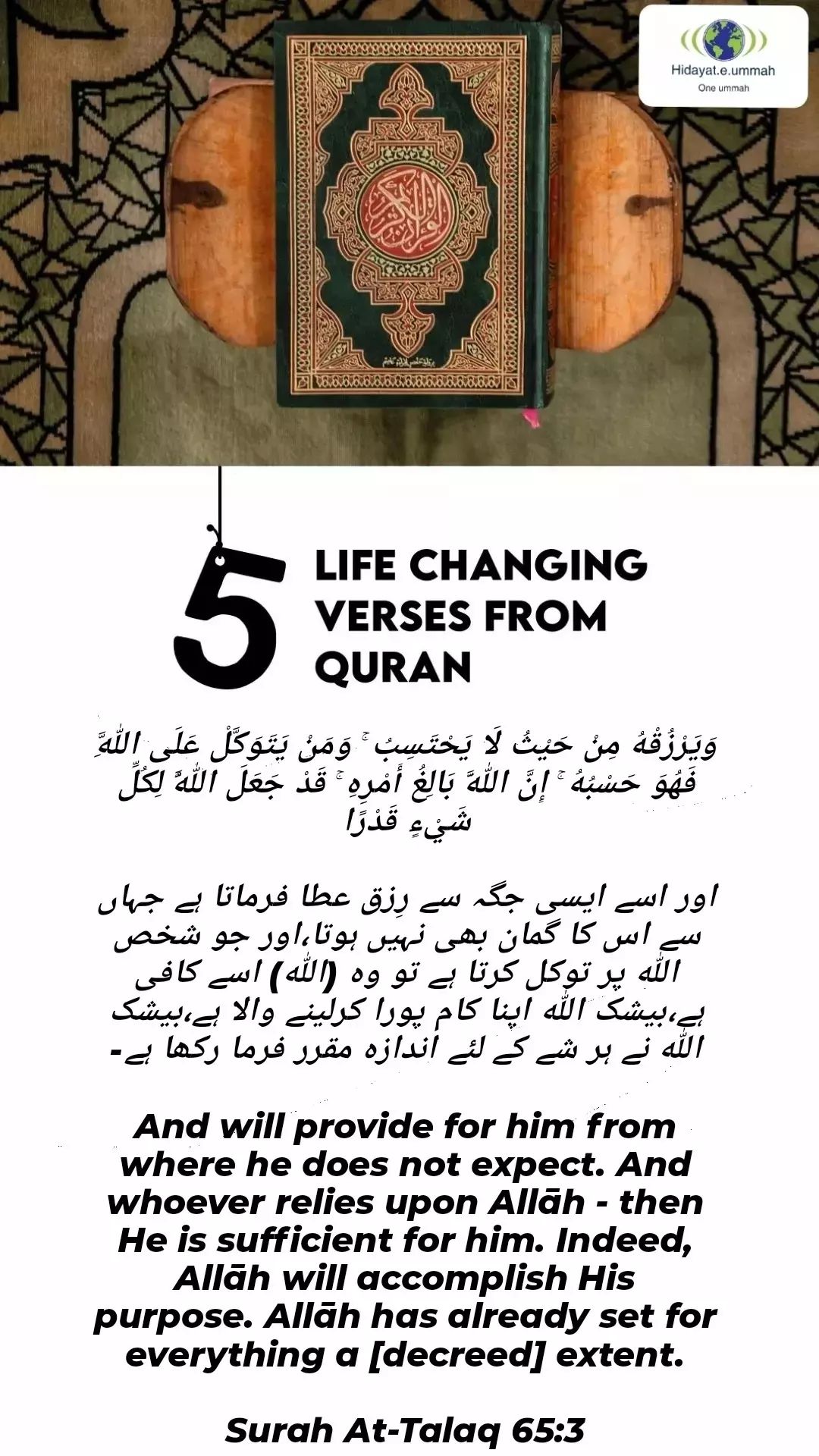
Surah At-Talaq 65:3
**Translation:**
_And will provide for him from where he does not expect. And whoever relies upon Allah – then He is sufficient for him. Indeed, Allah will accomplish His purpose. Allah has already set for everything a decreed extent._
**Explanation:**
This verse emphasizes the importance of trusting in Allah’s provision and relying on Him completely. Allah provides for His servants in ways they may not anticipate, and those who place their trust in Him will find that He is enough to meet all their needs. Allah’s plans are already set, and everything unfolds according to His wisdom and decree. The verse encourages complete reliance on Allah while trusting that He will fulfill His purpose and provide in ways beyond human comprehension.
**Key Points:**
1. **Unseen Provision:**
- Allah provides for His servants in unexpected ways, demonstrating His boundless generosity and wisdom.
2. **Reliance on Allah:**
- Trusting Allah fully means knowing that He is sufficient to handle all matters in life.
3. **Divine Decree:**
- Everything in life happens according to Allah’s plan and decree.
**Key Lessons:**
- Put your full trust in Allah, knowing that He will provide for you in ways you cannot foresee.
- Be patient and content with Allah’s decrees, trusting that His plan is always for the best.
**Practical Reflection:**
- Reflect on areas of your life where you can rely more on Allah and trust in His provisions.
- Whenever facing uncertainty, remind yourself that Allah is sufficient for you.
Hadith 53
53 of 68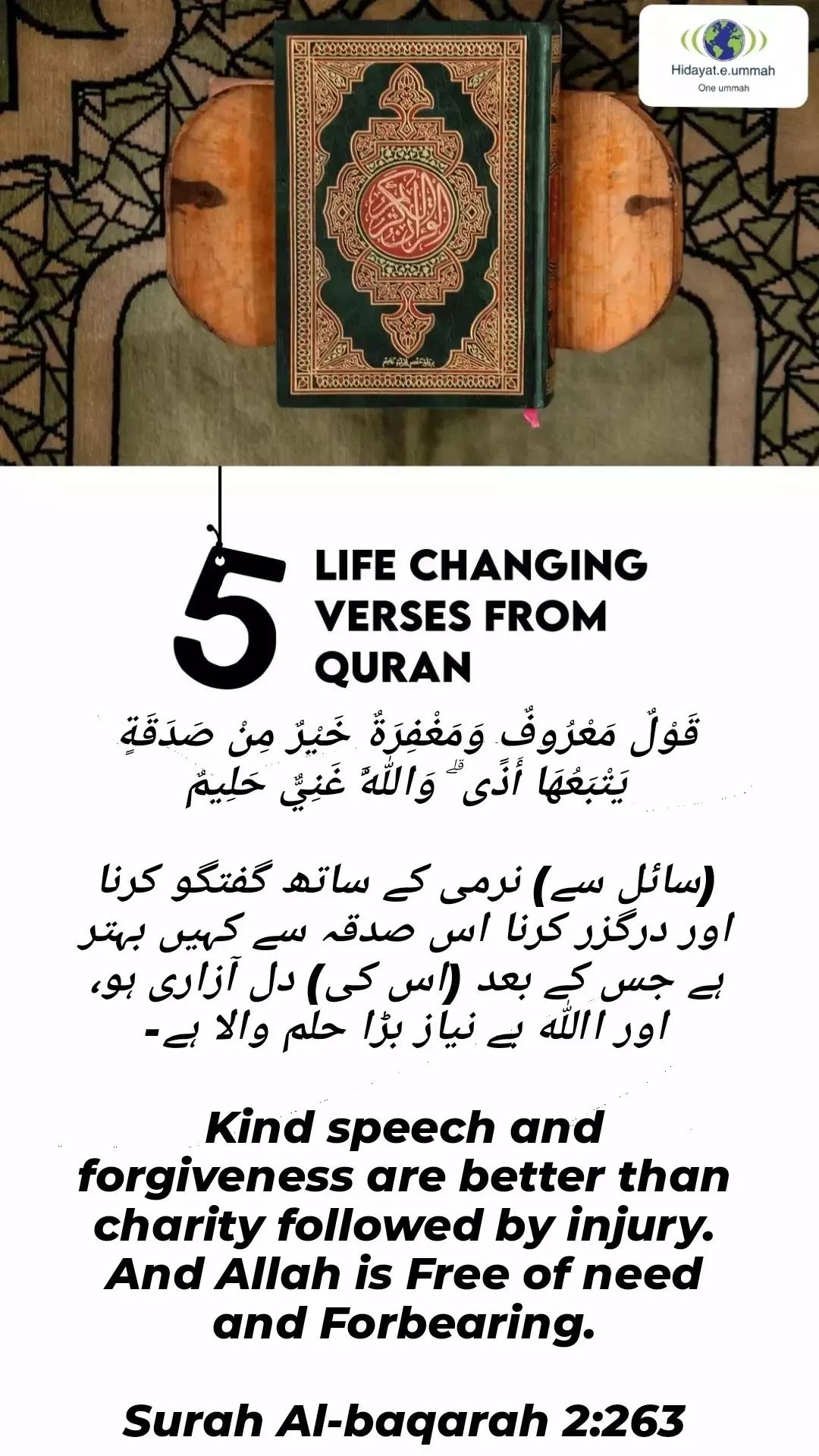
Surah Al-Baqarah 2:263
**Translation:**
_Kind speech and forgiveness are better than charity followed by injury. And Allah is Free of need and Forbearing._
**Explanation:**
This verse teaches that kindness and forgiveness hold greater value than giving charity and then harming others through negative words or actions. Allah values sincerity and purity of intention over acts of charity that are followed by harm or hurtful behavior. The verse encourages believers to offer charity with a good heart, without expecting anything in return or causing harm afterward. Allah, in His infinite wisdom, does not need our charity, but He appreciates goodness and patience in dealing with others.
**Key Points:**
1. **Kindness Over Charity with Harm:**
- Acts of kindness and forgiveness are more virtuous than giving charity if it causes harm or hurt afterward.
2. **Allah's Forbearance:**
- Allah is patient and does not need our charity, but He values good conduct and a pure heart.
**Key Lessons:**
- Give charity with good intentions and without expecting anything in return.
- Prioritize kindness and forgiveness in your interactions over the material acts of giving.
**Practical Reflection:**
- Practice kindness in your words and actions, especially when giving charity.
- Reflect on your intentions when helping others and strive to act without causing harm afterward.
Hadith 54
54 of 68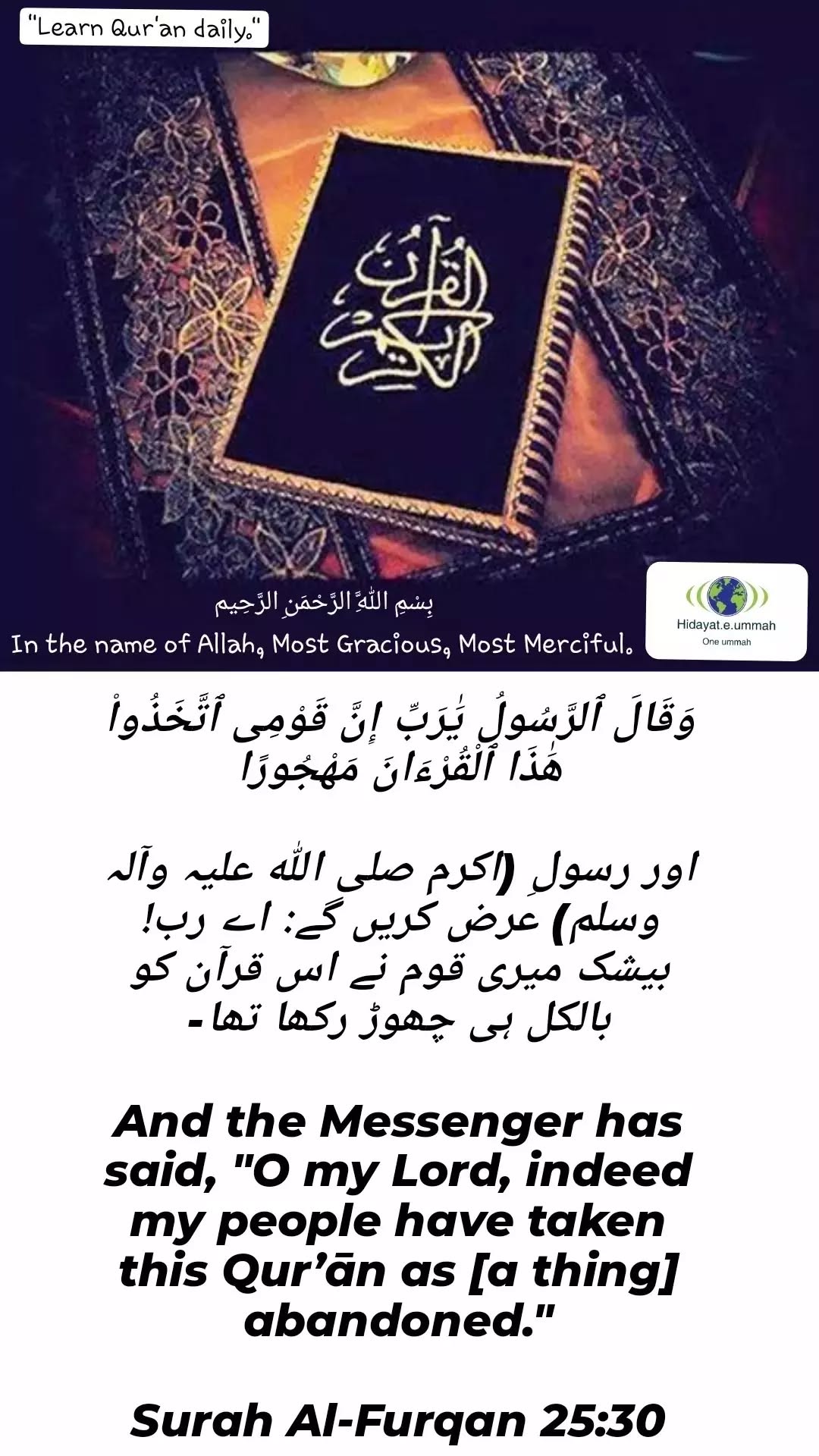
Surah Al-Furqan 25:30
**Translation:**
_And the Messenger has said, 'O my Lord, indeed my people have taken this Qur'an as [a thing] abandoned.'_
**Explanation:**
In this verse, the Prophet Muhammad (peace be upon him) laments that his people have neglected the Qur'an. Despite the Qur'an being a divine guidance, many have ignored or abandoned it, not fully utilizing its teachings. This verse expresses the sorrow of the Prophet as he witnessed the disregard for the Qur'an by his people. It serves as a reminder to Muslims to cherish and follow the guidance found in the Qur'an, rather than abandoning it or taking it lightly.
**Key Points:**
1. **Neglect of the Qur'an:**
- The verse highlights how some people turn away from the Qur'an, neglecting its message and guidance.
2. **Prophet’s Sorrow:**
- The Prophet’s grief is shown in his plea to Allah, seeking help for those who have abandoned the Qur'an.
**Key Lessons:**
- Do not neglect the Qur'an, as it is the ultimate guidance for believers.
- Reflect on your relationship with the Qur'an and make it a part of your daily life.
**Practical Reflection:**
- Make time to read, reflect, and implement the teachings of the Qur'an in your life.
- Share the message of the Qur'an with others and encourage them to engage with it.
Hadith 55
55 of 68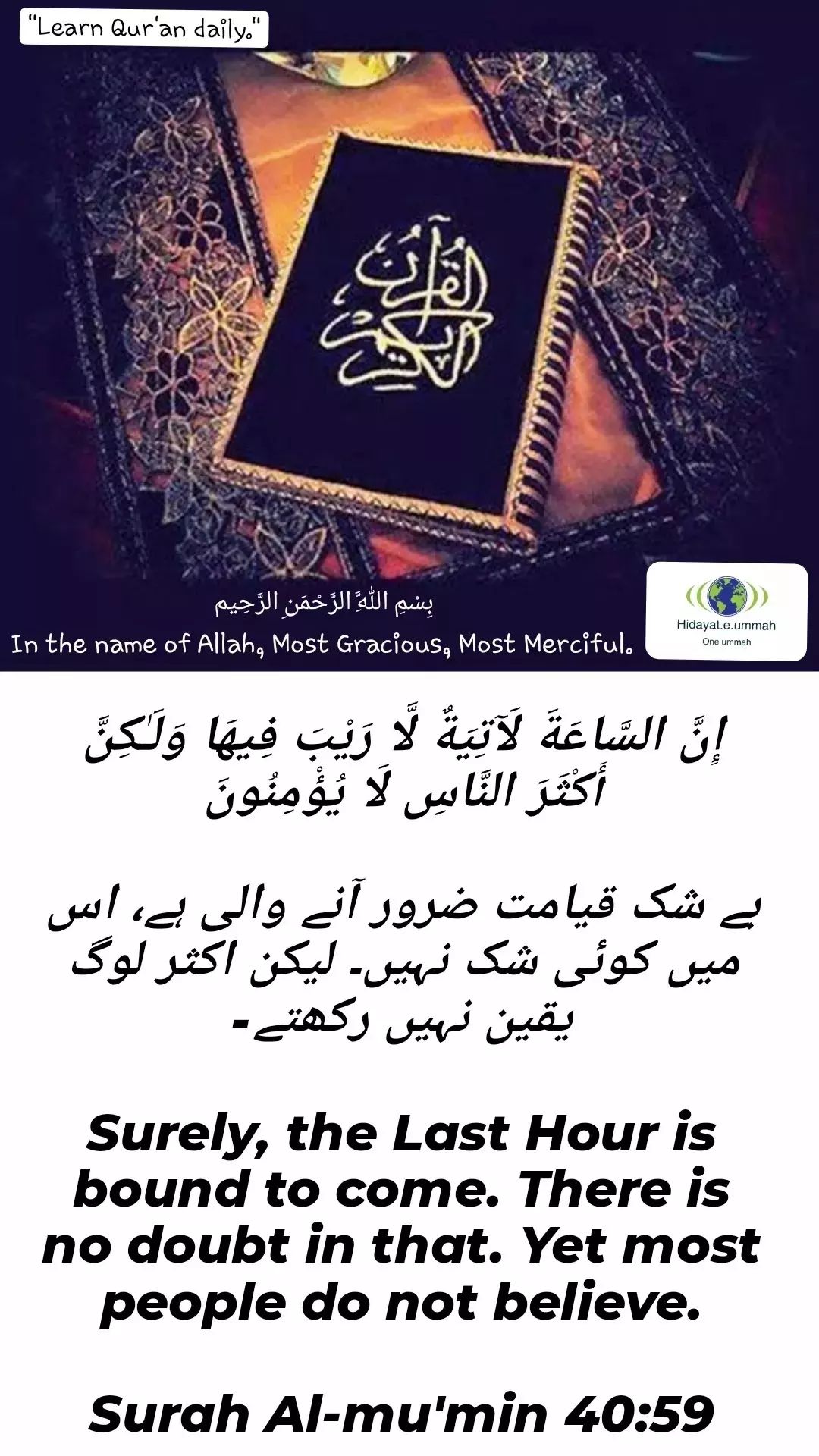
Surah Al-Mu'min 40:59
**Translation:**
_Surely, the Last Hour is bound to come. There is no doubt in that. Yet most people do not believe._
**Explanation:**
This verse affirms the certainty of the coming of the Last Hour (the Day of Judgment), a reality that all will face. Despite this certainty, many people remain in denial or disbelief, ignoring the truth and the inevitable reality of the end of the world.
**Key Points:**
1. **Certainty of the Last Hour:**
- The Day of Judgment is certain, and it will surely come.
2. **Disbelief Among Many:**
- Despite its certainty, many people do not believe in or prepare for the Last Hour.
**Key Lesson:**
- Acknowledge the reality of the Last Hour and live with awareness of the afterlife.
**Practical Reflection:**
- Reflect on how the awareness of the Last Hour can influence your actions and faith.
Hadith 56
56 of 68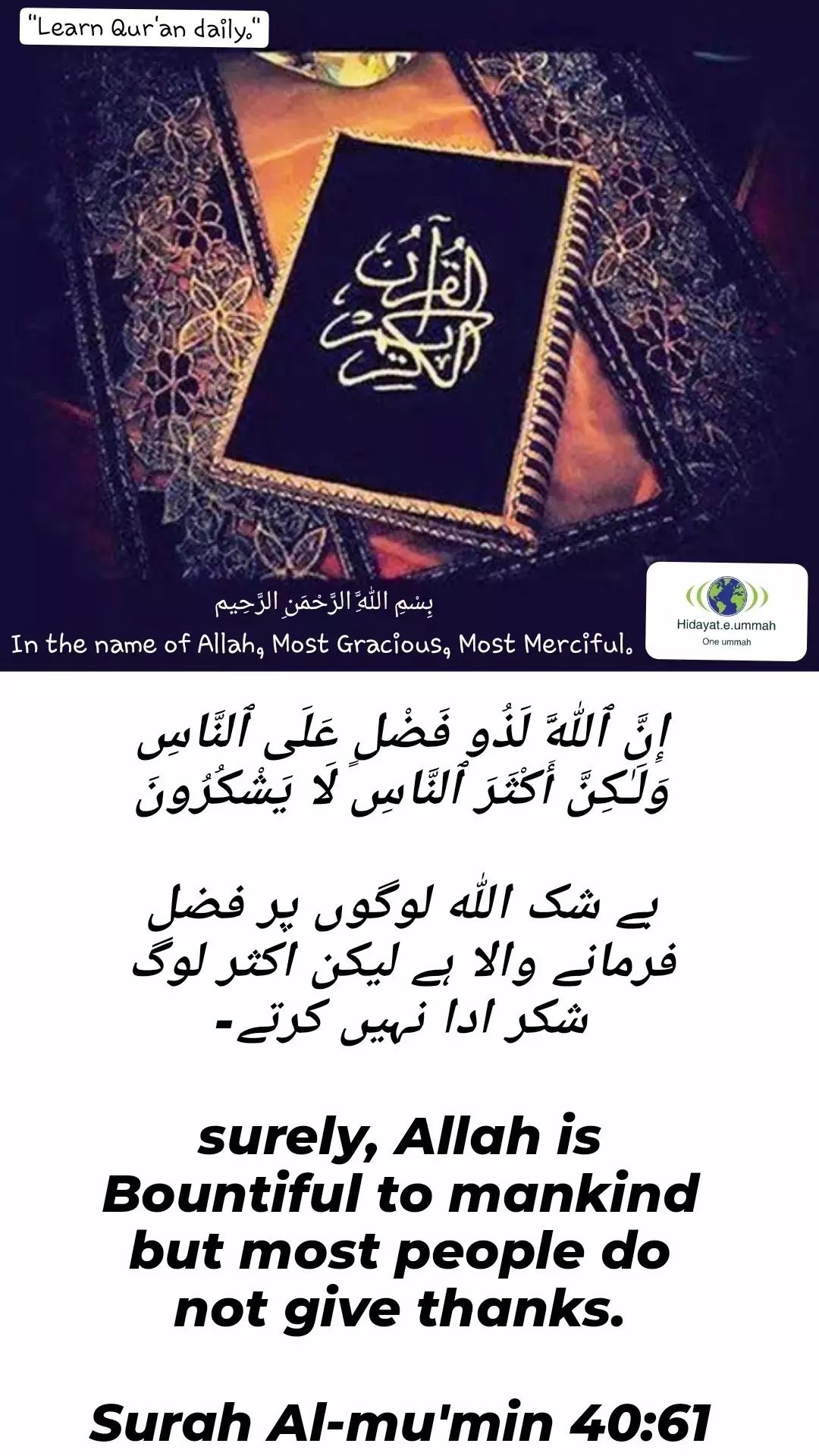
Surah Al-Mu'min 40:67
**Translation:**
_Surely, Allah is Bountiful to mankind, but most people do not give thanks._
**Explanation:**
This verse reminds us that Allah, in His infinite mercy and generosity, continually provides blessings to humanity. Despite Allah's abundant kindness, the majority of people fail to express gratitude or acknowledge His favors. It encourages believers to reflect on the countless blessings they receive from Allah and to be thankful for them.
**Key Points:**
1. **Allah's Generosity:**
- Allah is constantly bestowing blessings upon mankind, from the smallest to the greatest gifts.
2. **Lack of Gratitude:**
- Despite these blessings, many people do not show appreciation or thank Allah for His mercy.
**Key Lesson:**
- Be mindful of the blessings in your life and regularly show gratitude to Allah for His generosity.
**Practical Reflection:**
- Take time each day to thank Allah for the blessings you have, both big and small.
Hadith 57
57 of 68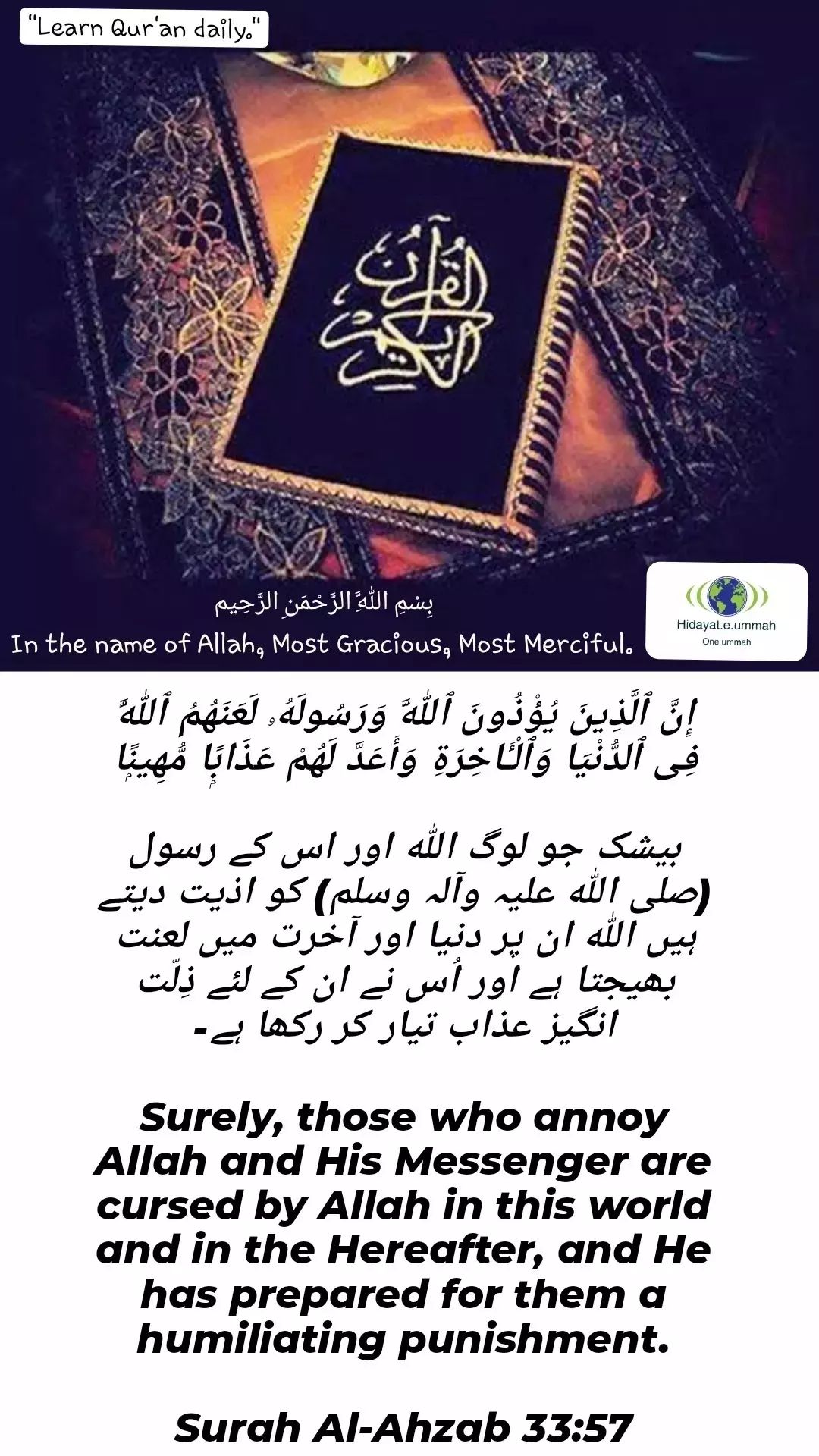
Surah Al-Ahzab 33:57
**Translation:**
_Surely, those who annoy Allah and His Messenger are cursed by Allah in this world and in the Hereafter, and He has prepared for them a humiliating punishment._
**Explanation:**
This verse highlights the serious consequences for those who harm or disrespect Allah and His Messenger. Such individuals are cursed both in this world and the Hereafter, and Allah has prepared for them a severe punishment. It serves as a warning to avoid actions or words that disrespect the sacredness of Allah's name and the honor of His Messenger.
**Key Points:**
1. **Seriousness of Disrespecting Allah and His Messenger:**
- Those who harm or annoy Allah and His Messenger face grave consequences in both this world and the Hereafter.
2. **Punishment for Harmful Actions:**
- Allah has reserved a humiliating punishment for those who disrespect His Messenger.
**Key Lesson:**
- Always honor Allah and His Messenger, avoiding actions that might bring harm or disrespect to their sacred names.
**Practical Reflection:**
- Strive to speak and act with respect toward Allah and His Messenger in all aspects of your life.
Hadith 58
58 of 68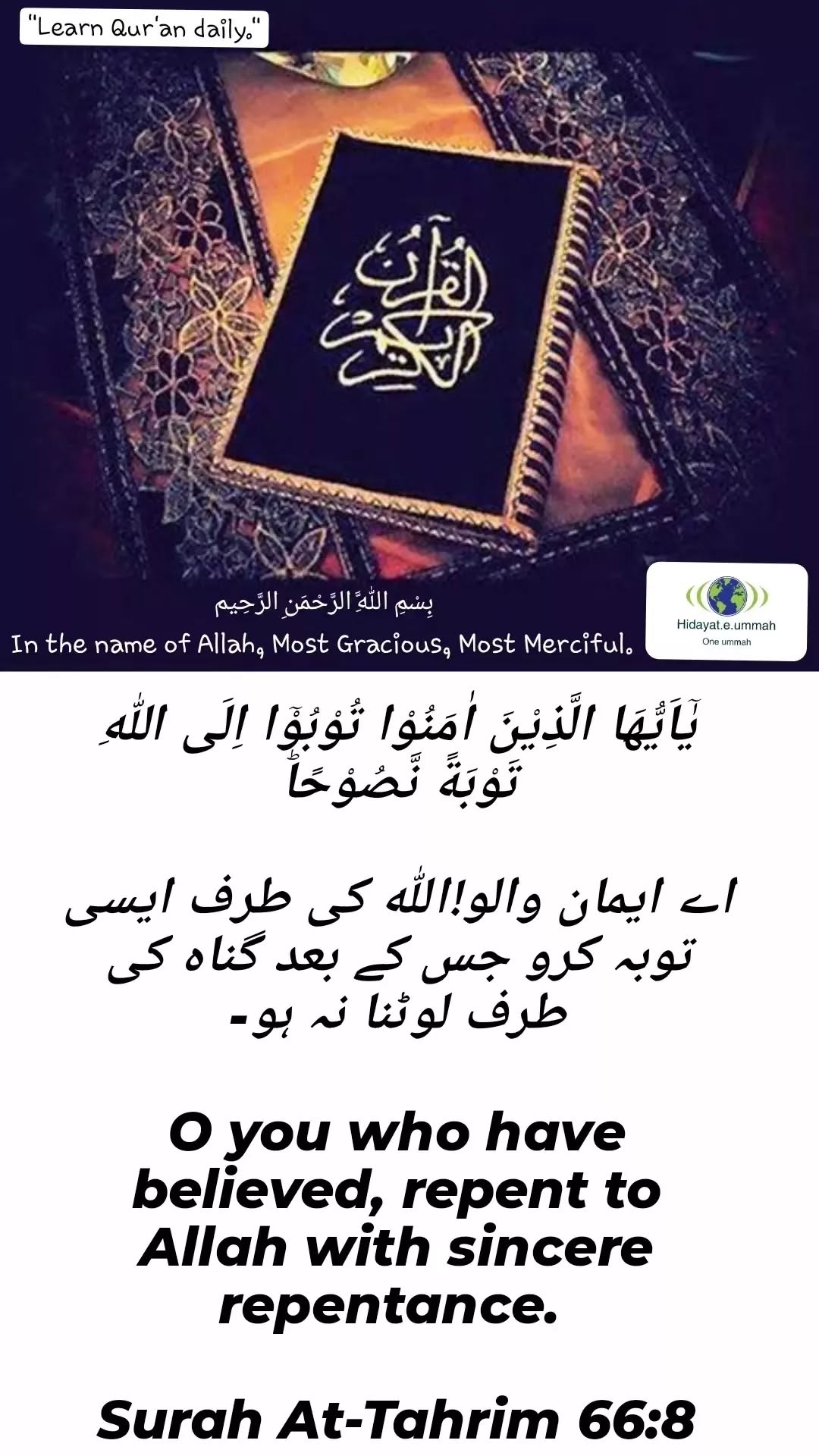
Surah At-Tahrim 66:8
**Translation:**
_O you who have believed, repent to Allah with sincere repentance._
**Explanation:**
This verse calls upon the believers to repent to Allah sincerely, acknowledging their wrongdoings and seeking His forgiveness with a pure heart. It emphasizes the importance of turning to Allah in repentance, recognizing His mercy and forgiveness.
**Key Points:**
1. **Sincerity in Repentance:**
- True repentance requires sincerity and a genuine desire to seek forgiveness from Allah.
2. **Allah's Mercy:**
- Allah is always ready to forgive those who truly repent.
**Key Lesson:**
- Repent sincerely and turn to Allah with a pure heart, knowing that He is most merciful.
**Practical Reflection:**
- Regularly seek forgiveness from Allah and strive to improve your actions and intentions.
Hadith 59
59 of 68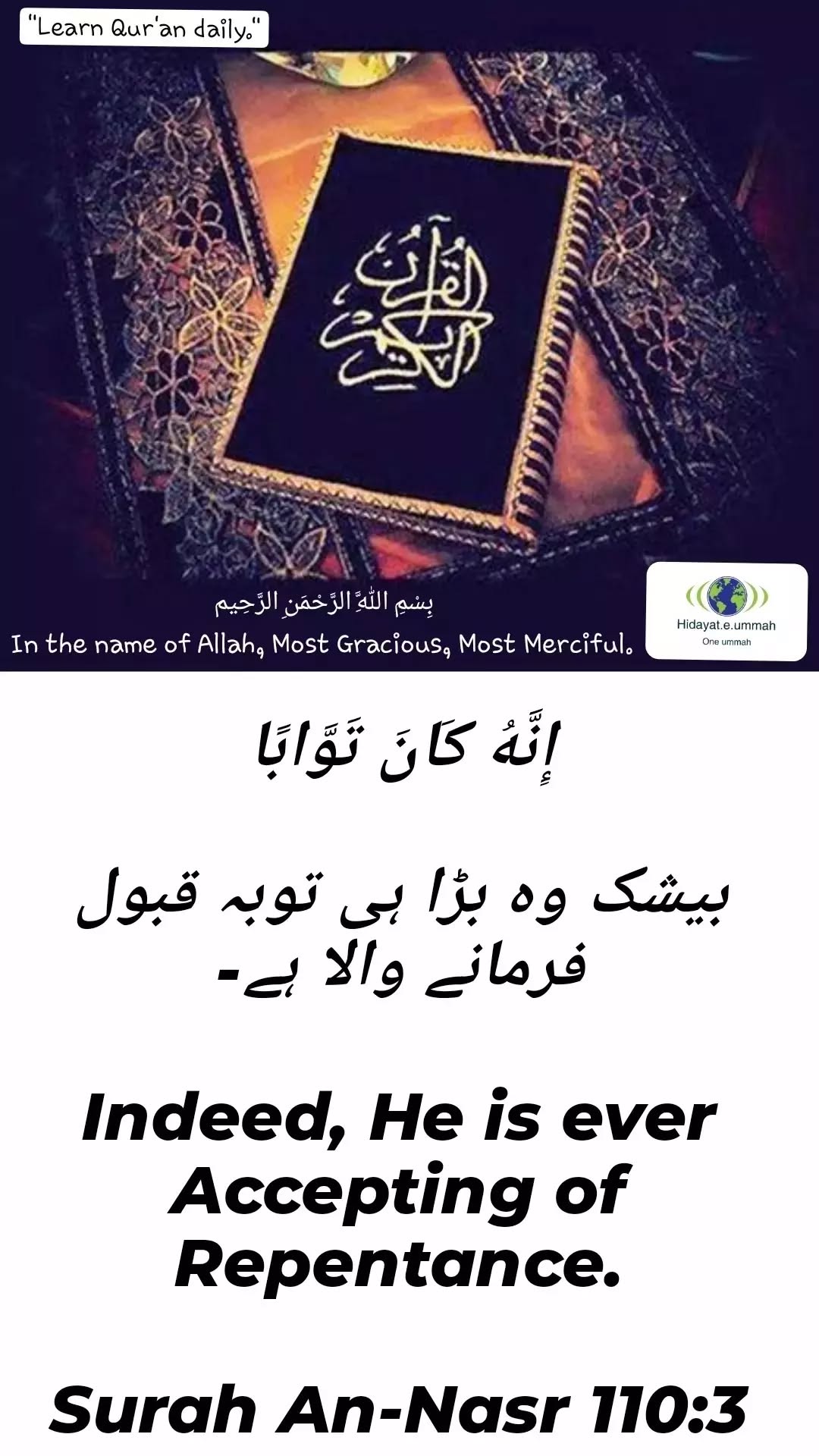
Surah An-Nasr 110:3
**Translation:**
_Indeed, He is ever Accepting of Repentance._
**Explanation:**
This verse reminds that Allah is always ready to accept the repentance of those who turn to Him with sincerity.
**Key Lesson:**
- Always seek forgiveness from Allah, knowing He is merciful and accepting of repentance.
Hadith 60
60 of 68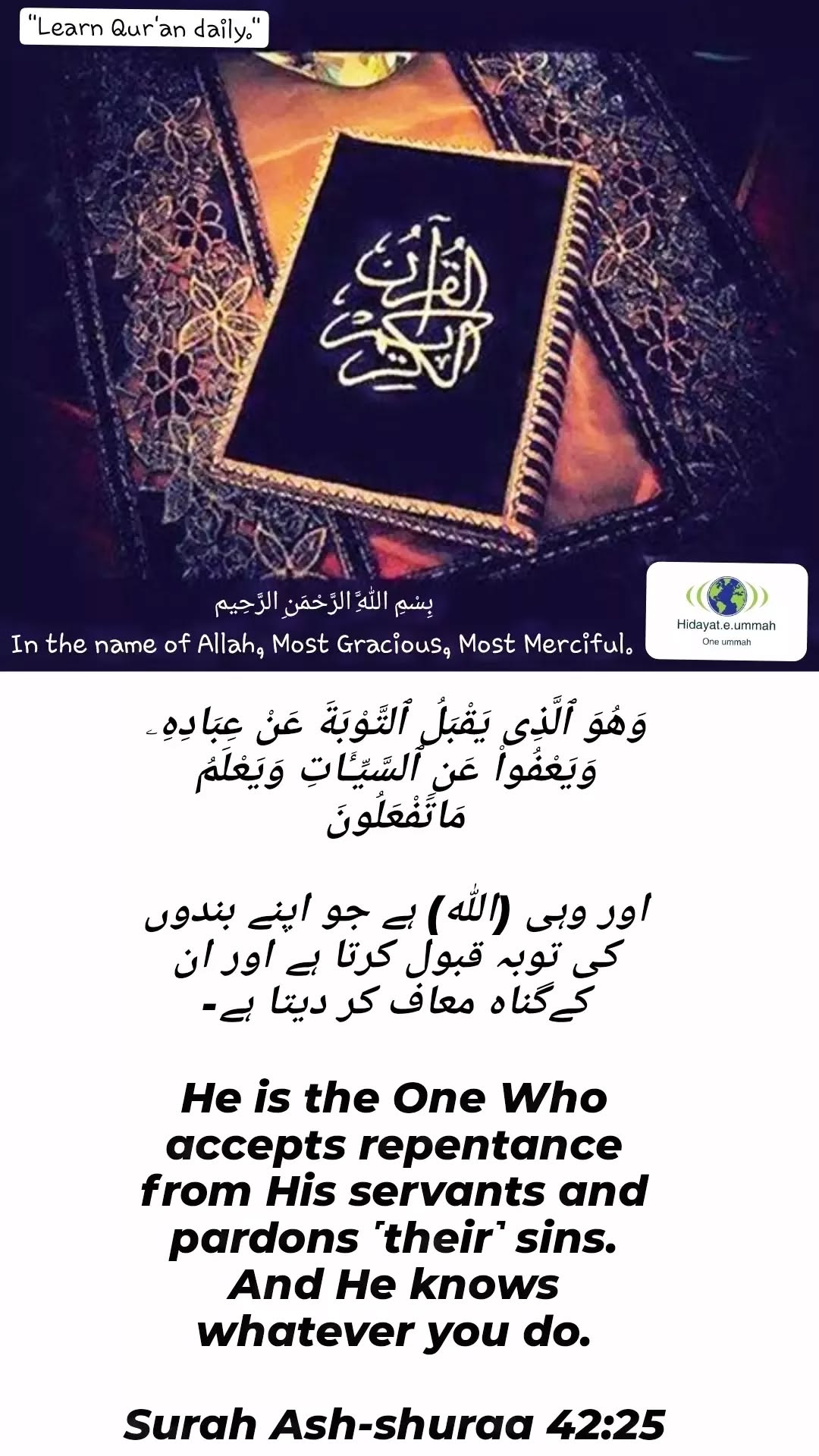
Surah Ash-Shuraa 42:25
**Translation:**
_He is the One Who accepts repentance from His servants and pardons their sins. And He knows whatever you do._
**Explanation:**
This verse emphasizes that Allah is the One who accepts the repentance of His servants and forgives their sins. No matter what wrongs a person has committed, Allah’s mercy and forgiveness are vast, and He knows everything, including our intentions and actions.
**Key Points:**
1. **Acceptance of Repentance:**
- Allah is always ready to accept the repentance of those who turn to Him sincerely.
2. **Forgiveness of Sins:**
- Allah forgives the sins of those who seek His pardon.
**Key Lesson:**
- Never despair in seeking Allah’s forgiveness, as He is always willing to forgive.
**Practical Reflection:**
- Make regular repentance a habit, knowing that Allah’s mercy is greater than any sin.
Hadith 61
61 of 68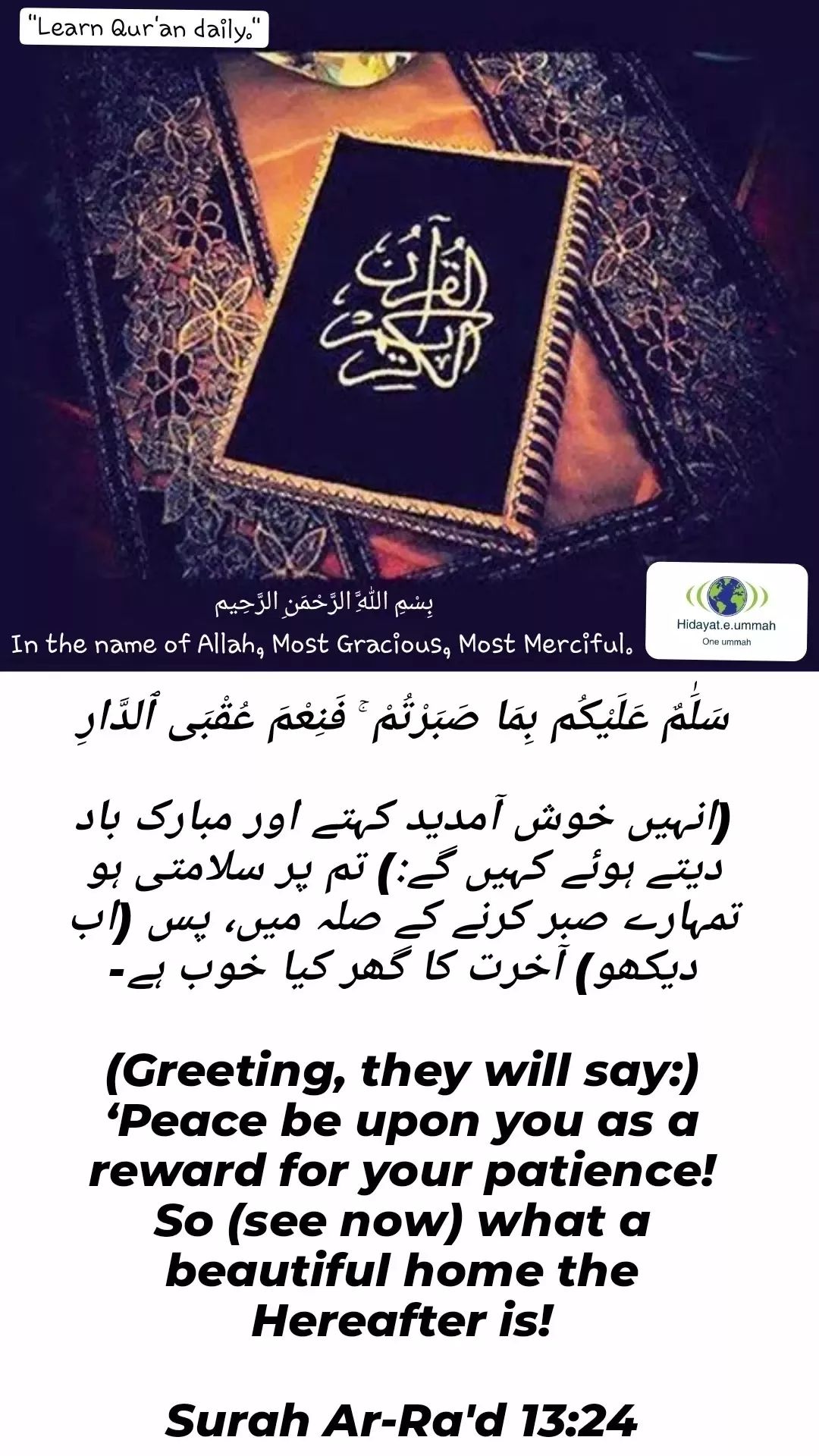
Surah Ar-Ra'd 13:24
**Translation:**
_Greeting, they will say: 'Peace be upon you as a reward for your patience! So (see now) what a beautiful home the Hereafter is!'_
**Explanation:**
This verse speaks of the reward in the Hereafter for those who endure patiently in the face of trials and hardships. The angels will greet them with peace as a reward for their patience, and they will be shown the beauty of their eternal home in Paradise.
**Key Points:**
1. **Reward for Patience:**
- Those who remain patient through life’s difficulties will be rewarded with peace and a beautiful home in the Hereafter.
2. **The Beauty of the Hereafter:**
- The Hereafter is described as a beautiful and peaceful reward for the righteous.
**Key Lesson:**
- Patience in this life leads to great rewards in the Hereafter.
**Practical Reflection:**
- Strive for patience in your challenges, knowing that the reward is beyond measure in the Hereafter.
Hadith 62
62 of 68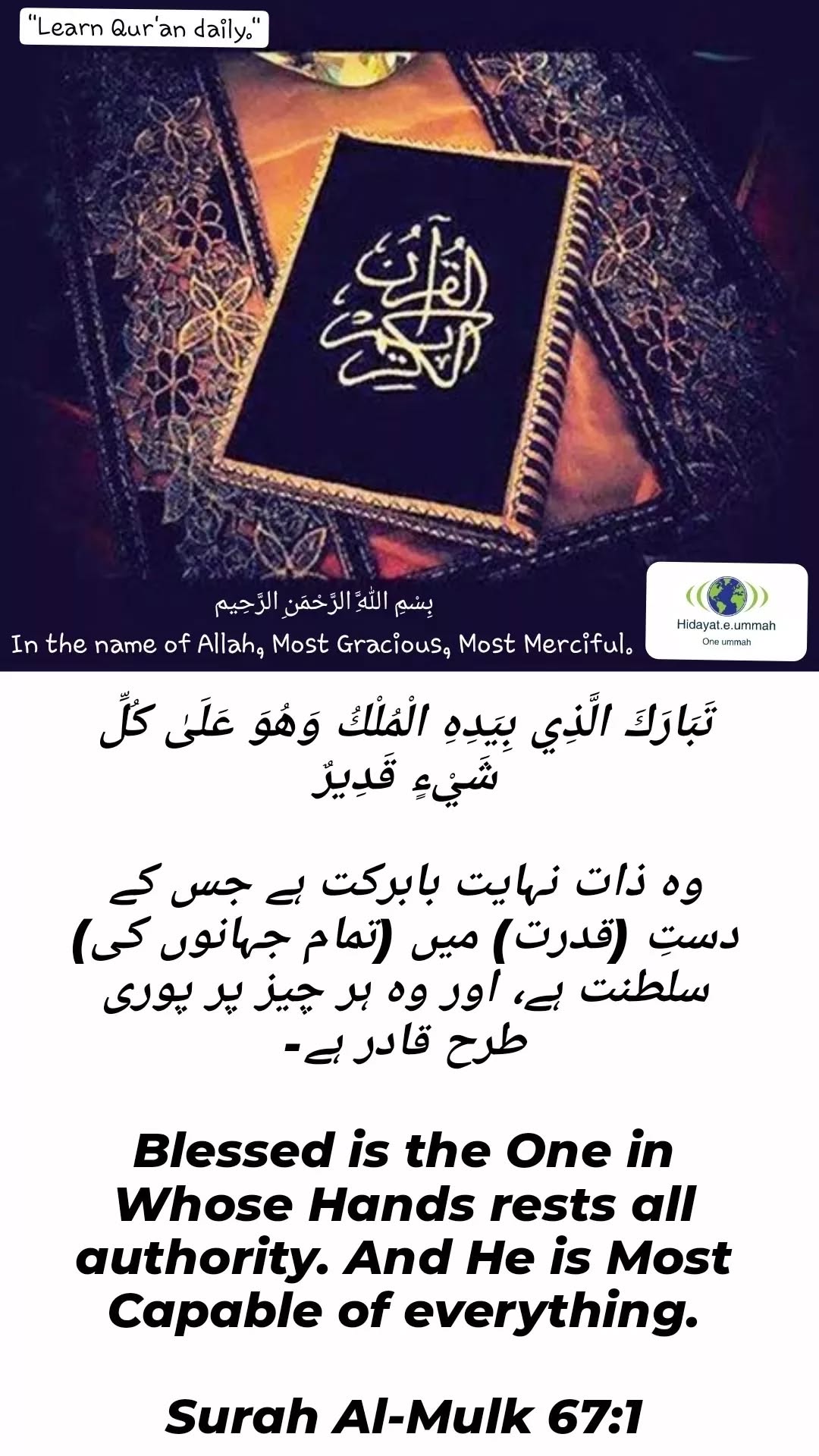
Surah Al-Mulk 67:1
**Translation:**
_Blessed is the One in Whose Hands rests all authority. And He is Most Capable of everything._
**Explanation:**
This verse highlights Allah’s supreme authority over all things. Everything in the heavens and the earth is under His control, and He is fully capable of managing everything in existence.
**Key Lesson:**
- Recognize the greatness and authority of Allah, who holds all power over creation.
Hadith 63
63 of 68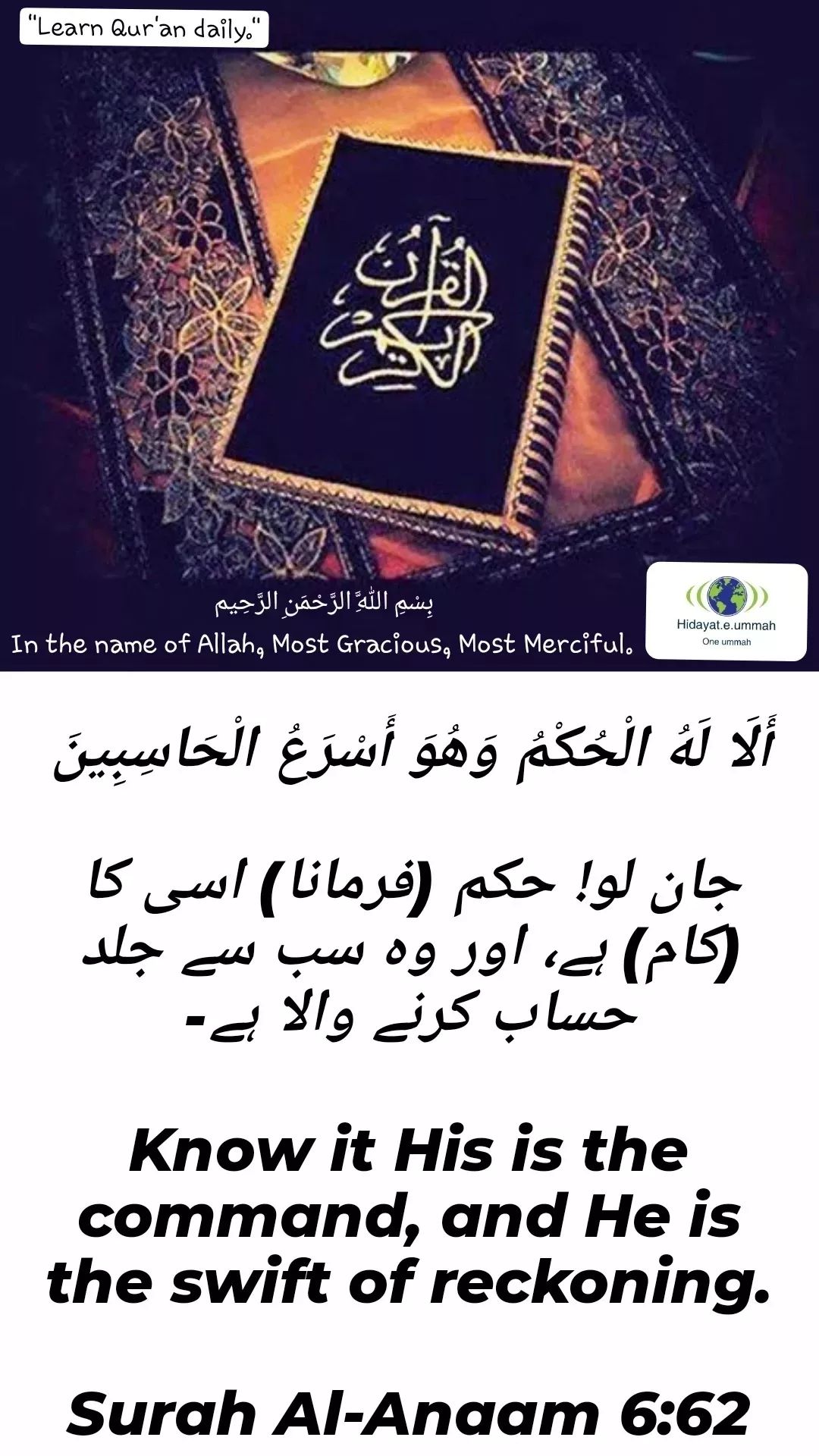
Surah Al-Anaam 6:62
**Translation:**
_Know it His is the command, and He is the swift of reckoning._
**Explanation:**
This verse reminds us that all matters are under Allah's control, and He is swift in holding everyone accountable for their deeds on the Day of Judgment.
**Key Lesson:**
- Trust in Allah’s command and be aware that He will swiftly account for all actions.
Hadith 64
64 of 68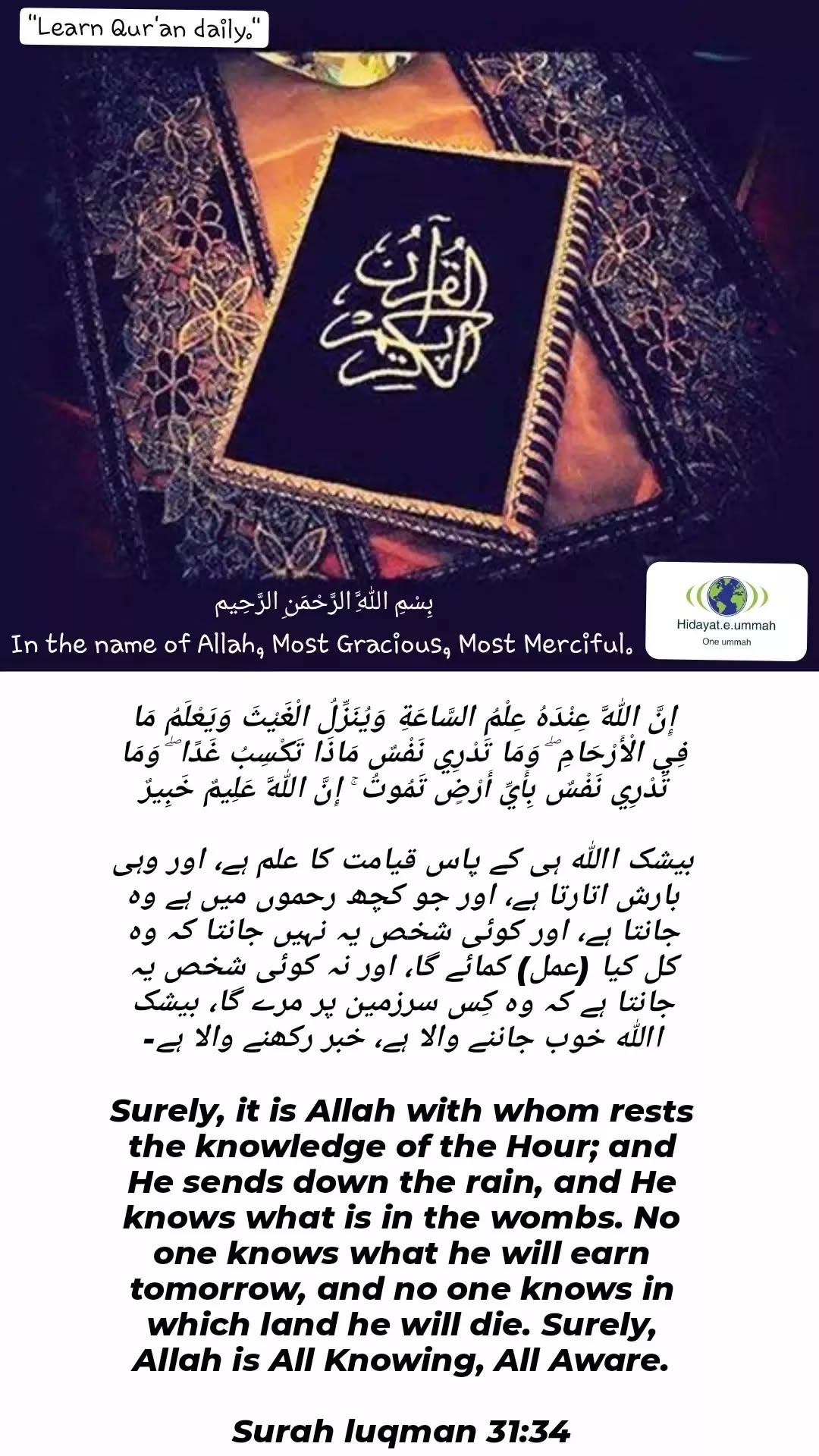
Surah Luqman 31:34
**Translation:**
_Surely, it is Allah with whom rests the knowledge of the Hour; and He sends down the rain, and He knows what is in the wombs. No one knows what he will earn tomorrow, and no one knows in which land he will die. Surely, Allah is All-Knowing, All-Aware._
**Explanation:**
This verse emphasizes Allah's complete knowledge and control over everything. He alone knows the unseen, including the timing of the Hour (the Day of Judgment), the rain, what is in the wombs, what people will earn, and where they will die. No one can predict these matters except Allah.
**Key Points:**
1. **Allah's Exclusive Knowledge:**
- Only Allah knows the hidden realities, like the Hour, rainfall, and what lies in the future.
2. **Uncertainty of Life:**
- Humans cannot predict their earnings, deaths, or the conditions of their lives.
**Key Lesson:**
- Trust in Allah’s wisdom and knowledge, acknowledging that only He controls the unknown aspects of life.
**Practical Reflection:**
- Let go of the need to control everything and have faith that Allah knows what is best for you.
Hadith 65
65 of 68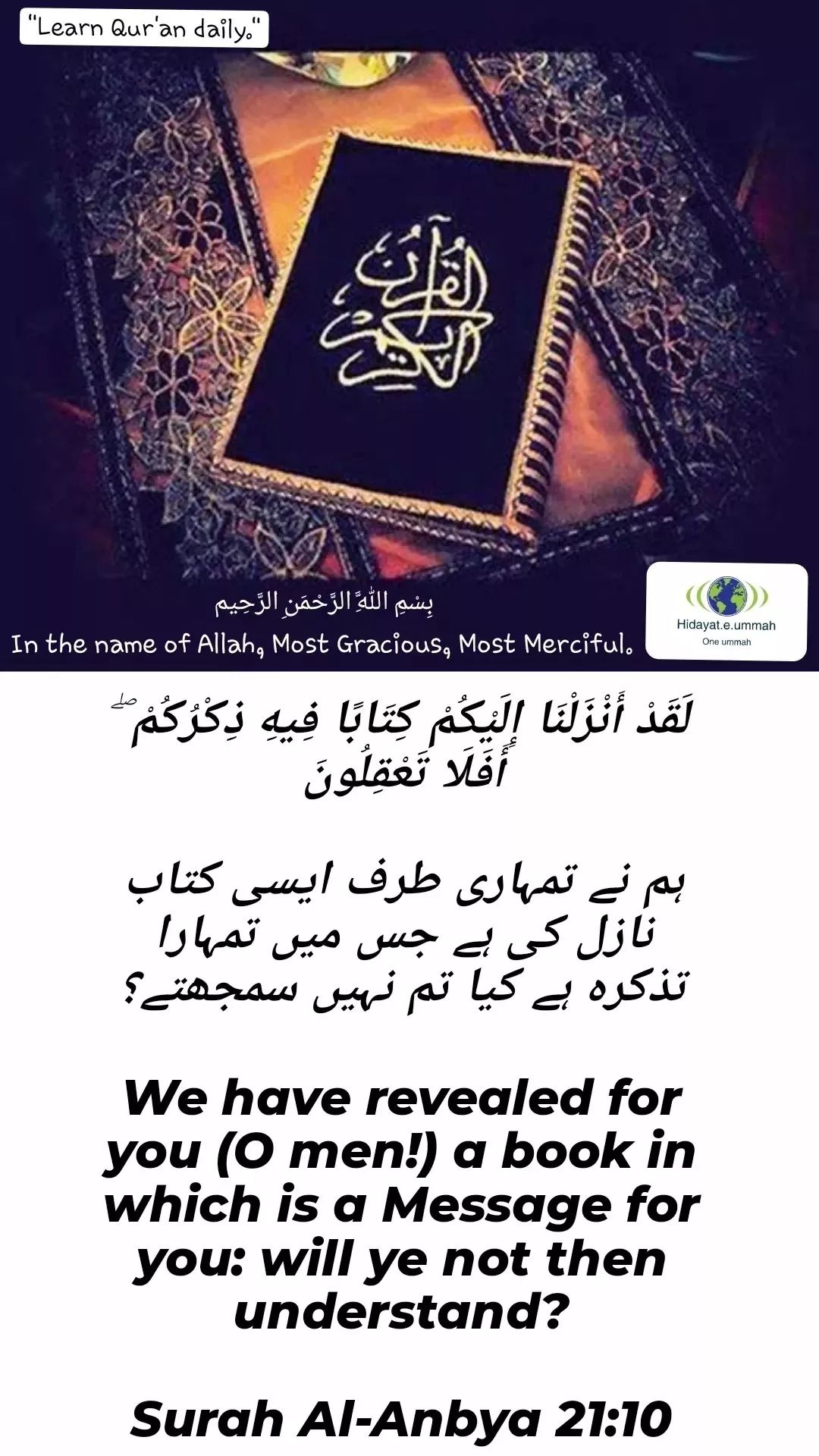
Surah Al-Anbya 21:10
**Translation:**
_We have revealed for you (O men!) a book in which is a Message for you: will ye not then understand?_
**Explanation:**
This verse highlights the Quran as a divine revelation from Allah, containing a message and guidance for all of humanity. It urges people to reflect on and understand the teachings in the Quran, which are meant to lead them to righteousness and truth.
**Key Points:**
1. **The Quran as Divine Guidance:**
- The Quran is revealed as a message from Allah, meant to guide people.
2. **Call to Understand:**
- People are encouraged to ponder the Quran’s teachings and apply them to their lives.
**Key Lesson:**
- Reflect on and seek to understand the guidance in the Quran.
**Practical Reflection:**
- Take time to read and contemplate the Quran regularly to gain wisdom and understanding.
Hadith 66
66 of 68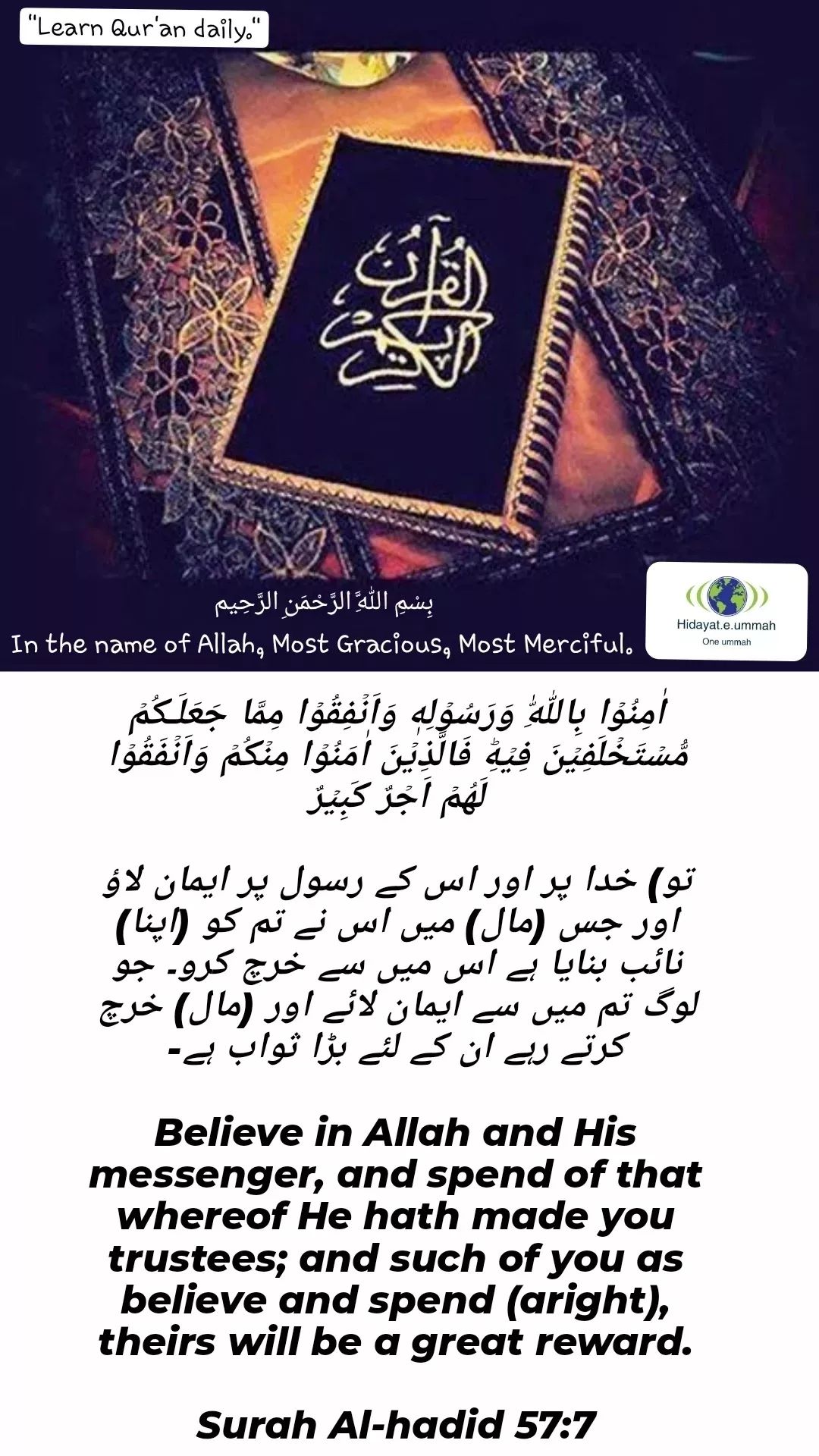
Surah Al-Hadid 57:7
**Translation:**
_Believe in Allah and His messenger, and spend of that whereof He hath made you trustees; and such of you as believe and spend (aright), theirs will be a great reward._
**Explanation:**
This verse encourages believers to have faith in Allah and His messenger and to spend from the wealth that Allah has entrusted to them. Those who believe and give in charity will be rewarded greatly by Allah.
**Key Points:**
1. **Faith and Action:**
- Belief in Allah and His messenger should be accompanied by actions, such as spending on others as an act of trust and charity.
2. **Reward for Charity:**
- Those who give with sincerity will receive a great reward from Allah.
**Key Lesson:**
- True belief is reflected in both faith and good deeds, especially in giving to others.
**Practical Reflection:**
- Regularly engage in acts of charity, remembering that they are a means of earning Allah’s reward.
Hadith 67
67 of 68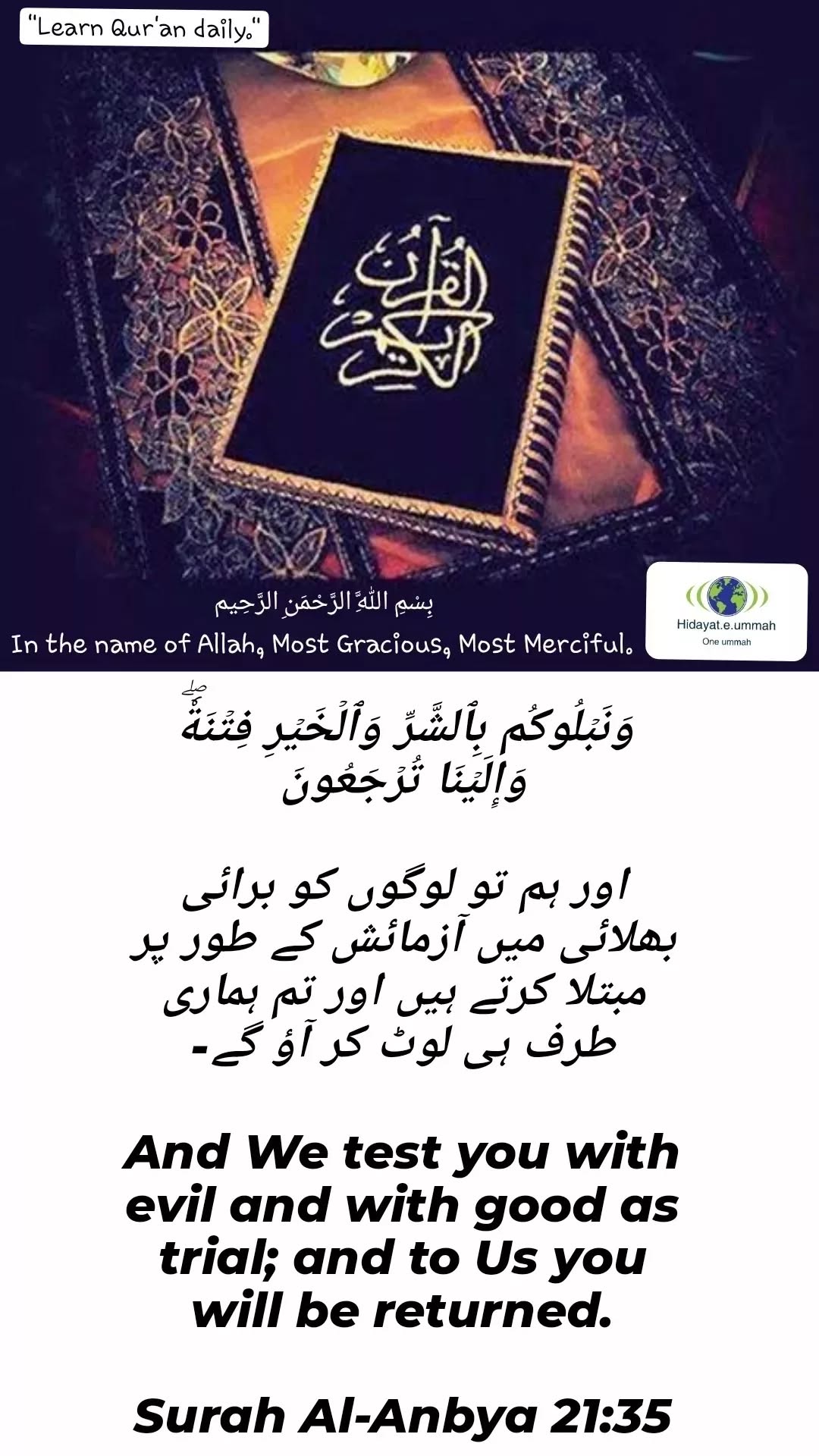
Surah Al-Anbya 21:35
**Translation:**
_And We test you with evil and with good as trial; and to Us you will be returned._
**Explanation:**
This verse reminds us that life is a test from Allah, where both good and bad experiences are part of this trial. Whether we face ease or hardship, everything is a test to see how we respond. Ultimately, we will return to Allah, where our actions will be judged.
**Key Points:**
1. **Life as a Test:**
- Both good and bad experiences are trials meant to test our patience, gratitude, and faith.
2. **Accountability:**
- Every action is accounted for by Allah, and we will return to Him for judgment.
**Key Lesson:**
- Accept both blessings and hardships with patience, knowing they are tests from Allah.
**Practical Reflection:**
- When facing challenges, remind yourself that they are a test, and focus on maintaining patience and trust in Allah.
Hadith 68
68 of 68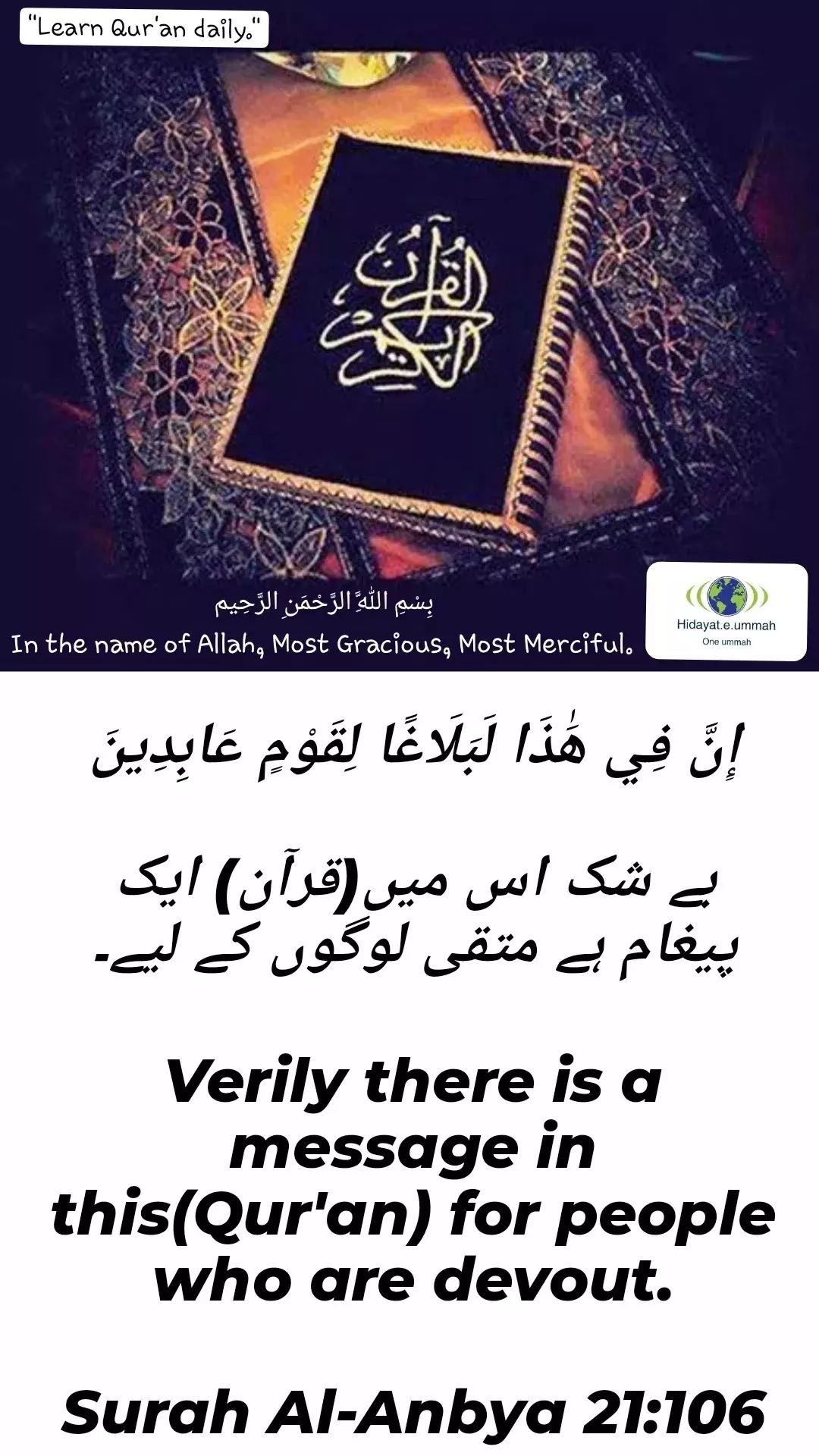
Surah Al-Anbya 21:106
**Translation:**
_Verily there is a message in this (Qur'an) for people who are devout._
**Explanation:**
This verse highlights that the Quran is a source of guidance for those who are devout and sincerely seek Allah’s path. It serves as a reminder and a message for those who are attentive and willing to learn and reflect.
**Key Points:**
1. **Guidance for the Devout:**
- The Quran provides profound guidance for those who are sincere in their devotion to Allah.
2. **Reflection and Understanding:**
- The message of the Quran becomes clear to those who approach it with a pure heart and a desire for spiritual growth.
**Key Lesson:**
- Approach the Quran with sincerity and devotion to benefit from its guidance.
**Practical Reflection:**
- Strive to read and reflect on the Quran regularly with a focus on understanding and applying its teachings.