
Ramadan
Hadith Collection
40 Hadiths
Hadith 1
1 of 40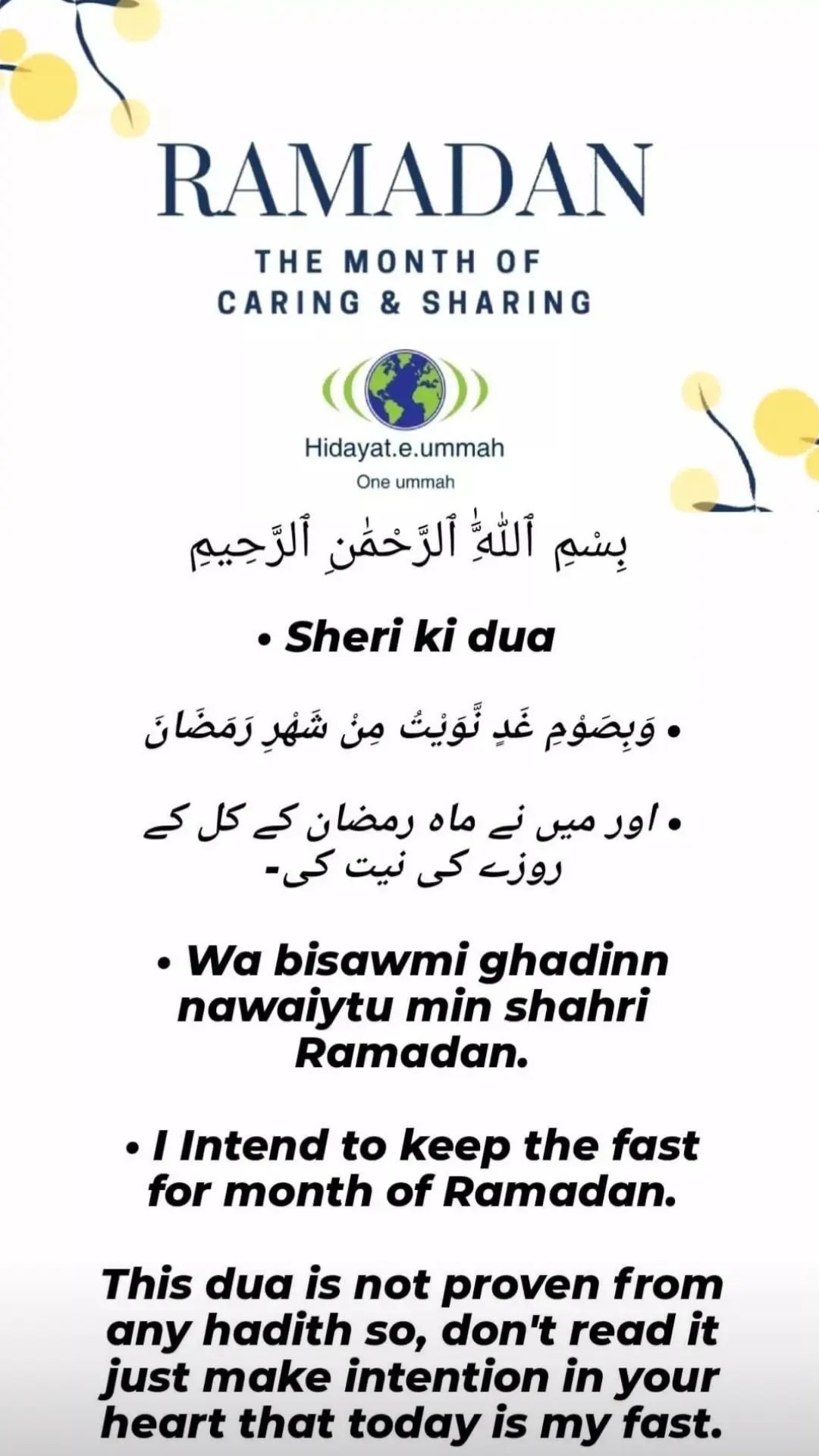
The best among you are those who have the best manners and character. – Prophet Muhammad (peace be upon him)
Hadith 2
2 of 40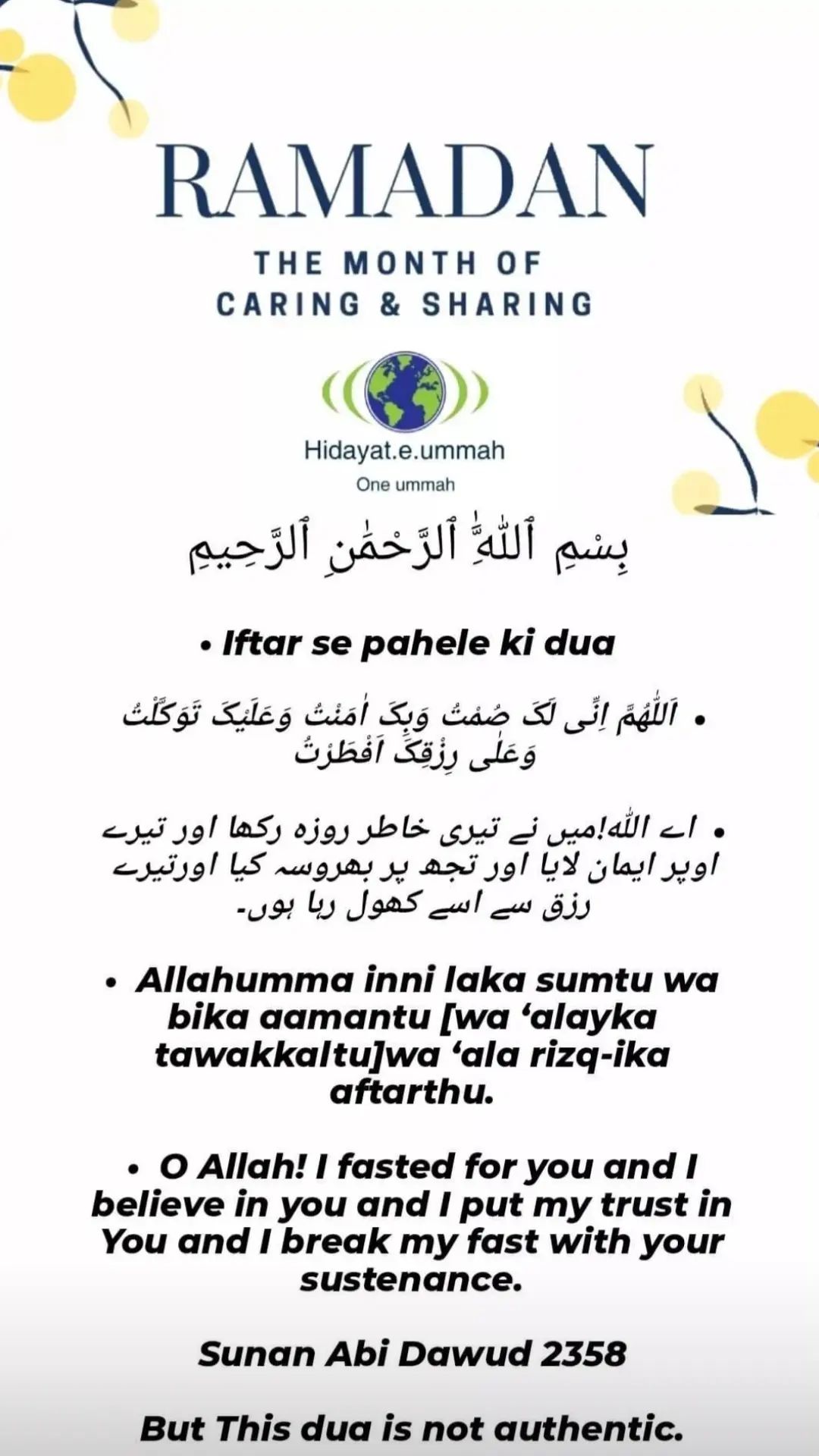
The strong man is not the one who wrestles others, but the one who controls himself when angry. – Prophet Muhammad (peace be upon him)
Hadith 3
3 of 40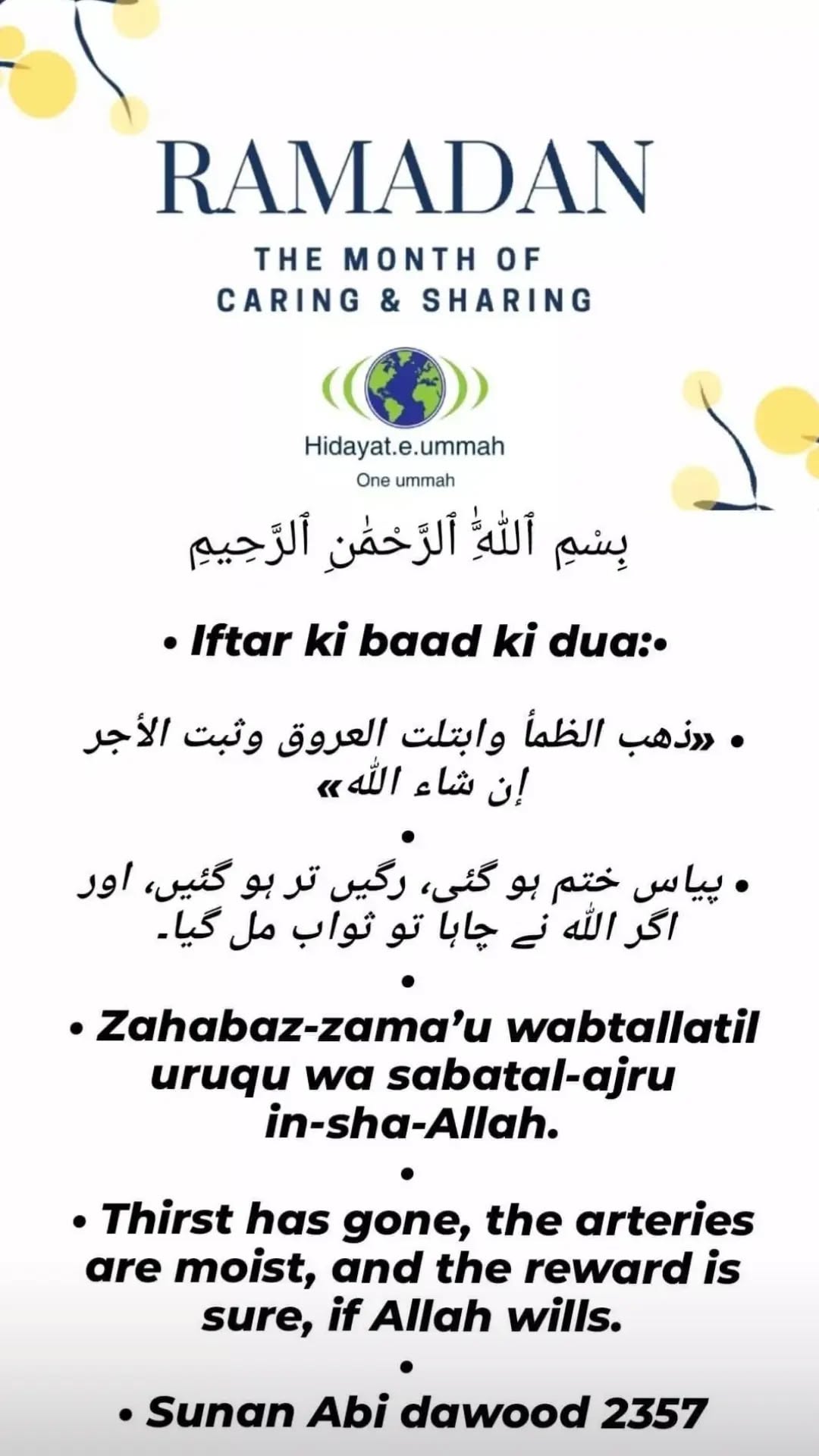
The strong man is not the one who wrestles others, but the one who controls himself when angry. – Prophet Muhammad (peace be upon him)
Hadith 4
4 of 40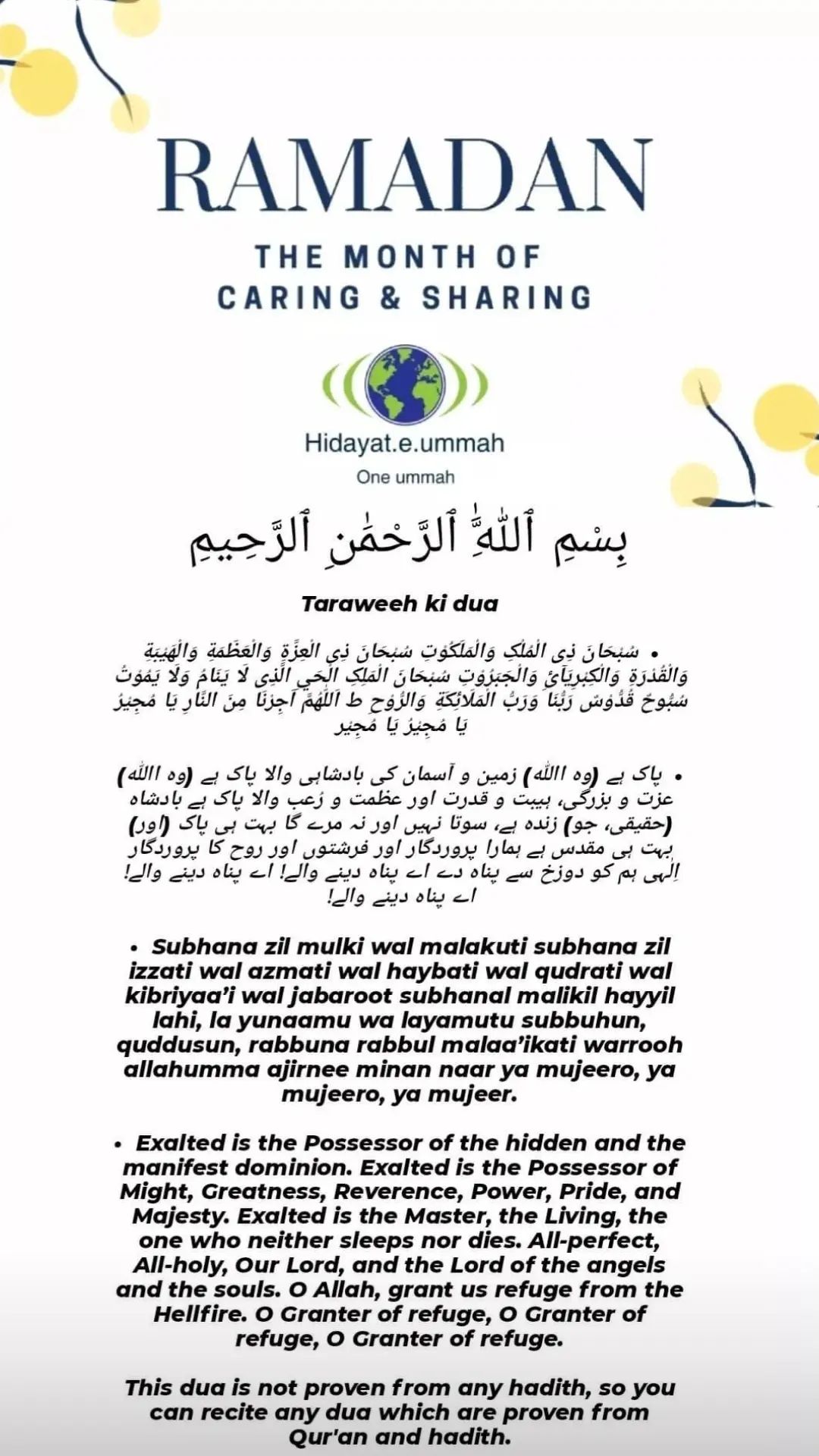
The strong man is not the one who wrestles others, but the one who controls himself when angry. – Prophet Muhammad (peace be upon him)
Hadith 5
5 of 40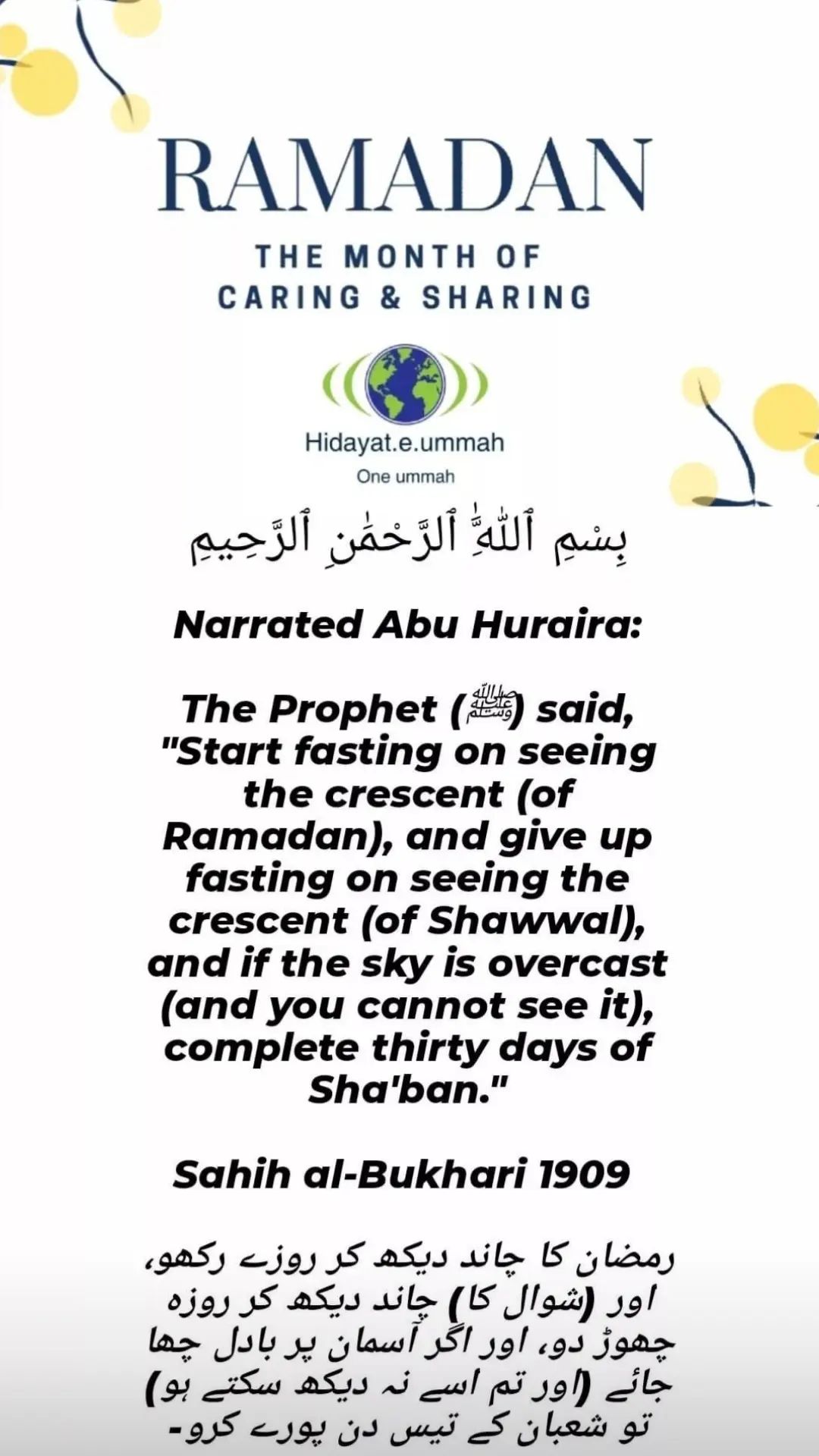
This hadith, narrated by Abu Huraira, explains the method of determining the beginning and end of Ramadan.
1. **Starting Ramadan:**
- Fasting begins upon sighting the crescent moon of Ramadan.
- The crescent moon acts as the indicator for the beginning of the month.
2. **Ending Ramadan:**
- Fasting ends with the sighting of the crescent moon of Shawwal, marking the start of Eid al-Fitr.
3. **When the moon is not visible:**
- If the sky is overcast or the moon cannot be seen, the month of Sha'ban (preceding Ramadan) should be completed with 30 days.
**Lesson:**
- This hadith emphasizes the importance of following the lunar calendar for Islamic practices and teaches reliance on natural signs (like the moon) for acts of worship, along with practical solutions when visibility is hindered.
Hadith 6
6 of 40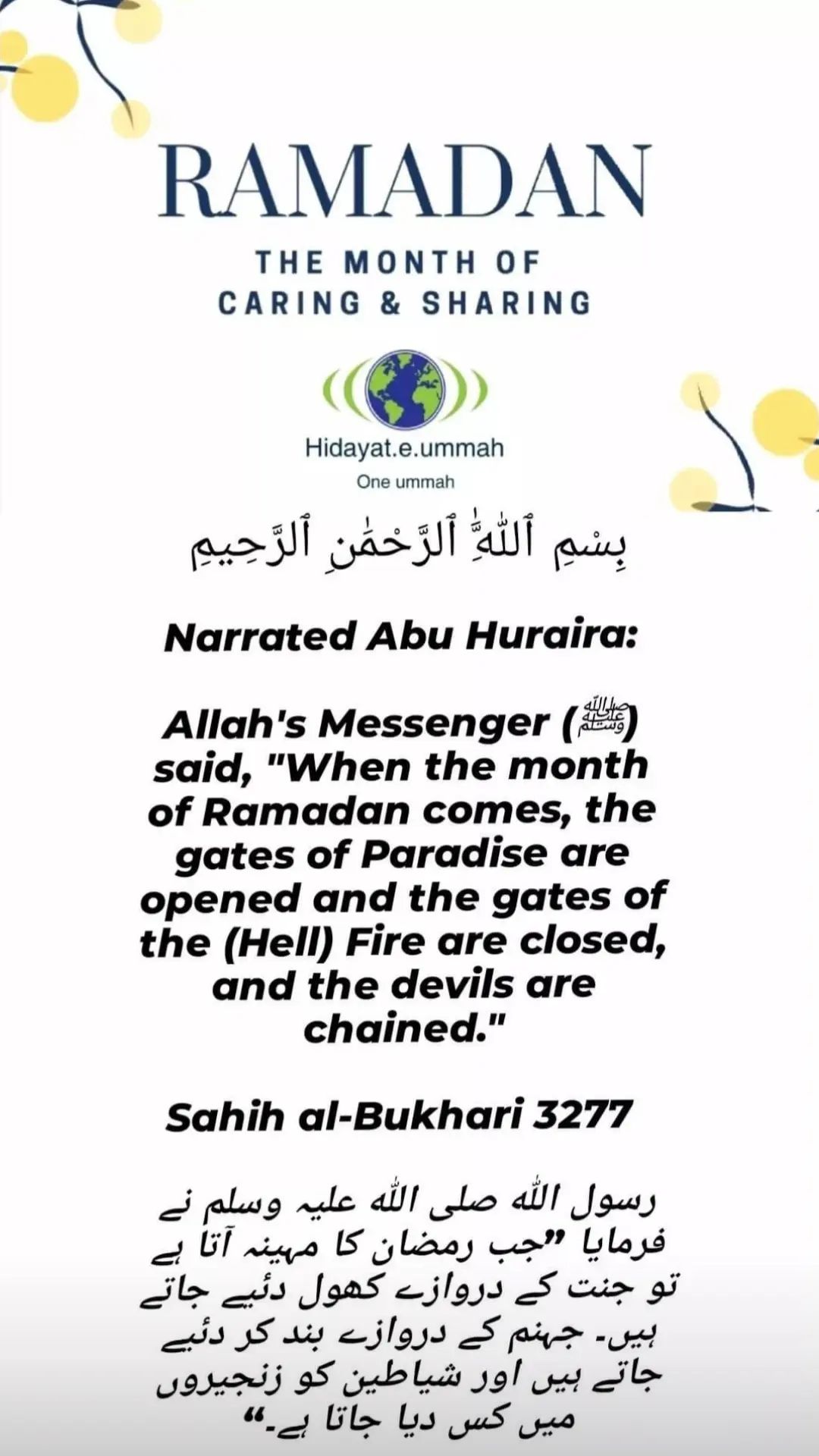
This hadith, narrated by Abu Huraira, highlights the spiritual significance of the month of Ramadan.
1. **Gates of Paradise Opened:**
- During Ramadan, the gates of Paradise are opened, symbolizing the increased opportunities for good deeds and mercy from Allah.
2. **Gates of Hell Closed:**
- The gates of Hell are closed, signifying reduced chances for committing sins and Allah’s forgiveness being readily available.
3. **Devils Chained:**
- The devils are chained during this blessed month, indicating a decrease in their influence over people, making it easier for believers to focus on worship and righteousness.
**Lesson:**
- Ramadan is a time of immense spiritual blessings, where good deeds are encouraged, sins are minimized, and believers are motivated to seek Allah’s mercy and forgiveness.
Hadith 7
7 of 40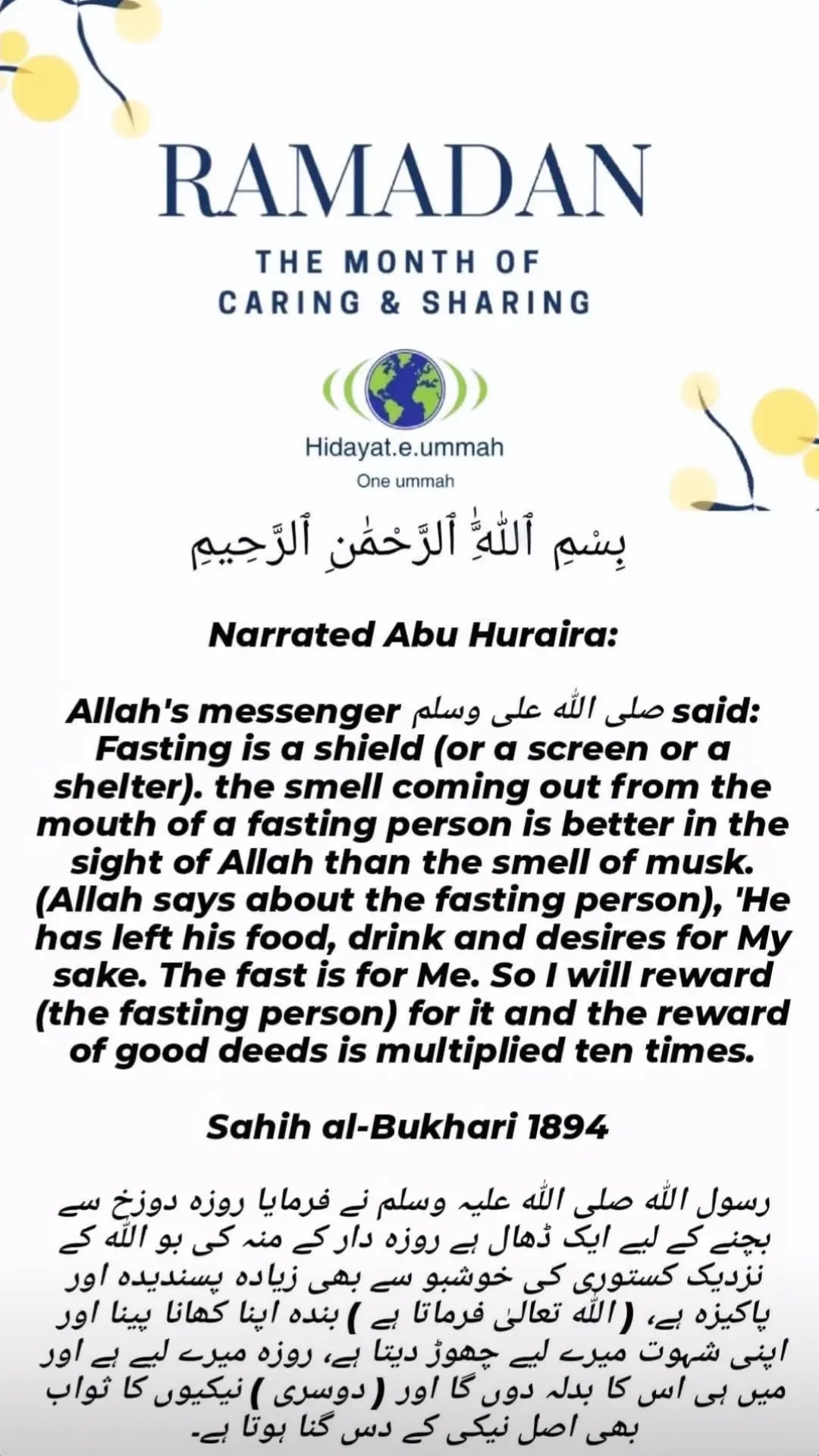
This hadith, narrated by Abu Huraira, emphasizes the unique virtues and rewards of fasting.
1. **Fasting as a Shield:**
- Fasting acts as a shield, protecting the believer from sinful actions and the punishment of Hell.
2. **The Pleasant Smell of Fasting:**
- The smell from the mouth of a fasting person, though unpleasant to humans, is more beloved to Allah than the scent of musk. This signifies Allah's appreciation of the effort and sacrifice involved in fasting.
3. **Fasting for Allah's Sake:**
- Allah highlights the sincerity of fasting, as the individual refrains from food, drink, and desires solely for His sake.
4. **Special Reward for Fasting:**
- Allah takes fasting as a unique act of worship and promises to reward it directly. Additionally, all good deeds are multiplied by tenfold or more.
**Lesson:**
- Fasting is a deeply spiritual act that strengthens the bond between a believer and Allah, offering immense rewards and protection from sin.
Hadith 8
8 of 40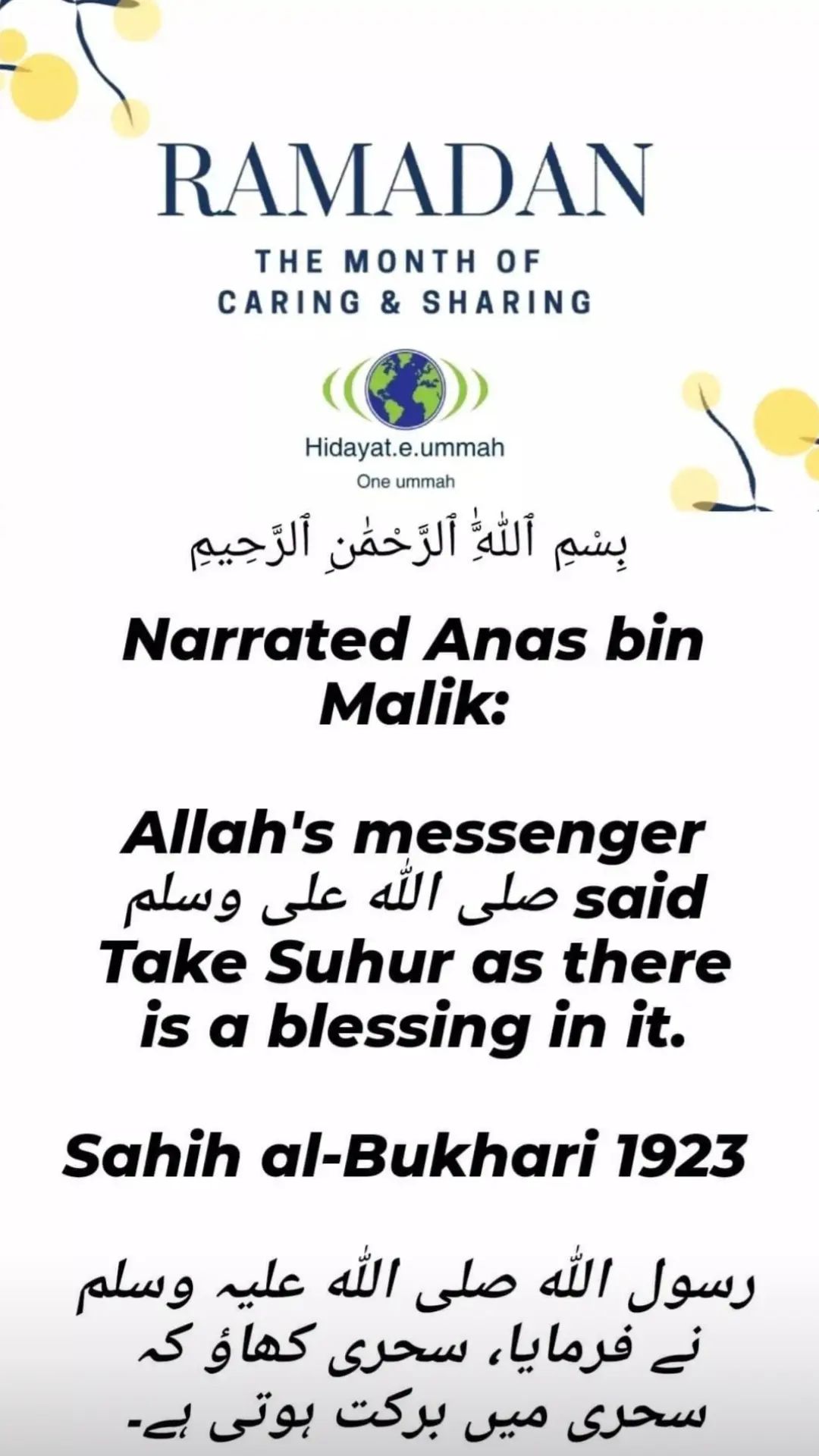
This hadith, narrated by Anas bin Malik, highlights the importance and benefits of Suhur (the pre-dawn meal) during fasting.
1. **Encouragement to Take Suhur:**
- The Prophet ( SAW Peace be upon him) advised Muslims to have Suhur before beginning their fast, as it is a source of blessings.
2. **Blessings in Suhur:**
- Suhur provides physical nourishment and energy for fasting, while also being a spiritual act that distinguishes Islamic fasting from the practices of other faiths.
3. **A Simple Yet Rewarding Act:**
- Even a small amount of food or drink consumed with the intention of Suhur carries great rewards.
**Lesson:**
- Suhur is not only a physical preparation for fasting but also a spiritually rewarding act that connects the believer to the Sunnah of the Prophet ( SAW Peace be upon him).
Hadith 9
9 of 40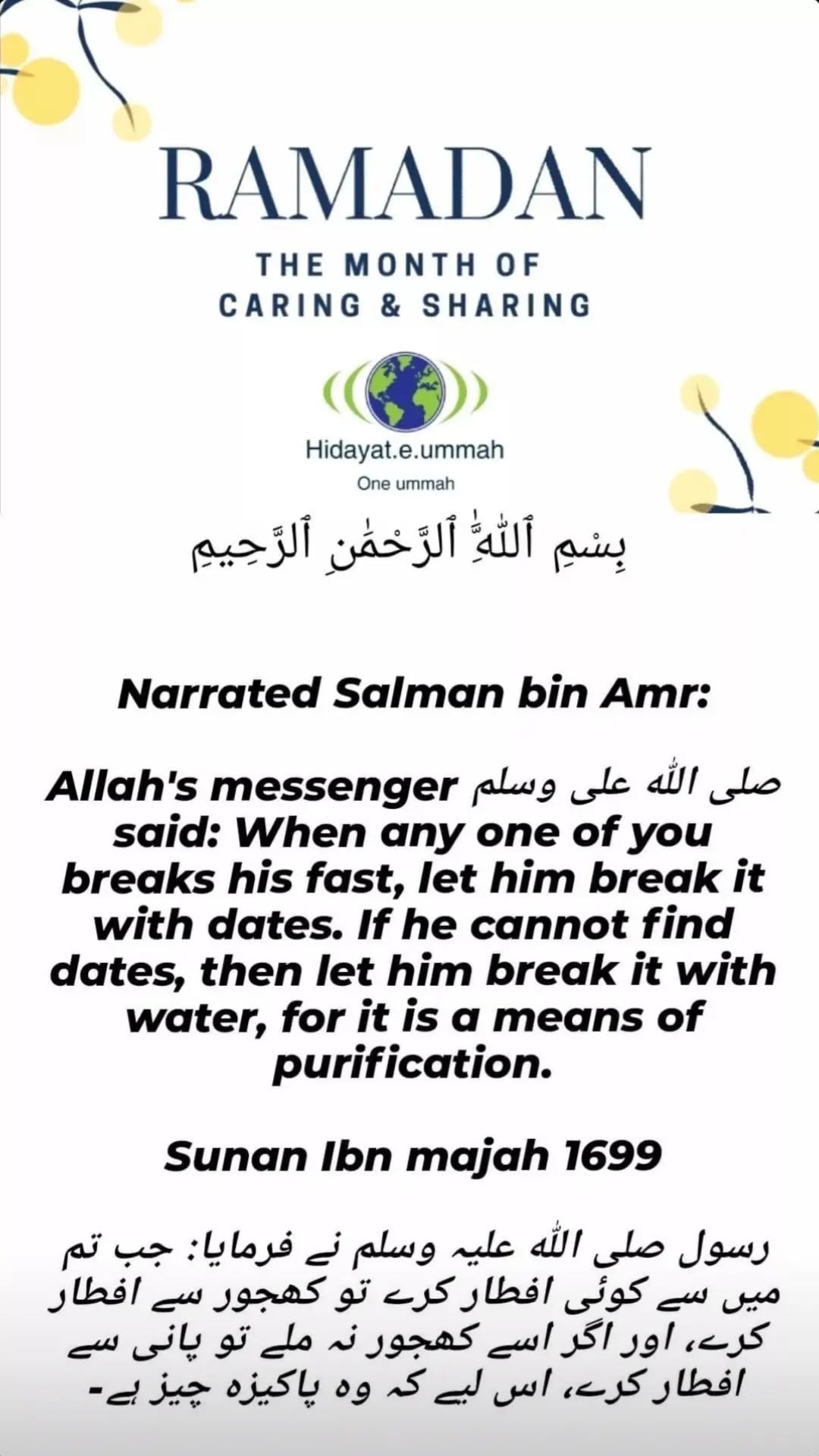
This hadith, narrated by Salman bin Amr, provides guidance on how to break the fast in the most beneficial way.
1. **Breaking the Fast with Dates:**
- The Prophet ( SAW Peace be upon him) instructed Muslims to break their fast with dates. Dates are rich in natural sugars, which quickly replenish energy after fasting.
2. **Alternative with Water:**
- If dates are not available, water should be used to break the fast, as it is pure and helps cleanse the body.
3. **A Sunnah Practice:**
- This method of breaking the fast is a Sunnah, emphasizing both the physical and spiritual benefits of following the Prophet’s ( SAW Peace be upon him) example.
**Lesson:**
- Breaking the fast with dates or water is simple, effective, and spiritually rewarding. It reflects the balance between fulfilling physical needs and adhering to the Sunnah.
Hadith 10
10 of 40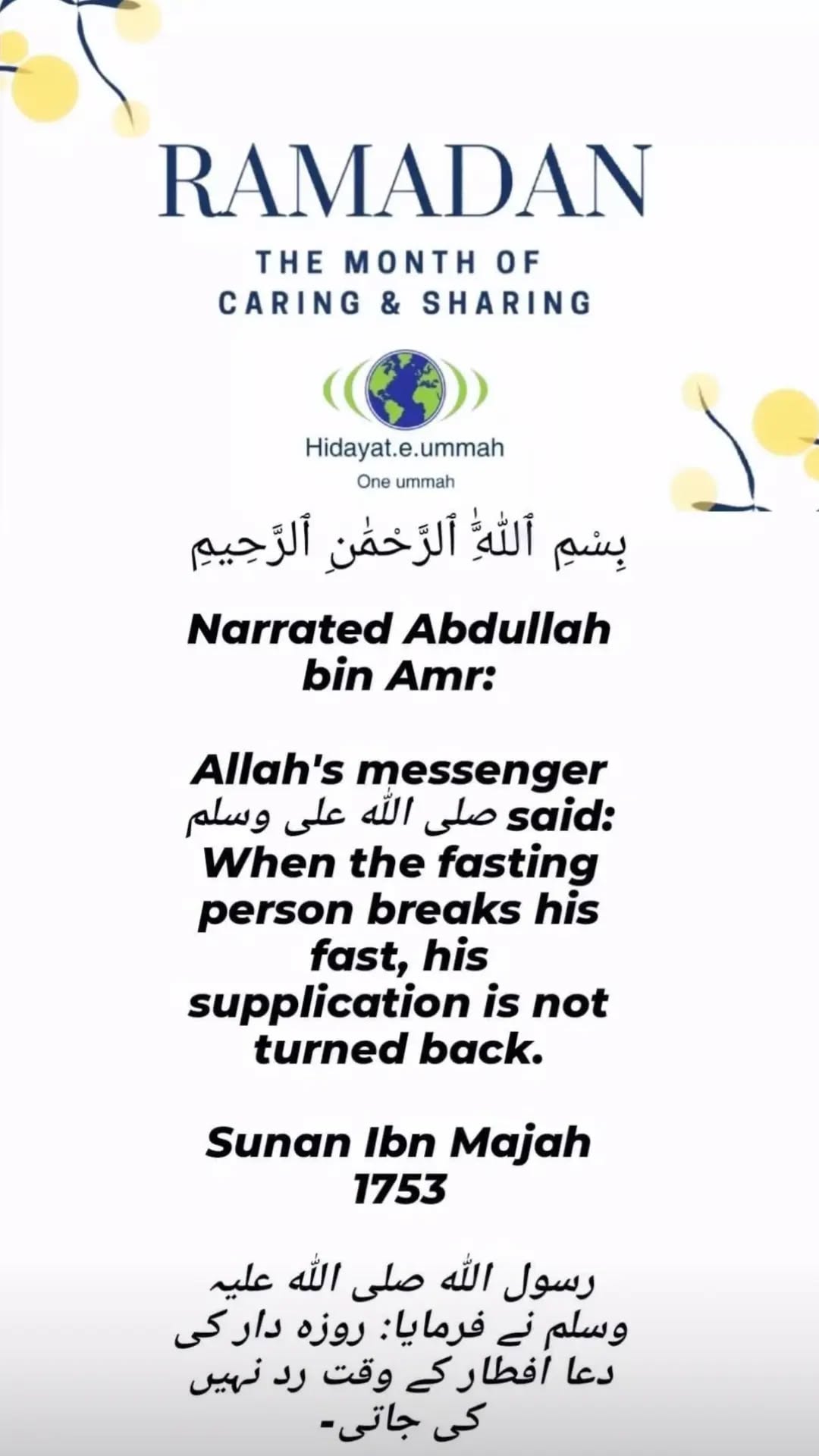
This hadith, narrated by Abdullah bin Amr, highlights the special status of a fasting person's supplication at the time of breaking the fast.
1. **Time of Acceptance:**
- The Prophet ( SAW Peace be upon him) emphasized that the supplication made by a fasting person at the time of breaking their fast is not rejected. This signifies the spiritual closeness to Allah during this moment.
2. **Encouragement to Make Dua:**
- Muslims are encouraged to use this blessed time to ask Allah for their needs, forgiveness, and guidance, as it is a time of mercy and divine acceptance.
**Lesson:**
- The time of breaking the fast is a powerful moment for supplication. Fasting Muslims should take advantage of this opportunity to sincerely connect with Allah and make dua for both worldly and spiritual blessings.
Hadith 11
11 of 40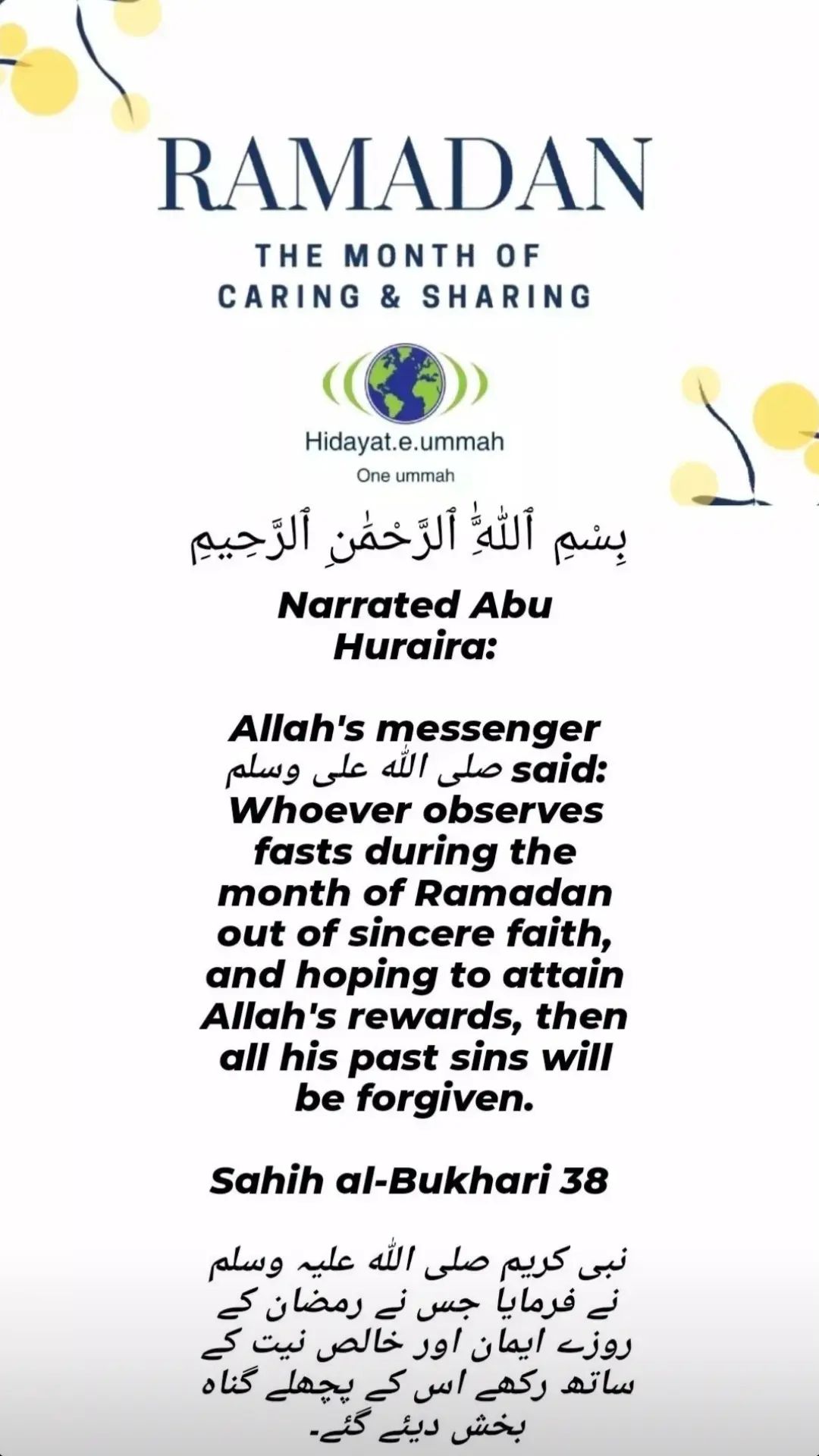
This hadith, narrated by Abu Huraira, emphasizes the immense spiritual reward of fasting during Ramadan.
1. **Fasting with Sincere Faith:**
- The Prophet ( SAW Peace be upon him) highlighted that fasting must be done with true faith in Allah and a desire to please Him.
2. **Hoping for Allah’s Rewards:**
- The fasting person should aim for Allah’s rewards, not for worldly recognition or benefits.
3. **Forgiveness of Sins:**
- As a reward for sincere fasting, Allah promises to forgive all past sins of the person who fulfills this act with genuine devotion.
**Lesson:**
- Ramadan offers a unique opportunity for Muslims to seek closeness to Allah, purify their souls, and gain forgiveness for their past mistakes by fasting with sincerity and hope.
Hadith 12
12 of 40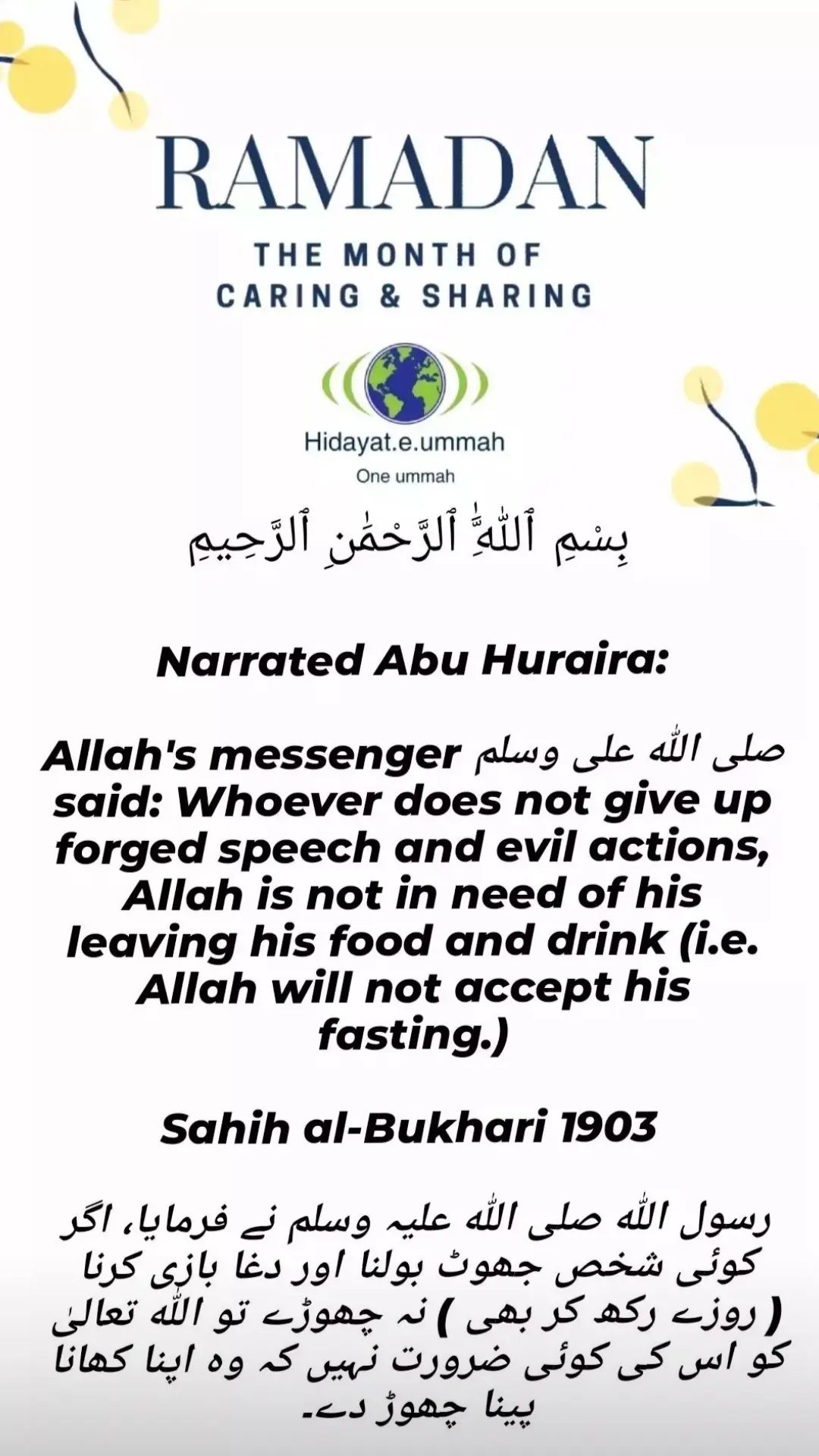
This hadith, narrated by Abu Huraira, emphasizes the importance of good character and behavior alongside fasting.
1. **Avoidance of Forged Speech:**
- The Prophet ( SAW Peace be upon him) highlights that fasting is not only about refraining from food and drink but also about abstaining from false speech and lies.
2. **Avoidance of Evil Actions:**
- A fasting person must also avoid sinful actions, such as harming others or indulging in immoral behavior.
3. **Allah's Acceptance:**
- If a person continues engaging in falsehood or evil, their fasting holds no value in the sight of Allah, as fasting is meant to instill self-discipline and righteousness.
**Lesson:**
- Fasting is not just a physical act but a spiritual exercise to purify one’s soul and actions. The true essence of fasting is achieved by combining physical restraint with moral and ethical integrity.
Hadith 13
13 of 40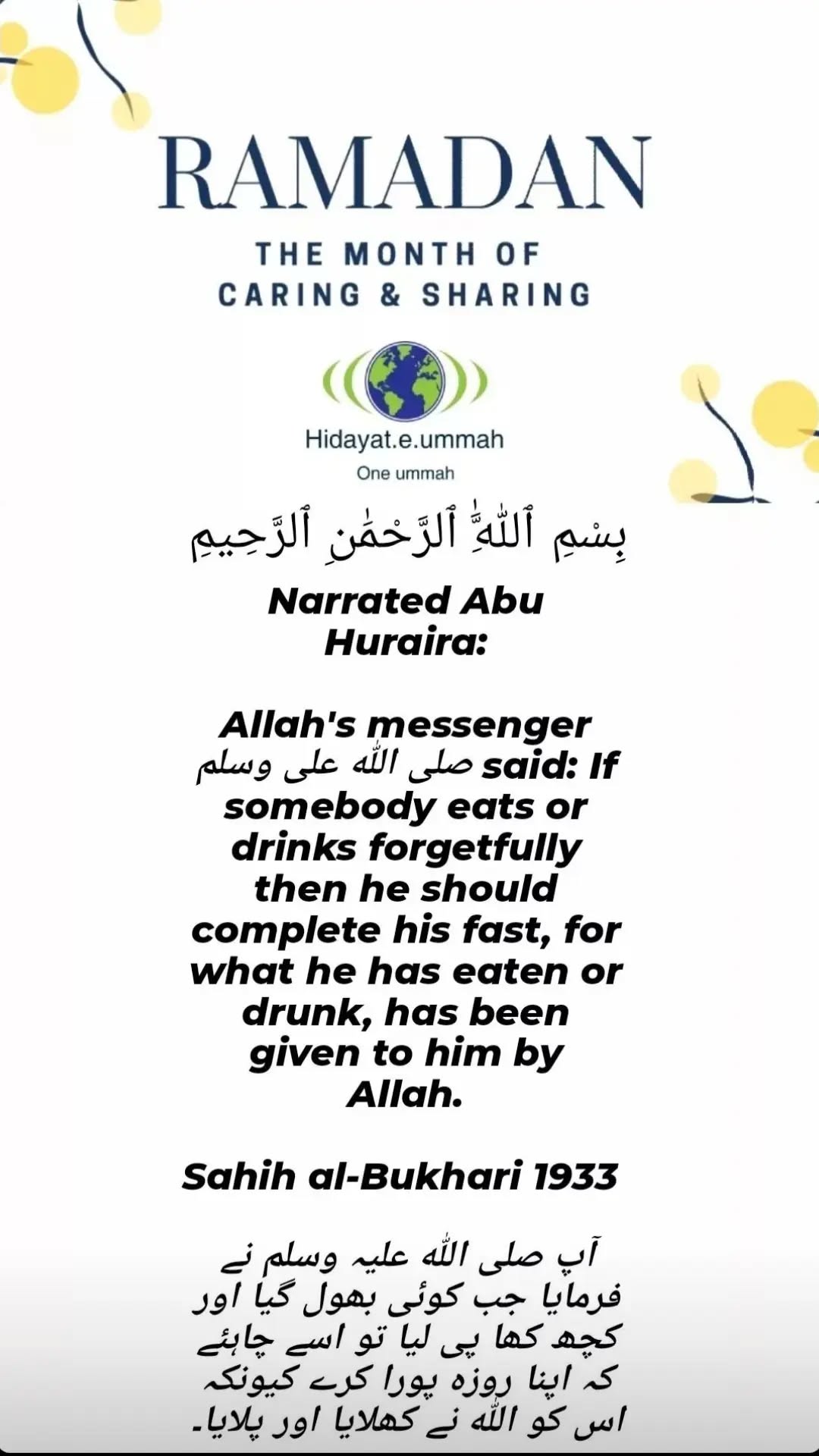
This hadith, narrated by Abu Huraira, addresses a situation where a person forgets that they are fasting and eats or drinks unintentionally.
1. **Forgetting to Fast:**
- If a person eats or drinks due to forgetfulness, it is not considered a violation of their fast.
2. **Continue Fasting:**
- The person should continue their fast for the rest of the day, as the act was done in forgetfulness, not intentionally.
3. **Allah’s Provision:**
- The hadith reminds us that whatever is consumed unknowingly has been provided by Allah, and He is aware of the situation.
**Lesson:**
- This hadith shows Allah’s mercy and understanding towards His servants. It encourages us to continue with our fast even if we make a mistake due to forgetfulness.
Hadith 14
14 of 40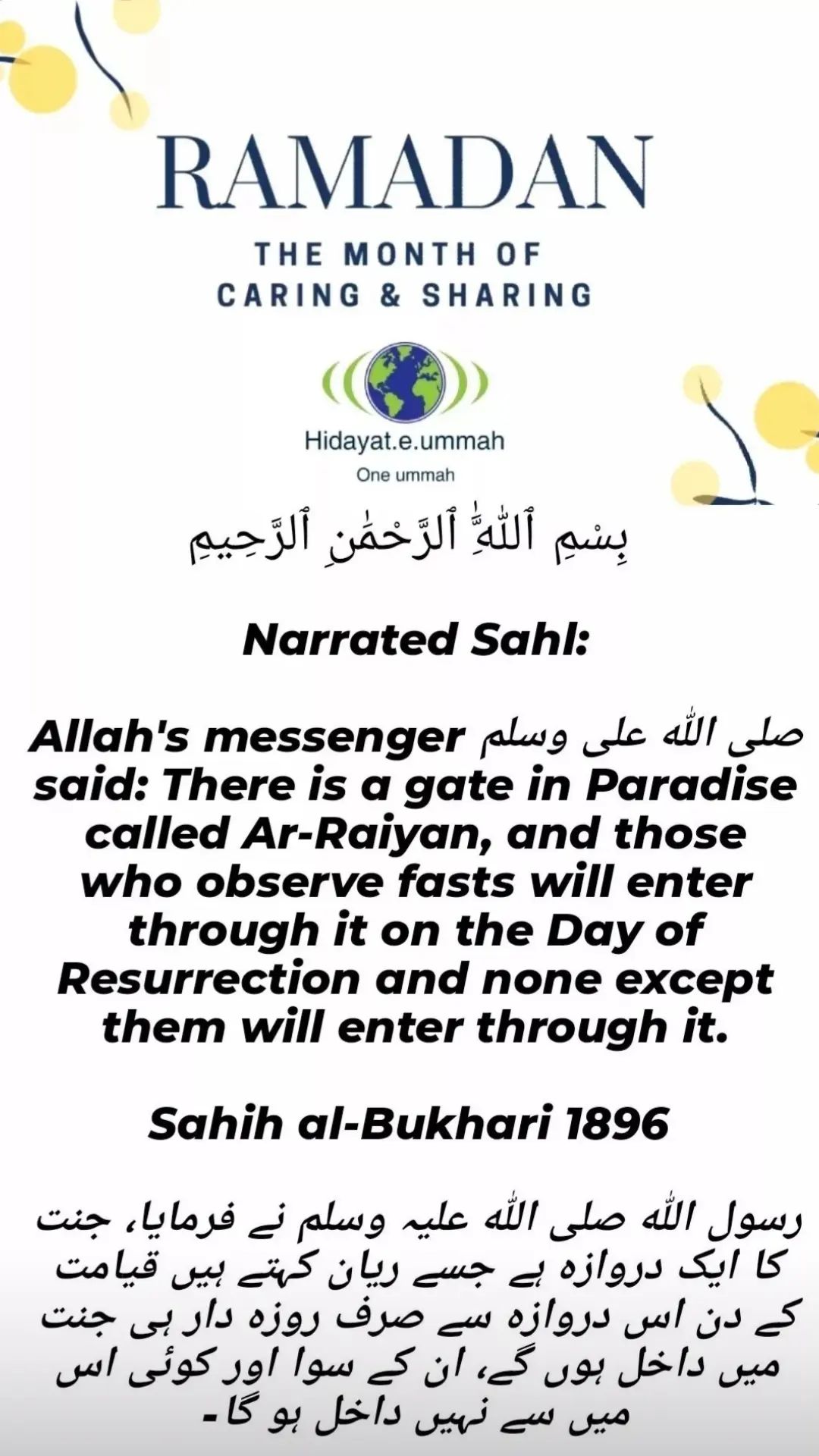
This hadith, narrated by Sahl, describes a special gate in Paradise for those who fast.
1. **The Gate of Ar-Raiyan:**
- There is a unique gate in Paradise called Ar-Raiyan, which is reserved for those who fast.
2. **Only Fasters Enter Through It:**
- On the Day of Resurrection, only those who have observed fasts will be allowed to enter through this gate, and no one else will be permitted.
3. **A Special Reward for Fasting:**
- This hadith highlights the great reward for fasting and the honor given to those who observe this act of worship.
**Lesson:**
- It encourages us to fast sincerely for the sake of Allah, as those who do so will be rewarded with a special entrance into Paradise.
Hadith 15
15 of 40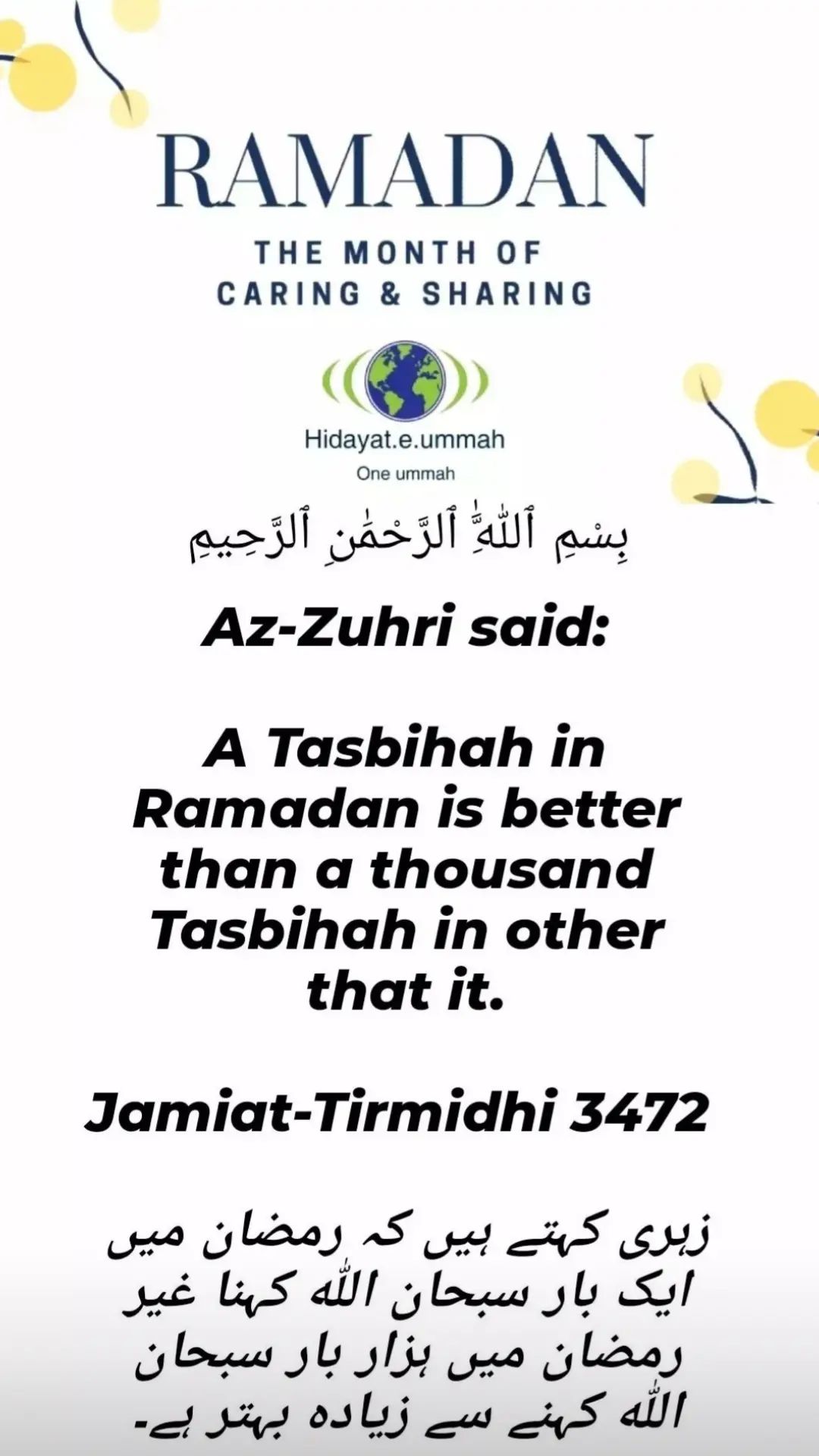
This hadith, narrated by Az-Zuhri, emphasizes the greater reward for acts of worship during the month of Ramadan.
1. **Tasbih in Ramadan:**
- A single Tasbih (praise of Allah) performed during Ramadan holds greater value and reward than a thousand Tasbihs performed at other times of the year.
2. **The Special Blessing of Ramadan:**
- Ramadan is a blessed and special time, where acts of worship are multiplied in reward.
**Lesson:**
- This hadith encourages Muslims to take full advantage of the holy month of Ramadan by increasing their worship, as even small acts like making Tasbih are rewarded immensely.
Hadith 16
16 of 40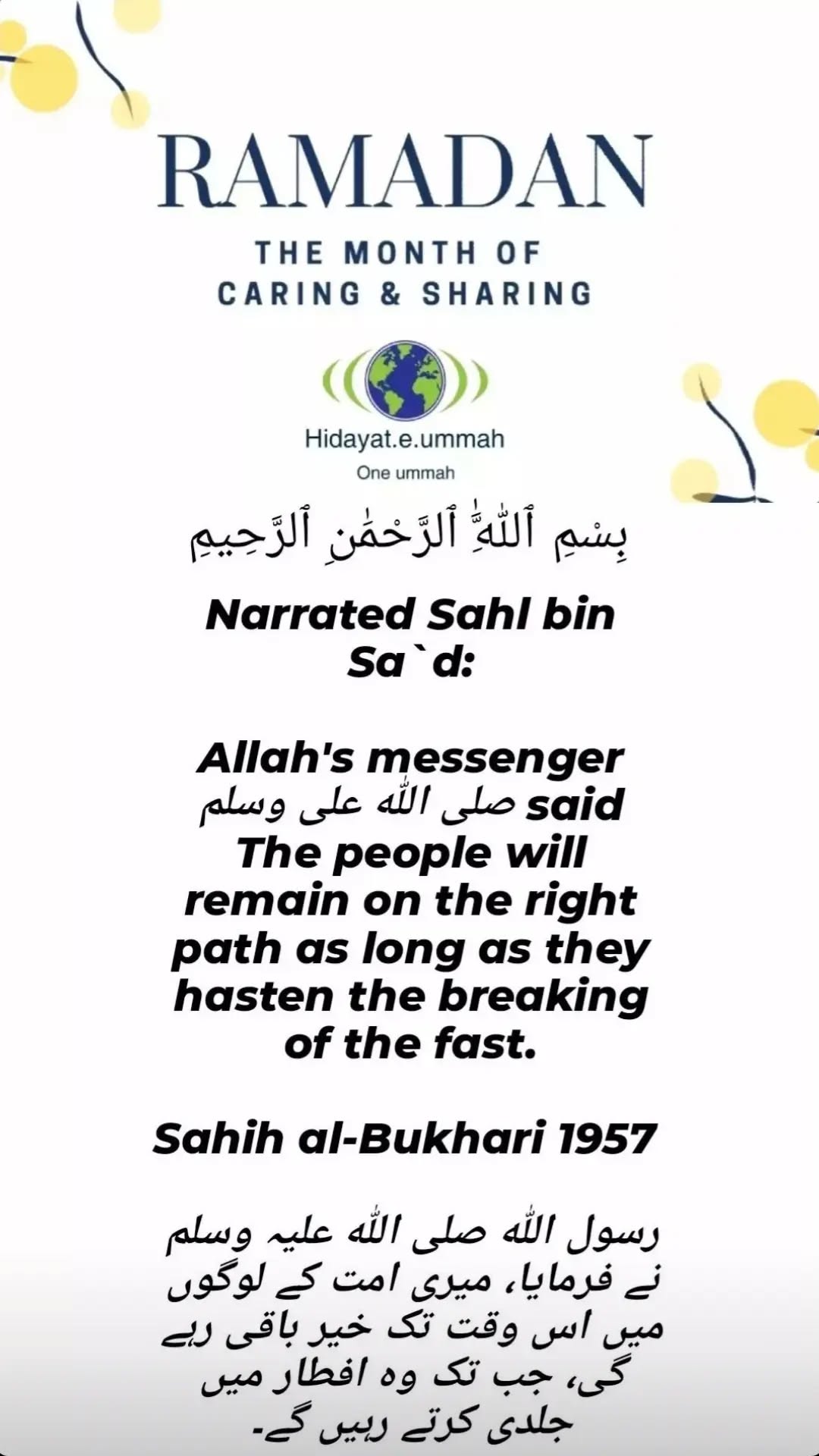
This hadith, narrated by Sahl bin Sa'd, highlights the importance of breaking the fast promptly during Ramadan.
1. **The Importance of Hastening to Break the Fast:**
- The Prophet ( SAW Peace be upon him) emphasized that Muslims should not delay breaking their fast after sunset.
- Hurrying to break the fast is a practice that ensures the proper observance of the fast.
2. **Remaining on the Right Path:**
- As long as Muslims follow this practice, they will remain on the right path in their faith.
**Lesson:**
- This hadith encourages Muslims to promptly break their fast, following the example of the Prophet ( SAW Peace be upon him), and reminds them that doing so aligns with the correct way of fasting.
Hadith 17
17 of 40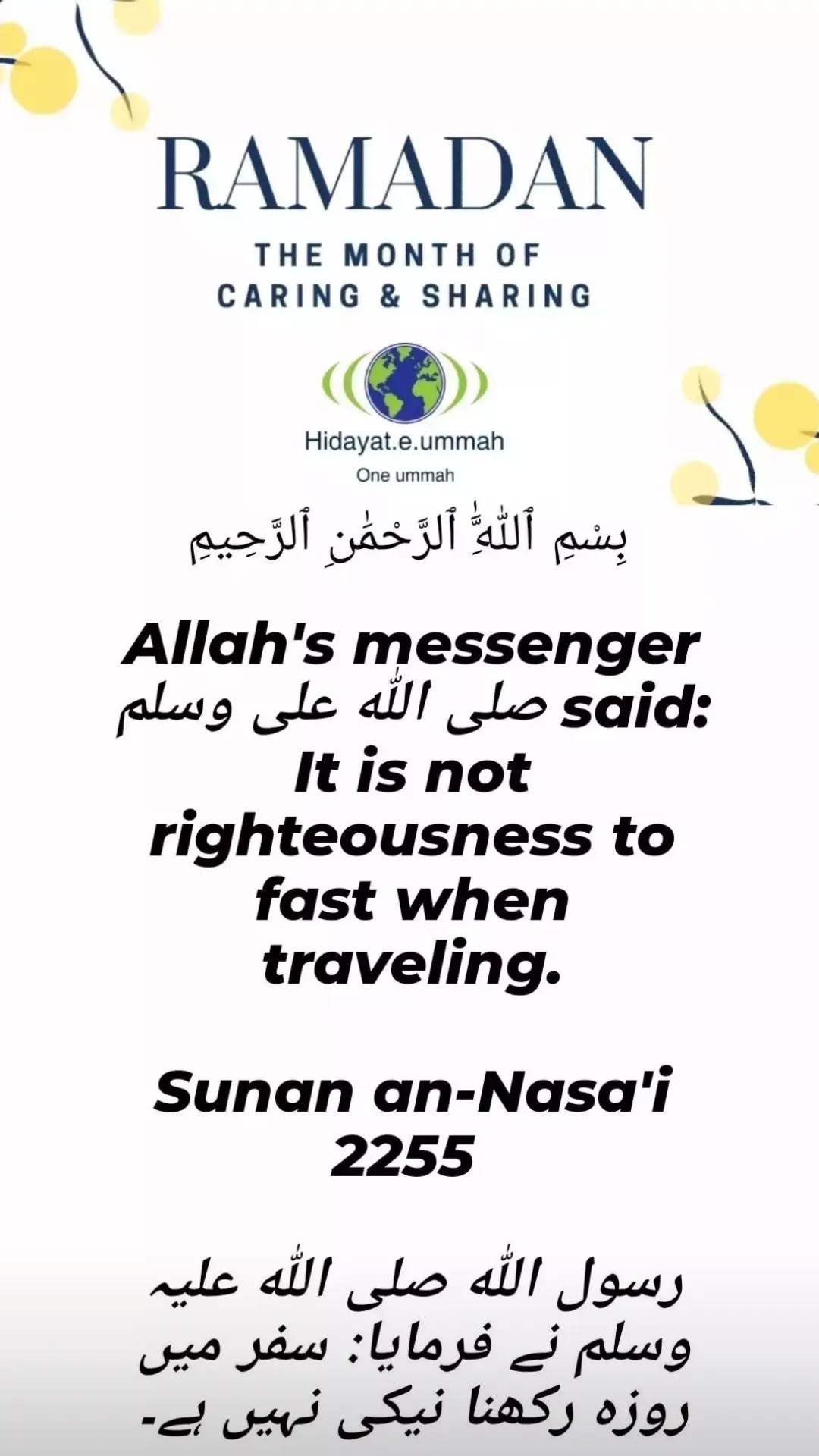
This hadith, narrated by Allah's Messenger ( SAW Peace be upon him), highlights an important aspect of fasting during travel.
1. **Not Fasting While Traveling:**
- The Prophet ( SAW Peace be upon him) clarified that it is not considered righteousness to fast when a person is traveling.
- This suggests that fasting during travel is not obligatory, and the person is allowed to break their fast if needed.
2. **Righteousness in Islam:**
- Righteousness in Islam is not about following a specific act, but rather about understanding the ease and allowances provided by Allah.
**Lesson:**
- This hadith teaches that fasting during travel can be difficult and is not expected from Muslims, as Allah has given allowances for such situations.
Hadith 18
18 of 40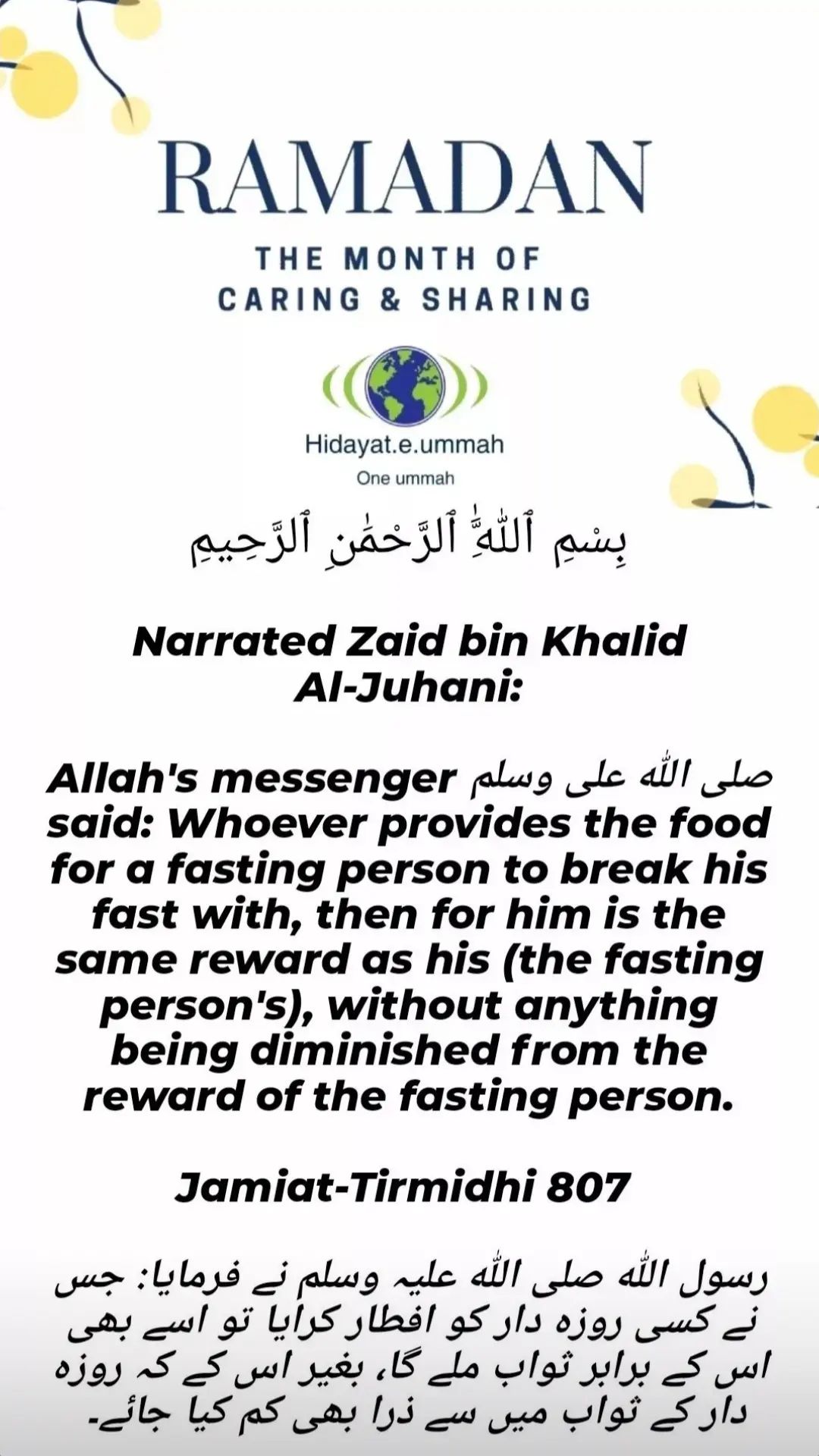
This hadith, narrated by Zaid bin Khalid, emphasizes the great reward for helping others to observe fasting.
1. **Reward for Providing Food for Fasting Person:**
- The Prophet ( SAW Peace be upon him) said that whoever provides food for a fasting person to break their fast will receive the same reward as the fasting person.
- This is a reminder that helping others in fulfilling religious obligations is highly rewarded in Islam.
2. **No Decrease in Reward:**
- Importantly, the reward of the fasting person is not diminished in any way by the one who provides the food.
**Lesson:**
- This hadith encourages generosity and helping others, showing that those who assist others in fulfilling good deeds also earn great rewards.
Hadith 19
19 of 40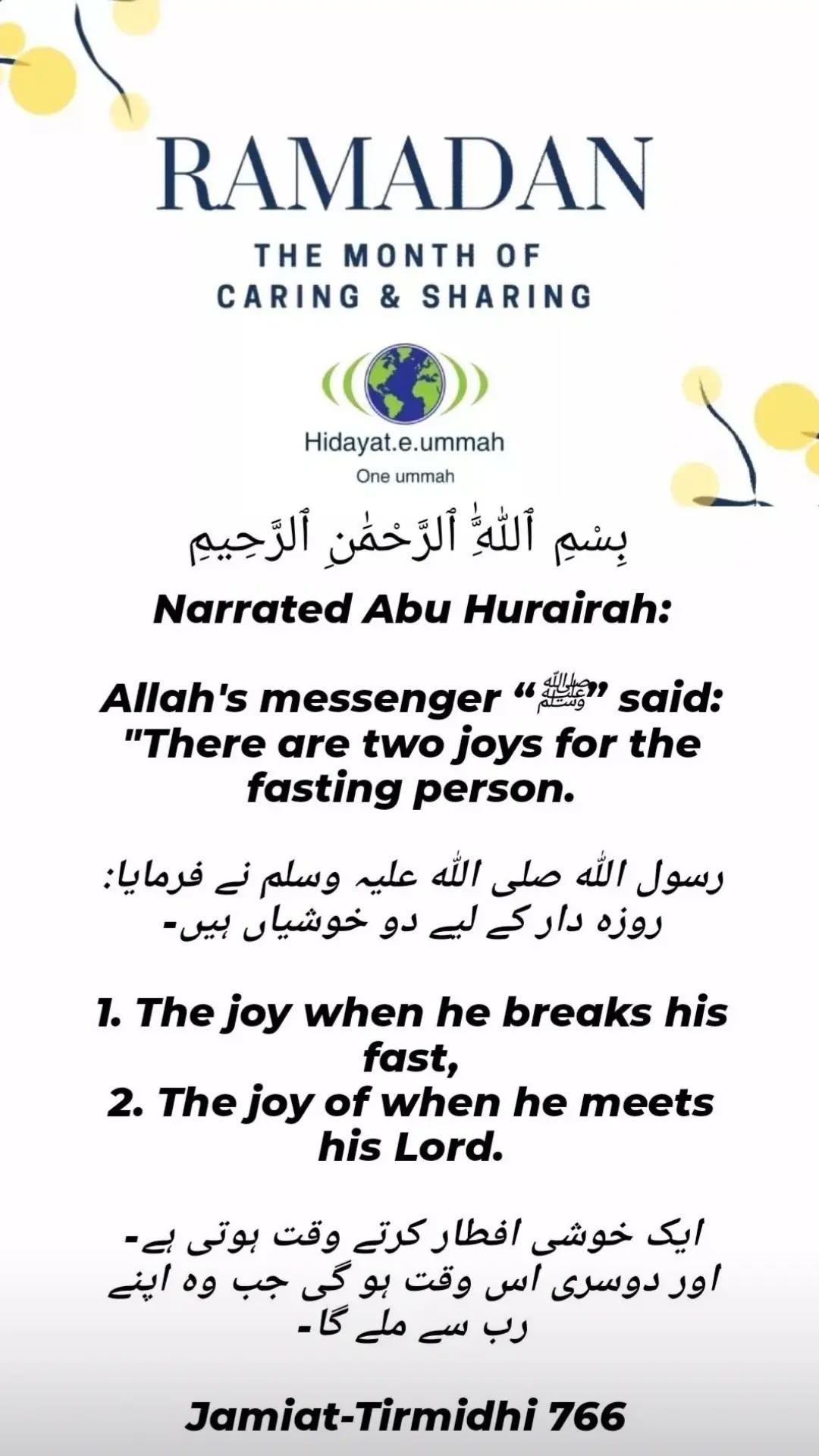
This hadith, narrated by Abu Hurairah, highlights the two significant joys that a fasting person experiences.
1. **Joy of Breaking the Fast:**
- The first joy is when a person breaks their fast, feeling the satisfaction and relief after a day of abstaining from food and drink.
- This joy is a reward for their patience and discipline during fasting.
2. **Joy of Meeting Allah:**
- The second joy is when the fasting person meets their Lord on the Day of Judgment, where they will be rewarded for their fasting and devotion.
**Lesson:**
- This hadith emphasizes that fasting not only brings joy in this world but also great rewards in the Hereafter, motivating Muslims to fast with sincerity and patience.
Hadith 20
20 of 40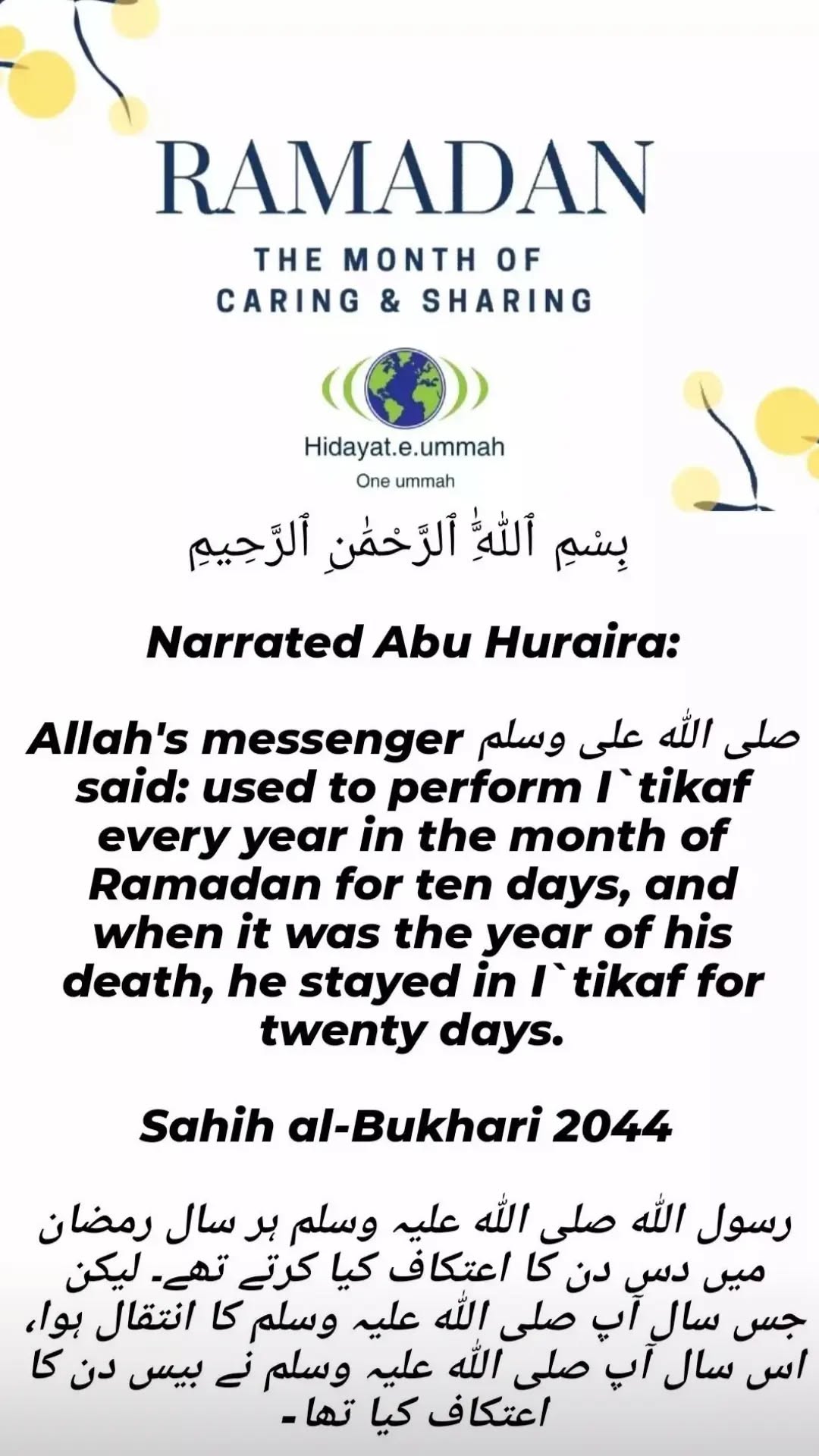
This hadith, narrated by Abu Hurairah, explains the practice of I'tikaf (spiritual retreat) observed by the Prophet Muhammad ( SAW Peace be upon him) during Ramadan.
1. **The Prophet's Regular Practice of I'tikaf:**
- Every year, the Prophet used to perform I'tikaf for ten days in the month of Ramadan, dedicating himself to worship, prayer, and reflection.
- I'tikaf involves secluding oneself in the mosque, avoiding worldly distractions, and focusing on spirituality.
2. **The Prophet's Increased I'tikaf in His Final Year:**
- In the year of his death, the Prophet performed I'tikaf for twenty days instead of the usual ten, indicating the importance he placed on this practice during Ramadan.
**Lesson:**
- This hadith emphasizes the significance of I'tikaf during Ramadan as a way to increase devotion and closeness to Allah. It also shows the Prophet's commitment to worship even in his final year.
Hadith 21
21 of 40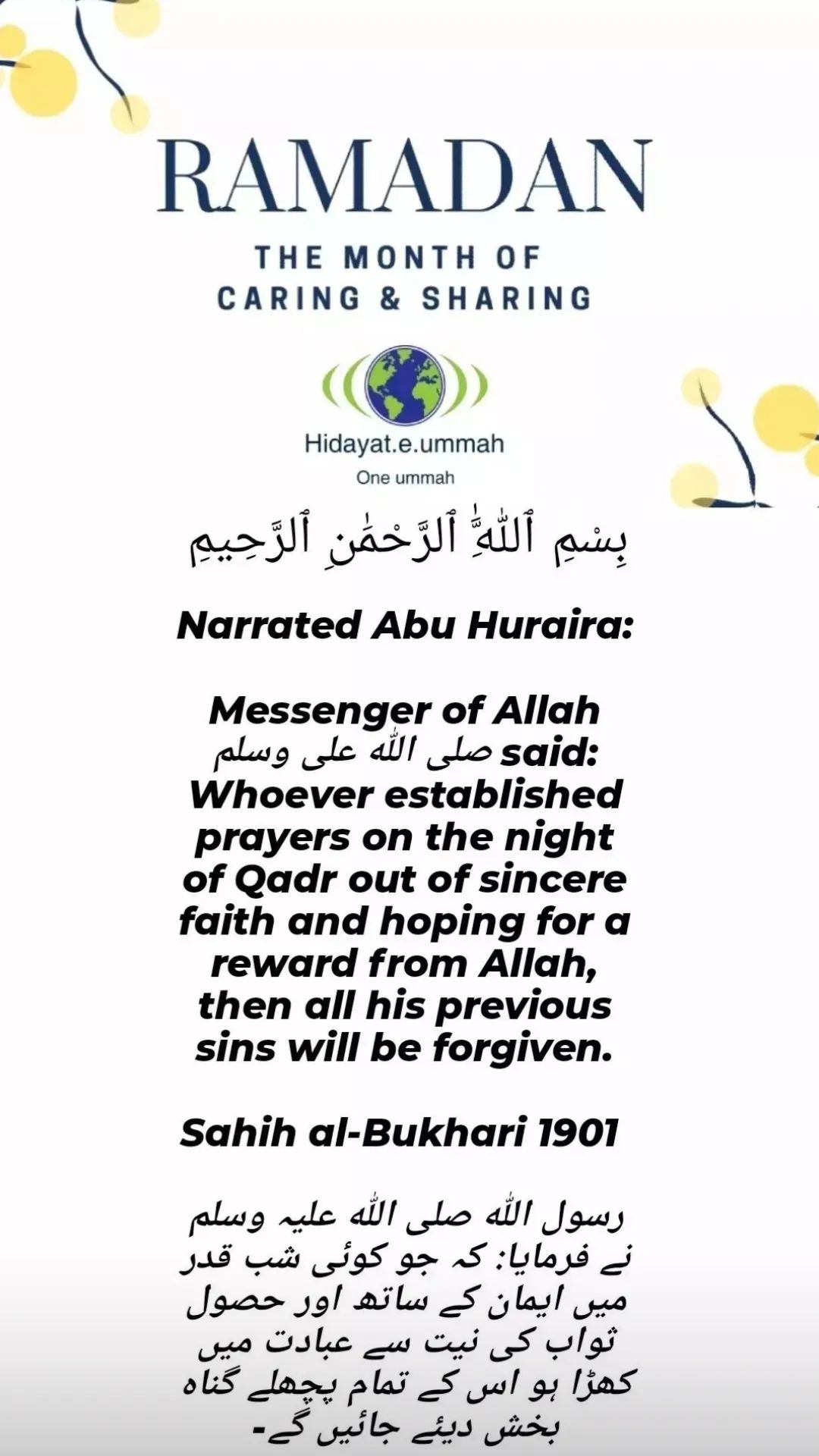
This hadith, narrated by Abu Huraira, highlights the immense reward for those who pray during the Night of Qadr (Laylat al-Qadr) in Ramadan.
1. **The Significance of Praying on the Night of Qadr:**
- The Night of Qadr is a blessed and powerful night in the month of Ramadan, during which prayers are especially rewarded.
- Whoever prays during this night with sincerity and hope for Allah's reward will have their previous sins forgiven.
2. **The Condition for Forgiveness:**
- The forgiveness is granted for those who offer prayers out of sincere faith and a desire to earn Allah's reward, not out of habit or for show.
**Lesson:**
- This hadith encourages us to strive to pray during the Night of Qadr, seeking Allah's forgiveness and mercy, knowing that it is an opportunity for a fresh start and purification from past sins.
Hadith 22
22 of 40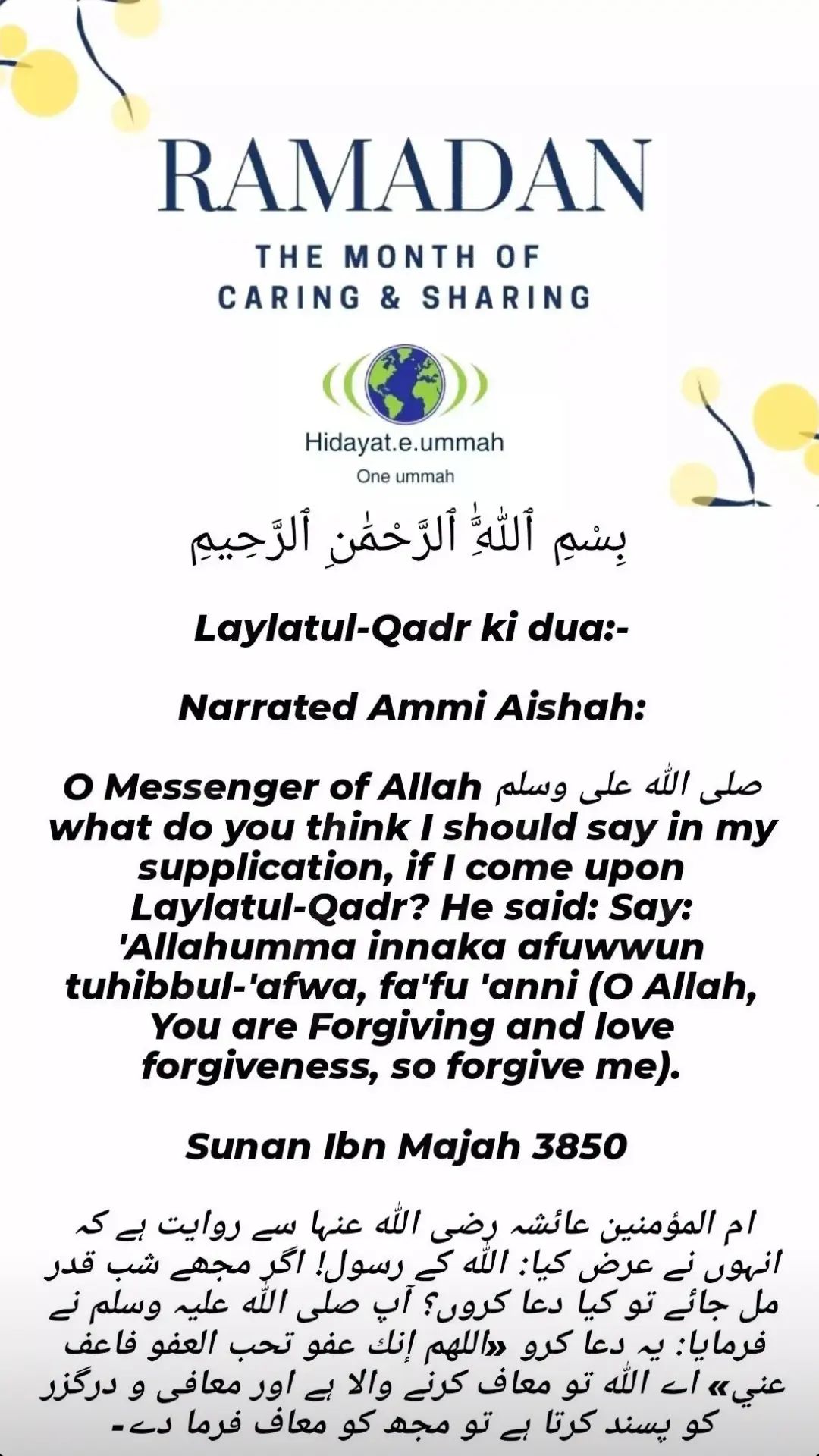
This hadith, narrated by Aisha, explains the special supplication recommended to recite during Laylatul-Qadr, the Night of Decree in Ramadan.
1. **The Importance of Laylatul-Qadr:**
- Laylatul-Qadr is a night of great blessings, during which Allah’s mercy and forgiveness are abundant. It is the night when the Quran was revealed and is better than a thousand months.
2. **The Supplication for Laylatul-Qadr:**
- The Prophet ( SAW Peace be upon him) taught Aisha the special dua to recite if she encounters Laylatul-Qadr: ‘O Allah, You are Forgiving and love forgiveness, so forgive me.’
- This supplication emphasizes seeking Allah's forgiveness and acknowledging His attribute of being the Most Forgiving.
**Lesson:**
- On Laylatul-Qadr, we should focus on asking Allah for forgiveness with sincerity, knowing that this night offers a tremendous opportunity to have our sins forgiven and to draw closer to Allah.
Hadith 23
23 of 40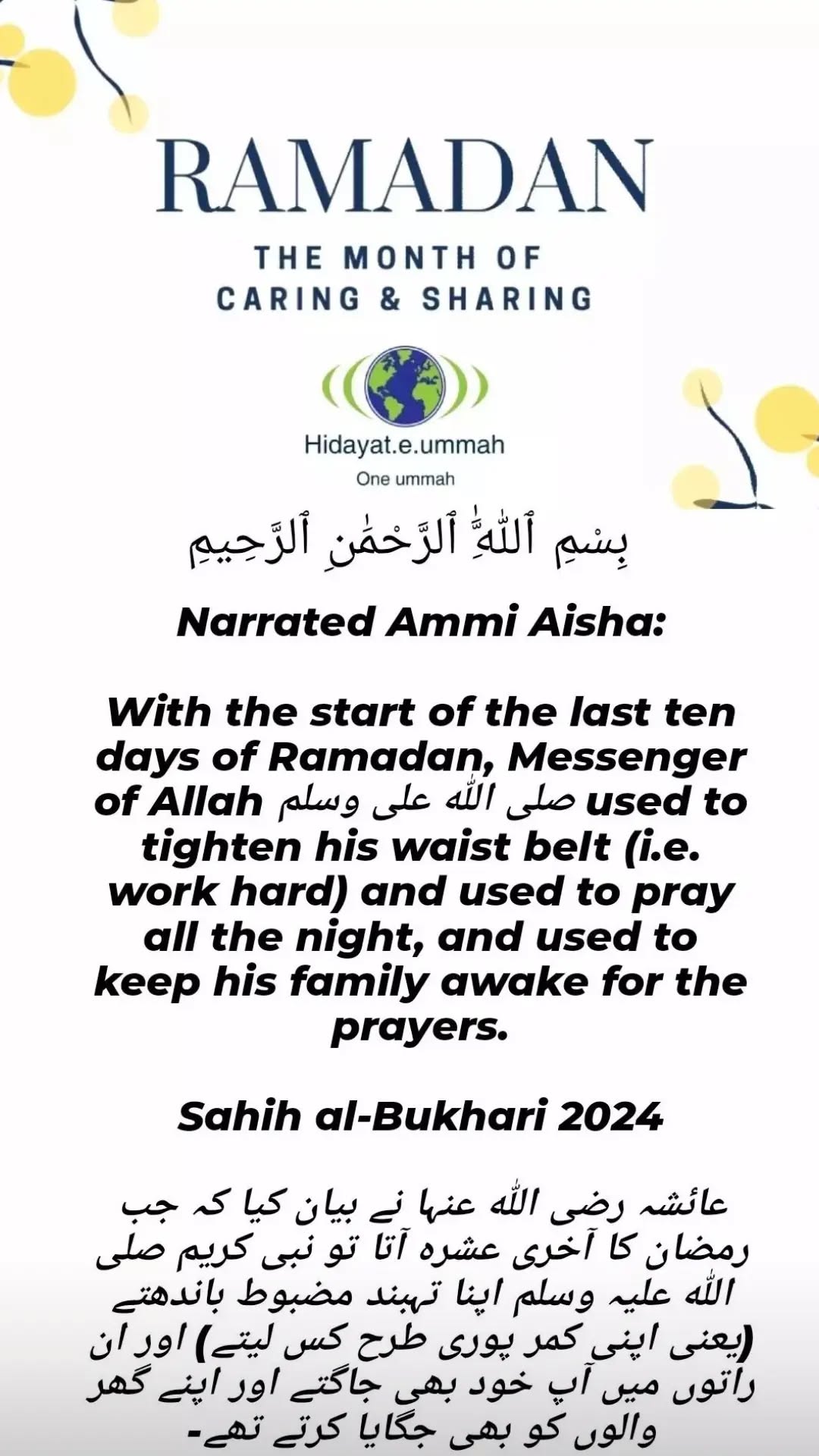
This hadith, narrated by Aisha, describes the behavior of the Prophet ( SAW Peace be upon him) during the last ten days of Ramadan.
1. **Increased Devotion in the Last Ten Days:**
- The Prophet ( SAW Peace be upon him) would exert extra effort during the last ten nights of Ramadan, as it is a time of heightened spiritual opportunity, especially for Laylatul-Qadr.
- He would 'tighten his waist belt,' which is a metaphor for dedicating himself to more intense worship.
2. **Night Prayers:**
- The Prophet ( SAW Peace be upon him) would spend the night in prayer, making the most of these blessed nights by engaging in acts of worship.
- He would also encourage his family to join him in prayer, emphasizing the importance of collective worship.
**Lesson:**
- During the last ten days of Ramadan, we should strive to increase our devotion to Allah through prayer, worship, and seeking forgiveness. It is a time to make the most of the opportunities for mercy and blessings.
Hadith 24
24 of 40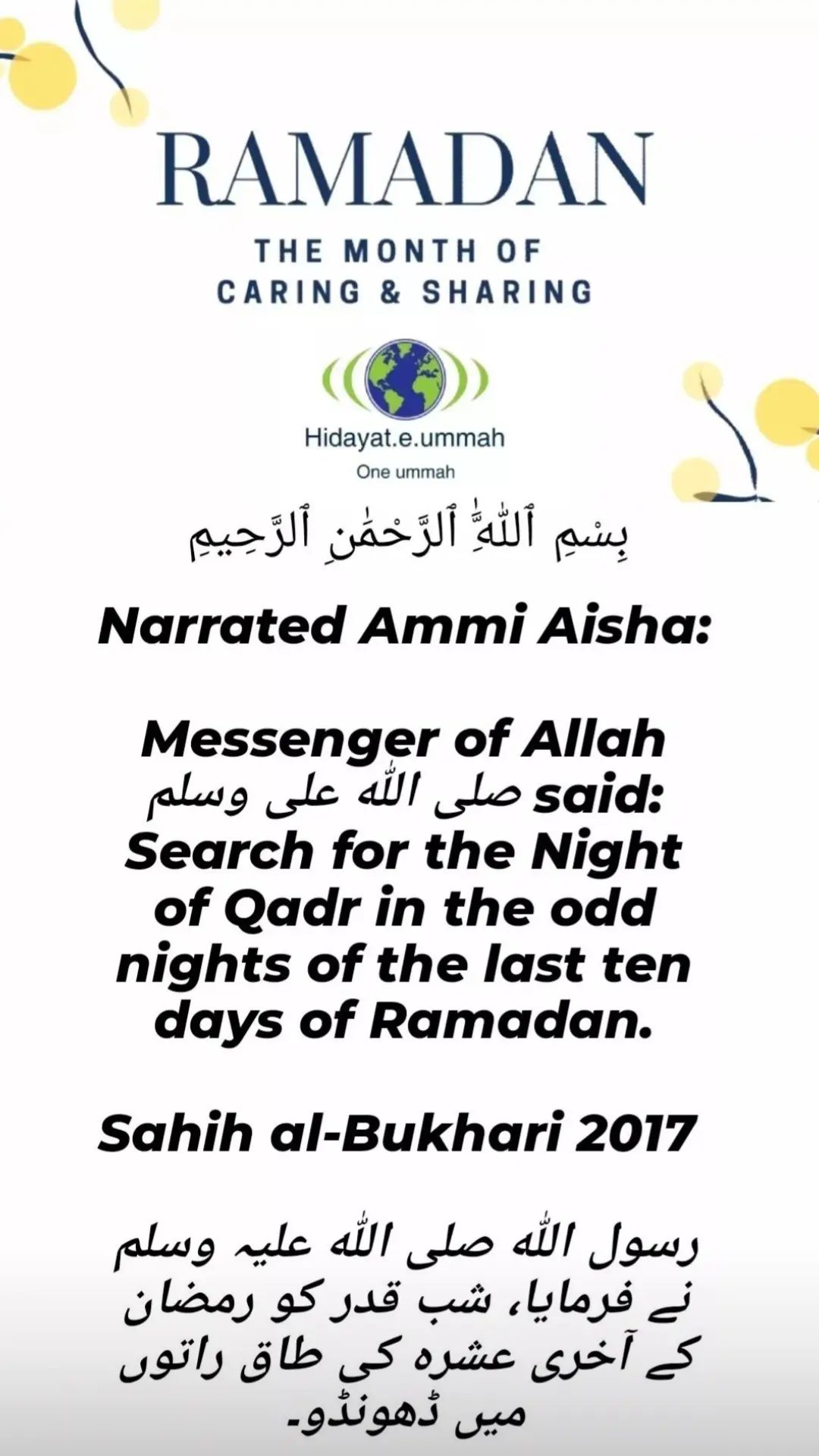
This hadith, narrated by Aisha, advises seeking Laylatul-Qadr during the last ten nights of Ramadan, specifically on the odd-numbered nights.
1. **The Importance of Laylatul-Qadr:**
- Laylatul-Qadr (the Night of Decree) is a night of great blessings and mercy, where Allah grants forgiveness and rewards abundantly.
- The Prophet ( SAW Peace be upon him) recommended searching for this night in the odd nights of the last ten days of Ramadan.
2. **The Odd Nights:**
- The odd nights of the last ten days (21st, 23rd, 25th, 27th, 29th) are especially significant for this search.
- While the exact night is not known, it is an opportunity to increase worship and supplication in hopes of catching this blessed night.
**Lesson:**
- In the last ten nights of Ramadan, we should increase our worship, prayer, and supplication, especially on the odd-numbered nights, to seek Laylatul-Qadr and its immense rewards.
Hadith 25
25 of 40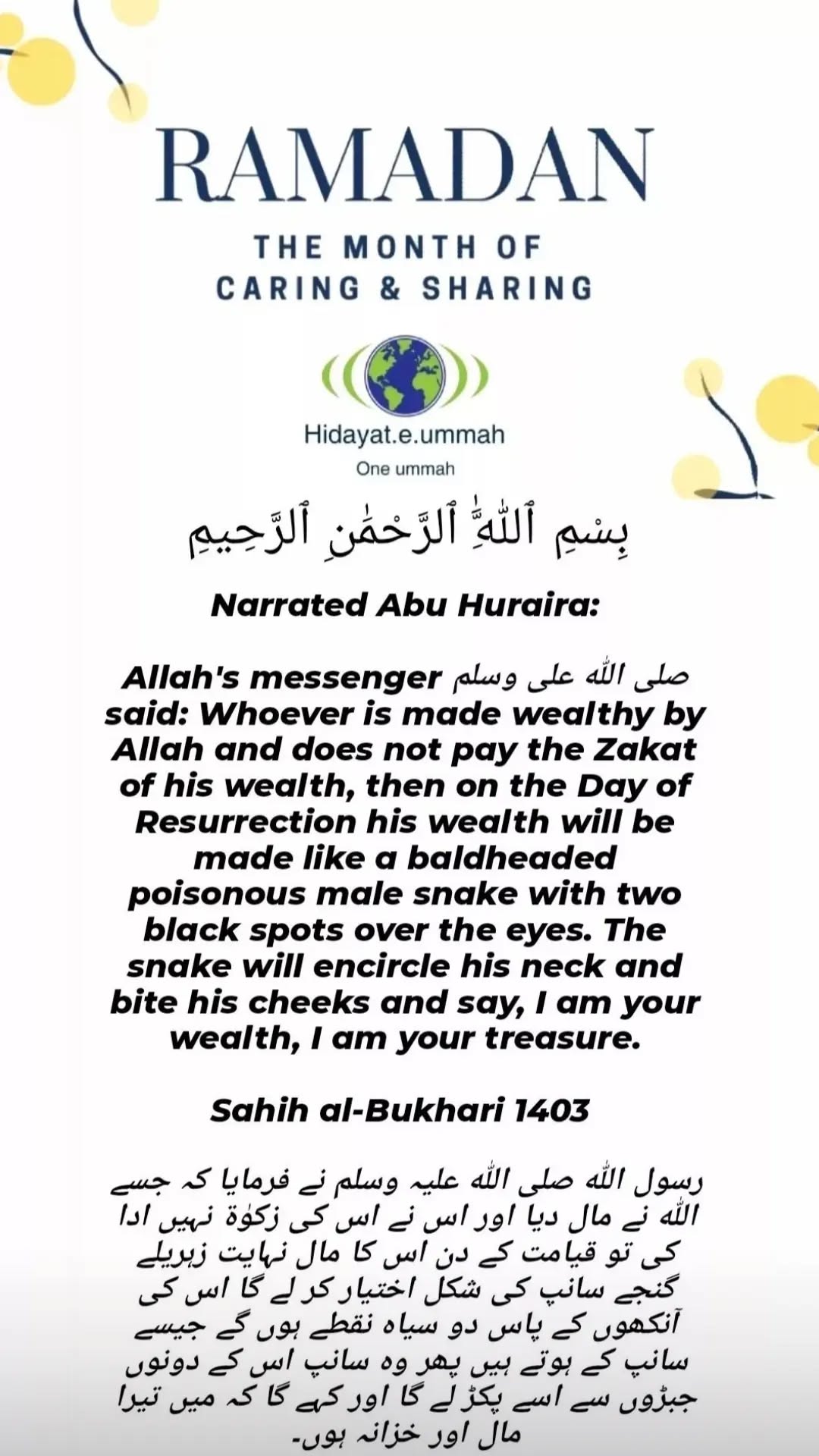
This hadith, narrated by Abu Huraira, warns about the severe consequences of not paying Zakat (the obligatory charity) on wealth.
1. **The Consequences of Not Paying Zakat:**
- If someone is blessed with wealth by Allah and fails to pay the Zakat, their wealth will be transformed into a dangerous snake on the Day of Resurrection.
- The snake will have a bald head, two black spots over its eyes, and will encircle the person’s neck, biting their cheeks, claiming to be their wealth and treasure.
2. **The Role of Zakat:**
- Zakat is a fundamental pillar of Islam, meant to purify wealth and help those in need.
- Not paying Zakat is considered a grave sin and leads to punishment in the Hereafter.
**Lesson:**
- This hadith emphasizes the importance of paying Zakat on one’s wealth. It serves as a reminder to fulfill this duty to avoid dire consequences in the Afterlife.
Hadith 26
26 of 40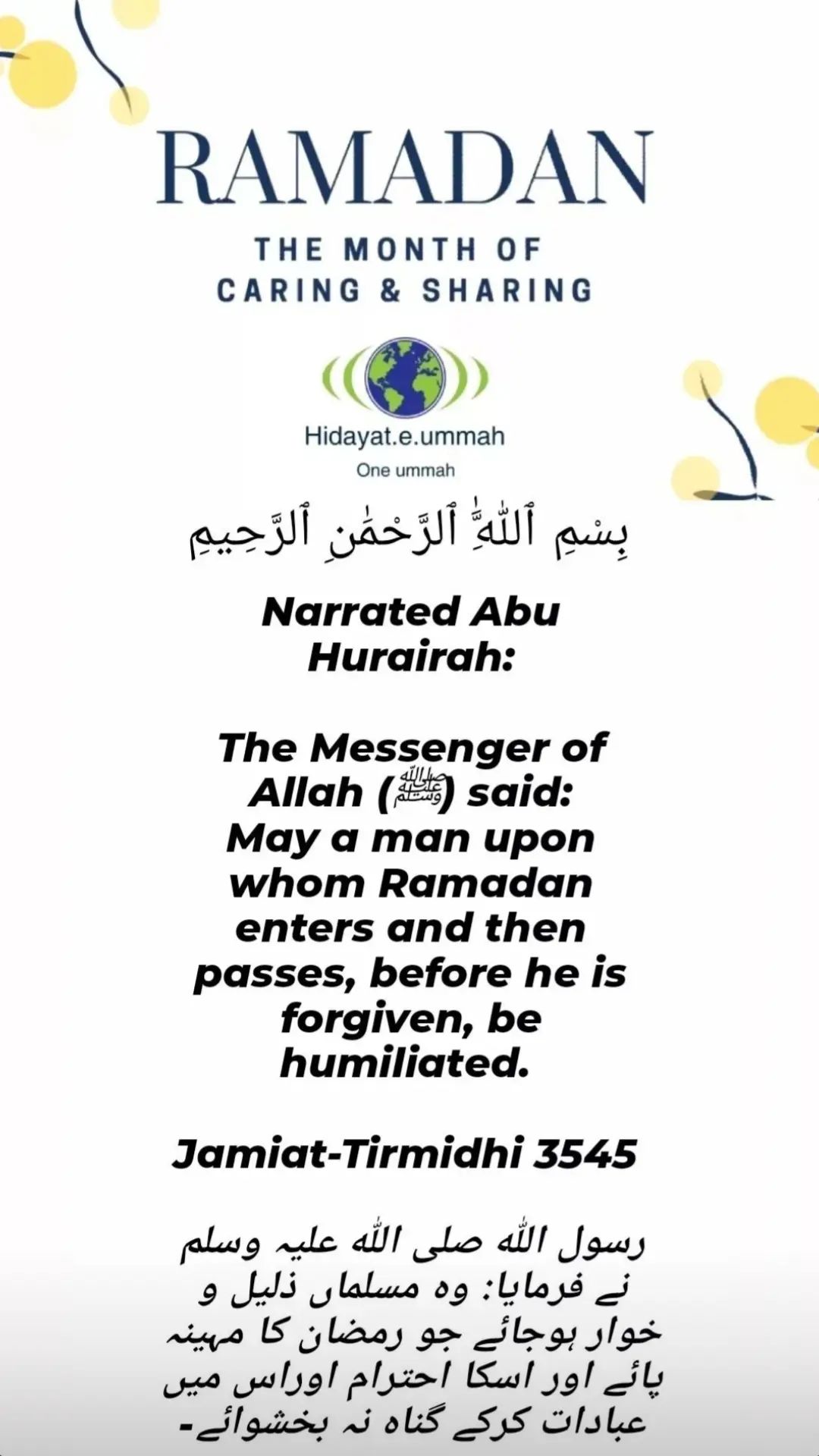
This hadith, narrated by Abu Hurairah, highlights the importance of utilizing the blessed month of Ramadan for seeking forgiveness and mercy from Allah.
1. **The Importance of Ramadan:**
- Ramadan is a sacred month, during which Muslims are given a unique opportunity to seek forgiveness and cleanse themselves of past sins.
- The Prophet ( SAW Peace be upon him) expresses sorrow for anyone who allows Ramadan to pass without taking advantage of this chance for spiritual renewal.
2. **The Consequence of Not Seeking Forgiveness:**
- If someone experiences Ramadan and does not seek Allah’s forgiveness during this time, they are considered humiliated, as they missed an important opportunity for redemption.
**Lesson:**
- This hadith encourages Muslims to make the most of Ramadan by turning to Allah for forgiveness, as it is a time when Allah’s mercy is abundant and sins are forgiven.
Hadith 27
27 of 40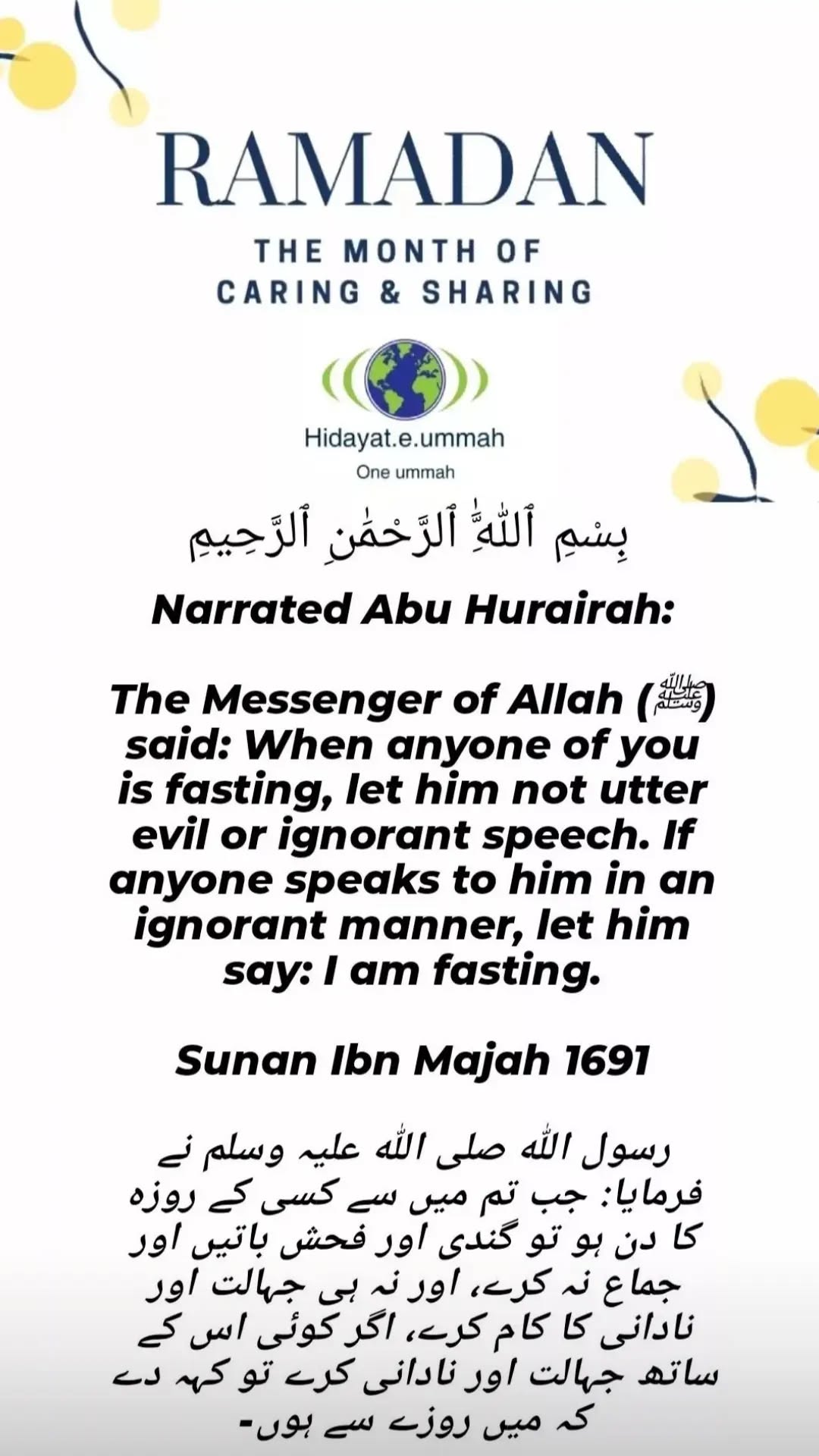
This hadith, narrated by Abu Hurairah, teaches us the proper conduct during fasting, especially when it comes to speech and behavior.
1. **Avoiding Negative Speech:**
- While fasting, Muslims should avoid speaking in an evil or ignorant manner. This includes refraining from arguments, bad language, and harmful speech.
2. **Responding to Provocation:**
- If someone provokes or argues with the fasting person, the correct response is to simply say: 'I am fasting,' which helps maintain self-control and peace.
**Lesson:**
- Fasting is not just about abstaining from food and drink, but also from negative behavior and speech. This teaches self-discipline and the importance of maintaining good character.
Hadith 28
28 of 40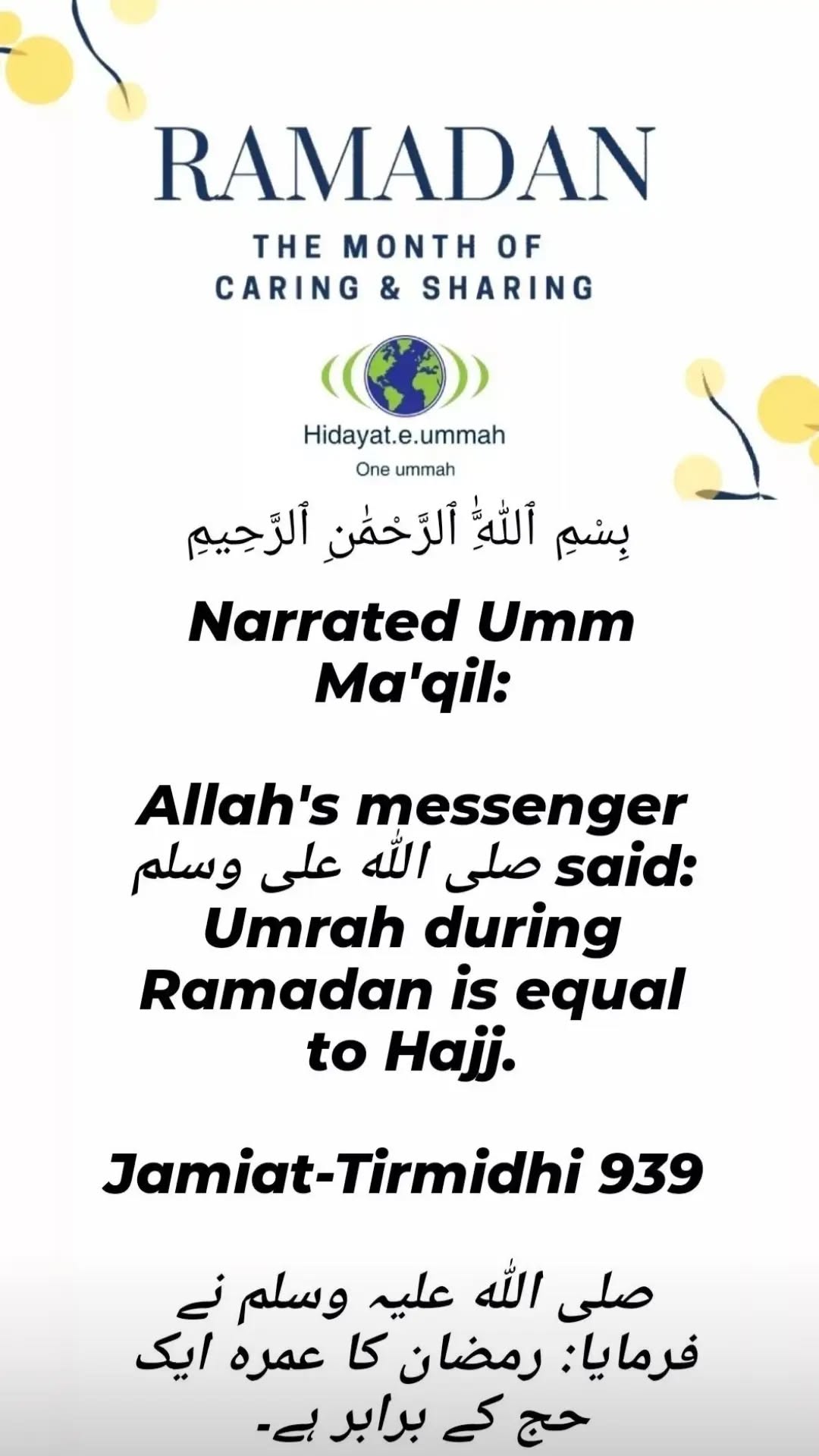
This hadith, narrated by Umm Ma'qil, highlights the significance of performing Umrah during the month of Ramadan.
1. **The Reward of Umrah in Ramadan:**
- The Prophet ( SAW Peace be upon him) said that performing Umrah during Ramadan holds a reward equivalent to performing Hajj. This emphasizes the great virtue and reward of Umrah when performed during this blessed month.
2. **Special Virtue of Ramadan:**
- Ramadan is a time when acts of worship are highly rewarded, and even a smaller act like Umrah is given the reward of a greater one like Hajj.
**Lesson:**
- This hadith encourages Muslims to strive to perform Umrah during Ramadan to gain immense rewards, as the act is greatly valued during this sacred month.
Hadith 29
29 of 40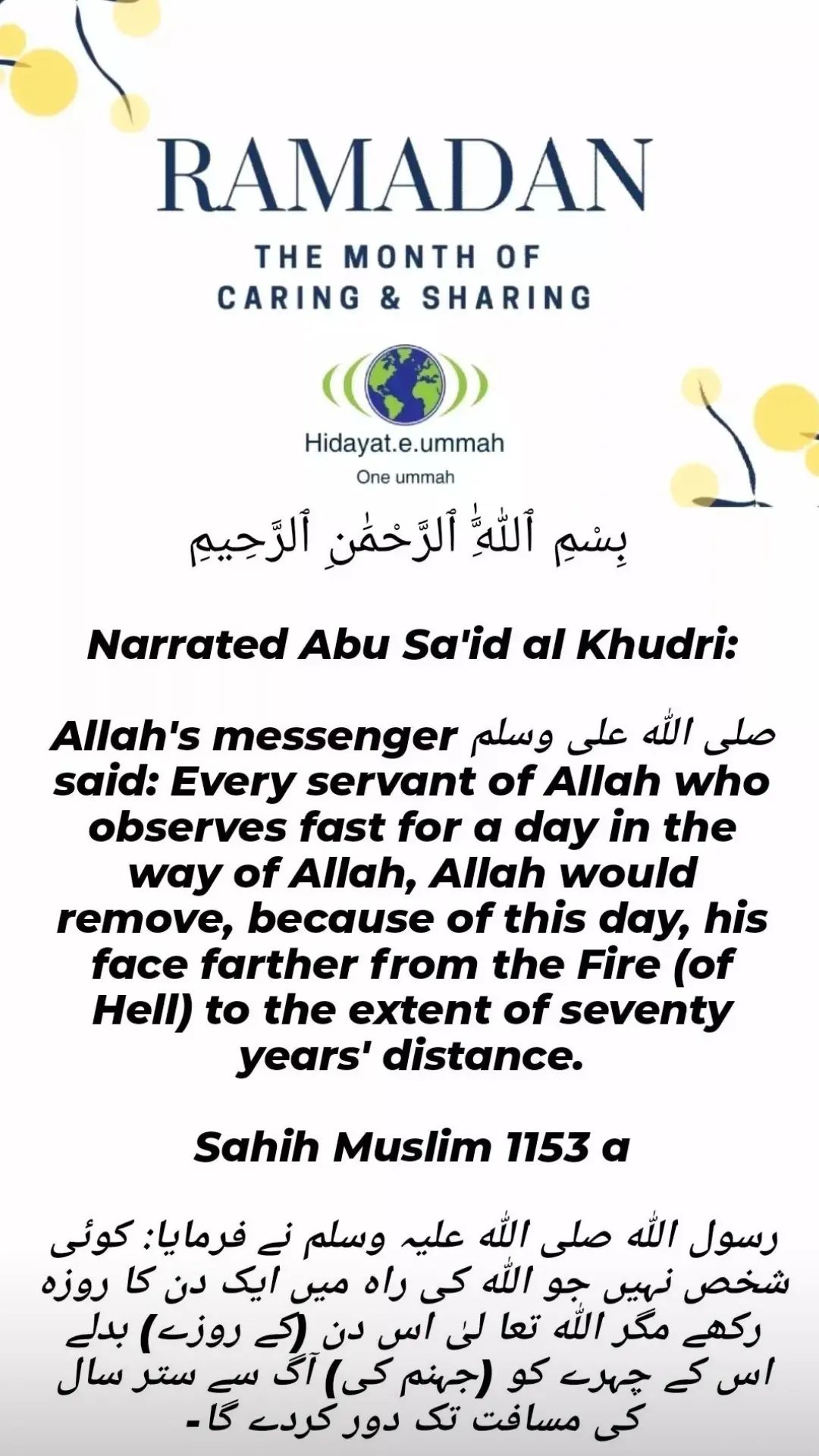
This hadith, narrated by Abu Sajid al-Khudri, emphasizes the great reward for fasting in the way of Allah.
1. **The Reward of Fasting in the Way of Allah:**
- Every servant who fasts for a single day in the way of Allah, meaning fasting with sincerity and devotion for His sake, will have their face distanced from the Fire of Hell by seventy years.
2. **The Distance from the Fire:**
- The hadith illustrates the immense reward of fasting, where even one day of fasting can save a person from the torment of Hell for an extremely long distance (seventy years).
**Lesson:**
- This hadith encourages Muslims to fast sincerely for the sake of Allah, as it brings not only spiritual benefits but also protection from the Hellfire.
Hadith 30
30 of 40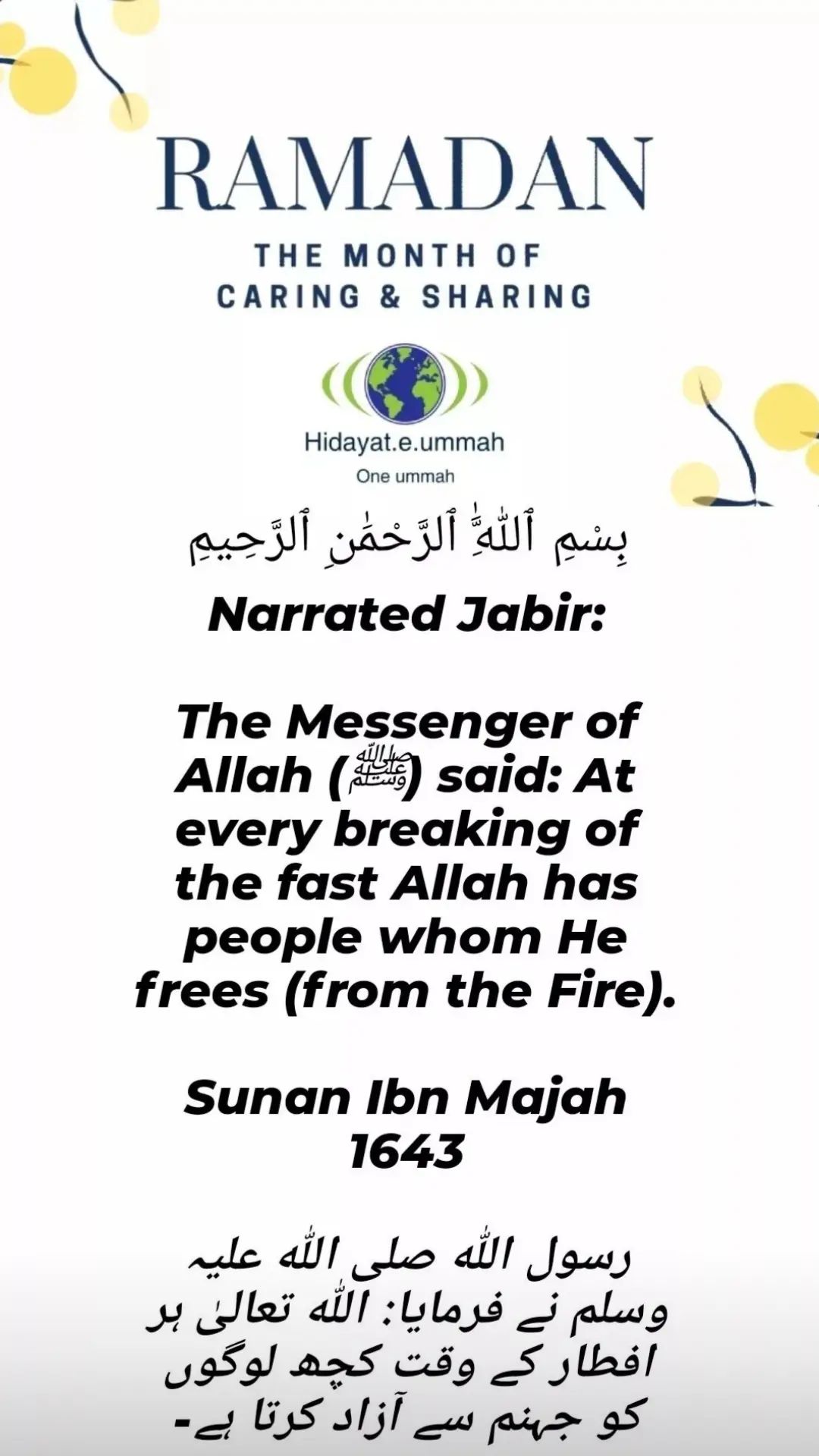
This hadith, narrated by Jabir, highlights Allah's mercy and forgiveness during the month of Ramadan.
1. **Freeness from the Fire:**
- Every time a fasting person breaks their fast, Allah frees certain people from the Fire (Hell). This refers to the special mercy and forgiveness Allah grants to those observing fasting.
2. **Allah's Mercy in Ramadan:**
- The hadith emphasizes that Ramadan is a time of great mercy, where Allah offers freedom from Hell to His believers at the time of breaking the fast.
**Lesson:**
- This hadith encourages Muslims to fast sincerely and break their fast with gratitude, as it is a time when Allah’s mercy is abundant, and people are saved from punishment.
Hadith 31
31 of 40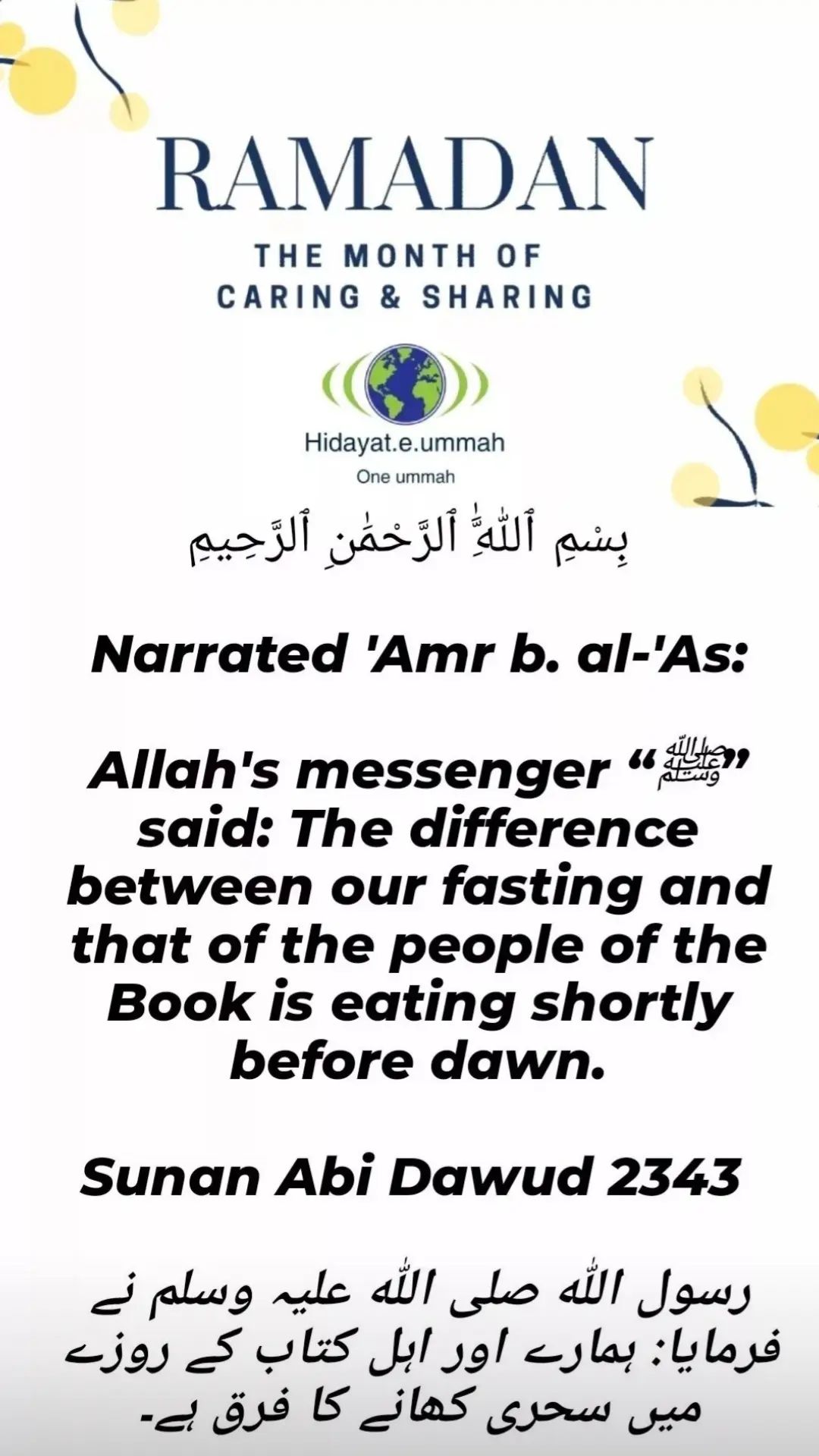
This hadith, narrated by Amr b. al-'As, explains the distinctive practice of fasting in Islam as compared to other religious communities.
1. **Key Difference in Fasting Practices:**
- The Prophet ( SAW Peace be upon him) highlights the difference between the fasting of Muslims and the fasting of the People of the Book (i.e., Jews and Christians). The key difference is that Muslims eat shortly before dawn (Suhur), whereas the People of the Book do not have this practice.
2. **Suhur as a Distinction:**
- The eating of Suhur (pre-dawn meal) is a distinctive feature of Islamic fasting, which makes it different from the fasting practices of other religious groups.
**Lesson:**
- This hadith teaches the importance of following the Sunnah and the unique practices that distinguish Muslim fasting from other faiths.
Hadith 32
32 of 40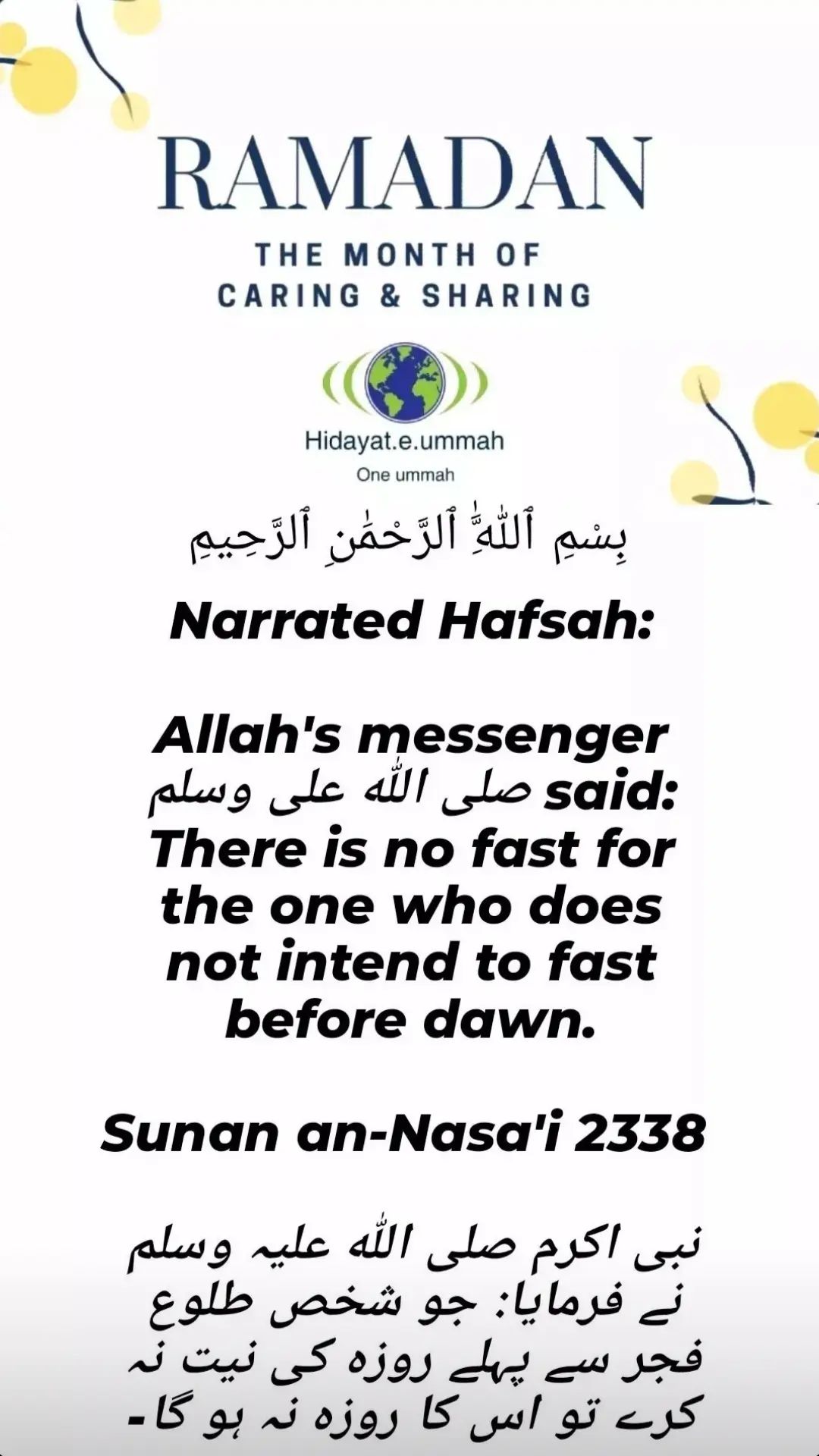
This hadith, narrated by Hafsah, emphasizes the importance of the intention behind fasting in Islam.
1. **Intention is Essential:**
- The Prophet ( SAW Peace be upon him) makes it clear that the fast of a person who does not make the intention (niyyah) before dawn is invalid. Intention is a key requirement for the validity of fasting in Islam.
2. **Timing of the Intention:**
- The intention must be made before dawn to ensure the fast is valid, highlighting the significance of preparing spiritually for the fast.
**Lesson:**
- This hadith teaches that intention plays a central role in all acts of worship, and fasting is no exception. One must intend to fast before dawn to ensure the fast is accepted.
Hadith 33
33 of 40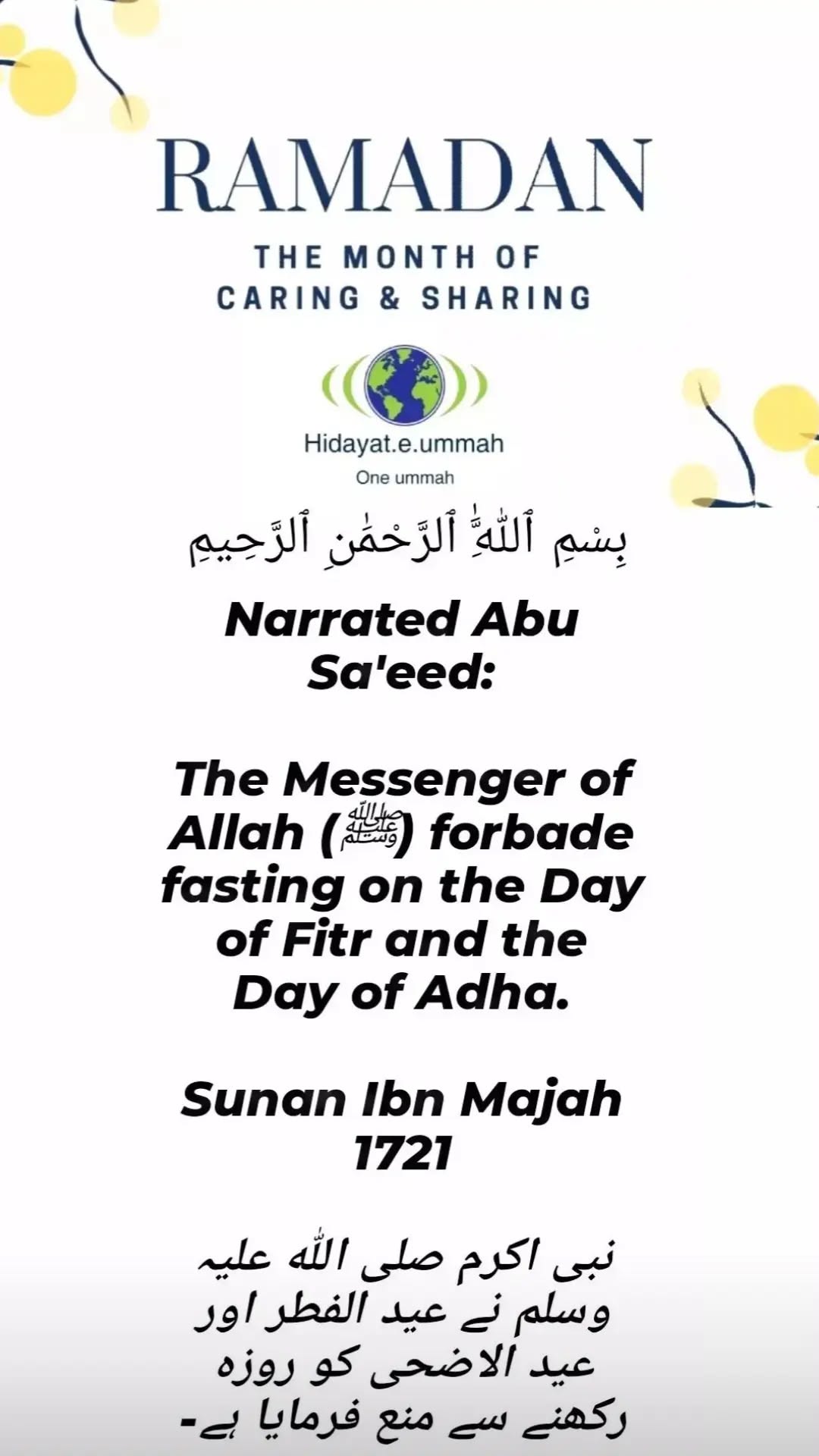
This hadith, narrated by Abu Sa'eed, conveys the prohibition of fasting on two important Islamic holidays.
1. **Days of Prohibition for Fasting:**
- The Prophet ( SAW Peace be upon him) forbade fasting on the **Day of Fitr** (the day after Ramadan) and the **Day of Adha** (during the festival of sacrifice).
2. **Why the Prohibition:**
- These two days are significant celebrations in Islam, and fasting on these days would go against the spirit of joy, feasts, and thankfulness associated with them.
**Lesson:**
- This hadith reminds Muslims to refrain from fasting on these special days to maintain the celebration and worship specific to these occasions.
Hadith 34
34 of 40
The strong man is not the one who wrestles others, but the one who controls himself when angry. – Prophet Muhammad (peace be upon him)
Hadith 35
35 of 40
The strong man is not the one who wrestles others, but the one who controls himself when angry. – Prophet Muhammad (peace be upon him)
Hadith 36
36 of 40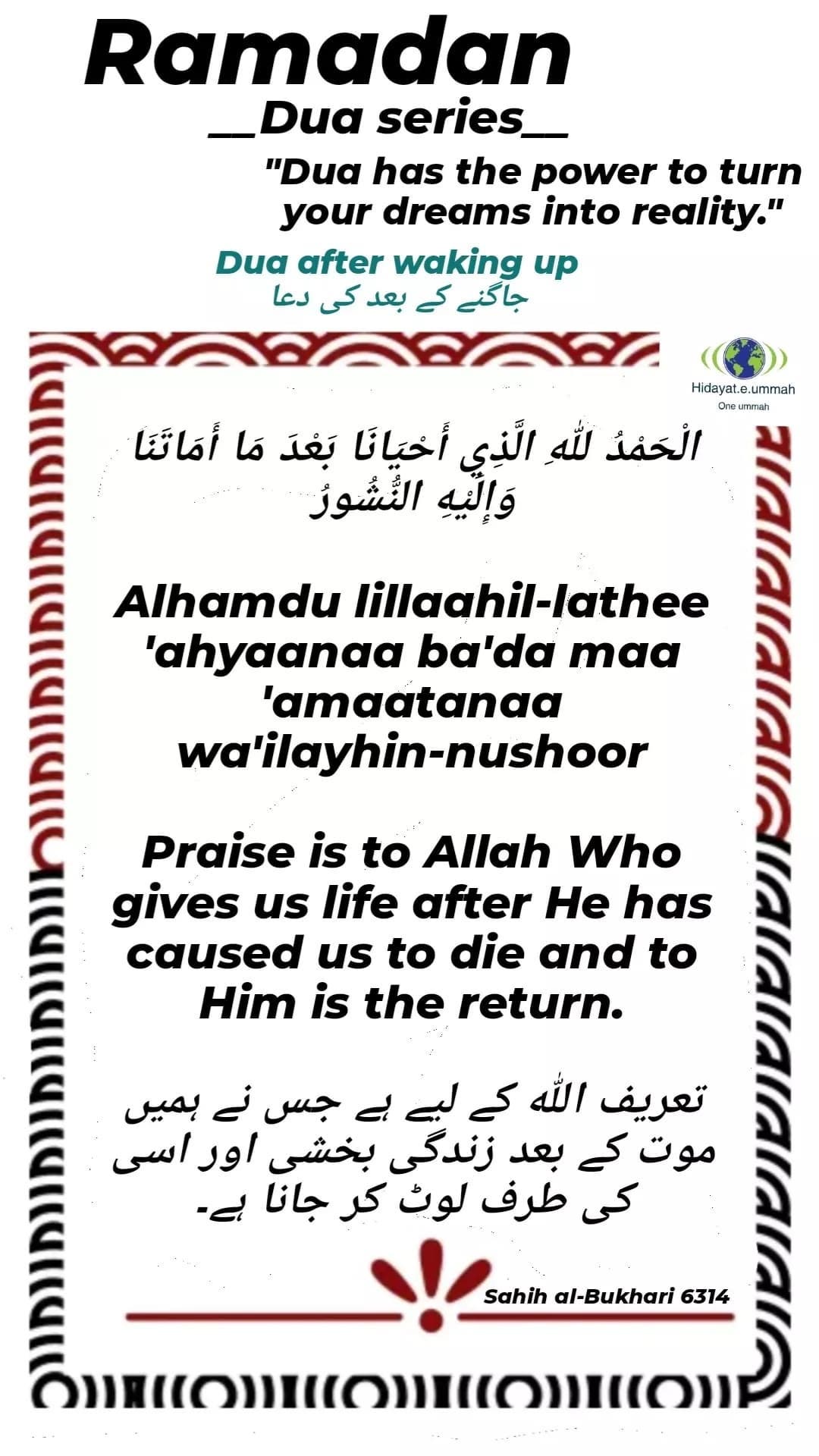
The strong man is not the one who wrestles others, but the one who controls himself when angry. – Prophet Muhammad (peace be upon him)
Hadith 37
37 of 40
The strong man is not the one who wrestles others, but the one who controls himself when angry. – Prophet Muhammad (peace be upon him)
Hadith 38
38 of 40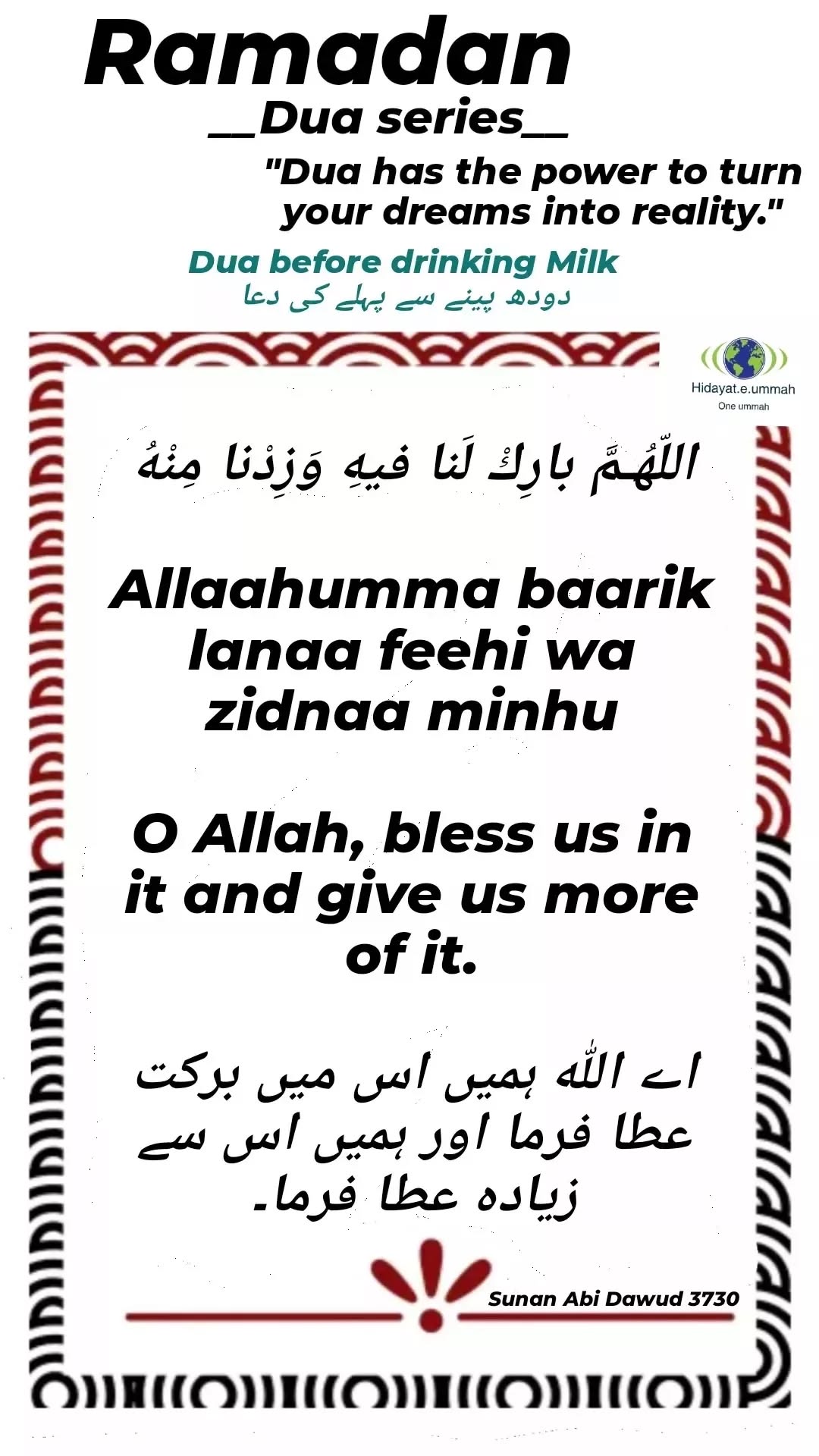
The strong man is not the one who wrestles others, but the one who controls himself when angry. – Prophet Muhammad (peace be upon him)
Hadith 39
39 of 40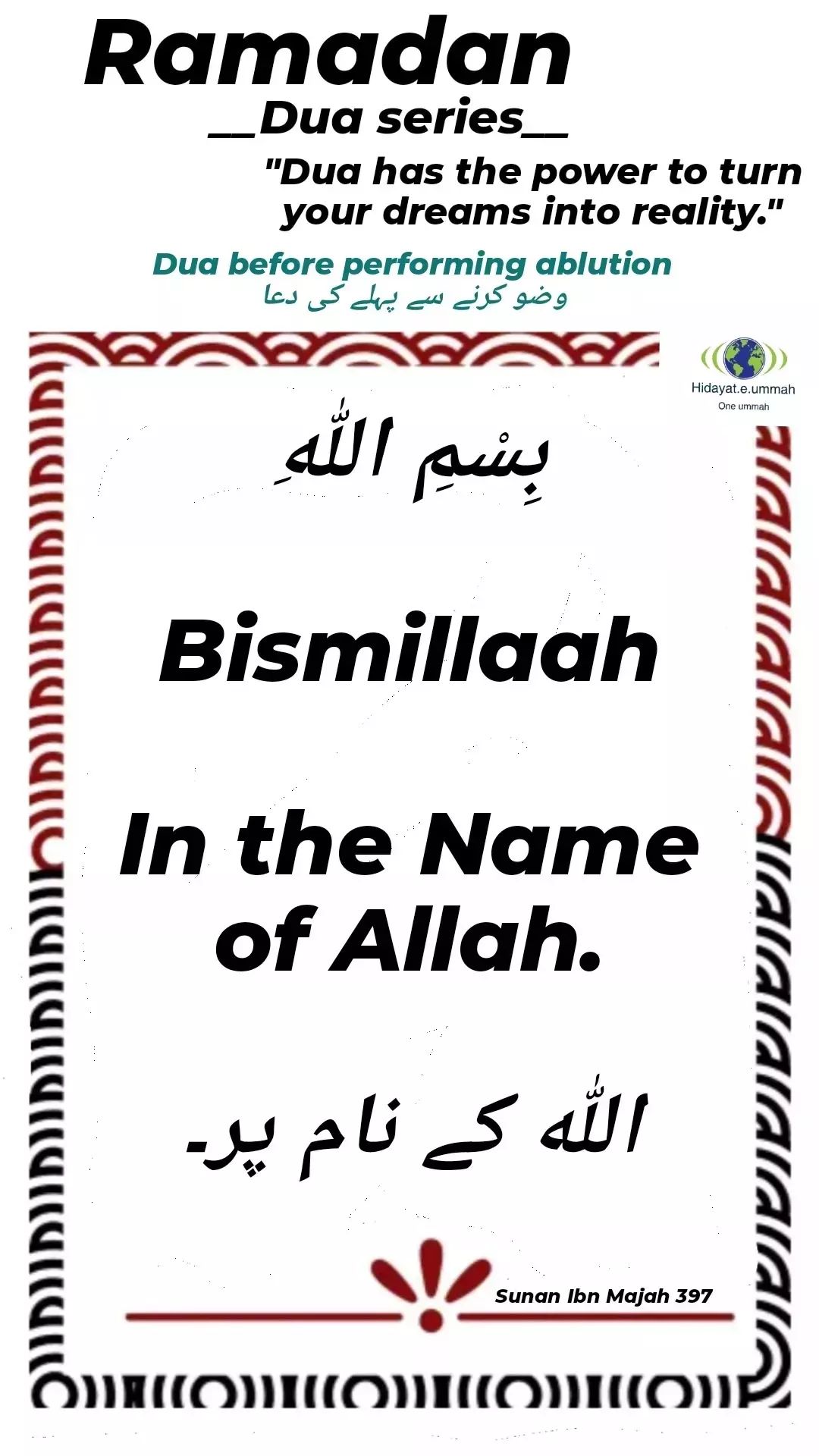
The strong man is not the one who wrestles others, but the one who controls himself when angry. – Prophet Muhammad (peace be upon him)
Hadith 40
40 of 40
The strong man is not the one who wrestles others, but the one who controls himself when angry. – Prophet Muhammad (peace be upon him)