
Travel
Hadith Collection
12 Hadiths
Hadith 1
1 of 12
This hadith, narrated by Anas, conveys advice from the Prophet Muhammad (peace be upon him) regarding travel:
1. **Traveling by Night:**
- The Prophet encourages traveling during the night because it is often more efficient and less tiring. During the night, the environment is cooler, which makes physical exertion easier compared to traveling under the heat of the day.
2. **Practical Benefit:**
- This guidance reflects the practical realities of the time when traveling was mostly on foot or by animal. Night travel allowed travelers to avoid the scorching daytime heat, ensuring they could cover greater distances with less exhaustion.
3. **Broader Wisdom:**
- The advice demonstrates the Prophet's consideration of ease and efficiency in daily life, highlighting the importance of planning and using circumstances to one's advantage.
**Lesson:**
This hadith teaches Muslims to consider practical and thoughtful approaches to tasks, such as choosing the best time for travel or work to maximize efficiency and reduce hardship.
Hadith 2
2 of 12
This hadith, narrated by Ibn Umar, highlights an important teaching of the Prophet Muhammad (peace be upon him) regarding the safety and wisdom of traveling alone at night:
1. **Caution Against Traveling Alone at Night:**
- The Prophet warned that if people knew the potential dangers associated with traveling alone, especially at night, they would avoid it.
2. **Reasons for the Warning:**
- Traveling alone at night could expose someone to various risks such as:
- Physical harm or accidents.
- Robbery or attacks by thieves.
- Getting lost due to poor visibility or lack of familiarity with the terrain.
- Emotional distress or fear from being isolated in a dark and potentially unsafe environment.
3. **Wisdom in Traveling Together:**
- The Prophet’s teaching emphasizes the importance of safety in numbers. Traveling in a group provides protection, companionship, and support in case of emergencies.
4. **Broader Lesson:**
- This hadith reminds us to take precautions and plan wisely when undertaking any journey, ensuring personal safety and well-being.
**Lesson:**
This guidance reflects the care and foresight of the Prophet in addressing practical aspects of life, urging Muslims to prioritize safety and avoid unnecessary risks.
Hadith 3
3 of 12
This hadith, narrated by Anas ibn Malik, shares a powerful and beneficial practice for Muslims when they leave their homes:
1. **Starting the Day with Trust in Allah:**
- The Prophet Muhammad (peace be upon him) encourages us to say a short but meaningful prayer when leaving the house: 'In the name of Allah, I trust in Allah; there is no might and no power but in Allah.'
- This prayer expresses reliance on Allah and acknowledges His supreme power.
2. **What Happens When You Say This Prayer:**
- **Guidance, Defense, and Protection:** When a person says these words, they are granted divine guidance, protection, and defense by Allah. This means that the person will be safeguarded in their actions and decisions throughout the day.
- **The Devils’ Reaction:** The devils (evil forces) are driven away from this person. They will not have power to harm or mislead him. Another devil, noticing this person’s protection, will be frustrated and ask, 'How can we deal with a man who has been guided, defended, and protected?'
3. **The Importance of Seeking Allah’s Help:**
- This hadith emphasizes the importance of starting any task or journey with the remembrance of Allah and placing full trust in Him.
- It shows that seeking Allah’s protection and guidance can shield a person from harm, misguidance, and the whisperings of evil forces.
**Lesson:**
- Always begin your day or any significant task by invoking the name of Allah and seeking His protection and guidance. This simple act can help protect you from difficulties and challenges.
Hadith 4
4 of 12
This hadith, narrated by Kab bin Asim, teaches a valuable lesson about fasting during travel:
1. **Fasting During Travel Is Not Always the Best Choice:**
- The Prophet Muhammad (peace be upon him) explains that it is not considered 'righteousness' or an ideal practice to fast when you are traveling.
- While fasting is a highly respected and important act of worship, it is not compulsory or encouraged to fast when traveling, especially if it may cause harm or make the journey more difficult.
2. **Why This Is the Case:**
- Traveling can be physically demanding and tiring. The Prophet’s guidance helps ease the burden on Muslims who may find it hard to fast while on a journey. Islam allows flexibility and compassion in such cases.
- Instead of fasting during travel, a Muslim may break their fast and make up the days later, ensuring their well-being during the journey.
3. **The Concept of Ease in Islam:**
- This hadith emphasizes that Islam is a religion that prioritizes ease over hardship. Allah has given us allowances, such as breaking the fast during travel, to ensure we do not face unnecessary difficulties.
- The core principle is to maintain balance in religious observance and personal comfort, showing that Allah does not intend for His followers to face undue hardship in acts of worship.
**Lesson:**
- If you are traveling and find fasting difficult, it is not a sign of unrighteousness to break your fast. Islam encourages you to take care of yourself and fast when it is manageable and comfortable.
Hadith 5
5 of 12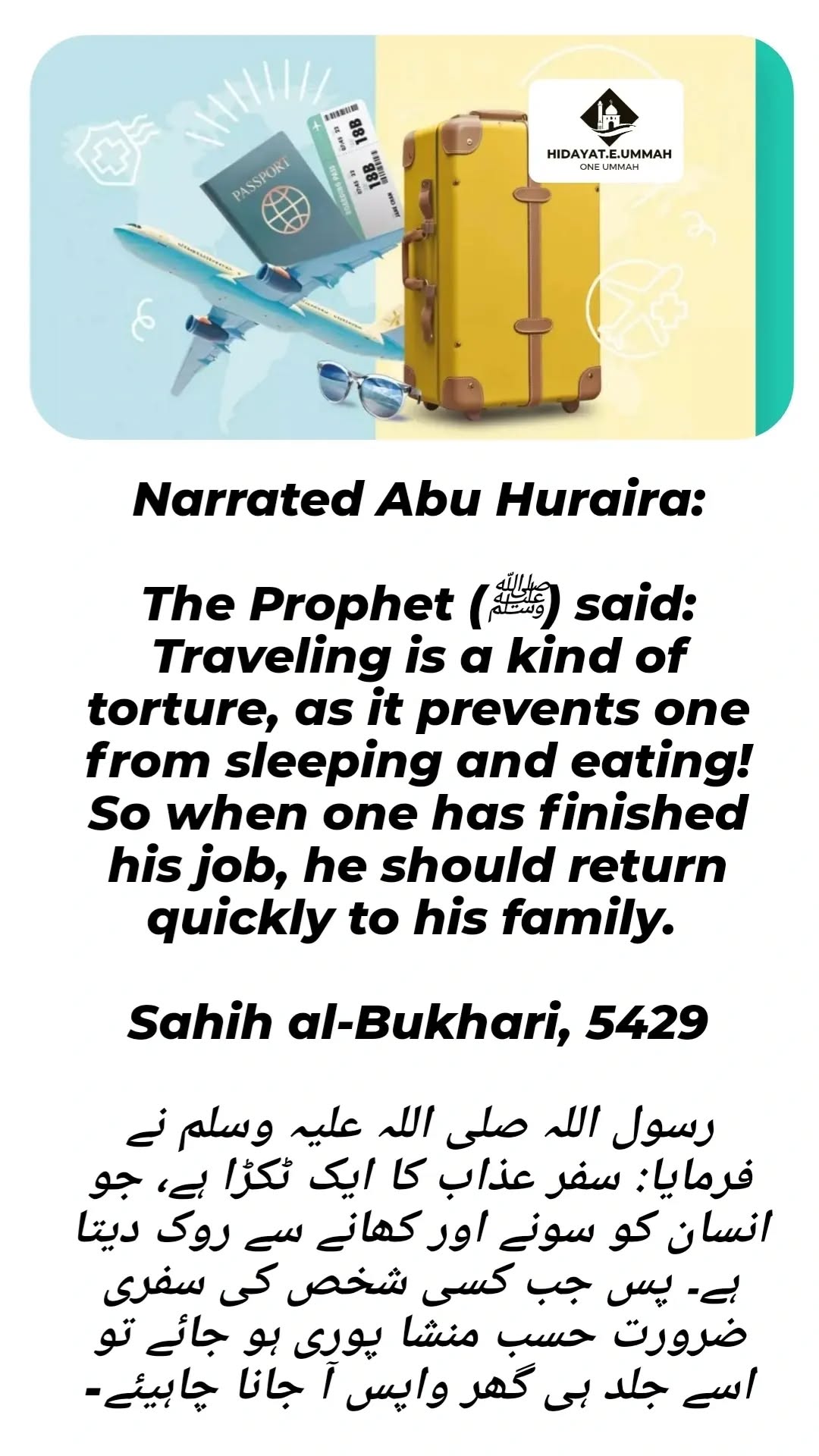
This hadith, narrated by Abu Huraira, highlights the difficulties and challenges of traveling:
1. **Traveling Can Be Difficult:**
- The Prophet Muhammad (peace be upon him) describes traveling as a kind of 'torture' because it disrupts normal life, particularly in terms of sleep and food. While travel is necessary in many circumstances, it often brings discomfort and inconveniences.
- The Prophet acknowledges that travel can be physically and mentally taxing, especially when one is away from the comforts of home.
2. **Return Home Quickly After Completing the Task:**
- Once a person has completed their work or purpose for the travel, the Prophet advises that they should return quickly to their family. This is to minimize the hardship of being away from home and loved ones.
- Islam encourages maintaining close family ties and the comfort of being at home, which is why the Prophet urges a swift return after fulfilling the reason for the journey.
3. **The Importance of Family and Comfort:**
- This hadith also reminds us that family and home provide comfort and stability. After enduring the challenges of travel, returning to family brings peace and a sense of relief.
- The Prophet’s advice reflects the Islamic value of caring for one’s well-being and ensuring that family connections remain strong.
**Lesson:**
- While travel may be necessary, it is understood as a challenge that should be endured only when necessary. Once your task is complete, returning home and reuniting with loved ones is encouraged to regain comfort and peace.
Hadith 6
6 of 12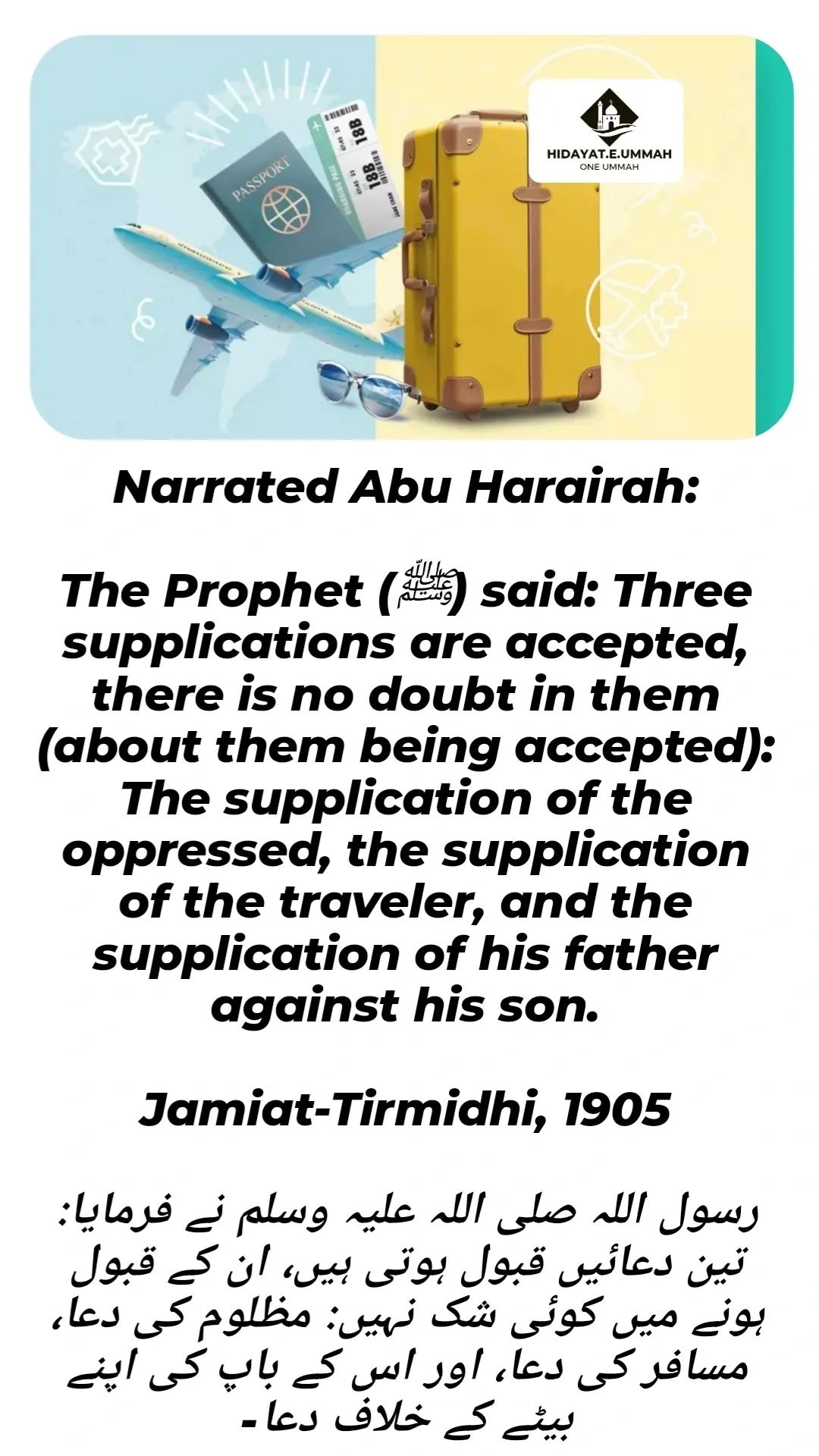
This hadith, narrated by Abu Huraira, mentions three types of supplications (du'a) that are guaranteed to be accepted by Allah. The Prophet Muhammad (peace be upon him) assures that there is no doubt about the acceptance of these prayers:
1. **The Supplication of the Oppressed (Dua of the Oppressed):**
- When someone is being wronged or treated unjustly, their prayers to Allah are powerful and are guaranteed to be answered. This shows the importance of justice and Allah’s mercy towards those who suffer oppression.
- The oppressed person’s supplication is not ignored, and Allah listens to their plea, especially when they are unable to defend themselves.
2. **The Supplication of the Traveler:**
- When a person is traveling, especially on a long or difficult journey, their supplications are also accepted by Allah. Traveling can be full of challenges and risks, and Allah promises to respond to the traveler’s prayers for safety, protection, and success.
- This highlights the importance of seeking Allah’s help and making du'a when away from home, as travelers face uncertainty and hardship.
3. **The Supplication of a Father Against His Son:**
- If a father makes a supplication against his son, it is also accepted. This highlights the powerful relationship between parent and child, and the deep emotional bond a father may feel when his son disobeys or causes harm. It is a reminder of the responsibility children have to their parents, especially in the way they treat them.
- It also serves as a warning to children about the importance of respecting and obeying their parents, as a father's du'a is a powerful tool.
**Lesson:**
- The Prophet emphasizes that certain supplications, especially those made by the oppressed, travelers, and parents, are especially powerful and are never overlooked by Allah. These three groups should be treated with kindness and respect, as their du'as are answered without fail.
Hadith 7
7 of 12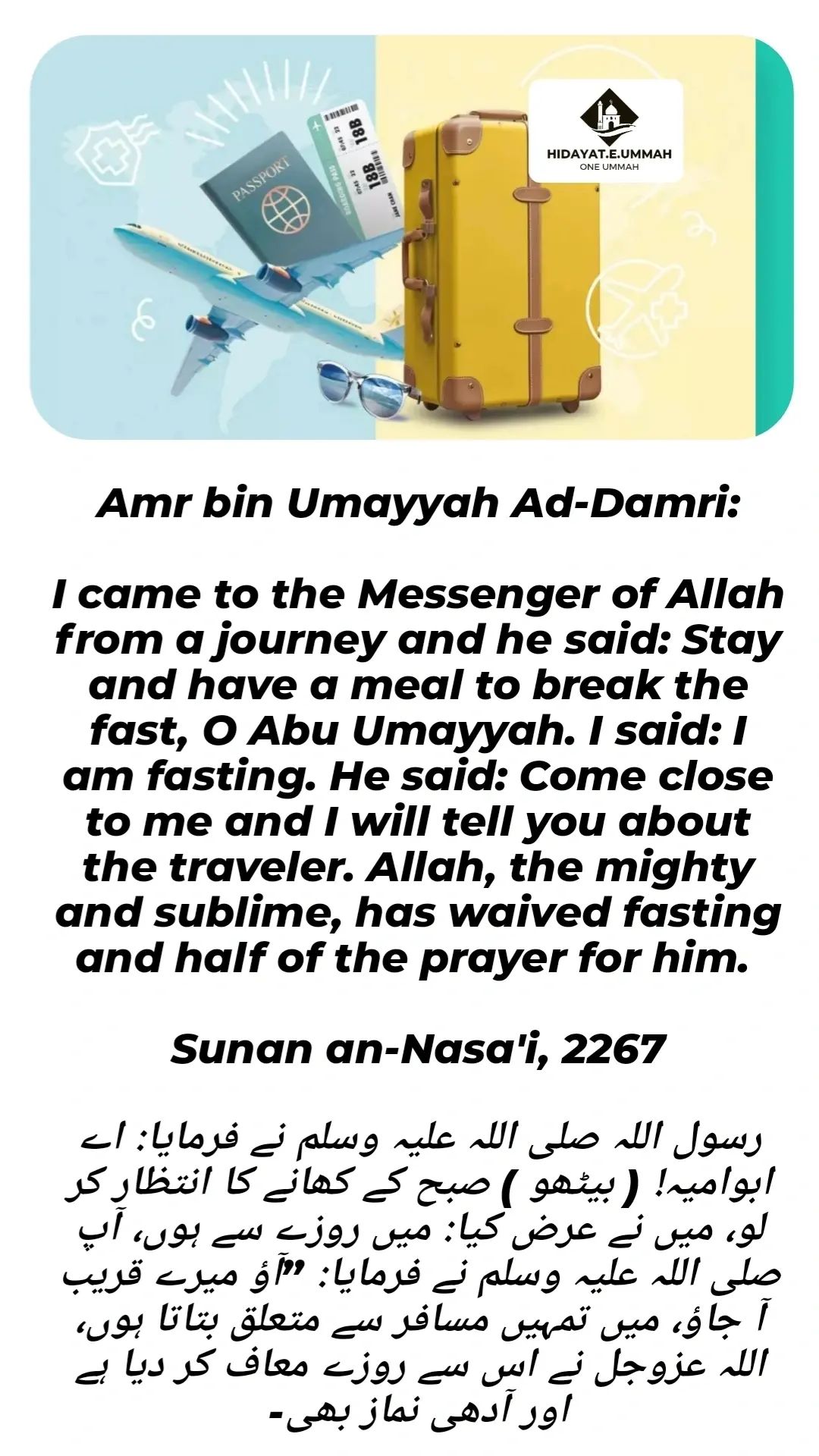
This hadith, narrated by Amr bin Umayyah Ad-Damri, emphasizes the special privileges granted to travelers in Islam. The Messenger of Allah (peace be upon him) reassures Amr that fasting is not obligatory during travel and invites him to break his fast after his journey:
1. **Exemption from Fasting for Travelers:**
- The Prophet Muhammad ( SAW Peace be upon him) explains that travelers are excused from fasting, as it may be difficult for them to fast during their journey. Allah, in His mercy, has given this concession to make it easier for those who are traveling. The traveler can make up the missed fasts later after their journey.
- The hadith emphasizes that traveling is hard, and thus the rules regarding fasting are relaxed for the traveler.
2. **Waiver of Half the Prayer (Qasr):**
- The Prophet ( SAW Peace be upon him) also highlights that travelers are allowed to shorten (Qasr) their prayers. Normally, prayers like Dhuhr, Asr, and Isha consist of four rak'ahs, but for travelers, these prayers are reduced to two rak'ahs, which makes it easier for them to fulfill their religious duties while on the move.
- This concession is a mercy from Allah, as it helps lighten the burden of worship during travel.
**Lesson:**
- The hadith reflects Allah’s mercy and understanding of the hardships faced by travelers. Islam provides flexibility to accommodate their needs by easing the obligations of fasting and prayer. Travelers should be grateful for these exemptions and use the opportunity to focus on other forms of worship or rest.
Hadith 8
8 of 12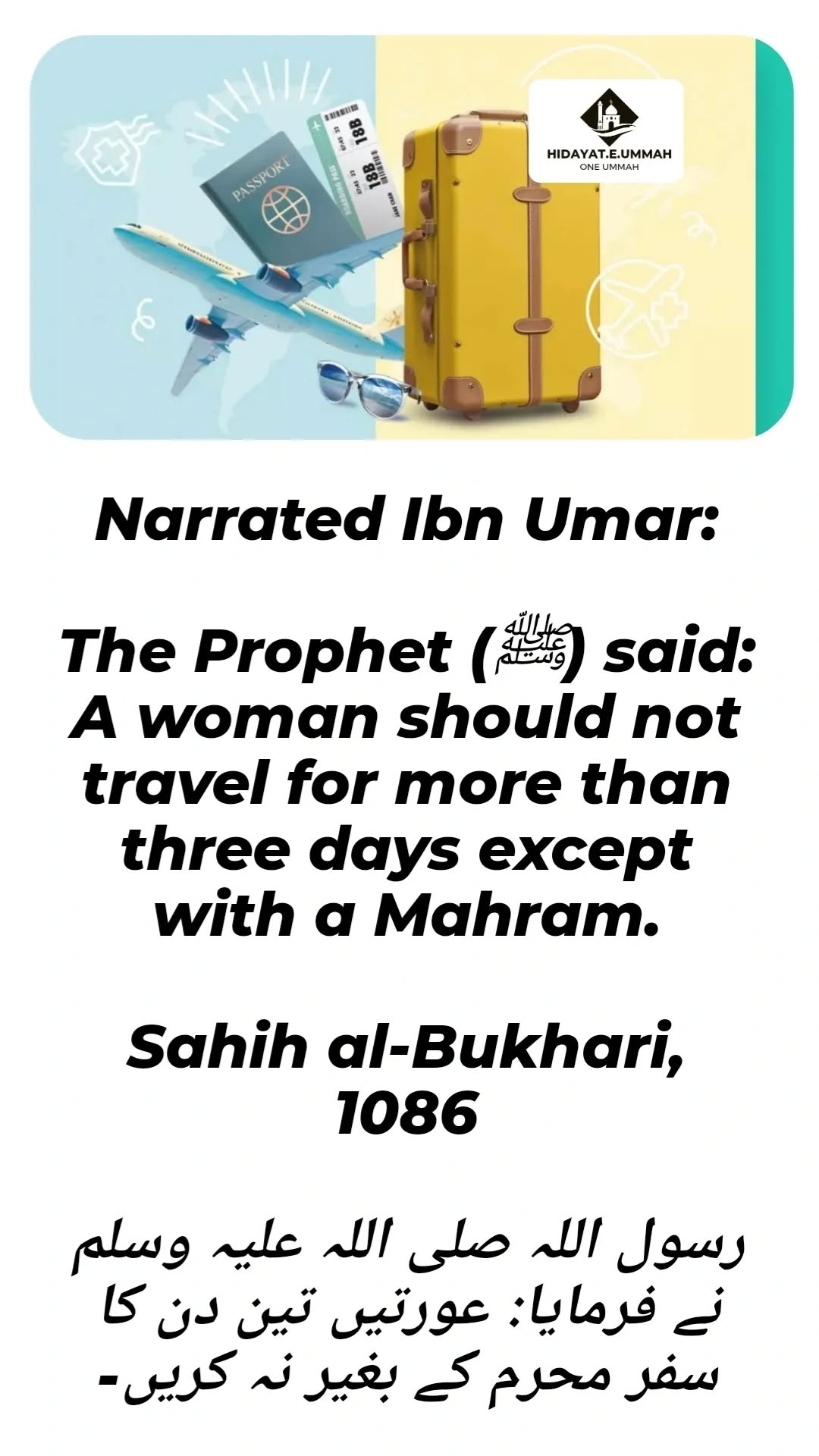
This hadith, narrated by Ibn Umar, explains a guideline set by the Prophet Muhammad (peace be upon him) regarding women traveling alone:
1. **Travel for Women:**
- The hadith states that a woman should not travel for more than three days without being accompanied by a Mahram (a male relative who is not permissible for her to marry, such as her father, brother, husband, or son). This is to ensure her safety and protection during her travels.
- The Prophet ( SAW Peace be upon him) emphasized the importance of a woman's security while traveling, which was a significant concern in the context of early Islam, when traveling could be dangerous or unsafe.
2. **Importance of a Mahram:**
- A Mahram serves as a guardian and protector for the woman while traveling. The presence of a male relative ensures that the woman is safeguarded from potential harm or danger during her journey. It also provides a sense of comfort and security, especially in unfamiliar or unsafe environments.
- The Mahram’s role is to accompany the woman and ensure she is treated with respect and dignity during her travel.
**Lesson:**
- This hadith reflects Islam’s concern for the safety and well-being of women. While it encourages women to travel, it stresses the importance of having a trustworthy male companion to ensure their protection. This principle is rooted in the idea of guarding women’s dignity and safety in environments that may not always be safe.
Hadith 9
9 of 12
This hadith, narrated by Jabir bin Abdullah, offers guidance on the manner in which a person should return to their family after being away for a long time:
1. **Returning to Family at Night:**
- The Prophet Muhammad (peace be upon him) advised that when a person has been away from home for an extended period, they should avoid returning to their family during the night. This is because the night may bring unexpected situations, and it is better to reunite during the day when it is easier to settle in and greet one’s family.
- The reasoning behind this advice is to prevent surprise or disturbance to the family during the night, which could lead to unnecessary anxiety or confusion. It also allows for a more peaceful and pleasant reunion.
2. **Reunion During the Day:**
- Coming back home during the day gives the family members time to prepare for the reunion, allowing the family to be more welcoming and giving everyone the chance to greet each other properly. It ensures that the return is smooth and not abrupt.
**Lesson:**
- This hadith teaches the value of thoughtfulness and consideration in how one approaches family life. It shows the importance of returning home in a manner that respects the family’s emotional and physical well-being. It is a reminder that even in personal matters, Islam promotes kindness, planning, and care for others.
Hadith 10
10 of 12
This hadith, narrated by Ka'b bin Malik, describes the practice of the Prophet Muhammad (peace be upon him) when he returned from a journey:
1. **Returning from a Journey:**
- When the Prophet ( SAW Peace be upon him) returned home from a journey, his first action was not to go straight to his house, but rather to go directly to the mosque.
- This shows the Prophet’s devotion to Allah and his habit of performing acts of worship as soon as he returned from a journey, before attending to any personal matters.
2. **Performing Two Rak'ah:**
- The Prophet ( SAW Peace be upon him) would then perform two Rak'ah (units of prayer) in the mosque. These are voluntary prayers (known as Salah) and are not obligatory, but rather an expression of gratitude and devotion to Allah.
- This act symbolizes starting fresh with worship after a journey, showing the importance of connecting with Allah first, even after a long or tiring trip.
**Lesson:**
- The hadith highlights the importance of prioritizing worship and devotion to Allah, even in the midst of personal or family matters. It serves as a reminder that seeking Allah’s pleasure should be the first priority in every situation. It also emphasizes the practice of offering voluntary prayers, which are highly valued in Islam.
Hadith 11
11 of 12
This hadith, narrated by Ka'b bin Malik, mentions the Prophet Muhammad's (peace be upon him) preference for setting out on journeys on Thursdays:
1. **The Prophet's Preference for Thursday:**
- The Prophet ( SAW Peace be upon him) specifically chose Thursday as the day to begin his expeditions and travels, such as the expedition of Tabuk. This indicates a special significance he placed on Thursdays for starting journeys.
- The choice of Thursday highlights a positive practice or habit of the Prophet ( SAW Peace be upon him) in setting out on travels. Although there is no direct religious command that makes Thursday the most favored day, the Prophet’s practice can be viewed as an encouragement to follow this Sunnah.
2. **The Expedition of Tabuk:**
- The Prophet ( SAW Peace be upon him) embarked on the expedition of Tabuk, a major military campaign, on a Thursday. This shows his leadership and dedication to his mission, but also his consistency in practicing his personal preferences.
**Lesson:**
- While the Prophet’s choice of Thursday does not establish an obligation for Muslims, it serves as a recommended practice. It also teaches us the importance of following the Prophet's example in our daily actions, even in seemingly small matters like the days we begin our journeys.
Hadith 12
12 of 12
This hadith, narrated by Abu Sa'id Al-Khudri, emphasizes the importance of appointing a leader when a group of three people sets out on a journey:
1. **The Importance of Leadership in a Group Journey:**
- The Prophet (peace be upon him) instructs that when three people go on a journey together, one of them should be appointed as the leader. This ensures that the group has a clear person in charge to make decisions and manage the journey effectively.
- Having a leader helps maintain order, reduces confusion, and ensures that responsibilities are clearly defined, especially in situations where decisions need to be made quickly or if unexpected challenges arise.
2. **Applying this to Group Activities:**
- While this hadith specifically applies to travel, the principle of appointing a leader can also be applied to any group activity or task, whether it is work-related, community activities, or even family planning. It encourages teamwork and organization.
**Lesson:**
- The hadith teaches the value of structure and leadership within any group. It reminds us that even in simple situations like traveling with others, it is important to have someone responsible for guiding the group. This helps in smoother execution and fosters cooperation.